Capitolo 1
Cities Reimagined: The Quest for Urban Joy
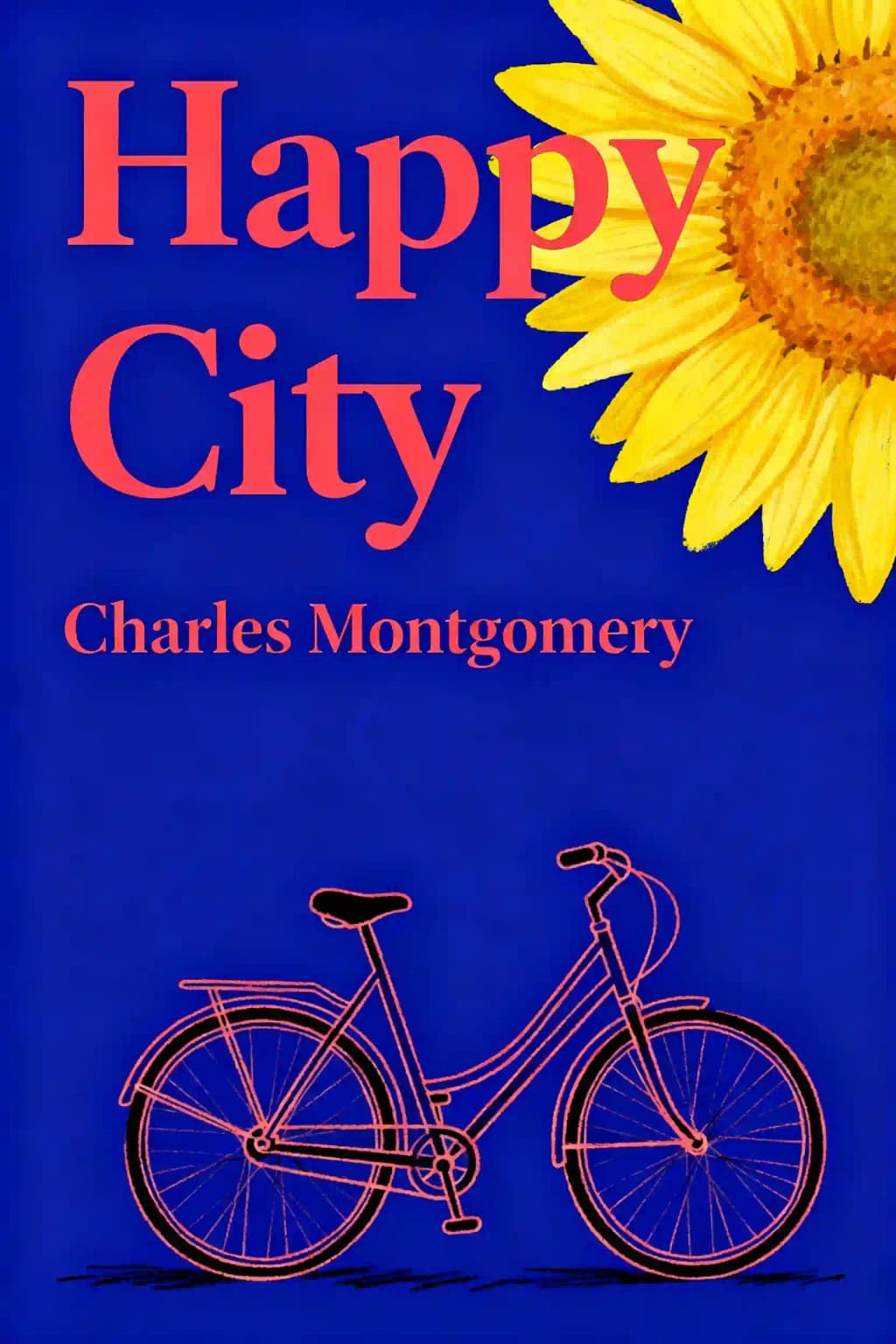
In a world where concrete jungles often feel isolating and stress-inducing, Charles Montgomery's "Happy City" arrives as a revolutionary manifesto. When Oprah featured this book in her 2018 "Books That Help Me Through" collection, it catapulted into mainstream consciousness, but urban planners and progressive mayors had already been quietly implementing its principles for years. Montgomery's work sits at the fascinating intersection of urban design, neuroscience, and human psychology-exploring how the shape of our cities directly impacts our mental health and social connections. The book's cultural impact extends beyond architecture schools; it has influenced municipal policies worldwide and sparked a movement reimagining cities as engines of well-being rather than mere economic machines. As Montgomery chased Enrique Penalosa-Bogota's visionary former mayor-through the streets of Colombia, he discovered a profound truth that would change how we think about urban spaces: "We might not make everyone as rich as Americans. But we can design the city to give people dignity, to make them feel rich. The city can make them happier."
Capitolo 2
The Urban Happiness Revolution
The happy city movement represents a fundamental shift in how we think about urban spaces. While Enrique Penalosa has become its most visible champion, the movement draws from decades of resistance against car-centric modernism. When Penalosa became mayor of Bogota in 1997, he declared war not on drugs or crime but on private automobiles. He scrapped highway expansion plans and instead built bike paths, parks, plazas, libraries, and a revolutionary bus rapid transit system. His boldest experiment was a car-free day that saw 800,000 vehicles sit idle while people reclaimed streets through walking, cycling, and skating. The results were remarkable: no traffic deaths occurred, hospital admissions dropped by a third, and pollution decreased dramatically.
This approach has spread globally, influencing cities from Shanghai to New York. The Penalosa brothers have advised municipalities worldwide, helping transform iconic spaces like Times Square. The movement has torn down freeways, reconfigured neighborhoods, and reimagined suburban malls as vibrant mixed-use communities.
What makes this revolution particularly compelling is how it challenges our assumptions about prosperity and happiness. Penalosa provocatively suggests that the unhappiest cities aren't in developing nations but in wealthy, car-dominated American metropolises like Atlanta, Phoenix, and Miami. This points to a profound paradox: despite unprecedented wealth accumulation in America during the late twentieth century, happiness levels flatlined. While Americans traveled more, ate more, and owned more homes and cars than ever before, surveys showed no corresponding rise in well-being. Depression rates increased three to tenfold compared to two generations earlier, with one in ten Americans taking antidepressants by 2010.
This disconnect between economic growth and emotional wealth suggests we've been building our cities in ways that undermine rather than support well-being. The suburban boom that drove economic expansion failed to deliver the happiness it promised, revealing that the shape of our urban environment might matter more for our joy than our GDP.
Capitolo 3
The City as a Happiness Project Through History
Cities have always been physical manifestations of our collective pursuit of the good life. As our understanding of happiness evolved, so did our urban forms. Ancient Athens built open spaces reflecting civic participation, while Rome shifted toward monuments glorifying imperial power. The Campus Martius became cluttered with spectacular but inward-facing structures, while streets remained narrow and inadequate. Roman emperors prioritized personal glory over public good, creating marble palaces while most citizens lived in cramped, dangerous tenements.
After Rome's fall, medieval cities prioritized security (walls) and salvation (cathedrals), with churches promising happiness in the afterlife rather than on earth. The Enlightenment transformed happiness from a heavenly promise to an earthly right. This new conception manifested in places like London's Vauxhall Gardens, where egalitarian hedonism flourished in leafy wonderlands open to anyone who could afford admission.
Since then, urban planning movements have explicitly promised to nurture society's collective well-being. The City Beautiful movement claimed aesthetic harmony would create social harmony. Later, Stalin's socialist realism employed architectural grandeur to project power and convince citizens of their advancement, declaring "Life has improved, my friends, life has become more cheerful."
When early economists couldn't measure happiness directly, they substituted purchasing power for utility. Despite Adam Smith's warnings that wealth alone wouldn't bring happiness, economic growth became equated with improved well-being. This thinking fueled suburban sprawl, which developers sold as fulfilling preferences for privacy and mobility. But Montgomery challenges this interpretation: sprawl wasn't a natural development but a designed, subsidized, and legally mandated urban form that preceded consumer demand.
Modern neuroscience has finally enabled us to measure happiness scientifically. Richard Davidson's brain imaging studies revealed that people who report being happy show more activity in their left prefrontal cortex. Daniel Kahneman, applying "hedonic psychology," discovered that socializing makes people happy while commuting makes them miserable. These insights provide empirical foundations for designing cities that genuinely promote well-being rather than just economic growth.
Capitolo 4
The Social Deficit of Modern Cities
The dispersed city represents historic feats of consumption: more space per person and more expensive to build and operate than any urban form ever constructed. It requires more infrastructure per resident, costs more to maintain and protect, pollutes more, and releases more carbon. When gas prices doubled between 2004-2008, exurban commuters were suddenly spending over $800 monthly on fuel-sometimes more than their mortgages. The farther a house was from a vibrant city center, the more likely it experienced foreclosure during the crash.
This design creates what might be called a "stretched life." Randy Strausser's daily routine in Mountain House, California exemplifies this: waking at 4:15 a.m., driving 120+ miles round-trip to work, returning exhausted by 7:30 p.m. Despite living in a pristine neighborhood, Randy distrusted his neighbors and couldn't wait to leave. The problem wasn't the aesthetics but the absence of community-most residents left before dawn and returned after dark, disappearing into their garages without interaction.
Italian economists discovered that America's declining social capital-not income inequality-was the primary factor suppressing happiness despite rising wealth. Most people's social networks are contracting, with almost half the population reporting they have just one confidant or none at all. This social isolation may be the greatest environmental hazard of city living. Connected people sleep better, handle adversity more effectively, and live longer.
The dispersed city directly contributes to this social deficit: people enduring 45+ minute commutes are 40% more likely to divorce; car-dependent neighborhoods produce less trusting residents who rarely know their neighbors; and sprawl dwellers participate less in politics and community groups. These places systematically squeeze serendipitous encounters from our lives. In places like Mountain House, even buying groceries requires driving to another town, turning neighbors into passing blurs.
Even children pay for this distance. In Stockton's Weston Ranch, teenagers complained of feeling trapped miles from anywhere-unable to access jobs, education, or entertainment without cars they couldn't afford. By 2010, Stockton had developed California's worst youth gang problem, with weak parent-child bonds identified as a key contributor. Even affluent suburbs produce troubled teens-Columbia psychologist Suniya Luthar found suburban teenagers were more anxious, depressed, and prone to substance abuse than inner-city teens, often self-medicating their distress. The common factor: lack of strong parental attachment, systematically undermined by marathon commutes and distant errands.
Capitolo 5
How We Got Here: The Ideology of Separation and Speed
The dispersed city wasn't an accident or natural evolution-it was deliberately shaped by powerful financial incentives, massive public investment, and strict land-use regulations born during an era of urban trauma. Two philosophical approaches emerged from the horrors of industrial cities: the school of separation (strictly segregating urban functions) and the school of speed (equating freedom with velocity and escape from the city).
The ideology of separation emerged as a natural response to the Industrial Revolution's urban horrors. With cities choking on soot and sewage, reformers like Ebenezer Howard envisioned garden cities, while Frank Lloyd Wright promised spiritual redemption in his Broadacre City plan. Le Corbusier took a modernist approach, believing cities could be fixed by rebuilding them as efficient machines with functionally pure districts.
Though modern cities are no longer physically toxic, this separationist philosophy lives on in American suburban planning, with rigid zoning laws that segregate living, working, shopping, and recreation. This system was cemented through federal mortgage programs favoring new suburban developments, racial segregation policies, and "exclusionary zoning" that effectively kept out lower-income residents.
Before the automobile, city streets belonged to everyone-a chaotic but democratic space serving as market, playground, park, and thoroughfare. When cars began pushing into cities after Ford's assembly line innovations, they brought "a new kind of mass death"-over 200,000 people killed in motor accidents in America during the 1920s, mostly pedestrians in cities, half of them children and youths.
Initially, drivers who killed pedestrians were mobbed and charged with manslaughter. But auto clubs and manufacturers launched a coordinated campaign to redefine streets for cars, not people. They invented the crime of "jaywalking," blamed pedestrians for accidents, and promoted their agenda through safety campaigns, newspapers, and city halls. The industry's rallying cry was "freedom"-not freedom to move as one pleased, but freedom for cars to move quickly, unhindered by friction.
This profound transformation was cemented by propaganda like the GM-sponsored "Futurama" exhibit at the 1939 World's Fair, which showed 24 million visitors a high-speed future that captivated the national imagination. The dispersed city model became self-replicating through a virus-like process of entrenchment and expansion, hardening into building codes, zoning laws, and road design standards that continue to shape our cities today.
Capitolo 6
Our Happiness Blind Spots
The path to creating happier cities faces a fundamental challenge: humans aren't naturally equipped to make decisions that maximize happiness. We make predictable errors when deciding where and how to live, and the professionals who shape our environments make these same mistakes.
Neoclassical economics assumes we make rational choices that maximize utility, but behavioral economics reveals we consistently make systematic errors. The "commuting paradox" exemplifies this: people with long commutes report lower life satisfaction, not just commute dissatisfaction. A one-hour commute requires earning 40% more money to maintain the same happiness as someone who walks to work. We adapt quickly to constant pleasures like larger homes but struggle to adapt to variable discomforts like daily commutes.
Harvard students' anxiety over dormitory assignments demonstrates our flawed happiness predictions. Students consistently overvalued obvious physical differences between residences while undervaluing less visible factors like community and relationships. Most students acknowledged that social life would be more important to their happiness than architecture, yet still put greater weight on physical features when predicting their satisfaction.
We consistently misjudge what will make us happy due to the focusing illusion. Asked whether California or the Midwest offers greater happiness, most people choose California-yet surveys show residents of both regions report similar life satisfaction. We fixate on conspicuous differences like weather while undervaluing less visible factors like crime rates, commute times, and social connections.
Our decision-making is further corrupted by cultural messaging. Neuroscience reveals how our brains physically change based on exposure to cultural information. In one experiment, architecture students' evaluations of buildings diverged significantly from non-architects, with brain scans showing heightened activity in their reward-processing regions. Similar effects appear in mundane choices like Coke versus Pepsi, where brand recognition activates memory centers more powerfully than taste itself.
Even urban professionals fall into psychological traps, commonly simplifying complex problems into binary opposites. Le Corbusier admitted that planners become "fatigued" by complexity, leading modernists to embrace extreme simplification. Brasilia exemplifies this approach-designed as a perfect geometric plan with segregated functions and identical housing blocks, it was meant to eliminate chaos and inequality. Yet residents felt so disoriented by its vast, empty spaces and lack of organic street life that they invented a new term-brasilite-to describe their malaise.
Capitolo 7
The Nature Connection
During a 2011 Guggenheim Museum project in New York's East Village, researchers measured people's emotional responses to different urban environments. Participants reported the greatest happiness spike when entering a community garden, confirming extensive research on nature's psychological benefits.
Studies show hospital patients with nature views need less pain medication and recover faster. Even images of nature reduce anxiety in medical settings and improve test performance in schools. This supports Edward O. Wilson's concept of biophilia-humans are hardwired to find nature calming and restorative.
The difference lies in attention types: urban environments demand constant voluntary attention (deciding what to focus on), which is exhausting, while nature engages our effortless involuntary attention, allowing restoration. In Chicago's Ida B. Wells housing project, courtyards with trees and grass fostered social activity while barren ones remained empty.
Environmental psychologists Frances Ming Kuo and Sullivan discovered that nature deprivation was not merely unhealthy but dangerous. Buildings overlooking greenery experienced half the violent crime rate of those facing barren courtyards. People living near green spaces knew more neighbors, reported them as more friendly and supportive, had more get-togethers, and felt stronger belonging. Nature doesn't just benefit us-it brings out the good in us, as University of Rochester psychologists found when people who viewed nature scenes valued deep relationships more and were more generous with money than those who viewed urban scenes.
Our universal preference for savanna-like landscapes-open fields with scattered trees and water bodies-reflects our evolutionary history. However, biologist Richard Fuller found that while we might prefer simple savanna views, we actually benefit more from "messier," biologically complex landscapes. Park visitors felt healthier and more grounded after spending time among diverse trees and birds than in parks with just lawns and few trees-suggesting suburban lawns might be "hollow calories" for our nature-craving brains.
Vancouver transformed itself by rejecting highways through its core while embracing density. Despite adding 150 residential towers since the 1980s and doubling its downtown population between 1991-2005, Vancouver consistently ranks among the world's most livable cities with North America's lowest per capita carbon footprint. The city's success stems from accommodating residents' biophilic needs through "view corridors" that preserve mountain vistas.
Capitolo 8
The Social Machine: Balancing Density and Privacy
The dense human environment of Manhattan offers electric potential and a sense of communion with strangers-what Walt Whitman called "fuses me into you now." Yet this hyperdensity creates tension between social stimulation and the need for solitude. Psychologists found correlations between high population density and psychosomatic illnesses, with tower residents reporting more depression and fear. Stanley Milgram observed that urban crowding creates "overload," forcing residents to adopt aloofness as a coping strategy, pushing people physically together but socially apart.
Crowding isn't simply about physical density but psychological perception. We tolerate others better when we can control our interactions-having private rooms to retreat to or quiet public spaces to escape to. Architecture directly shapes social behavior, as demonstrated by Andrew Baum's 1973 study comparing two college dormitories. Students in corridor-style housing felt stressed and avoided neighbors, while suite-style residents formed friendships and showed prosocial behaviors even outside their living environment.
Trust, belonging, social contact, and happiness exist in a perfect triangle that rises and falls together. John Helliwell's research shows people who feel they belong to their community are happier, those who trust neighbors feel greater belonging, and this sense is influenced by social contact-including casual encounters that are just as important as family connections.
The ideal urban form balances our competing needs for privacy, nature, conviviality, and convenience-a hybrid between vertical and horizontal city. Examples range from Copenhagen's Mountain Dwellings, which stack apartments with generous patios over parking, to traditional streetcar suburbs that emerged across North America in the late 1800s. These neighborhoods were created not by utopians but by profit-seeking developers who built rail lines and homes within walking distance of shops and services. Their formula-small lots (33-foot frontages), mixed uses, and walkable distances-created the perfect scale for happy living: bustling market streets with quiet residential areas behind them, where everything needed was a five-minute walk away.
Capitolo 9
Designing for Conviviality
Jan Gehl, a Danish architect, underwent a transformation in his thinking after spending six months with his psychologist wife studying medieval Italian towns in the 1960s. While Copenhagen was embracing car culture and suburban sprawl, the Gehls documented the vibrant human activity in places like Siena's Piazza del Campo-a car-free public space that naturally drew people together and encouraged lingering.
Gehl pioneered a revolutionary approach by studying pedestrians with the same methodical precision traffic engineers had reserved for cars. His fundamental insight was elegantly simple: "If you make more road space, you get more cars. If you make more bike lanes, you get more bikes. If you make more space for people, you get more people and of course then you get public life."
When Copenhagen embraced Gehl's work, they began an incremental transformation of the city core, pedestrianizing streets and creating spaces for people to linger. Between 1968 and 1995, the number of people just lingering on Copenhagen's streets more than tripled, and outdoor cafe culture flourished even in winter months.
Modern cities have created a peculiar social deficit. Unlike our ancestors who had to gather daily for trade, conversation, and socialization, we can now meet almost all our needs without public interaction. Technology and prosperity have privatized our exchanges-we shop in malls, entertain ourselves at home, and connect through screens. The word "community" increasingly refers to people who never actually meet.
Our physical surroundings profoundly influence how we treat one another. As sociologist Erving Goffman suggested, public spaces function like stages that cue our social performances. Neuroscience reveals that our brains respond to environmental cues before we're even aware of them-the hippocampus compares current surroundings to memories and signals the brain's fear and reward centers accordingly. Places that seem sterile or confusing trigger stress hormones like cortisol, while familiar, navigable environments activate feel-good serotonin and oxytocin, the trust hormone.
Antisocial spaces are often simply blank and boring. Jan Gehl's research demonstrates that uniform facades with few doors or functions cause people to move quickly past, while varied facades with many openings slow pedestrians down and encourage pausing. The "big-boxing" of urban blocks actively harms residents, particularly the elderly, who age more quickly when surrounded by dead frontage.
Capitolo 10
Mobilicities: The Psychology of Movement
Nearly 90% of American commuters drive to work daily, with similarly high percentages in Canada and Britain. Driving offers emotional dividends: mastery, status (especially with luxury vehicles), and identity. Young men even experience testosterone surges when driving expensive cars.
Yet half of urban commuters dislike their daily journeys-mostly drivers. Traffic neutralizes the car's promise of freedom and speed. Urban driving floods the body with stress hormones like adrenaline and cortisol, creating stress levels comparable to fighter pilots in combat. Despite massive infrastructure investments, commute times keep increasing, with major cities now averaging 60-80 minute round trips.
Self-propelled commuters-walkers, runners, cyclists-consistently report more enjoyment than drivers or transit users. In bike-friendly Netherlands, cyclists report more joy and less negative emotion than other commuters. Even in hostile environments like New York City, cyclists report greater journey satisfaction.
This preference stems from basic human physiology. We evolved to move our bodies, with our genetic ancestors walking for four million years. The average American office worker gets barely one-fifth the exercise of modern hunter-gatherers. Exercise makes us smarter and happier. Psychologist Robert Thayer found that students who walked more reported higher energy, better moods, higher self-esteem, and even perceived their diets as healthier.
Despite the joy of self-propelled travel, only 5% of American commuters take public transit, 3% walk, and a mere 1% cycle. This isn't about laziness-it's about design. Atlanta exemplifies how environments engineer behavior. The average suburbanite drives 44 miles daily, with 94% commuting by car. Lawrence Frank's research showed a white male in walkable Midtown weighed ten pounds less than his identical twin in suburban Mableton simply because neighborhood design doubled his likelihood of getting enough exercise.
Public transit should theoretically be appealing-it frees users from driving stress and allows them to text, work, or relax. Yet transit riders in North America report the highest commuting misery levels of all travelers. This isn't because transit is inherently unpleasant, but because decades of underinvestment have made it slow, crowded, uncertain, and uncomfortable.
Capitolo 11
The Future of Urban Mobility
The future of urban mobility isn't about fantastical new machines but reimagining how we use existing ones through data, smart cards, and wireless communications. Paris exemplifies this with Velib'-a revolutionary bike-sharing system with 20,000 bicycles at 1,250 stations throughout central Paris. Each Velib' bike gets used 3-9 times daily, generating up to 200,000 trips. The system embodies a radical philosophy: Parisians can simultaneously save the planet and become more free by owning less stuff.
Transportation is about utility, not ownership. Most private vehicles sit unused while costing owners money in insurance, payments, parking and depreciation. Paris launched Autolib', an electric car-share system, while other companies like Daimler's CAR2GO offer even more flexibility-allowing users to simply leave vehicles at their destination. In Vancouver, with multiple car-share options and robust transit, residents are selling their cars and the city is repurposing parking garages.
Copenhagen represents the pilgrimage destination for urban mobility freedom. During rush hour, 37% of commuters travel by bicycle (55% excluding suburbs), outpacing both cars and public transit. These cyclists aren't environmentalists-they're ordinary people in business attire who find cycling the most convenient option. This shift began after the 1970s energy crisis when public demonstrations demanded bike infrastructure. The city built physically separated bike lanes that made cycling feel safe for everyone, not just the brave. Copenhagen now boasts over 200 miles of separate bike paths, bike-only traffic signals that give cyclists a head start, traffic lights synchronized for cycling speed, and "green" routes through parks.
Cities seeking true mobility freedom must confront the space inefficiency of private cars. A single car takes up 150 square feet when parked-thirty times more than a standing person and 7.5 times more than someone on a bicycle or bus. At 30 mph, a solo driver uses twenty times more space than a bus passenger. Some cities have addressed this through economics: London's congestion charge reduced core traffic by 25% while generating 122 million annually after three years. But truly transforming urban mobility requires redistributing street space itself-treating streets as valuable real estate to be put to their highest use, not just moving cars.
Capitolo 12
The Urban Equity Doctrine
In Bogota, Colombia, Enrique Penalosa's transformation of the city demonstrated how urban design could address deep inequalities. The TransMilenio bus system claimed prime road space from private cars and featured high-quality station finishes, aiming not just to reduce travel times but to elevate the status of public transit users. In El Paraiso, a misnamed slum neighborhood, the author found surprising urban interventions: the El Tintal library, a transformed garbage processing plant with grand architecture, and wide pedestrian promenades that prioritized people over cars.
Penalosa approached urban design through an equity lens. Born to privilege but sensitized to inequality by his father's work redistributing land to peasants, he rejected a Japanese-backed plan for elevated highways, instead raising gas taxes and selling city shares in utilities to fund public spaces, schools, libraries, and parks. His philosophy was radical fairness: "One of the requirements for happiness is equality... an environment where people don't feel inferior."
Research confirms this intuition: we judge our position relative to others, and status affects health in profound ways. The Whitehall Studies showed that lower-ranking employees suffer more disease and earlier mortality than their higher-status colleagues. In American cities with wide income gaps, poor people experience worse health outcomes than those in more equal cities. Being low in status creates a physiological stress response that damages health over time.
The backlash against urban redesign isn't unique to Bogota. New York City's bike lanes faced hysterical opposition despite the fact that only a small minority of residents regularly commute by car. In Mexico City, drivers protested street closures for cyclists, with one radio host even calling on drivers to run over cyclists. This resistance stems partly from entrenched beliefs about what streets are for and fears of losing privileges.
But the equity argument favors redesign: current systems are deeply unfair. A third of Americans don't drive, leaving them dependent on others or inadequate transit. Children, teenagers, and seniors suffer most from this arrangement. Poor people and minorities have less access to parks, jobs, healthy food, and even sidewalks. They're more likely to die on roads-in Atlanta, poor Black children frequently die trying to cross highways to reach bus stops. The financing is also unfair: cyclists and pedestrians subsidize drivers through taxes, while the poorest Americans spend over 40% of their income on cars.
Bogota's experiment proved that the fairer city benefits everyone. Despite initial opposition that nearly led to Penalosa's impeachment, his equity program achieved remarkable results: downtown revitalization, 30% increase in school enrollment, expanded water access, and doubled cycling rates. The TransMilenio bus system moved people so efficiently that even car drivers saw commuting times drop by 20%. Streets became calmer, with accident and murder rates falling by nearly half.
Capitolo 13
Everything Is Connected
In 2010, Copenhagen held a competition for a new power plant, won by Bjarke Ingels Group with a revolutionary design that transformed an industrial necessity into urban recreation. The waste-to-energy facility would be wrapped in an exoskeleton forming an artificial ski slope spanning seven football fields. Ingels called this "hedonistic sustainability"-the idea that sustainability isn't a burden but can improve quality of life.
This functional mashup illustrates a fundamental truth: despite our attempts to separate urban functions across the landscape, everything remains interconnected. Movement, consumption, pleasure, waste, carbon emissions, and the economy are all intertwined in the complex systems that define city life.
The synergy between climate action and urban design extends to public health. The Lancet found that making walking and cycling safe and comfortable is more effective at reducing emissions than technological fixes. There's an inverse relationship between carbon burned by machines and calories burned by humans. The dispersed city that promotes inactivity creates massive financial burdens through healthcare costs, lost productivity, and traffic accidents.
Joseph Minicozzi, an architect who settled in Asheville after a motorcycle trip, discovered a profound economic truth about urban development. Comparing a renovated six-story downtown building with a Walmart on the city's edge, he found the downtown property generated $330,000 in property tax per acre versus just $50,800 per acre from Walmart. The job density was even more striking: 74 jobs per acre downtown versus fewer than 6 jobs per acre at Walmart.
Cities that manage growth intelligently can fight climate change while creating prosperity. Portland, Oregon established urban growth boundaries in the 1970s and invested in light-rail, streetcars and bicycle lanes instead of freeways. By 2008, Portlanders drove 20% fewer miles daily than residents of other major US cities, saving about $1.1 billion annually on gas-money that stayed in the local economy instead of flowing to distant oil companies.
Vancouver's Olympic Village demonstrates how human density creates unexpected energy synergies. This showcase of green urbanism houses thousands in pedestrian-friendly streets with thriving social spaces. But beyond metaphorical energy, the Southeast False Creek Neighbourhood Utility captures actual thermal energy from residents' wastewater. When villagers shower or flush toilets, the warm water flows to a sewage pumping station where heat is extracted and transferred to clean water that's returned to provide heating and hot water throughout the neighborhood.
Capitolo 14
Retrofitting Sprawl
The happy city's benefits remain inaccessible to millions living in sprawling suburbs, creating an equity problem as wealthy residents recolonize downtowns. By 2030, one in five Atlanta residents will be over sixty, many stranded in car-dependent suburbs. Meanwhile, surveys show six in ten Americans prefer walkable, mixed-use neighborhoods, though only 10% of Atlanta homes have access to such environments.
Architect Galina Tachieva specializes in "urban surgery" that reverses sprawl damage by returning cities to human scale. With America projected to grow by 120 million people by 2050, and most jobs already outside city limits, retrofitting suburbs isn't just altruistic-it's profitable. Demographics are shifting dramatically: most future homebuyers will be empty-nesters or their single adult children, not families with kids. Only one in ten buyers will have children, making traditional suburban homes increasingly obsolete.
Tachieva's Sprawl Repair Manual offers ambitious solutions: inserting streets into business parks, transforming highways into main streets, connecting cul-de-sacs with new roads, converting McMansions into apartments, and humanizing gas stations with street-front businesses. In Lakewood near Denver, a dying 104-acre mall has been transformed into twenty-three smaller blocks with mixed uses, housing 1,500 people in a walkable environment with a town green and central plaza.
Despite growing demand for walkable communities, sprawl persists because of contradictory preferences and entrenched systems. While people want walkability, they also desire detached homes with privacy. The real estate market shows a tectonic shift-in Washington DC, walkable urban neighborhoods now command 50-70% higher prices per square foot than suburban areas, reversing the trend from 2000.
However, retrofitting faces three major obstacles: most sprawl is already sold and occupied, making large-scale redesign difficult; single stubborn property owners can block redevelopment; and most critically, the legal framework that created sprawl remains firmly in place. In most jurisdictions across North America, the mixed-use, walkable developments people desire are literally against the law due to rigid zoning codes.
The battle to repair sprawl on a large scale requires convincing developers they can profit from building what they've avoided for decades. Tachieva argues that form-based codes alone aren't enough, as sprawl continues through entrenched incentives at every government level. These include "traffic impact exactions" that penalize density, accelerated depreciation tax deductions rewarding new construction over renovation, mortgage interest deductions favoring suburban fringe homes, and infrastructure spending heavily weighted toward highways over transit.
Capitolo 15
The Citizen Revolution
Cities appear shaped by powerful forces, but ordinary citizens hold significant power to reshape them. As Henri Lefebvre argued, the right to shape a city belongs to its inhabitants-the "citadins"-not just officials or planners.
In 2009, twelve-year-old Adam Kaddo Marino challenged his school's cycling ban in Saratoga Springs. Despite having partial achromatopsia affecting his vision, Adam and his mother defied the 1994 district ban on walking and biking to school. Their persistence and resulting media attention forced the district to reverse its policy.
Aaron Naparstek's activism began with honking on Brooklyn's Clinton Street. After an confrontation involving eggs and an angry driver, he sought constructive solutions. He posted honking-themed haiku that attracted neighbors to community meetings. Through studying traffic patterns, he discovered the city's "green wave" light timing created bottlenecks. His persistence convinced the Department of Transportation to implement "feathered" timing that reduced honking by staggering traffic flow.
Mark Lakeman's journey to revitalize Portland's Sellwood district led him to a Lacandon village in Mexico. There, he observed how pathways naturally widened into community gathering spaces. The village elder's advice to "fix your own village" helped him recognize how rigid street grids had suppressed community connections.
The orthogonal street grid dominating North American cities has colonial roots, from Assyrian camps to Roman towns. Jefferson's Land Ordinance of 1785 established it as the standard west of Ohio, prioritizing economic efficiency through easily managed rectangular units.
Modern cities, despite their wealth and technology, often fail to promote health and happiness. They foster isolation and prioritize status over relationships, speed over freedom, and simplicity over beneficial complexity.
While not everyone has resources for urban transformation, individual choices can create significant change. Kim Holbrook improved her family's life by moving closer to work. Conrad Schmidt found a richer life after moving to a walkable neighborhood-selling his car, running to work, and negotiating a four-day workweek reduced his expenses and improved his health and social connections.
These stories demonstrate that we build the happy city through our choices. By moving closer, slowing down, and embracing urban life, we transform both our lives and our cities. The happy city, the low-carbon city, and the city that will save us are the same-we create it by living it.