Capitolo 1
The Paradox of Leadership: Strength Through Vulnerability
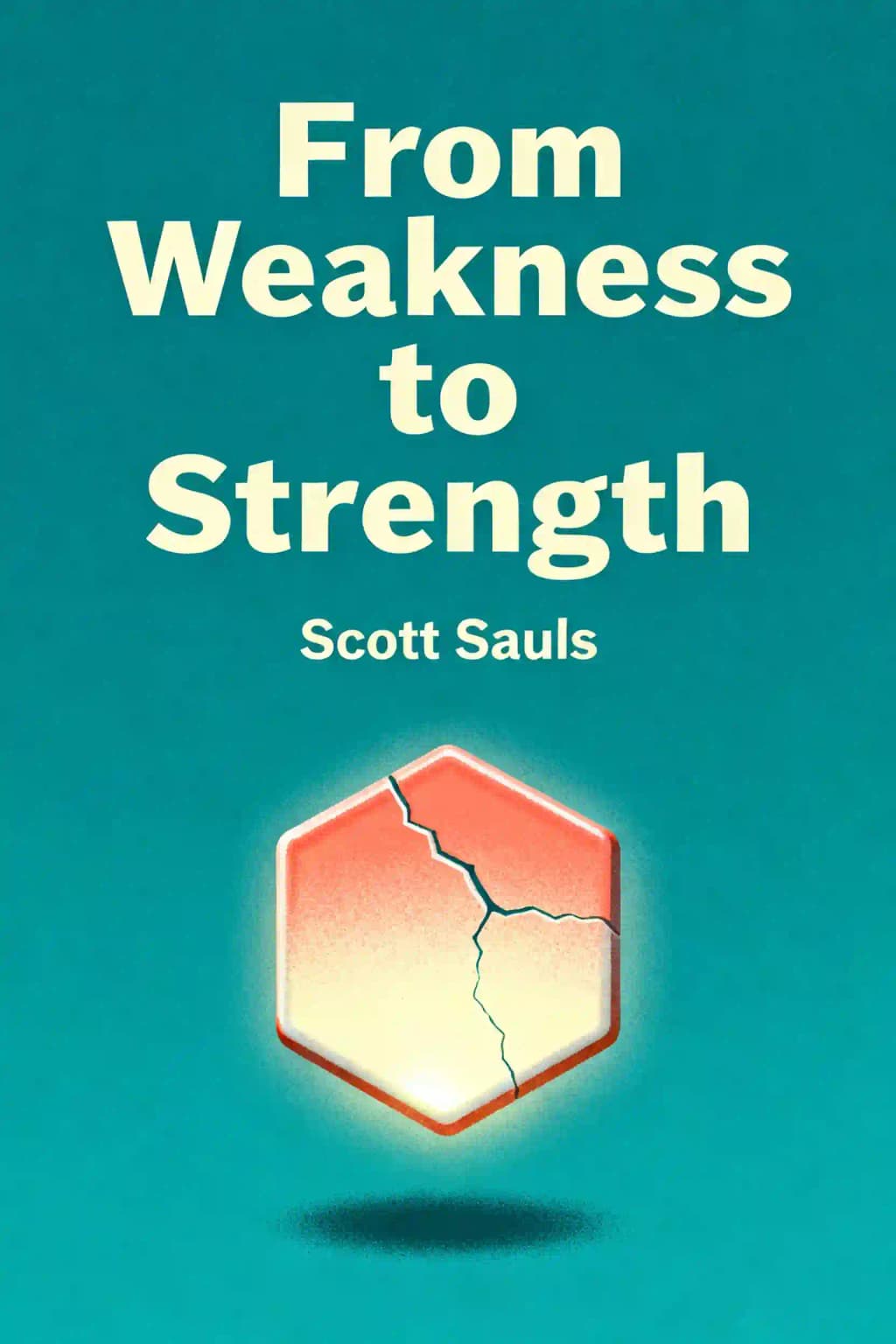
Have you ever wondered why some of the most influential leaders throughout history weren't the strongest, most confident, or most charismatic individuals? Scott Sauls's "From Weakness to Strength" challenges our conventional understanding of leadership with a counterintuitive premise: true leadership emerges not from our strengths, but from our weaknesses. This perspective has resonated with readers across various fields, from business executives to church leaders, making it a favorite among those seeking authentic leadership principles. The book has been endorsed by influential figures like Tim Keller and Joni Eareckson Tada, who herself contributed the foreword. In a culture obsessed with projecting strength and hiding vulnerability, Sauls offers a refreshing alternative that aligns with ancient wisdom: power is made perfect in weakness. As we navigate an era where leadership failures regularly make headlines, this book provides timely guidance on how embracing our limitations might be the very key to lasting impact.
Capitolo 2
When Dreams Crumble: The Gift of Unfulfilled Ambition
Sometimes God's greatest act of love is giving you your dream job, then taking it away. This paradoxical truth became painfully clear to Scott Sauls when, after being called to serve as one of four lead pastors at Redeemer Presbyterian Church in New York City-groomed as potential successors to Tim Keller-plans changed unexpectedly. Within a year of his commissioning, where they had prayed Wesley's Covenant Prayer with its surrender language ("put me to suffering... let me be laid aside... brought low"), Redeemer's structure shifted from four congregations to three, and Sauls resigned.
This apparent catastrophe revealed something crucial: his heart wasn't fully surrendered. Like hot water drawing tea from a tea bag, disappointment exposed the ugly ambition lurking within-idols of success, fame, and self-importance that had taken root. He had come to believe that leading in a global city with prestigious credentials would give him significance and justify his existence.
The collapse of this dream ultimately led him to Christ Presbyterian in Nashville, a role that has exceeded his previous aspirations. Through this journey, he learned that God's ambition for his life was superior to his own. Our failures and disappointments reveal the state of our souls, showing us what we truly worship. When ministry becomes a broken cistern we depend on for love and approval that only Jesus can provide, we lose our way.
Finding happiness in achievements inevitably leads to disappointment. As C.S. Lewis wisely noted, "Aim at heaven and you will get earth thrown in; aim at earth and you will get neither." Tennessee Williams described his own "Catastrophe of Success" after his Broadway triumph left him "walking around dead in my shoes," confirming that earthly achievements cannot sustain us. Only Jesus can fulfill our deepest desires and give us the happily-ever-after we seek. Making much of His name is infinitely superior to making a name for ourselves.
Capitolo 3
The Dangerous Territory of Isolation
The Bible unflinchingly reveals our shared human frailty through biblical figures who accomplished remarkable things while harboring serious moral failures. Abraham lied about his wife's identity, Jacob deceived his father, Rahab was a former prostitute, Peter denied Christ three times, and David - "the man after God's own heart" - committed adultery and murder. Church history continues this sobering pattern with deeply flawed leaders like Calvin (who approved the execution of heretics), Luther (who wrote anti-Semitic treatises), Edwards (who owned slaves), and Martin Luther King Jr. (who struggled with marital infidelity). These stories simultaneously encourage us by showing hope for flawed people and soberly warn us to guard our hearts with relentless vigilance.
Leaders become especially vulnerable precisely when they believe they're invulnerable. Sin typically begins as an acorn that, if not immediately crushed, grows into an uncontrollable forest fire. As Puritan theologian John Owen powerfully cautioned, "Be killing sin, or sin will be killing you." King David's catastrophic moral collapse with Bathsheba began with seemingly innocuous compromises - staying home in comfort while his men fought battles, indulging in afternoon naps while others worked, and gradually developing a sense of entitlement after years of faithful service. These small compromises created fertile soil for greater transgressions.
This "magisterial self-pity" leads many leaders to view themselves as victims rather than servants, believing they deserve special treatment or exemptions for their sacrifices. Leadership brings unique pressures that often lead to dangerous isolation and spiritual despair. Recent studies reveal that pastors experience disproportionately high rates of anxiety and depression due to intense spiritual warfare, unrealistic congregational expectations, constant criticism (amplified exponentially in the digital age), chronic insufficient rest, mounting family tensions, persistent financial strain, and unhealthy comparison with other ministries.
Some congregations unknowingly create impossible workload expectations - one revealing survey showed church members collectively expected pastors to work 114 hours weekly, nearly three times the normal workweek! This pressure extends beyond pastors to their families, with spouses facing constant scrutiny of their involvement and children living in a fishbowl of congregational expectations. Many pastor's kids report feeling like they can never simply be themselves. The solution isn't further isolation but intentional vulnerability with a small circle of trusted friends who can speak hard truth into our lives before small compromises metastasize into catastrophic moral failures. These accountability relationships must be proactively cultivated before crisis strikes, as isolation makes leaders particularly susceptible to self-deception and rationalization.
Capitolo 4
The Refining Fire of Criticism
Criticism comes with leadership territory. While we might improve at receiving feedback over time, especially when it reveals our blind spots, most of us still struggle with unfair criticism-or even fair criticism delivered poorly. When leaders defensively "wrestle with pigs," both get dirty but only the pig enjoys it. Worse, fighting back conditions us to reject all criticism, even the valuable kind.
Each of us contains potential for both great good and exceptional evil-simultaneously saints and sinners. Even Paul acknowledged this dual reality in Romans 7, lamenting that he did the evil he hated rather than the good he desired. Thankfully, he follows this confession with the hope-filled solution in Romans 8: in Christ, there is no condemnation, and nothing can separate us from God's love.
We need honest voices in our lives to help us see the sin we cannot see and confront us when necessary. Rebecca Pippert writes that true love detests whatever destroys those we love. Bonhoeffer similarly noted that nothing is more compassionate than the severe reprimand that calls another Christian back from sin's path.
David exemplifies good leadership by not resisting Nathan's rebuke after his sin with Bathsheba. Instead, he received it humbly, repented, and made restitution. His confession in Psalm 51 stands as one of history's most comprehensive acknowledgments of sin. As Elbert Hubbard wrote, "The final proof of greatness lies in being able to endure criticism without resentment."
We should welcome soul examination just as we welcome medical examinations. Scripture affirms this: "Let a righteous man strike me-it is a kindness" and "Faithful are the wounds of a friend." Winston Churchill noted that criticism serves the same function as pain in the body-it signals something unhealthy. While healthy leaders confess and repent, unhealthy ones manipulate and spin.
Even with unfair criticism, we can profit. When Shimei cursed David, he responded with humility rather than retaliation. Tim Keller suggests we can benefit from criticism even when only 20% is true, and Jack Miller would tell critics, "You don't know the half of it," acknowledging he was worse than they realized. True leadership values character over saving face.
Capitolo 5
The Poison of Comparison
Envy is an ugly reality that disturbs our hearts-a sign the Holy Spirit is at work in us. For leaders who have "made it to the top," envy emerges when we compare ourselves with others and covet what they have. In its sinister way, envy rejoices when others mourn and mourns when others rejoice-the opposite of love. The underlying cause is pride and the rival spirit, which compels us to elevate ourselves above others.
King Saul exemplifies how envy works in all directions. After David defeated Goliath, the women of Israel sang, "Saul has struck down his thousands, and David his ten thousands." Rather than celebrating alongside them, Saul became furious and kept a jealous eye on David, even plotting to kill him. As C.S. Lewis noted, "Pride is essentially competitive... It gets no pleasure out of having something, only out of having more of it than the next person."
Leaders of all types-executives, authors, parents, athletes-have hearts prone to compete and compare. A pastor with 3,000 members can envy one with 5,000 just as easily as a pastor of 50 can envy one with 70. As Bertrand Russell observed, "Envy consists in seeing things never in themselves, but only in their relations"-a never-ending chain where even the most successful envy someone else.
Consider eighteen-year-old Instagram star Essena O'Neill who, despite half a million followers and financial independence, quit social media, describing it as a "snowballing addiction to being liked by others" that left her "lost, lonely and miserable." Her experience confirms that chasing fame and recognition is ultimately hollow.
The contrast between Saul and his son Jonathan reveals two responses to others' success. When David gained popularity, Saul sought to eliminate him to protect his own stature, while Jonathan wanted to exalt David by giving up his own. Though Jonathan was the assumed heir to the throne, he surrendered to God's will, giving David his royal robe and sword-making himself vulnerable since new kings typically executed their predecessors' descendants. Jonathan became great by making himself small, while Saul became small by desperately clinging to his status.
Capitolo 6
Finding Peace in Our Primal Insecurity
A search online reveals nearly 1.5 million books about religion and spirituality - a staggering number that testifies to humanity's unquenched inner thirst. This primal insecurity is powerfully captured in U2's famous lyric, "I still haven't found what I'm looking for," where even believers acknowledging Christ's sacrifice find themselves grappling with a persistent sense of incompleteness. From Fortune 500 CEOs to religious leaders, even the most accomplished individuals experience this inner conflict; many lie awake at 3 a.m. wrestling with self-doubt, unmet expectations, and the gnawing sense their work will never quite measure up to their aspirations.
In quiet moments - whether during meditation, prayer, or sleepless nights - God's presence can be both profoundly comforting and deeply disruptive, reminding us of our fundamental smallness and mortality. Like Brennan Manning, we're all "bundles of paradoxes" - believing yet doubting, trusting yet suspicious, confident yet uncertain. The biblical story of Jacob wrestling with God until daybreak provides a powerful metaphor and offers hope that nighttime spiritual wrestling may actually indicate vitality rather than lostness. Jacob emerged from his struggle with both a blessing and a limp - a perfect illustration of how our encounters with the divine often leave us simultaneously strengthened and humbled.
Madonna's candid admission of a "horrible fear of being mediocre" despite decades of unprecedented success resonates with many high achievers. A renowned musician once confided feeling "the loneliest person in the room" while surrounded by thousands of adoring fans. These confessions reveal a universal truth: our hearts remain restless until finding their security in God alone. This deep-seated insecurity isn't something to eliminate but to embrace - it's the very thing that drives us to our knees in recognition that we cannot sustain ourselves. The Japanese concept of kintsugi, where broken pottery is repaired with gold, illustrates how our acknowledgment of brokenness can become our greatest strength.
The most effective leaders aren't those who have conquered all self-doubt, but those who have learned to function faithfully despite it. They recognize that their limitations create space for God's power to be displayed. As Paul wrote in 2 Corinthians, "When I am weak, then I am strong" - not because weakness itself is the goal, but because acknowledged weakness creates the conditions for divine strength to manifest. This paradox appears throughout scripture: Moses's speech impediment, David's youth, Peter's impulsiveness - all became channels for God's power rather than obstacles to it.
Contemporary leaders like Eugene Peterson and Henri Nouwen have written extensively about how their greatest ministry flowed not from their strengths but from their acknowledged weaknesses. This understanding transforms our relationship with insecurity from something to overcome into something that, properly understood, can deepen our dependence on God and enhance our effectiveness in serving others.
Capitolo 7
When Success Feels Empty
Like many successful leaders, the writer of Ecclesiastes had achieved everything by earthly standards yet described his experience as "vexation"-a severe distress making him hate life and view his achievements as empty. This ancient writer revealed a universal truth: we can pursue goals, achieve them completely, and still feel profoundly unsatisfied.
Business Insider reported how Markus Persson, Minecraft's founder, sold his company for $2.5 billion and began living lavishly, only to tweet his deep isolation: "The problem with getting everything is you run out of reasons to keep trying" and "I have never felt more isolated." Similarly, Silicon Valley's leaders, despite material wealth, often experience relational, spiritual, and emotional poverty. This is the anticlimax of success-the disillusionment of those who reach the top only to discover emptiness.
For pastors, anticlimax takes many forms: members leaving for other churches despite our best efforts, complaints about sermons we poured ourselves into, criticism about worship services from every angle, and churches remaining stagnant despite countless hours of prayer. Even Jesus-the perfect leader-experienced profound anticlimax when Judas betrayed him, Peter denied him, his closest friends fell asleep during his hour of need, and all abandoned him at his crucifixion. After his resurrection, he had only 120 followers.
While Frederick Buechner theorized that our calling is where "our deep gladness and the world's deep hunger meet," reality often contradicts this. A Gallup Poll revealed that what people want most globally is a satisfying job, yet 87% of workers feel disengaged in their current positions. Two biblical forerunners offer perspective on this painful reality. Isaiah received a calling that promised rejection and failure, yet responded "Here am I; send me!" Paul, writing from prison after losing his prestigious status, authored "the Epistle of Joy" (Philippians).
Like Sisyphus eternally rolling his rock uphill only to watch it fall, we often feel trapped in frustrating, anticlimactic work. Tolkien's short story "Leaf by Niggle" captures this beautifully-an artist who dreams of painting a magnificent tree but completes only a single leaf before death, only to discover in heaven that his small contribution was part of something grand and eternal. Our seemingly insignificant work has eternal significance in God's greater story.
Capitolo 8
Leading with Love in a Hostile World
In our increasingly divided nation, violence and hatred have become commonplace. From mass shootings to racial killings to polarizing politics, hostility permeates American society. As Christian leaders facing a climate increasingly hostile to historic Christian beliefs, we must remember two biblical imperatives: do not fear, for God is with us; and do not hate, for our true enemy is invisible.
Scripture repeatedly commands "Do not fear" because Christians know the final chapter has already been written-a New Heaven and Earth where Jesus reigns in perfect peace. The more deeply we understand how loved and forgiven we are, the less offended and more loving we become-even toward those hostile to our beliefs.
Christians have historically made their greatest impact not from positions of power and privilege but as a "life-giving, love-driven minority." Throughout history, Christians have shown groundbreaking leadership in science, arts, healthcare, mercy and justice, and education. Even secular observers like Nicholas Kristof note how Christians are first to serve in crises and last to leave.
When Jesus told the parable of the Good Samaritan, he deliberately made the hero someone considered a religious and political enemy by his audience. While religious professionals passed by the injured Jewish man, the Samaritan risked his life to provide comprehensive care. This challenges Christian leaders today: in a world where people of faith are sometimes treated as enemies, are we thinking like the Samaritan?
Our mission isn't to defend our rights but to deny ourselves, take up our cross, and surprise our neighbors with life-giving love. The early Christians exemplified this when, during Rome's plague, they sheltered dying, contagious Romans who considered them opponents. Many Christians died showing this sacrificial love, yet their actions transformed Rome's moral fabric.
Rather than declaring what we're against, Christians should herald what we're for, embodying Jesus's ethics so beautifully that non-believers feel compelled to consider him. True love maintains conviction while communicating compassion to those who disagree. Jesus demonstrated this with the rich young man who walked away sad, not judged or marginalized, after Jesus looked at him with love despite their disagreement.
Capitolo 9
The Transformative Power of Suffering
Suffering can become a gateway to authenticity, healing, and hope for those in tune with the Holy Spirit. One example is Ben Ellis, a beloved teacher with terminal cancer, whose story went viral when hundreds of students worshipped outside his window. Ben prayed for more days not for healing but to share God's grace through his affliction-revealing the essence of gospel leadership: readiness to suffer so others might find hope.
True Christian leadership embraces honest lament rather than false positivity. During a jail ministry, the author observed suburban musicians singing that "in Jesus's presence, our problems disappear"-a well-intentioned but unbiblical message for prisoners serving life sentences. Jesus actually promised his followers would face increased troubles, persecution, and suffering because of their faith.
When affliction comes, proper response includes both faith and protest. Like Job who said, "Though He slay me, I will hope in Him; yet I will argue my ways to His face," and David who cried "How long, O LORD? Will you forget me forever?", Christians can honestly express their pain to God. Nicholas Wolterstorff, after losing his son in a climbing accident, and C.S. Lewis, after his wife's death from cancer, both demonstrated this raw, honest protest. Jesus himself wept and grew angry at Lazarus's tomb-giving us permission to repudiate sickness, sorrow, and death while remaining hopeful about the renewed world to come.
Personal suffering can become a pathway to healing others. The author shares how his own battle with severe anxiety and depression-which left him bedridden, unable to sleep despite medication, and praying daily for either healing or death-later became a source of connection with his congregation. After sharing this story, a man told him, "Today you became my pastor."
Anne Lamott notes that "all the best people" are "crazy and very damaged," while Joni Eareckson Tada, paralyzed since her teens, observes that "Sometimes God allows what he hates to accomplish what he loves." Other examples include Steven and Mary Beth Chapman, who channeled grief over their daughter Maria's death into their adoption ministry Show Hope, and Rick and Kay Warren, who after losing their son Matthew to suicide, now help others with mental illness, declaring that "broken trees bear fruit."
For suffering friends, we can pray for strength to endure present sorrows based on our shared future in Christ. Without Christ's resurrection, we'd be most pitied and life would be "a tale told by an idiot" as Shakespeare wrote. But Christ has risen, guaranteeing our resurrection too. Sometimes the most life-giving leadership comes through suffering well, refusing to let death dictate our story. God not only sees our tears but shares and treasures them. Death isn't the end-fairy tales with happy endings ring true because they echo the True Story.
Capitolo 10
Leadership That Leaves a Legacy
Throughout history, certain faithful men and women have exemplified leadership through weakness. Some we've never met but have been influenced by-Martyn Lloyd-Jones, William Wilberforce, Eugene Peterson, Martin Luther King Jr., Amy Carmichael, Dallas Willard, Jonathan Edwards, and C.S. Lewis. Others we've known personally, whose private influence exceeded their public impact.
One such person is Dr. Timothy Keller, who embodies nearly all the virtues discussed in this book. Beyond being our era's best Christian preacher and thinker, Keller rejected Christian celebrity culture, never chasing spotlight or self-promotion. He waited until nearly sixty to publish his first book, humbly wanting wisdom before writing. Unlike pastors who view others as competition, Tim consistently built up fellow ministers and churches, focusing on reaching skeptics rather than poaching members.
Despite Redeemer's growth, Keller never pursued "bigger and bigger," preferring quality ministry over filled seats and envisioning not a megachurch but a network of contextualized midsize churches serving neighborhoods. As his influence grew, so did his dependence on Scripture and prayer, reading through Psalms monthly, the Bible yearly, and about eighty books annually.
Keller exemplifies covering shame with the gospel, never tearing others down but assuming good in people and responding with humble restraint even when criticized. He received criticism graciously, letting it bring out his best rather than worst, looking for kernels of truth in criticism, repenting where needed, and remaining gracious to critics while avoiding smugness.
Through his example, Keller showed integrity exceeding imperfections, character exceeding giftedness, and humility exceeding influence. Now he's painting a picture of finishing well, demonstrating what it means to decrease so Christ might increase-the ultimate goal of leadership that emerges from weakness rather than strength.