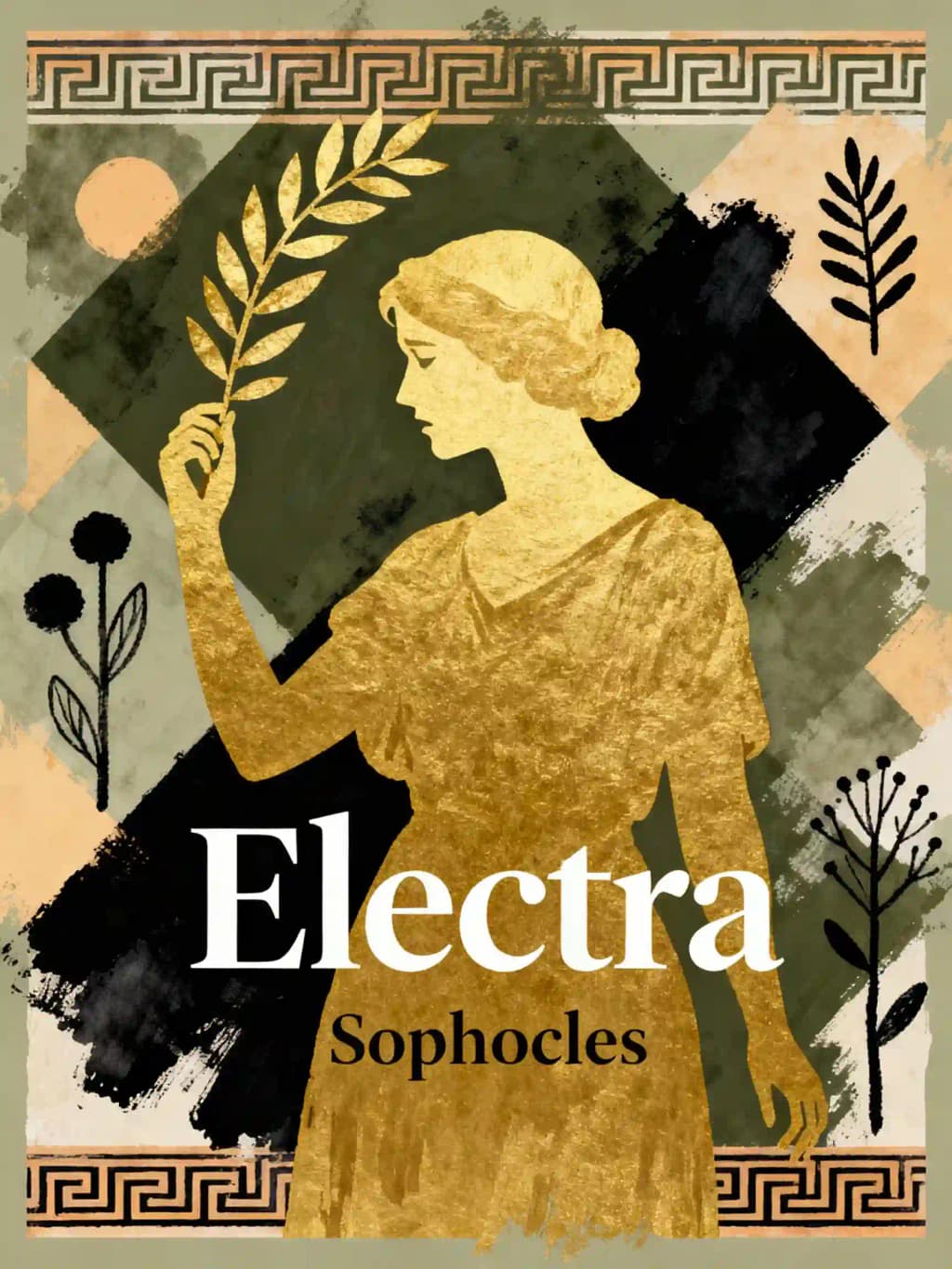
Sophocles' "Electra" - a 410 BCE masterpiece where vengeance meets justice. This Greek tragedy inspired Freud's psychological theories and sparked endless moral debate: is matricide ever justified? Experience the play that made revenge a timeless, haunting art form.
Sophocles (c. 497/496 – 406/405 BC) was an ancient Greek tragedian celebrated for his profound influence on classical drama, exemplified in Electra, a gripping exploration of vengeance, justice, and familial loyalty. A central figure in Athenian theater, Sophocles won 24 of 30 dramatic competitions at the Dionysia festival, solidifying his reputation as a master of tragic storytelling.
Electra, part of his surviving oeuvre alongside Oedipus Rex and Antigone, delves into the psychological torment of its titular heroine as she seeks retribution for her father Agamemnon’s murder, weaving themes of honor, divine will, and moral conflict.
Known for pioneering innovations like adding a third actor to amplify dramatic tension, Sophocles’ works shaped Western literature. His Theban plays—Oedipus Rex, Oedipus at Colonus, and Antigone—remain seminal texts in Greek tragedy, often adapted in modern theater.
A contemporary of Aeschylus and Euripides, Sophocles’ nuanced characterizations and exploration of human agency against fate continue to resonate. His plays have been translated into countless languages and staged globally, with Electra enduring as a timeless study of grief and resilience in the face of injustice.
Electra by Sophocles is a Greek tragedy centered on Electra and her brother Orestes seeking vengeance for their father Agamemnon’s murder by their mother Clytemnestra and her lover Aegisthus. The play explores themes of justice, familial betrayal, and the moral complexities of revenge, as Electra’s grief fuels her resolve while Orestes executes a deceptive plot to reclaim their throne.
This play appeals to enthusiasts of classical Greek literature, students exploring tragic themes of revenge and justice, and readers interested in psychological character studies. Its exploration of moral ambiguity and intense emotional conflicts makes it valuable for discussions on ancient drama’s societal and ethical dimensions.
Yes, Electra is a cornerstone of Greek tragedy, renowned for its gripping narrative and Sophocles’ masterful character development. Its examination of vengeance, loyalty, and retribution offers timeless insights into human nature, making it essential for those studying classical literature or tragic drama.
Key themes include justice versus revenge, familial duty, and the consequences of obsession. The play questions whether Clytemnestra’s murder of Agamemnon (justified as retribution for their daughter’s sacrifice) legitimizes Electra and Orestes’ vengeful actions, highlighting the cyclical nature of violence.
Electra’s unrelenting grief and hatred for her mother propel the plot. Her refusal to submit to complacency—contrasted with her sister Chrysothemis’ pragmatism—underscores her tragic determination. Her emotional monologues and interactions with the Chorus reveal her inner torment and resolve to avenge Agamemnon.
The Chorus acts as a moral commentator, reflecting societal norms and amplifying tension. They empathize with Electra’s plight but caution against excessive hatred, balancing her fervor with pragmatic advice. Their odes foreshadow impending violence and underscore the play’s tragic tone.
The urn, falsely presented as containing Orestes’ ashes, symbolizes deception and the catalyst for revenge. It allows Orestes to infiltrate the palace undetected, triggering Clytemnestra’s downfall. The object also embodies Electra’s despair and eventual hope upon learning her brother lives.
Sophocles juxtaposes Clytemnestra’s “justice” for Iphigenia’s sacrifice with Electra’s demand for retribution, blurring moral lines. The play critiques vengeance’s futility, as Orestes’ matricide perpetuates cycles of violence rather than restoring order.
Electra’s lament, “My hateful bed in a house of pain is witness to all my laments”, captures her anguish and obsession. Orestes’ declaration, “by feigned death, find true life”, underscores the deceit central to their plot.
Unlike Oedipus Rex, which focuses on fate, Electra emphasizes human agency and emotional conflict. Its focus on a female protagonist’s psyche distinguishes it, offering deeper exploration of grief and resilience compared to his other works.
Some critics argue the play prioritizes dramatic intensity over ethical resolution, leaving the moral cost of vengeance unaddressed. Others note Electra’s singular focus risks reducing her to a symbol of rage rather than a nuanced character.
The play’s themes of justice, trauma, and familial strife resonate in modern discussions about retribution and mental health. Electra’s portrayal as a woman defying societal expectations also invites analysis of gender roles in ancient and contemporary contexts.
Senti il libro attraverso la voce dell'autore
Trasforma la conoscenza in spunti coinvolgenti e ricchi di esempi
Cattura le idee chiave in un lampo per un apprendimento veloce
Goditi il libro in modo divertente e coinvolgente
Justice requiring injustice.
Little words can mean death or life.
I cannot stop, I will not stop this crying out.
Justice demands unrighteous deeds.
Electra embodies moral complexity.
Scomponi le idee chiave di Electra in punti facili da capire per comprendere come i team innovativi creano, collaborano e crescono.
Distilla Electra in rapidi promemoria che evidenziano i principi chiave di franchezza, lavoro di squadra e resilienza creativa.

Vivi Electra attraverso narrazioni vivide che trasformano le lezioni di innovazione in momenti che ricorderai e applicherai.
Chiedi qualsiasi cosa, scegli la voce e co-crea spunti che risuonino davvero con te.

Creato da alumni della Columbia University a San Francisco
"Instead of endless scrolling, I just hit play on BeFreed. It saves me so much time."
"I never knew where to start with nonfiction—BeFreed’s book lists turned into podcasts gave me a clear path."
"Perfect balance between learning and entertainment. Finished ‘Thinking, Fast and Slow’ on my commute this week."
"Crazy how much I learned while walking the dog. BeFreed = small habits → big gains."
"Reading used to feel like a chore. Now it’s just part of my lifestyle."
"Feels effortless compared to reading. I’ve finished 6 books this month already."
"BeFreed turned my guilty doomscrolling into something that feels productive and inspiring."
"BeFreed turned my commute into learning time. 20-min podcasts are perfect for finishing books I never had time for."
"BeFreed replaced my podcast queue. Imagine Spotify for books — that’s it. 🙌"
"It is great for me to learn something from the book without reading it."
"The themed book list podcasts help me connect ideas across authors—like a guided audio journey."
"Makes me feel smarter every time before going to work"
Creato da alumni della Columbia University a San Francisco

Ottieni il riassunto di Electra in formato PDF o EPUB gratuito. Stampalo o leggilo offline quando vuoi.
A woman stands outside a palace that was once her home, dressed in rags that mock her royal blood. For years, she has done nothing but scream-not the private tears of acceptable mourning, but public, political howls that shake the foundations of an illegitimate regime. This is Electra, and her story has haunted audiences for over 2,400 years. When Natalie Portman prepared for "Black Swan," she studied this ancient Greek tragedy to understand obsession's psychological toll. Martin Scorsese cited it as inspiration for his crime dramas. Why does this ancient play still grip us? Because it asks a question that never ages: When justice fails, what do we owe the dead?