Capitolo 1
The Counterintuitive Power of Pressing Pause
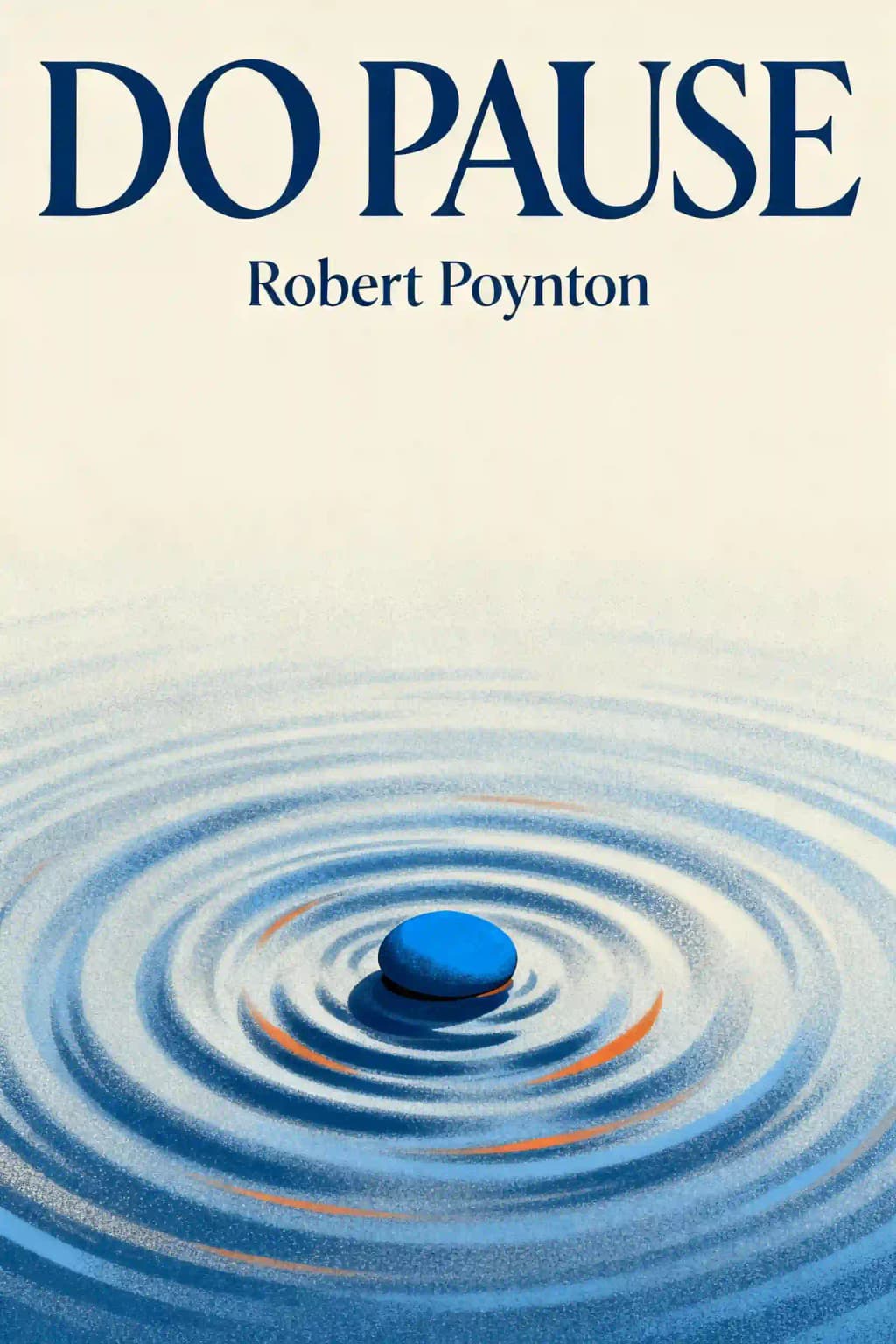
In our hyper-connected world of endless notifications and back-to-back meetings, the idea of deliberately pausing seems almost rebellious. Yet "Do Pause" has become something of a cult classic among high-performers seeking sustainable success. The book has found champions in unexpected places-from Silicon Valley executives to creative directors at major agencies-who credit its principles with transforming both their work and wellbeing. While not topping bestseller lists, it's frequently cited as "the book that changed everything" by those who've discovered it. Author Robert Poynton, who splits his time between an off-grid Spanish homestead and Oxford University's Said Business School, brings a refreshing perspective that bridges ancient wisdom with modern challenges. What makes this book particularly powerful is how it challenges our fundamental relationship with time itself-suggesting that our obsession with productivity might be the very thing preventing our best work and most meaningful experiences.
Capitolo 2
When Constant Motion Becomes Self-Defeating
Our modern world seems designed to eliminate pause from our lives, creating an environment where perpetual motion is both expected and celebrated. Technology imposes machine rhythms on human beings-we're expected to be "always on," responding instantly to every notification, email, and message, regardless of the hour or context. Our culture reinforces this by elevating busy-ness to a status symbol, where being overwhelmed is perversely seen as a sign of importance and success. We've created an entire industry of "personal productivity" that prizes efficiency above all else, associating pause with procrastination rather than wisdom, leading to an endless pursuit of optimization techniques and life hacks.
This pressure comes from multiple directions, creating a perfect storm of constant activity. Our devices are engineered to capture and hold our attention through carefully designed notification systems, infinite scrolling, and algorithmic content delivery, creating what feels like a perpetual state of drowning or addiction-hence the increasingly common language of needing to "detox" from technology. Meanwhile, our social environment rewards visible activity over invisible contemplation, with social media amplifying this effect by showcasing constant achievements and activities. How often do we respond "busy" when asked how we're doing, wearing it as a badge of honor? This response has become so automatic that we barely notice its implications for our mental health and well-being.
Deeper still, overwork often serves as escape from ourselves-we fear what we might discover if we stop. The constant noise of activity drowns out uncomfortable questions about purpose, meaning, and satisfaction. Together, these forces create a myopic loop making pause seem not just unnecessary but almost taboo, leading to a culture where being still is viewed with suspicion. We've begun to adapt to machines rather than ensuring technology serves our human rhythms, forgetting that our bodies and minds evolved with natural cycles of activity and rest.
Simply advocating for "slowing down" isn't the answer, though. The sensation of struggling to keep up isn't new-Goethe complained in 1825 that "wealth and speed are what the world admires," just as writers did in 1880 and 1908. Our experience of time resembles our sense of taste-it's subjective, affected by context and expectations. Since our perception of speed exists within us, we need to work on our responses rather than futilely resist acceleration, developing personal strategies to maintain our humanity in an accelerated world.
The concept of "work-life balance" similarly misses the mark by setting up work and life as opponents competing for time. This creates a false dichotomy-good work contains liveliness, while personal relationships require effort and intentionality. Fast versus slow, work versus life-these are bogus choices that ignore the value of variation and modulation, suggesting instead that we need a more nuanced approach to managing our energy and attention.
What happens when we never pause? At worst, burnout-a striking image of being consumed by fire, increasingly common among "successful" people in high-pressure fields like medicine, law, and technology. Less dramatic but more insidious is the slow, suffocating smolder of becoming our to-do lists, learning to live with less of ourselves, gradually losing connection with our creativity and inner wisdom. Beyond health costs, failing to pause means missing opportunities-the view that might inspire, the path not taken that could lead to innovation, deeper conversations that build meaningful relationships, creative thinking that solves complex problems. The moral dimension suffers too-without pausing to question what we're doing, how can we know it's right? This ethical consideration becomes increasingly crucial as our actions have wider-reaching consequences in an interconnected world.
Capitolo 3
What Happens When You Press Pause
A pause isn't merely absence-it's a rich opening that allows new possibilities to emerge. Unlike external interruptions, a pause comes from within-something you consciously choose and sink into. Its effects extend beyond its duration, like a marinade leaving flavor after cooking. Just as a well-marinated dish develops deeper flavors over time, a thoughtful pause creates lasting ripples in our thinking and behavior.
Pausing isn't simply about slowing down. "More haste, less speed" suggests action without pause can actually be slower. In improvisational theater, novices rush while skilled performers know when to pause, creating better flow. Elite athletes pause for microseconds before action-the essence of perfect timing. A tennis player's brief moment before serving, a gymnast's breath before a routine, or a musician's silence before the first note - these micro-pauses are crucial for peak performance. Pause relates more to rhythm than pace, offering alternative strategies to constant hurry.
What makes pause so powerful? As leadership expert Dov Seidman beautifully puts it: "When you press pause on a machine it stops. But when you press pause on human beings, they start." This counterintuitive truth reveals why pause is essential to creativity. Steven Johnson describes the "slow hunch"-fragile ideas that require cultivation through fallow periods. Creative director Jack Foster explicitly includes "Forget about it" as a stage in idea generation. Whether called "mental digestion" or "incubation," creative processes universally incorporate disconnection from the task. The famous "eureka moments" happen during pauses - Archimedes in his bath, Newton under the apple tree, Einstein during his daily walks.
Beyond conscious creation, pauses create space for serendipity. Life-changing experiences often happen during unplanned pauses-meeting a future spouse during a transportation disruption or starting a business during an aimless visit to a new city. Consider how many innovations emerged from accidental discoveries: penicillin from a contaminated petri dish, Post-it notes from a failed adhesive experiment. Such opportunities vanish when we're rushing toward predetermined destinations.
Pauses profoundly affect relationships too. As a facilitator, I've learned to cherish silence-people eventually break it, giving you something to work with. My favorite facilitation question is simply "So...?" with a pause that invites open response. This gentle patience yields insights about what people truly want to discuss. In therapy sessions, counselors deliberately use silence to create space for deeper reflection. In negotiations, strategic pauses can shift power dynamics and create breakthrough moments.
How you pause reveals character. Politicians who never pause appear untrustworthy while leaders who deliberately yield space gain respect. Alfred Sloan of General Motors once paused a crucial meeting when everyone agreed too readily, reconvening weeks later to generate "constructive disagreement" instead of destructive assent. Warren Buffett and Charlie Munger are known for taking long pauses before making investment decisions, demonstrating how strategic patience can lead to better outcomes. The ability to pause - whether in conversation, decision-making, or action - often distinguishes exceptional leaders from average ones.
Capitolo 4
Small Pauses, Big Impact
Pause is beautifully accessible-requiring no special training or belief system-yet offers remarkable depth and variety. Even tiny pauses can be transformative. Film director David Keating uses "the length of a breath or two" before calling "action" to shift the entire mood on set, allowing actors to center themselves and tap into authentic emotions. Writer Tom Chatfield advocates "doing nothing" as a powerful filter against technology-driven immediacy, noting that "pause and silence are the friends of better thought." This intentional stillness creates space for deeper reflection and more considered responses in our hyperconnected world.
Breathing offers an always-available pause opportunity that can be practiced anywhere, anytime. By shifting attention to your belly and taking a gentle breath, you can transform your mental state in seconds-a technique theater improvisers use to handle unpredictability and stay present in challenging moments. Dan Klein, who teaches improvisation at Stanford, notes that 40% of business presenters speak too quickly, not allowing listeners to digest information. Consciously breathing between phrases creates space for both audience comprehension and your own thinking. This simple practice can transform a rushed presentation into an engaging dialogue, allowing key points to land with impact.
Walking provides another simple yet powerful pause practice. Coach Justin Wise suggests clients leave their desk two or three times daily to walk around the block-an initially awkward practice that becomes indispensable as they begin noticing bodily sensations and receiving unexpected insights. Many report that their best ideas come during these brief walking breaks, away from screens and deadlines. Walking and thinking are intimately connected; Frederic Gros notes in "A Philosophy of Walking" that it "unshackles the body's limbs along with the mind's faculties." Even five minutes can shift perspective dramatically, breaking through mental blocks and refreshing creative energy.
Forgetting to pause is common in our fast-paced culture, which is why building in structural reminders is crucial. In Zen monasteries, a wooden bar across doorways forces momentary awareness when entering meditation halls-a deliberate "speed bump" for consciousness. An everyday equivalent is counting to one before entering meetings; this minimal pause creates space for self-awareness and intention-setting. The World Health Organization's surgical safety checklist functions similarly, forcing medical teams to pause before operations, measurably improving patient outcomes by reducing errors and improving communication.
Rather than viewing commutes as wasted time, they can be reframed as valuable pause opportunities. Some use these transitions deliberately: one father creates empty space while driving his son to rock-climbing, using this time for meaningful conversation without distractions. Another commuter transforms their train ride home by memorizing fellow passengers' faces and details, creating a cleansing boundary between work and home life. Leadership coach Gil Dove suggests pausing thirty seconds at your doorstep before entering home to notice what mood your family is in and properly connect with loved ones - a practice that has helped many executives transition more mindfully between their professional and personal roles. These transition moments, when approached intentionally, become powerful tools for presence and connection.
Capitolo 5
Designing Deeper Pauses
For fifteen years, Poynton has worked with executives at Oxford University's Said Business School, leading transformative programs that blend academic rigor with personal development. Despite the program's rich content, including world-class speakers and cutting-edge research, participants consistently value one element above all others: "time out to think." This "time out" is rare in two senses-both scarce in busy lives and remarkably valuable. Creating genuine thinking time requires more than just intellectual space; it demands engagement of the whole person-thinking with hands through creative activities, hearts through emotional reflection, through physical movement that energizes the body, and through deep, meaningful conversation with others.
Improv actors make a crucial distinction between "action" and "activity"-action fundamentally changes things and moves stories forward, while activity is merely busy motion that doesn't create meaningful difference. In organizational terms, busyness often manifests as endless meetings, constant email checking, and reactive decision-making - all activity without real action. To create genuine action that makes a difference requires deliberately interrupting these patterns through strategic pause. The renowned psychologist William James noted that "eagerness, breathlessness and anxiety are not signs of strength, they are signs of weakness and bad co-ordination." This insight remains particularly relevant in today's hyperconnected world.
A pause's impact isn't proportional to its length-a few seconds of silence can dramatically shift a film set's mood, a few days of retreat can anchor and define an entire year's direction. We typically overestimate how long pauses need to be while underestimating their lasting effects. This works because pauses allow deeper immersion, creating vivid, memorable experiences that contrast sharply with the blur of constant activity. Like yeast to dough, these concentrated moments of reflection and presence transform the everyday routine into something more meaningful and substantial.
For truly effective pauses, avoid rigid objectives and predetermined outcomes. Prefer open intentions over specific goals-if you tightly define what you want and succeed, you only get exactly what you expected, limiting yourself to known possibilities rather than allowing space for emergence and discovery. While business normally demands precise outcomes defined in advance, a pause isn't a task to be completed but a space to be explored. Be tight about certain elements (who attends, leaving work devices behind, maintaining boundaries) but remain open and receptive to what naturally emerges.
Place selection is perhaps the most crucial choice when designing a retreat-like pause. Natural settings and environments of beauty provide the quickest and most profound mental shift, though we often surrender to practical concerns about travel time or appearances of productivity. An hour spent in a remarkable place - whether a mountain vista, peaceful garden, or historic cathedral - outweighs a day in an average conference room. Even busy cities contain quiet, thought-provoking spots if you seek them out-like London's Rotherhithe foreshore, where the Thames mud and calling gulls create a radical shift in perspective from the urban rush above.
Against today's relentless productivity fetish, creating empty space requires both strategic planning and sometimes a plausible cover story to satisfy organizational demands. While you might need to present a program that looks detailed and structured to satisfy skeptics, the true aim is creating space for emergence and insight, not filling time with activities. Defending these boundaries takes considerable courage and conviction, as illustrated by a CEO who successfully resisted intense pressure to schedule an "empty" day during a leadership summit-a day that ultimately proved vital for processing and integrating previous discussions into meaningful action plans.
Capitolo 6
Creating Cultures of Pause
While traditional cultures offer one path to pause, creating new cultural spaces provides another. Burning Man Festival exemplifies this approach-evolving from a small 1986 gathering to a temporary "metropolis" hosting 70,000 people annually in Nevada's desert. Despite its vibrant energy, it functions as a different kind of pause-a suspension of normal rules allowing radical inclusion, self-reliance and self-expression. Participants often adopt different names, literally pausing their usual identities to experiment with alternatives.
Religious traditions have long integrated regular pauses into social fabric through sabbaths-weekly days of rest connected to natural rhythms. Even non-religious people can adopt this practice, as Poynton did during university exams by implementing a Jewish-inspired study break from Friday sunset to Saturday sunset. This structured pause provided guilt-free rest and helped maintain focus during work periods. Modern adaptations include "screen-free Saturdays" or digital detoxes.
Spanish culture builds pauses around meals, with lunch particularly sacred. Between 2pm and 5pm outside major cities, businesses close as locals enjoy lengthy meals followed by either siesta (rest) or sobremesa-the time spent at the table after eating, conversing over coffee or drinks. This practice stands in stark contrast to eating sandwiches at one's desk, offering a culturally-sanctioned pause anyone can adopt.
The sabbatical year extends the pause concept. Designer Stefan Sagmeister takes a full year off every few years, refusing all client work to travel, think and discover. Rather than harming his business, these breaks generate creative seeds that drive future growth. Finance director Iain McIntosh takes a different approach, engineering shorter breaks between jobs by leveraging corporate timelines. These pauses help him address neglected aspects of life, gain objectivity, and consider bigger questions.
Naming pauses helps create culture around them. Labels like Bill Gates' "Think Weeks" or "Screen Free Saturdays" make practices more memorable and substantive while signaling their purpose to others. Borrowing terminology from other cultures can enhance this effect-Spanish phrases like sobremesa or "consult with their pillow" (for sleeping on a decision) provide vivid, sticky language that supports pause practices.
For those seeking a compelling reason to build pause into their lives, getting a dog creates a double commitment-to the animal and to regular pausing. Dogs require daily walks regardless of weather or mood, and their enthusiasm for these outings is infectious. These walks provide opportunities to disconnect, reflect, and shift focus to another living creature. Dr. Mike Evans notes that walking 30 minutes daily is the single best thing for health, affecting conditions from dementia to depression.
Capitolo 7
Practical Tools for Implementing Pause
Traditional calendars present time as linear and one-dimensional, forcing us to view our days as mere sequences of events. By reimagining your calendar with different layers or types of time (like "inhale" and "exhale" time), you can transform it from a list of obligations into a rich composition of life. Create your own meaningful categories - such as tasks/learning/loves, mind/hand/body/heart, or creative/administrative/social time - using colors, symbols, or visual cues to ensure balance. For example, you might mark creative work in blue, relationship time in red, and personal development in green, making it instantly visible if any area is being neglected.
Borrowed from Stewart Brand's concept of civilization's pace layers, the principle of different speeds can revolutionize personal time management. Just as fashion moves faster than infrastructure, different aspects of our lives have natural rhythms. Apply this thinking systematically by considering what pauses you could implement across multiple timeframes: daily meditation breaks, weekly nature walks, monthly reflection days, or yearly retreats. Building practices across these multiple time layers creates a compound effect more powerful than focusing on just one dimension. For instance, a daily five-minute breathing practice might support a weekly technology sabbath, which in turn enhances a monthly day of solitude, creating a reinforcing cycle of renewal.
The "scanner" visualization tool offers a concrete method to identify where to insert pauses by mapping how time feels throughout your chosen period. Using binary notation-"I" for intense activity and "O" for calm, spacious experiences-create a pattern representing any timeframe. For a typical workday, it might look like "IIIOIIIOIII," revealing the natural rhythms and potential stress points. Examine these patterns for long stretches without breaks or imbalances, then experiment with strategic pauses. For example, if you notice five consecutive hours of intensity, you might insert a 15-minute walk or meditation. This exercise makes hidden patterns visible and suggests where changes might be beneficial, encouraging flexible experimentation rather than rigid solutions.
Consider also the quality of these pauses - some might be active (like exercise or gardening), while others are contemplative (meditation or journaling). The key is matching the type of pause to your needs and the natural rhythm of your day. For instance, morning pauses might focus on centering and intention-setting, while afternoon breaks could emphasize physical movement or creative expression. By consciously designing these intervals, you create a more sustainable and enjoyable relationship with time.
Capitolo 8
Time Is Not Money
Exploring pause in depth reveals that focusing on strategic pauses is more valuable than maintaining traditional "work-life balance." This perspective requires fundamentally rethinking our relationship with time and challenging the deeply ingrained assumption that doing more is always better. The diminishing returns of constant activity eventually become self-defeating, leading not just to stress and burnout, but also to decreased creativity, poorer decision-making, and strained relationships.
At the core of our frenetic pace lies Benjamin Franklin's influential notion that "time is money"-a concept we rarely question despite its significant limitations. This metaphor has profoundly shaped our modern relationship with time, encouraging us to view it as a scarce commodity to be maximized, measured, and monetized. Yet time isn't a uniform raw material-it's wildly variable in experience and quality. A minute waiting in traffic differs dramatically from a minute savoring ice cream; a year grinding at work isn't comparable to a year traveling and exploring new cultures. The same hour spent in flow state can feel like minutes, while an hour of tedious work can feel eternal.
Rather than seeing time as linear, regular and objective, we might experience it as elastic, variable and layered-more like a river with varying depths and currents than a mechanical clock ticking away uniformly. The focus shifts from cramming more activities into life to getting more depth and meaning out of each moment. A pause is not empty time but an opening-a portal to other options, perspectives, and choices. Like yeast leavening heavy dough, even small amounts of pause can lighten and transform your entire life experience.
Poynton's own experience writing this book embodied these principles in multiple ways. His process included a lengthy gestation period between initial idea (2015) and active writing (2018), which allowed ideas to mature organically as a "slow hunch." He deliberately built pauses into his writing schedule through regular visits with friends, a sailing trip to Norway, and periods of complete disconnection from the project. Even seemingly disruptive unplanned pauses-like covering for an ill colleague or dealing with family emergencies-proved surprisingly productive rather than merely delaying progress, often leading to new insights and connections.
For the actual writing process, he adopted the "Darwin-Lubbock method," working in focused 90-minute chunks with substantial breaks between sessions, limiting himself to 1-3 sessions daily. This structured approach to pause allowed for deep work while preventing mental exhaustion. He found that ideas often crystallized during the breaks rather than during active writing time. The experience of writing became both an exploration of pause and a living experiment in practicing it-demonstrating how sometimes "the pause turns out to be more significant than what it interrupts." This approach challenged conventional productivity wisdom that emphasizes maximizing active work time, showing instead how strategic pauses can enhance both output quality and personal wellbeing.