Capitolo 1
Nature's Greatest Deception: The Art and Science of Mimicry
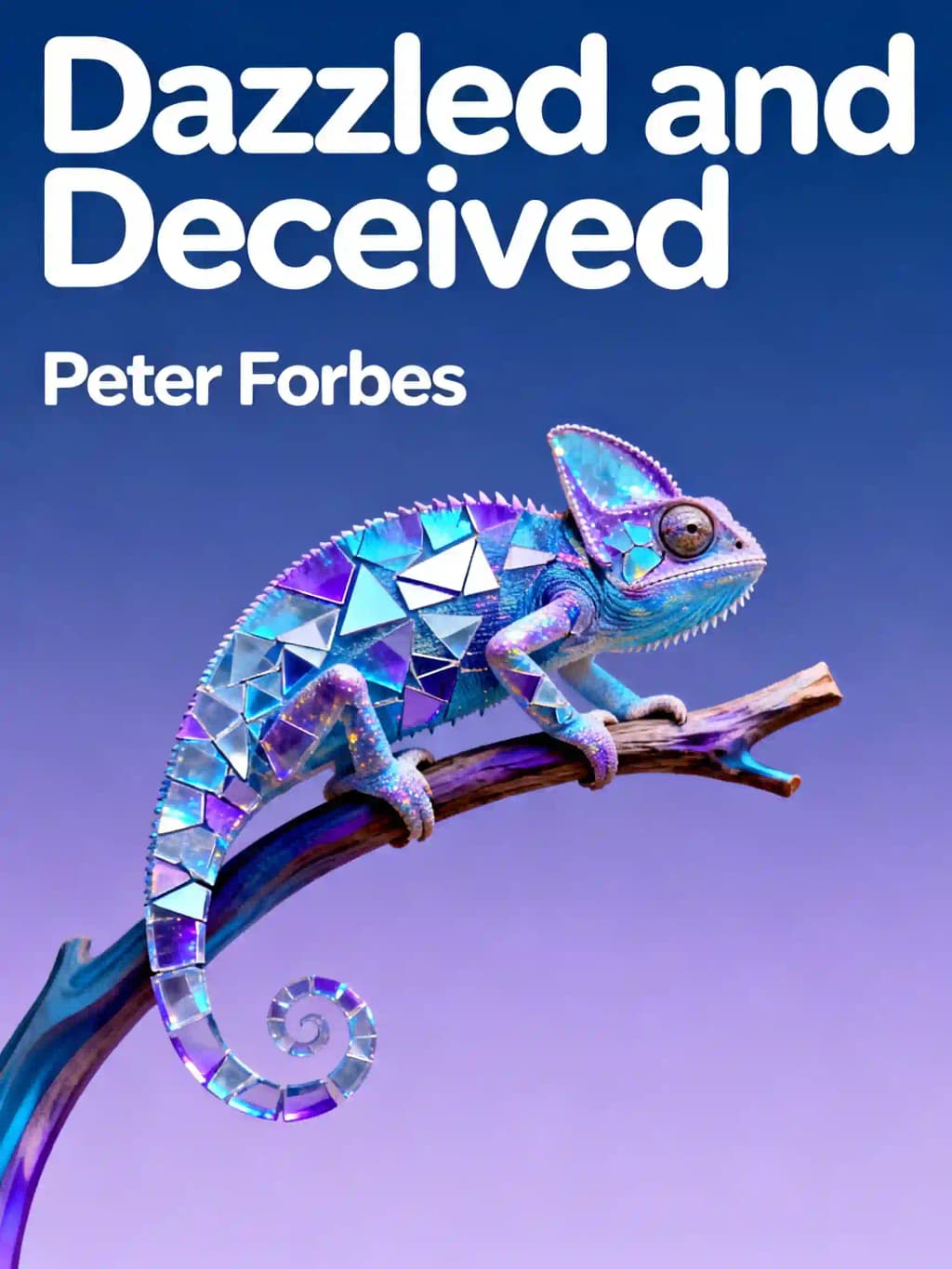
Have you ever wondered why a butterfly might look exactly like a dead leaf, complete with fake veins and spots of decay? Or why some harmless snakes sport the same bright warning colors as their venomous cousins? Peter Forbes' "Dazzled and Deceived" takes us on a fascinating journey through nature's most elaborate visual tricks and their profound impact on both science and human warfare. The book has captivated readers from evolutionary biologists to military historians since its publication, winning the 2011 Warwick Prize for Writing. Even David Attenborough praised it as "a compelling story told with both elegance and authority." What makes this exploration so powerful is how it connects Darwin's early observations of mimicry to modern genetic research and shows how nature's deceptive strategies directly inspired military camouflage that saved countless lives in both World Wars. As we'll discover, the boundaries between natural adaptation, artistic innovation, and military deception are far more blurred than you might imagine.
Capitolo 2
The Evolutionary Magic of Mimicry
When Henry Walter Bates, a hosier's son from Leicester, spent eleven years exploring the Amazon rainforest in the mid-19th century, he made a discovery that would provide crucial evidence for Darwin's then-controversial theory of evolution. In a single hour's walk from his base, Bates could find 700 butterfly species-more than ten times the number in the entire British Isles. Among these butterflies, he noticed something remarkable: certain species from entirely different families had evolved nearly identical wing patterns.
Specifically, butterflies from the family Pieridae (Leptalis) had somehow acquired the distinctive red and yellow patterns of toxic Heliconidae butterflies (Ithomiae). Even more astonishingly, when the toxic Ithomia species changed their patterns from region to region, their harmless Leptalis mimics changed accordingly to maintain the resemblance. This was no coincidence-it was natural selection in action.
What made this discovery so powerful was that it provided observable evidence of evolution's mechanisms. Unlike most evolutionary processes where fitness is circularly defined by survival, mimicry offers a measurable goal and outcome. We can see precisely what the mimic is trying to copy and how successful it's been. As the author puts it, "For mimicking species, there is a goal: to copy the model, providing an index of evolutionary success."
Darwin was electrified by Bates's findings, writing that they brought us "as near witnesses as we can ever hope to be of the creation of a new species on this earth." The patterns of these butterflies became living proof of natural selection's creative power-showing how random variations, when beneficial, could be preserved and accumulated over time to create remarkable adaptations.
But Bates wasn't alone in these groundbreaking discoveries. Alfred Russel Wallace, who had traveled with Bates initially before they split to cover more territory, made equally important observations in Indonesia. There, Wallace discovered the remarkable phenomenon of female-limited polymorphic mimicry in swallowtail butterflies. Some species produced multiple female forms from a single brood-some resembling males and others mimicking entirely different butterfly species. When Wallace's colleague Roland Trimen presented these findings to the Linnean Society in 1868, collector W.C. Hewitson objected that it would "require a stretch of imagination" to believe one butterfly species could have multiple distinct female forms-the idea shocked his "notions of propriety."
The final proof came when J.P.M. Weale successfully bred male butterflies and all four female forms from single broods. This polymorphic mimicry proved advantageous: by imitating several different toxic species, these swallowtails could "spread the load" and increase their population without compromising their mimetic protection.
Capitolo 3
Beyond Butterflies: Nature's Deceptive Masterpieces
While butterflies provided the first scientific evidence of mimicry, nature's deceptive talents extend far beyond these winged wonders. Consider the bird-dropping spider (Ornithoscatoides decipiens), which Henry Forbes encountered in Java and Sumatra. This remarkable creature transforms its web into a film mimicking the runny portion of bird excreta while positioning itself as the solid part. The disguise not only protects the spider from predators but actually attracts insects seeking salt in the droppings-turning defense into offense.
Even more impressive are creatures that transcend conventional classifications. The Kallima butterfly (known as the leaf butterfly) is an animal pretending to be a plant, while the living stones of South Africa are plants masquerading as minerals. When closed, Kallima's wings perfectly resemble dead leaves, complete with veining and apparent decay. More complex examples include Ityraea nigrocincta insects that collectively form flower-like structures, and flower mantises that match the colors of orchids to lure and consume bees.
These remarkable adaptations blur boundaries between animal, vegetable, and mineral kingdoms, demonstrating nature's endless capacity for deceptive innovation. As the author notes, these creatures create "gold from filth" by transforming the mundane into something extraordinary through mimicry.
Edward Bagnall Poulton systematized these various forms of mimicry into categories still used today. His classification included protective resemblance (special resemblance where creatures mimic discrete objects like leaves or twigs, and general resemblance where creatures blend with backgrounds); aggressive resemblance (predators using camouflage); adventitious protection (using props like grass or shells); variable protective resemblance (color-changing abilities); warning colors (bright patterns advertising toxicity); protective mimicry (Batesian and Mullerian forms); and aggressive mimicry (exploiting signals of other creatures).
Poulton explained mimicry's prevalence in insects due to their defenselessness, fertility, and rapid generations allowing natural selection to operate more quickly and perfectly. However, he sometimes saw resemblances where critics like McAtee found none, as with the contentious lobster moth caterpillar that supposedly mimicked everything from spiders to withered leaves.
Capitolo 4
The Genetics Behind the Disguise
As the nineteenth century turned to the twentieth, biology moved beyond surface appearances into the deep structure of living matter. While Darwin had proposed a "pangenesis" theory suggesting that cells threw off "gemmules" to reproduce organisms, he couldn't know these "gemmules" actually lived inside cells. Near Darwin's life's end, Walther Flemming observed chromosomes during cell division, while Gregor Mendel's inheritance experiments-rediscovered in 1900-provided crucial insights into how characteristics pass unchanged from parent to offspring.
Mendel's work with peas revealed that traits don't blend but remain distinct, with some dominant over others. When crossing plants with opposing traits like wrinkled versus round seeds, all first-generation offspring showed only the dominant trait (round). Yet when these hybrids crossed, the recessive trait (wrinkled) reappeared in precisely one-quarter of plants. This revolutionary finding solved Darwin's troubling question: if traits merely blended, how could new characteristics persist through generations? Mendel showed traits could remain hidden yet intact, ready to resurface in future generations-a mechanism crucial for understanding mimicry in butterflies.
Reginald Punnett's studies of swallowtail butterflies revealed that a single brood could produce non-mimicking males and three different mimicking female forms with no intermediates. As a devoted Mendelian, Punnett argued this polymorphism must have emerged suddenly through single-gene mutations rather than gradual accumulation. His evidence showed these patterns were inherited intact-either present or absent-suggesting one-off mutations rather than piecemeal assembly.
In his 1915 book "Mimicry in Butterflies," Punnett proposed that limited pattern-making machinery in butterflies explained why supposedly unrelated species could develop similar patterns, comparing it to how rabbits, mice, and guinea pigs share a common palette of coat colors despite their differences.
The debate between gradualists and those favoring larger evolutionary leaps continued for decades. Richard Goldschmidt, a German-Jewish zoologist, developed his controversial "hopeful monster hypothesis" in the 1930s-the idea that large, beneficial mutations could create significant evolutionary leaps rather than small, incremental changes. He suggested mimetic species might emerge through single large mutations that created near-perfect likenesses immediately.
Most biologists fiercely opposed these ideas, with R.A. Fisher leading the Darwinian resistance, arguing that large genetic leaps would almost certainly produce detrimental effects across multiple body systems, rendering creatures unviable.
Capitolo 5
From Nature to Warfare: The Birth of Military Camouflage
In the 1890s, American painter Abbott Handerson Thayer disrupted the field of natural camouflage with his discovery of countershading-the principle that animals are darkest where light falls strongest and lightest where shadows form, creating a flattening effect that helps them blend with their surroundings. Despite his genuine insights, Thayer's artistic temperament led to dogmatic overreach, claiming all animal coloration served concealment purposes-even flamingos, which he bizarrely argued were perfectly camouflaged against sunset skies.
When World War I erupted, Thayer attempted to apply his principles to military camouflage, bombarding authorities with detailed proposals based on natural camouflage principles. Despite initial interest from the Admiralty and Churchill, his ideas were ultimately dismissed as impractical and "academic." However, marine painter Norman Wilkinson developed a different approach called "dazzle" camouflage in 1917 while serving in the Royal Naval Volunteer Reserve.
Unlike Thayer who sought invisibility, Wilkinson's approach used bold geometric patterns to confuse submarine targeting by creating optical illusions about a ship's course and speed. His practical approach and naval connections helped him succeed where others failed. He established a camouflage unit at the Royal Academy with artists including vorticist Edward Wadsworth. By October 1917, his operation received royal validation when King George V visited and failed to correctly guess a model ship's course.
When America entered the war, Wilkinson advised their navy and convinced Assistant Secretary Franklin Roosevelt of dazzle's merits over Thayer's impractical "invisibility" schemes. The patterns created the illusion that ships were split into semi-independent blocks, making them appear to turn when actually on a straight course. By June 1918, 2,367 merchant ships had been dazzle-painted.
While naval camouflage was influenced by zoologists, land camouflage during WWI was dominated by artists. The war's innovations-machine guns, aeroplanes, and tanks-created new camouflage challenges, particularly hiding troops and equipment from aerial reconnaissance. The French established the first Allied camouflage unit under painter Lucien-Victor Guirand de Scevola in 1915. These camoufleurs, who adopted the chameleon as their emblem, specialized in creating observation posts disguised as trees and other deceptive installations.
The connection between modern art and military camouflage was explicit. Georges Braque noted how armies shifted from impressionist-influenced "horizon blue" uniforms to cubist-inspired camouflage. French camoufleur Lucien-Victor Guirand de Scevola explicitly acknowledged using cubist principles to deform objects' appearances. Picasso famously claimed "it is we who made it" upon seeing a camouflaged truck in Paris.
Capitolo 6
World War II: The Triumph of Deception
By World War II, camouflage had evolved from an artistic curiosity to a sophisticated military science. Hugh Cott, a zoologist and author of the definitive work "Adaptive Coloration in Animals," applied his scientific understanding of natural camouflage to military applications. When given the chance to demonstrate his principles, Cott camouflaged a rail-mounted coastal gun using countershading techniques that proved remarkably effective in aerial photography compared to the standard patterned gun.
Despite initial resistance, Cott's expertise gained recognition at the Royal Engineers' Camouflage Development and Training Centre at Farnham Castle, where his book became required reading. Many soldiers left his courses seeing the world "with different eyes," having learned preternatural awareness and observation skills-from reading time from church shadows to understanding why cowboy jackets had ragged leather strips.
The culmination of military deception came in Operation Bertram before the Battle of El Alamein in 1942. The strategy required creating a dummy army in the south while concealing the real attack force in the north. The deception involved ingenious disguises: artillery pieces were transformed into "Cannibals" (fake trucks) while tanks became "Sunshields"-coverings that could be removed in seconds.
The operation's true genius lay in its chess-like maneuvers. Empty Sunshields were first placed where tanks would eventually position, then tanks were smuggled underneath at night. Meanwhile, dummy forces were substituted in the south. This confused German Field Marshal Rommel, who split his depleted forces between both locations. A fake water pipeline further suggested an attack date well after the real one, prompting Rommel to leave for Germany. When the attack began on October 23, 1942, the Sherman tanks emerged from their disguises to Churchill's later praise: "By a marvellous system of camouflage, complete tactical surprise was achieved in the desert."
The D-Day invasion represented another triumph of military deception. Under "Operation Fortitude," elaborate decoy forces were created in Scotland and eastern England to suggest invasions of Norway and Pas de Calais, while the real invasion force assembled along England's south coast. Though some specific ruses went unnoticed, the broader deception succeeded brilliantly-German high command remained convinced the real invasion would target Pas de Calais, keeping nineteen powerful divisions, including crucial panzer reserves, idle for nearly two months after the Normandy landings.
Capitolo 7
From Butterflies to Babies: The Medical Breakthrough
In October 1952, a small advertisement in the Bulletin of the Amateur Entomologists' Society would lead to groundbreaking medical discoveries. Dr. Philip Sheppard of Oxford's Genetics Laboratory sought living swallowtail butterfly specimens for genetic research. The ad was answered by Dr. Cyril Clarke, a Liverpool physician and amateur lepidopterist who had been breeding swallowtails as a hobby since returning from naval service.
Clarke had recently cross-bred a black American swallowtail with a yellow British species, discovering that the black coloration was dominant. When back-crossed to the yellow parent, offspring appeared in the classic Mendelian ratio of half black and half yellow, suggesting the color patterns were controlled by a single polymorphic gene. This discovery sparked a collaboration between Clarke and Sheppard, who had been a navigator in WWII before being shot down and spending three years in prison camps.
Their butterfly research revealed striking parallels between wing pattern inheritance and human blood group inheritance. Just as mimicry genes were switched off in male butterflies, Clarke realized similar sex-linked inheritance might apply to the Rhesus blood incompatibility problem, where Rh-negative mothers developed antibodies against Rh-positive fetal blood cells, causing fatal complications in subsequent pregnancies.
Inspired by this connection, Clarke and Sheppard developed a preventative treatment: administering anti-Rh antibodies to mothers immediately after delivery to disable any incompatible cells before the mother's immune system could respond. Clinical trials in 1965-66 showed that in 78 treated Rhesus-negative mothers, none developed the dangerous antibodies, while 19 of 78 untreated controls did. By 1970, the treatment became routine medical practice, dramatically reducing infant mortality from Rhesus disease from 1.6 per thousand in 1950 to just 0.1 per thousand by the early 1980s.
This remarkable medical breakthrough came directly from studying butterfly mimicry-a powerful example of how basic research in seemingly unrelated fields can lead to life-saving applications.
Capitolo 8
The Chemical Foundations of Mimicry
Miriam Rothschild, though not officially part of Oxford University, became a key member of E.B. Ford's inner circle and carried the tradition of the amateur scientist into the 21st century. During WWII, Rothschild worked as an Enigma code breaker at Bletchley Park. Though fleas were her primary expertise, she developed profound insights into mimicry, recognizing that it involved more than visual appearances.
Her pioneering work focused on how plants and animals use chemicals to attract and repel-understanding that mimicry begins when insects evolve the ability to harvest and store toxic chemicals from food plants. Collaborating with Nobel-winning chemist Tadeusz Reichstein, they identified five principal cardenolides-heart poisons similar to digitalis-in monarch butterflies. Their groundbreaking work showed monarchs and pupae contained 1.8 times the lethal dose for a cat.
This research established that mimicry begins even earlier than previously thought-when butterflies lay eggs on toxic plants that herbivores avoid. The caterpillars that can tolerate these toxins gain both exclusive food sources and protection. Eventually, they evolve to absorb the toxins themselves, developing bright warning coloration to advertise their unpalatability to predators.
Thomas Eisner, whom Rothschild inspired, became the prince of chemical ecology through his work with the bombardier beetle. These black and yellow warning-colored beetles eject a hot benzoquinone spray at nearly 100C in machine-gun bursts of 500-1,000 pulses per second. Eisner discovered their remarkable defense mechanism involves mixing hydrogen peroxide and hydroquinone in a reaction chamber with enzymes as catalysts-essentially a natural rocket propulsion system with a swiveling nozzle.
Rothschild brilliantly encapsulated mimicry as resulting from three factors: heredity worked on by birds' or insects' color vision, with necessary pre-adaptations making different forms of mimicry possible. This insight recognized that most butterflies aren't mimetic because they lack these pre-adaptations-a concept mathematically confirmed by researchers a year later.
Capitolo 9
Modern Science Unlocks Ancient Secrets
Modern genetic research has finally begun to unlock the mechanisms behind nature's remarkable mimetic patterns. Sean Carroll's team discovered that fruit fly genes like distal-less (dll) had been co-opted for butterfly eyespot patterns-an old gene finding a new use. They also found that butterfly wing scales are genetically similar to fruit fly wing hairs, revealing how evolution repurposes existing structures.
Nature scavenges genes and adapts them to new purposes much like World War II camoufleurs scavenged materials. This works because genes' actions are chemical-small molecular changes can create new functions. A brilliant example is Antarctic fish, which developed antifreeze proteins from modified digestive enzymes when the Antarctic froze 10-14 million years ago. The original trypsinogen gene was duplicated, allowing the copy to mutate for a new purpose while the original maintained its digestive function.
Research on Heliconius butterflies has been particularly revealing. These butterflies are Mullerian mimics-different species wearing identical warning patterns to signal unpalatability to predators. Their complex wing patterns feature splashes of color arranged with "artistic abandon," prompting biologist Sir Alister Hardy to compare butterfly collections to "galleries of abstract art."
Modern researchers like Chris Jiggins have discovered that color-pattern genes in co-mimics H. erato and H. melpomene map to the same genomic locations in each species-confirming one of Goldschmidt's controversial ideas that mimicry might involve the same genetic processes in both model and mimic. While pattern genes determine layout, color genes determine pigmentation. In Heliconius, scales can only be red, orange, yellow, white or black. Bob Reed discovered that red wing scales require an overlap of two genes: cinnabar and vermilion. Yellow scales form where only one gene is expressed.
Perhaps most remarkably, researchers demonstrated that hybridization could create new species when they synthesized H. heurippa in the lab by crossing cydno and melpomene. These lab-created butterflies preferred to mate with others sharing their pattern, showing that pattern genes and mate preference genes are linked. This explains how new species can form rapidly through hybridization when viable new wing patterns emerge.
Capitolo 10
Seeing Through Different Eyes
Early studies of mimicry assumed animals see what humans see, but research into animal visual systems reveals significant differences. Most mammals lack our three-color vision, while birds and insects can see ultraviolet light invisible to us.
The crab spider case demonstrates this complexity. These spiders, which sit in white or yellow flowers to catch bees, were thought to be camouflaged. However, Lars Chittka discovered that in ultraviolet light (visible to bees but not humans), the Australian white crab spider appears exceptionally bright-actually attracting bees to "spider-flowers" rather than being invisible.
Further research by Mariella Herberstein revealed that odor also plays a crucial role, with both spiders and bees attracted to fragrant flowers. Most surprisingly, native Australian bees have evolved to recognize the spiders despite their ultraviolet glow, while introduced European bees remain susceptible-a rare case where a native Australian species benefited from European settlement.
The 150-year-old phenomenon of Batesian mimicry continues yielding surprises, particularly with coral snakes and their kingsnake mimics. David Pfennig's research revealed that the non-venomous scarlet kingsnake exists hundreds of kilometers beyond its venomous model's range, where mimicry should be disadvantageous. Most surprisingly, the best mimicry occurs at the edge of the model's range, not where models are abundant. This makes evolutionary sense: where venomous snakes are common, anything resembling them is avoided, but at the range edge, predators might risk attacking imperfect mimics, creating stronger selection pressure for precise mimicry.
Capitolo 11
The Legacy of Nature's Deception
Military camouflage has evolved significantly since World War II. The revolutionary change came through psychological research in the 1970s. Traditional large-blotched patterns gave way to fractal-inspired designs after Lieutenant Colonel Timothy O'Neill developed "Dual Tex"-combining macropatterns that disrupt target recognition with micropatterns matching background texture. This approach culminated in digital camouflage: first CADPAT (Canadian Disruptive Pattern) in 1997, then MARPAT (Marine Pattern) in 2004, and finally ACUPAT for the entire US Army.
Digital camouflage resolves the military conundrum between "invisibility" and "unrecognizability" by addressing the two separate visual systems humans use-one for locating objects, another for identifying them. The micropattern hinders detection while the macropattern prevents identification.
An interdisciplinary research effort is now emerging where biologists, visual psychologists, and computer scientists systematically study camouflage as a perceptual problem using modern instrumentation and computer analysis. The Royal Society's 2009 special issue on camouflage noted an "explosion of studies" in recent years, partly arising from research into warning coloration and mimicry.
Mimicry is both imitation and a fertile creative process. We humans learn first by copying, and while we value originality, artists know how much it owes to imitation. As T.S. Eliot noted, mature poets don't merely imitate-they steal. Nature's mimicry preceded human art, displaying expressive visual gestures that signify danger or attraction long before cave paintings or sculptures.
Some artists like Nabokov and Abbott Thayer consciously incorporated nature's mimicry into their work, while others like Picasso more organically ransacked nature for materials and inspiration. Picasso's post-WWII sculptures, made from found objects, echo the desert camoufleurs' creativity-a wicker basket becomes a goat's ribcage, toy cars transform into a baboon's face. Like nature, artists are bricoleurs, tinkerers who transform available materials into something rich and strange.
Art, nature, and warfare converge in camouflage. The rock pocket mice of the southwestern deserts exemplify this connection as the first camouflaged animals whose genetic mechanism we understand. On dark volcanic outcrops, these typically sandy-colored mice have evolved dark forms in less than a million years through a single gene mutation-the quantum of genetic change. This smoking gun of adaptive change would have thrilled Darwin, who wanted to know nature in all its detail.
Camouflage and mimicry belong to the great empire of non-verbal communication. As long as living things exist on earth, they will continue finding new ways to hide, feign threats, startle, and copy each other's fascinating patterns-and humans will continue to learn from and be inspired by nature's endless capacity for deception and transformation.