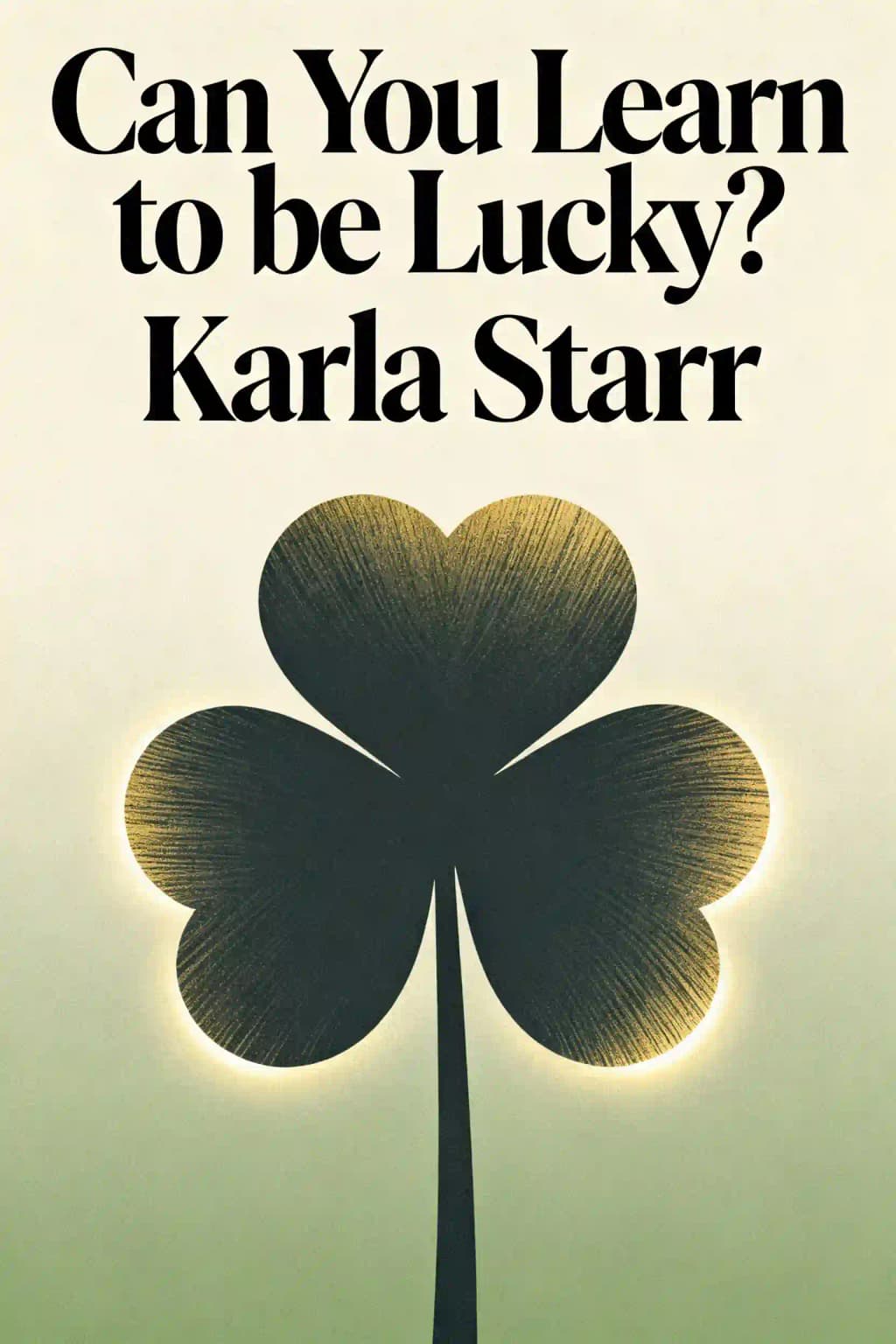
Is luck random or engineered? Karla Starr reveals hidden patterns behind seemingly lucky breaks, endorsed by Adam Grant and Daniel Pink. First impressions, timing, and confidence can all be manipulated - discover why some people consistently win while others don't. Your fortune awaits.
Karla Starr, bestselling author of Can You Learn to Be Lucky? Why Some People Seem to Win More Often Than Others, is a behavioral science writer and speaker known for translating complex research into actionable insights.
Drawing from her background in journalism—including contributions to The Atlantic, Slate, and Popular Science—Starr explores themes of randomness, decision-making, and success strategies in this genre-blending work of psychology and self-improvement. Her expertise is further showcased in Making Numbers Count, co-authored with Stanford professor Chip Heath, which distills data communication principles for broad audiences.
A recipient of the Society of Professional Journalists’ Best Science/Health Story award, Starr regularly shares evidence-based strategies through her Substack newsletter, The Starr Report, and has been featured on NPR and CBS Sunday Morning. Can You Learn to Be Lucky? was named a Fast Company Best Book of the Year, solidifying her reputation as a thinker who bridges academic rigor with practical application.
Can You Learn to Be Lucky? by Karla Starr challenges the notion that luck is purely random, arguing it stems from subconscious biases, strategic habits, and societal patterns. The book explores how factors like timing, appearance, confidence, and social connections influence opportunities, offering actionable strategies to align with these hidden forces. It blends behavioral science with real-world examples to show how anyone can cultivate a "luck-ready" mindset.
This book is ideal for professionals, entrepreneurs, and anyone seeking to improve career or personal outcomes. It’s particularly relevant for those interested in psychology, behavioral economics, or self-improvement, offering science-backed tactics to optimize decision-making, networking, and opportunity recognition. Readers who enjoy Malcolm Gladwell or Adam Grant will appreciate Starr’s research-driven approach.
Yes—the book provides actionable insights rarely covered in traditional self-help guides. Starr combines rigorous research with relatable anecdotes, debunking myths about innate talent or random chance. Its focus on tangible strategies (e.g., leveraging timing biases, refining first impressions) makes it a practical tool for career advancement and personal growth.
Karla Starr is an award-winning science journalist and bestselling author. A member of the National Association of Science Writers, she’s written for The Atlantic, Slate, and Popular Science. Her work focuses on decoding human behavior, with Can You Learn to Be Lucky? named a Fast Company Best Book of the Year.
Starr identifies eight key strategies, including optimizing timing (e.g., appearing last in evaluations), leveraging familiarity bias (dressing/acting the part), and building strategic networks. She emphasizes confidence as a learnable skill and curiosity as a tool for spotting opportunities. Critically, she argues luck requires combining multiple small advantages, not relying on one "big break."
Confidence acts as a self-fulfilling prophecy: those who project it attract more opportunities, from job offers to collaborations. Starr explains confidence isn’t innate—it’s shaped by social conditioning and deliberate practice. Simple tweaks like adopting power poses or reframing failures as feedback can create a luck-enhancing feedback loop.
Humans subconsciously associate attractiveness with competence, trustworthiness, and intelligence. Starr cites studies showing attractive people receive more job interviews, higher salaries, and faster promotions. While genetics play a role, grooming, posture, and style choices can significantly amplify perceptions of “merit” in professional and social settings.
Starr argues luck thrives on “weak ties”—casual connections outside your immediate circle. These contacts often provide unexpected job leads, collaborations, or insights. The book advises diversifying networks (e.g., attending interdisciplinary events) and adopting a “give-first” mindset to build reciprocity.
Curiosity drives exposure to new ideas, people, and environments—key sources of serendipity. Starr notes curious people ask more questions, take calculated risks, and adapt faster to change. This proactive stance helps them spot overlooked opportunities, like emerging industries or undervalued skills.
Unlike vague “think positive” advice, Starr roots her strategies in neuroscience and sociology. For example, she explains how the brain’s pattern recognition favors familiar faces (the “mere-exposure effect”), making consistent visibility crucial for luck. The book also avoids overt optimism, acknowledging systemic biases while teaching readers to navigate them.
Absolutely. Tactics like timing job applications (avoiding mid-day submission rushes), tailoring resumes to bypass unconscious bias, and strategically volunteering for high-visibility projects align with Starr’s research. The book also advises targeting industries in flux, where luck opportunities multiply due to rapid change.
Some critics argue the book underemphasizes structural barriers like race or socioeconomic status. Others note its strategies require baseline privileges (e.g., time to network, access to education). However, Starr acknowledges these factors and focuses on maximizing agency within individual circumstances.
Senti il libro attraverso la voce dell'autore
Trasforma la conoscenza in spunti coinvolgenti e ricchi di esempi
Cattura le idee chiave in un lampo per un apprendimento veloce
Goditi il libro in modo divertente e coinvolgente
Many rejections aren't personal-they're just the result of decision-maker fatigue or poor timing.
Our brains love connecting dots, and we rarely question when someone matches our expectations-it simply feels right.
Scomponi le idee chiave di Can You Learn to Be Lucky? in punti facili da capire per comprendere come i team innovativi creano, collaborano e crescono.
Distilla Can You Learn to Be Lucky? in rapidi promemoria che evidenziano i principi chiave di franchezza, lavoro di squadra e resilienza creativa.

Vivi Can You Learn to Be Lucky? attraverso narrazioni vivide che trasformano le lezioni di innovazione in momenti che ricorderai e applicherai.
Chiedi qualsiasi cosa, scegli la voce e co-crea spunti che risuonino davvero con te.

Creato da alumni della Columbia University a San Francisco
"Instead of endless scrolling, I just hit play on BeFreed. It saves me so much time."
"I never knew where to start with nonfiction—BeFreed’s book lists turned into podcasts gave me a clear path."
"Perfect balance between learning and entertainment. Finished ‘Thinking, Fast and Slow’ on my commute this week."
"Crazy how much I learned while walking the dog. BeFreed = small habits → big gains."
"Reading used to feel like a chore. Now it’s just part of my lifestyle."
"Feels effortless compared to reading. I’ve finished 6 books this month already."
"BeFreed turned my guilty doomscrolling into something that feels productive and inspiring."
"BeFreed turned my commute into learning time. 20-min podcasts are perfect for finishing books I never had time for."
"BeFreed replaced my podcast queue. Imagine Spotify for books — that’s it. 🙌"
"It is great for me to learn something from the book without reading it."
"The themed book list podcasts help me connect ideas across authors—like a guided audio journey."
"Makes me feel smarter every time before going to work"
Creato da alumni della Columbia University a San Francisco

Ottieni il riassunto di Can You Learn to Be Lucky? in formato PDF o EPUB gratuito. Stampalo o leggilo offline quando vuoi.
What if luck isn't random at all? Consider this: Olympic figure skaters who perform last have a 14% chance of winning versus just 3% for those going first. Israeli judges grant parole 65% of the time at the start of their day but nearly 0% right before lunch. Bar patrons rate others as increasingly attractive as closing time approaches. These aren't coincidences-they're predictable patterns in how human brains make decisions. We like to think we're rational creatures, carefully weighing options before choosing. The reality? Our brains are lazy. They follow what Nobel laureate Daniel Kahneman calls "the law of least effort," constantly seeking shortcuts to conserve mental energy. This means timing isn't just important-it's everything. When judges evaluate performances sequentially, early competitors get measured against our perfect ideals while later entries benefit from adjusted expectations. Think about Tara Lipinski upsetting Michelle Kwan at the 1998 Winter Olympics despite Kwan's flawless performance. Judges gave Kwan 5.9s instead of perfect 6.0s because they needed to "leave room at the top." Meanwhile, as decision fatigue sets in throughout the day, our brains default to the easier option-saying no. This explains why your brilliant proposal got rejected not because it lacked merit, but because your boss reviewed it at 4:47 p.m. on a Friday. The lesson? Go last whenever possible, and when you can't, be so memorable that you're the first person who comes to mind when decisions get made.