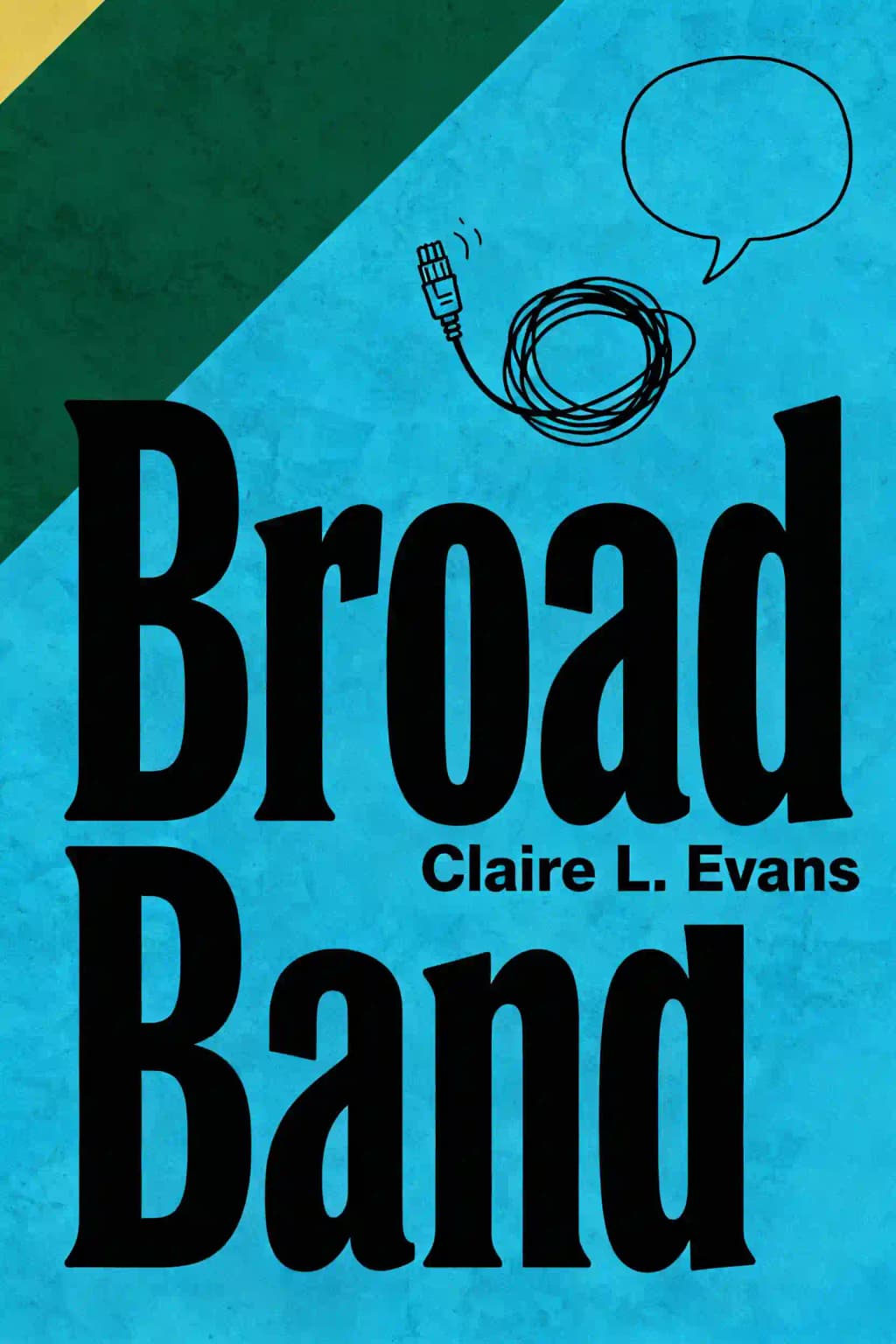
Discover the erased heroines who built our digital world. "Broad Band" reveals how women like Ada Lovelace and Grace Hopper shaped computing across two centuries, challenging tech's male-dominated narrative. What groundbreaking online communities did women create while men got all the credit?
Claire L. Evans, author of Broad Band: The Untold Story of the Women Who Made the Internet, is a technology historian, Grammy-nominated musician, and celebrated voice in speculative fiction. A founding editor of VICE's science-fiction platform Terraform and singer of the avant-pop group YACHT, Evans intertwines art, technology, and cultural critique in her work.
Broad Band, a groundbreaking non-fiction exploration, reclaims the erased contributions of women in computing—from 19th-century programmers to dot-com pioneers—challenging Silicon Valley’s male-dominated narratives. Evans’ research draws from firsthand interviews with surviving tech pioneers, blending rigorous scholarship with narrative urgency.
A frequent contributor to The Guardian, WIRED, and Aeon, Evans also co-edited the anthology Terraform: Watch/Worlds/Burn and advises graduate design students at Art Center College of Design. Her interdisciplinary approach extends to her music: YACHT’s AI-collaborative album Chain Tripping and her talks at institutions like MIT reflect her fusion of creativity and technical innovation. Recognized by The Verge as one of the Greatest Tech Books of All Time (2023), Broad Band has become essential reading for reunderstanding technology’s hidden histories.
Broad Band uncovers the pivotal yet overlooked contributions of women to computing and internet development, from WWII-era programmers to 1990s web pioneers. Claire L. Evans traces their roles in creating ARPANET, hypertext systems, and early online communities, challenging the male-dominated narrative of tech history. The book blends technical innovation stories with social commentary on gender and technology.
Tech enthusiasts, feminists, and history buffs will find this book essential. It’s ideal for readers interested in intersectional tech history, reclaiming women’s legacy in STEM, or understanding how marginalized voices shaped the internet. Computer science students and professionals seeking a nuanced perspective on digital evolution will also benefit.
Yes. Evans’ well-researched narrative fills critical gaps in mainstream tech history, offering fresh insights into groundbreaking women like Elizabeth Feinler and Radia Perlman. Reviews praise its balance between technical detail and accessible storytelling, calling it a “satisfactory introduction” to internet origins and gender dynamics in tech.
The book highlights:
Evans argues that women’s contributions were systematically erased despite shaping foundational tech, from military computers to social web platforms. She critiques how commercialization replicated real-world inequalities online but also emphasizes these pioneers’ resilience as a blueprint for inclusive design.
The book spans:
Evans notes that while early web communities like Echo fostered inclusivity, commercialization entrenched sexism, racism, and class divides. She contrasts pioneers’ optimistic visions with modern challenges like misinformation, urging readers to “remake” tech by learning from this history.
Stacy Horn’s Echo, launched in 1990, was one of the first online spaces prioritizing gender balance and “safe” sub-communities. Evans frames it as a precursor to modern social media, highlighting how Horn’s grassroots approach countered the male-dominated internet culture of the time.
Unlike male-centric narratives (e.g., The Innovators), Broad Band recenters women as architects of digital infrastructure. It merges technical milestones (like Perlman’s networking protocols) with social context, offering a holistic view of innovation.
Some readers find the ending abrupt, as Evans shifts from critiquing tech’s flaws to advocating for systemic change without a clear roadmap. Critics suggest this pivot feels underdeveloped, leaving practical solutions for future works.
As debates about AI ethics and online equity intensify, Evans’ examination of historical exclusion offers lessons for building inclusive tech. The book’s focus on community-driven design resonates with current movements toward decentralized platforms.
Senti il libro attraverso la voce dell'autore
Trasforma la conoscenza in spunti coinvolgenti e ricchi di esempi
Cattura le idee chiave in un lampo per un apprendimento veloce
Goditi il libro in modo divertente e coinvolgente
Technology is never wholly separate from us.
Computing had become so associated with women that mathematicians measured machine power in 'girl-years'.
Johnson famously noted she was a computer back when 'the computer wore a skirt.'
It felt like history had been made that day, and then it had run over us and left us in its tracks.
Programming was seen as merely manipulating hardware.
Scomponi le idee chiave di Broad Band in punti facili da capire per comprendere come i team innovativi creano, collaborano e crescono.
Distilla Broad Band in rapidi promemoria che evidenziano i principi chiave di franchezza, lavoro di squadra e resilienza creativa.

Vivi Broad Band attraverso narrazioni vivide che trasformano le lezioni di innovazione in momenti che ricorderai e applicherai.
Chiedi qualsiasi cosa, scegli la voce e co-crea spunti che risuonino davvero con te.

Creato da alumni della Columbia University a San Francisco
"Instead of endless scrolling, I just hit play on BeFreed. It saves me so much time."
"I never knew where to start with nonfiction—BeFreed’s book lists turned into podcasts gave me a clear path."
"Perfect balance between learning and entertainment. Finished ‘Thinking, Fast and Slow’ on my commute this week."
"Crazy how much I learned while walking the dog. BeFreed = small habits → big gains."
"Reading used to feel like a chore. Now it’s just part of my lifestyle."
"Feels effortless compared to reading. I’ve finished 6 books this month already."
"BeFreed turned my guilty doomscrolling into something that feels productive and inspiring."
"BeFreed turned my commute into learning time. 20-min podcasts are perfect for finishing books I never had time for."
"BeFreed replaced my podcast queue. Imagine Spotify for books — that’s it. 🙌"
"It is great for me to learn something from the book without reading it."
"The themed book list podcasts help me connect ideas across authors—like a guided audio journey."
"Makes me feel smarter every time before going to work"
Creato da alumni della Columbia University a San Francisco

Ottieni il riassunto di Broad Band in formato PDF o EPUB gratuito. Stampalo o leggilo offline quando vuoi.
Your first computer probably wasn't remarkable-maybe a beige box with a screeching modem that transformed your bedroom into something magical. Mine certainly wasn't special by today's standards, yet it opened portals to worlds I'd never imagined. Those machines are gone now, recycled or rusting in distant landfills, but what they enabled remains: human connection across impossible distances. Here's what most technology histories won't tell you-the internet wasn't built by lone geniuses in garages. It was constructed, programmed, and imagined into existence by women whose names you've likely never heard. From the first algorithm to the social architecture of online communities, women have been there at every technological revolution, often doing work nobody valued until suddenly everyone did. For nearly two centuries, "computer" wasn't a machine-it was a job title. Classified ads sought human computers to perform complex calculations, charting stars and solving equations in intellectual factories. By the mid-twentieth century, this work became so associated with women that mathematicians measured machine power in "girl-years" and "kilogirls." The connection between textiles and computing runs deeper than metaphor. Joseph-Marie Jacquard's revolutionary loom used punched cards to weave intricate patterns, separating design from execution for the first time. Charles Babbage, inspired by a silk portrait of Jacquard woven using 24,000 punched cards, adopted textile language for his computing machines-"store" and "mill" became memory and processor.




