Capitolo 1
Happiness Is Mandatory: Your Pleasure Is Programmed
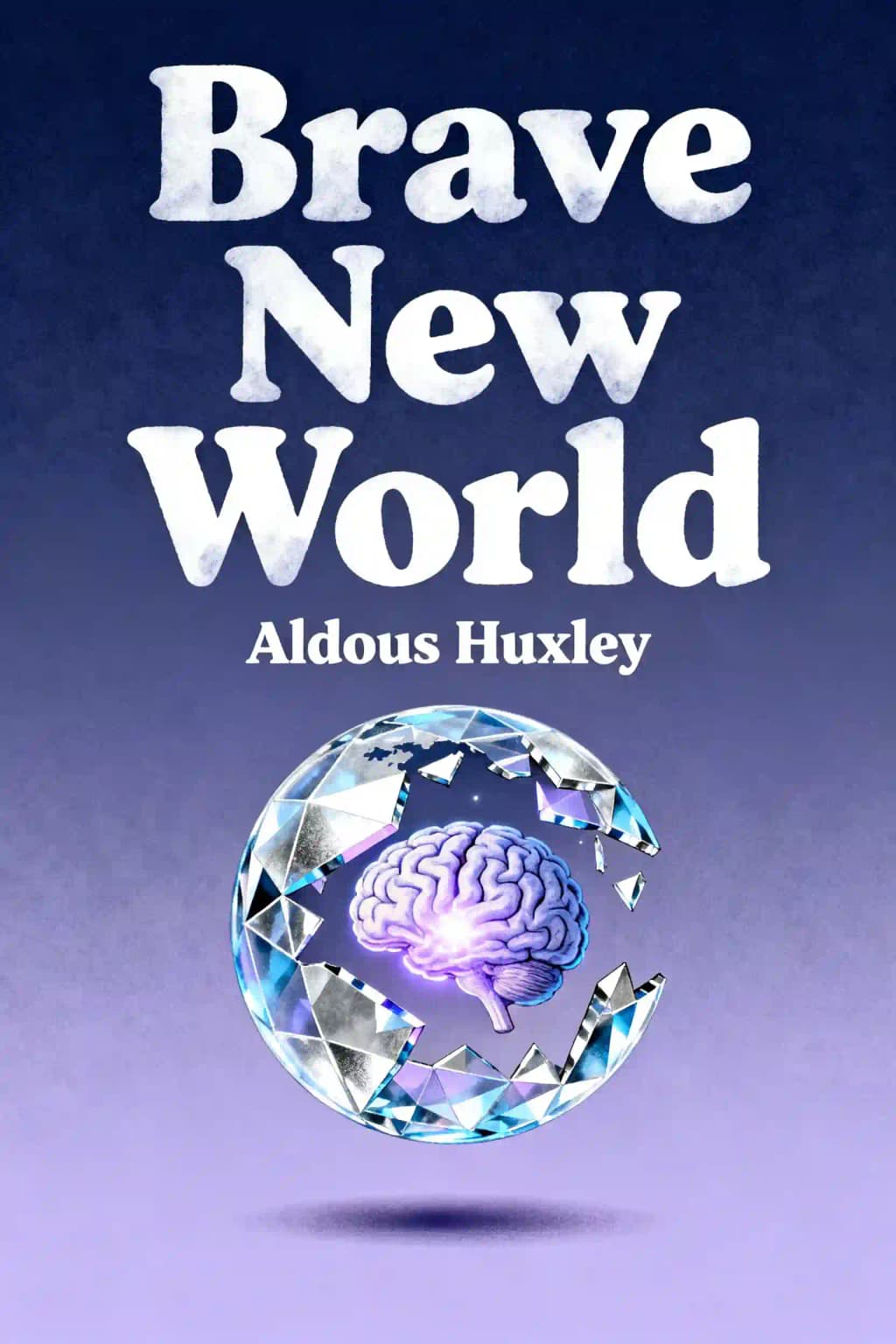
In Huxley's chilling masterpiece, the future isn't merely predicted - it's dissected with surgical precision. Written in 1931 while the author experimented with peyote and mescaline, "Brave New World" imagined a society where happiness is chemically guaranteed and freedom is the true obscenity.
Before Orwell's surveillance state, Huxley recognized the more insidious threat: a world where oppression comes gift-wrapped as pleasure. His dystopia feels increasingly prophetic in our era of algorithmic content, designer drugs, and endless distraction.
What's most unsettling? Huxley's fictional soma drug parallels our modern pharmacological solutions to unhappiness, while his assembly-line baby factories eerily foreshadowed IVF technology decades before its invention.
Reading "Brave New World" today offers the rare, uncomfortable gift of seeing our technological paradise through a disturbing lens. You'll never scroll mindlessly through social media or accept "because it feels good" as justification again. This isn't just literature - it's a vaccination against the seductive comforts threatening our humanity.
Capitolo 2
A Society Engineered for Stability
In the World State, human reproduction has been entirely mechanized. The Central London Hatchery and Conditioning Centre embodies the regime's core values: "COMMUNITY, IDENTITY, STABILITY." Inside this sterile facility of steel and glass, human embryos are mass-produced through the revolutionary Bokanovsky's Process, which can create up to ninety-six identical humans from a single egg. This isn't just a technological marvel - it's the foundation of social control.
The facility's Director proudly explains to students how embryos are predestined for specific societal roles through precise chemical treatments. Oxygen deprivation creates the lower castes - Gammas, Deltas, and Epsilons - while Alphas and Betas receive optimal conditions. These aren't merely functional differences; they're engineered hierarchies that ensure social stability through biological determinism.
What's particularly chilling is how this system eliminates the concept of choice entirely. Before birth, humans are conditioned to love their predetermined fate. Lower castes receive chemical treatments that limit their intelligence and physical growth, ensuring they'll never question their position. Meanwhile, the privileged Alphas and Betas are designed with the intelligence needed to manage society, but lack the imagination to question its foundations.
The process continues after "decanting" (birth), where infants undergo Neo-Pavlovian conditioning. Delta babies are placed near books and flowers, then subjected to alarms and electric shocks until they develop a lifelong aversion to literature and nature. The Director explains the economic rationale: "We condition the masses to hate the country, but simultaneously condition them to love all country sports. At the same time, we see to it that all country sports shall entail the use of elaborate apparatus. So that they consume manufactured articles as well as transport."
This conditioning extends to sleep-teaching (hypnopaedia), where children absorb moral lessons while unconscious. A Beta child might hear thousands of repetitions of phrases like "Alpha children wear grey. They work much harder than we do, because they're so frightfully clever. I'm really awfully glad I'm a Beta, because I don't work so hard." The result? A population that not only accepts its place but feels genuinely thankful for it.
Capitolo 3
The Elimination of Family and Intimacy
Perhaps nothing distinguishes Huxley's dystopia more than its complete restructuring of human relationships. In the World State, words like "mother," "father," and "family" are considered obscene. Children are raised collectively, with no knowledge of their biological origins. The very concept of parental attachment is viewed as dangerous and primitive.
The Controller, Mustapha Mond, explains to students how the old world's emphasis on family created instability: "Home, home - a few small rooms, stiflingly over-inhabited by a man, by a periodically teeming woman, by a rabble of boys and girls of all ages. No air, no space; an understerilized prison; darkness, disease, and smells." In his view, the family unit created emotional dependencies that threatened social harmony.
In place of family bonds, the World State promotes universal promiscuity. The slogan "everyone belongs to everyone else" is repeated from childhood. Monogamy is considered aberrant behavior, worthy of suspicion. When Lenina dates Henry Foster for four months, her friend Fanny expresses concern: "I really do think you ought to be careful. It's such horribly bad form to go on and on like this with one man."
This sexual freedom isn't liberating - it's another form of control. By removing the possibility of deep emotional attachment, the state prevents the formation of loyalties that might compete with dedication to the collective. Sex becomes mechanical and meaningless, a recreational activity devoid of intimacy or consequence. Contraception is mandatory, with women wearing "Malthusian belts" stocked with birth control. Those who can reproduce are conditioned to view pregnancy as disgusting.
The result is a society where human connection has been systematically hollowed out. People interact constantly but never truly connect. They participate in elaborate solidarity services that mimic religious rituals, culminating in drug-fueled orgies, but these experiences provide only momentary escape from their essential loneliness. Bernard Marx, despite participating in these ceremonies, leaves feeling "more isolated now than ever."
What makes this vision so disturbing is how it recognizes that humans need not just physical comfort but emotional belonging. The World State doesn't just control bodies; it restructures the human heart itself.
Capitolo 4
The Cult of Consumption and Happiness
"Ending is better than mending. The more stitches, the less riches." This hypnopaedic slogan reveals another pillar of the World State: mandatory consumption. Citizens are conditioned from infancy to discard rather than repair, to constantly consume new products, and to view frugality as antisocial.
The economic system requires constant consumption to maintain stability. When children are conditioned against flowers, the Director explains it's because "a love of nature keeps no factories busy." Leisure activities are designed to require elaborate equipment and transportation, ensuring economic activity. Even death is repurposed for efficiency - crematoriums recover valuable phosphorus from corpses, turning human remains into a resource.
The pursuit of happiness isn't just encouraged - it's mandatory. Any sign of discomfort is immediately treated with soma, a perfect drug that provides "all the advantages of Christianity and alcohol; none of their defects." A gram of soma offers a holiday from reality without hangovers or health consequences. The drug enables citizens to escape any unpleasant emotion, maintaining the placid surface of society.
When Lenina notices Bernard seems melancholy, she immediately suggests: "Take a holiday from reality whenever you like, and come back without so much as a headache or a mythology." This casual recommendation reveals how thoroughly the society medicates its discontent. The slogan "a gramme is better than a damn" encourages immediate chemical intervention rather than processing difficult emotions.
What's particularly insidious is how this system frames unhappiness as not just unpleasant but morally wrong. When Bernard expresses dissatisfaction, others view him with suspicion and concern. His desire for solitude and contemplation marks him as deviant. The Controller explains that happiness has been prioritized over truth or beauty because it promotes stability: "People are happy; they get what they want, and they never want what they can't get."
This manufactured contentment comes at tremendous cost. Art, literature, and religion have been eliminated as sources of potential dissatisfaction. Scientific research is carefully controlled to prevent discoveries that might destabilize society. The result is a population that remains perpetually infantile, seeking immediate gratification rather than meaning or growth.
Capitolo 5
The Outsiders: Bernard and Helmholtz
Not everyone fits perfectly into the World State's design. Bernard Marx, despite being an Alpha Plus, suffers from physical defects rumored to result from alcohol in his blood surrogate. Shorter than his caste-mates and insecure, Bernard experiences the alienation of someone who can see the system's flaws but lacks the courage to truly challenge them.
Bernard's discontent manifests in small rebellions - he prefers conversation to sex, enjoys being alone, and resents the casual way others discuss Lenina as if she were a piece of meat. Yet his criticism stems largely from personal grievance rather than moral conviction. When given the opportunity to exploit John the Savage's novelty for social advancement, Bernard quickly abandons his principles, hosting parties and enjoying his newfound popularity.
Helmholtz Watson presents a different kind of misfit. Physically perfect and professionally successful, Helmholtz suffers not from inadequacy but from excess potential. As a lecturer at the College of Emotional Engineering, he crafts hypnopaedic slogans and emotional engineering scripts but finds himself dissatisfied with their superficiality. He tells Bernard: "I'm pretty good at inventing phrases... but that doesn't seem enough. It's not enough for the phrases to be good; what you make with them ought to be good too."
Helmholtz yearns for something meaningful to write about - some powerful emotion or idea worthy of his talents. When John introduces him to Shakespeare, Helmholtz responds with mixed fascination and confusion. He appreciates the language but laughs at the outdated notions of mothers, fathers, and romantic jealousy. Yet unlike Bernard, when crisis comes, Helmholtz chooses principle over safety, joining John's soma rebellion despite the consequences.
These characters reveal how even perfect conditioning has its limits. Bernard's physical differences create a gap between him and society that allows critical distance. Helmholtz's exceptional abilities create a hunger for meaning that conventional pleasures can't satisfy. Both demonstrate that human individuality persists despite systematic efforts to eliminate it - though neither ultimately finds a satisfying resolution to their discontent.
Capitolo 6
The Savage Reservation: Preserving Humanity
The Savage Reservation in New Mexico serves as the World State's opposite - a place where traditional human culture continues with all its messiness, pain, and beauty. Protected by an electrified fence and maintained as a living museum, the reservation allows citizens of the World State to observe "primitive" human life with fascinated disgust.
When Lenina visits the reservation with Bernard, she's horrified by what she sees. The pueblo of Malpais assaults her senses with unfamiliar stimuli - dirt, strong smells, breastfeeding mothers, and elderly people showing visible signs of aging. Having been conditioned to value cleanliness, youth, and comfort above all else, Lenina can only respond with revulsion: "It's horrible," she kept repeating. "How can they live like this?"
The reservation preserves elements of human experience that have been engineered out of the World State: family bonds, religious ritual, physical hardship, and cultural tradition. A ceremony they witness involves a young man being whipped to ensure a good harvest - a practice that combines physical suffering with spiritual meaning in a way completely foreign to the visitors.
Yet Huxley doesn't romanticize this traditional society. The reservation has its own forms of cruelty and limitation. Linda, a woman from the World State who was accidentally left behind years earlier, has been ostracized for her promiscuity and strange values. Her son John has grown up caught between worlds - taught to read from his mother's memories of civilization but excluded from tribal rituals because of his mother's outsider status.
The reservation represents not an ideal alternative but a reminder of what has been lost in the pursuit of stability and comfort. Its inhabitants experience genuine emotion - love, grief, spiritual ecstasy, and physical pain - that give their lives depth and meaning despite their material poverty. When John discovers Shakespeare's works, he finds in them a vocabulary for the complex emotions that his life in the pueblo has allowed him to develop.
This contrast sets up the novel's central question: Is the comfort and stability of the World State worth the sacrifice of these quintessentially human experiences? Is a life without suffering also inevitably a life without depth?
Capitolo 7
Shakespeare and the Language of Emotion
John's discovery of a decaying volume of Shakespeare's complete works becomes his window into understanding the complex emotions that his unusual upbringing has allowed him to experience. In the poetic language of Shakespeare, John finds expression for feelings that neither the tribal vocabulary of Malpais nor his mother's simplified World State language could articulate.
Shakespeare becomes more than literature for John - it becomes his framework for interpreting reality. When he falls in love with Lenina, he sees her through the lens of romantic heroines like Juliet. When he rages against his mother's lover Pope, he draws on Hamlet's fury. Shakespeare gives him a moral vocabulary in a world where morality has been reduced to social utility.
This literary education makes John uniquely equipped to critique the World State when he eventually visits it. Unlike Bernard and Helmholtz, whose discontent remains somewhat inarticulate, John can draw on centuries of human wisdom to challenge the Controller's utilitarian arguments. When Mustapha Mond defends the elimination of high art on the grounds that people wouldn't understand it, John quotes Miranda from *The Tempest*: "O brave new world that has such people in it."
The irony of this quotation - initially expressing Miranda's naive wonder at seeing new people, now highlighting John's disillusionment with the World State - underscores how Shakespeare functions in the novel. The Bard's works represent the depth and complexity of human experience that has been sacrificed for comfort and stability.
Yet Shakespeare also reveals the limitations of John's understanding. His rigid adherence to Shakespearean notions of chastity and honor prevents him from connecting with Lenina, despite his attraction to her. When she expresses her desire for him directly - the only way she knows how - he recoils in horror, calling her "impudent strumpet" and driving her away in terror. His inability to reconcile his Shakespearean ideals with the reality of the World State ultimately contributes to his tragic end.
The novel suggests that while Shakespeare's language offers profound insights into human nature, simply transplanting these values into a radically different society creates its own form of dysfunction. Neither John's romantic idealism nor the World State's utilitarian hedonism offers a complete vision of what human life could be.
Capitolo 8
The Controller's Revelation: Happiness vs. Truth
The philosophical heart of the novel emerges in the extraordinary conversation between Mustapha Mond, the World Controller, and John the Savage. Unlike typical dystopian villains, Mond is neither sadistic nor power-hungry. He understands exactly what has been sacrificed to create stability and defends these choices with sophisticated arguments.
Mond reveals that the World State deliberately suppresses scientific research that might threaten stability. He shows John a paper on "A New Theory of Biology" that he's rejecting for publication despite its brilliance, explaining: "It's brilliant, but what would be the point? We can't allow science to undo its own good work." Similarly, he keeps a collection of forbidden books - the Bible, Shakespeare, poetry - locked in his safe, acknowledging their beauty while insisting they're dangerous.
When John challenges the elimination of God from society, Mond offers a startling response: "God isn't compatible with machinery and scientific medicine and universal happiness." Religious sentiment, he argues, only flourishes amid suffering and uncertainty. In a world where youth is preserved, disease eliminated, and death made comfortable, there's no need for divine consolation.
Most provocatively, Mond admits he chose social stability over the pursuit of truth. As a young scientist, he faced the same choice now confronting Helmholtz - exile to an island or conformity to the system. He chose to become a Controller because "I liked the science. It was real science. Full, pure." The islands where dissenters are sent actually offer more intellectual freedom than mainstream society, but at the cost of influence.
This conversation reveals the novel's central dilemma: the World State has achieved stability and universal happiness by systematically eliminating the conditions that produce great art, scientific discovery, and spiritual depth. As Mond puts it: "Actual happiness always looks pretty squalid in comparison with the overcompensations for misery... And being contented has none of the glamour of a good fight against misfortune."
John counters with his own argument for a fully human life, embracing both joy and suffering: "I don't want comfort. I want God, I want poetry, I want real danger, I want freedom, I want goodness. I want sin." His declaration articulates the novel's fundamental question: Is comfort worth the sacrifice of everything that gives life meaning?
Capitolo 9
The Impossibility of Escape
As the novel reaches its conclusion, all three main characters who have questioned the World State face the impossibility of finding a place within it. Bernard and Helmholtz are exiled to islands - Bernard to Iceland and Helmholtz to the Falkland Islands. Though presented as punishment, these assignments actually offer them communities of like-minded individuals where they can pursue intellectual interests forbidden in mainstream society.
John's situation proves more tragic. When he asks to join them in exile, Mond refuses, explaining that the experiment must continue. Unable to tolerate further observation, John retreats to an abandoned lighthouse outside London, attempting to create a life of self-sufficient simplicity. He grows his own food, makes tools by hand, and performs purification rituals adapted from Malpais traditions.
This attempt at escape proves futile. John's self-flagellation, intended as private penance, is secretly filmed by a journalist and transformed into mass entertainment. "The Savage of Surrey" becomes a sensation, drawing crowds of curious onlookers who demand to see his suffering as performance. What began as personal spiritual practice becomes public spectacle.
The final scene depicts John's complete mental collapse as the boundaries between his private ritual and public entertainment dissolve. Surrounded by a chanting crowd, his self-punishment transforms into a "soma-holiday" orgy involving the spectators. The next morning, overcome with self-disgust, John hangs himself.
This tragic conclusion suggests there is no escape from the World State's influence. Even John's attempt to create an authentic life on his own terms is commodified and transformed into entertainment. His suicide represents not just personal despair but the impossibility of maintaining human dignity in a system that reduces everything to sensation and spectacle.
The novel's ending offers no resolution to its central dilemmas. Bernard and Helmholtz find compromised freedom in exile, while John's more radical rejection of the system ends in death. Huxley presents no clear alternative to the World State - only the haunting suggestion that something essential to humanity has been lost in the pursuit of comfort and stability.
Capitolo 10
The Prophetic Vision That Haunts Us Still
*Brave New World* remains uniquely disturbing because it depicts a dystopia that many might mistake for utopia. Unlike the overt brutality of Orwell's *1984*, Huxley's World State controls through pleasure rather than pain. Citizens aren't terrorized - they're entertained and medicated into compliance. They don't fear the government - they love the comforts it provides.
This vision resonates powerfully with contemporary concerns about technology and social control. Our smartphones deliver constant entertainment and social validation, algorithms curate our information environment to maximize engagement, and pharmaceutical solutions for unhappiness proliferate. We too live in a world where consumption is equated with citizenship and distraction serves as a political tool.
The novel's most prescient insight may be its recognition that freedom can be surrendered willingly when the alternative seems more appealing. As Neil Postman observed in *Amusing Ourselves to Death*: "What Orwell feared were those who would ban books. What Huxley feared was that there would be no reason to ban a book, for there would be no one who wanted to read one."
Yet *Brave New World* doesn't simply condemn pleasure or technology. Its moral complexity stems from acknowledging genuine problems the World State has solved - disease, warfare, environmental destruction, and material insecurity. The Controller's arguments can't be easily dismissed. When he asks whether freedom is worth mass suffering, the question lingers uncomfortably.
Perhaps the novel's enduring power comes from refusing easy answers. It doesn't tell us exactly what balance to strike between comfort and freedom, stability and progress, happiness and truth. Instead, it forces us to confront these tensions ourselves, to recognize the costs of our choices, and to consider what aspects of humanity we're unwilling to sacrifice for convenience.
In our age of unprecedented technological capability and growing social challenges, Huxley's masterpiece doesn't just entertain - it warns, questions, and ultimately challenges us to define what makes a human life worth living. The brave new world may already be here, but how we respond to it remains our choice.