Capitolo 1
When the Legends Stumble: Learning from Wall Street's Greatest Mistakes
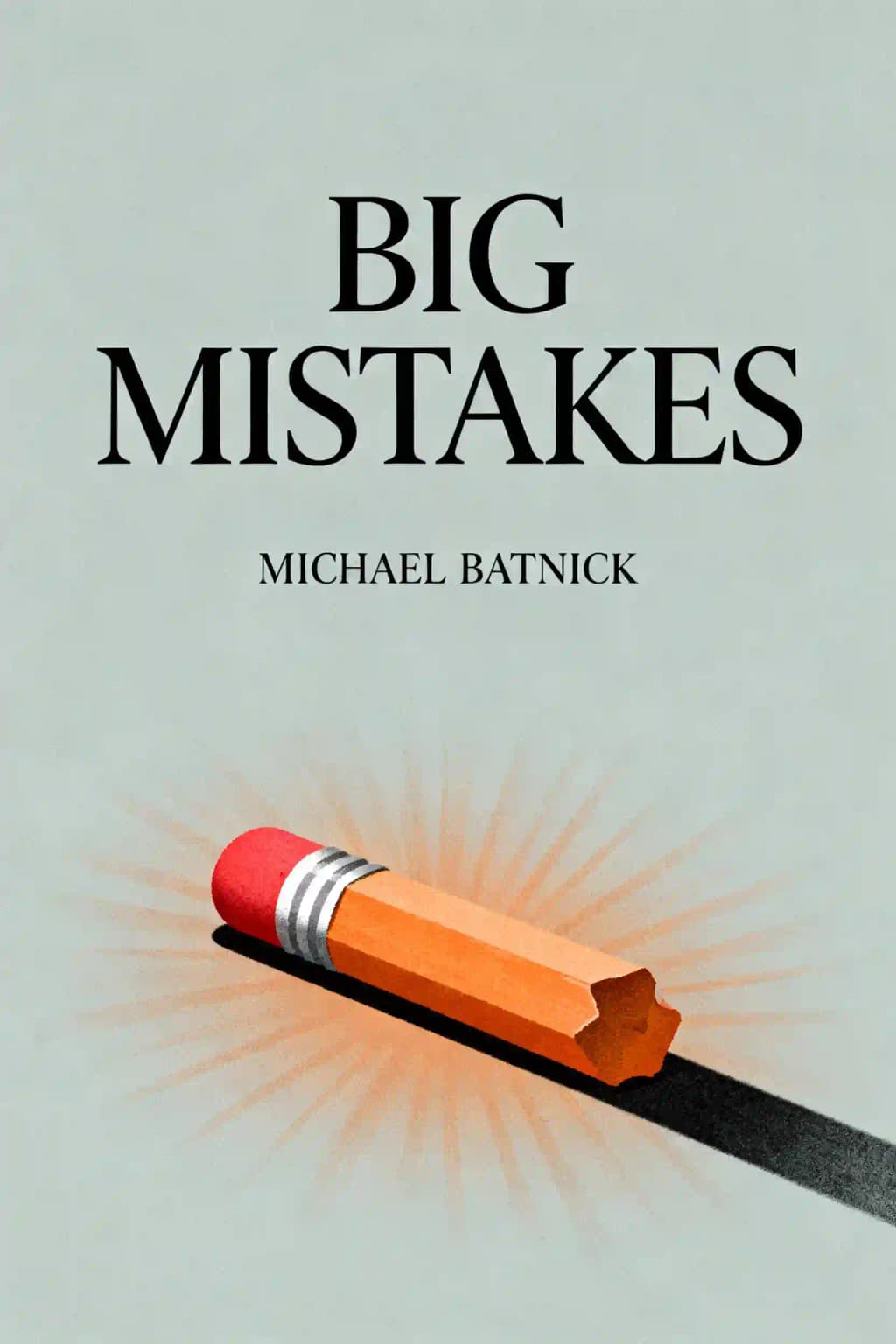
Warren Buffett once said, "It's good to learn from your mistakes, but better to learn from others'." This wisdom perfectly captures the essence of Michael Batnick's groundbreaking work examining how even the most brilliant financial minds have stumbled spectacularly. The book has become a secret weapon for hedge fund managers and retail investors alike, with Ray Dalio calling it "required reading" for anyone serious about investing. What makes this exploration so compelling isn't just the schadenfreude of watching legends fall, but the universal patterns of human psychology that emerge. From Benjamin Graham to Charlie Munger, these stories reveal that success in investing isn't about avoiding mistakes entirely-it's about making the right kind of mistakes and learning the right lessons from them. As the book climbs bestseller lists and appears in the libraries of everyone from Elon Musk to financial TikTok influencers, its message resonates: wisdom comes through reflection, imitation, and experience-with experience being the most painful teacher of all.
Capitolo 2
The Fallibility of Investment Principles
Benjamin Graham, the father of value investing, created principles that have outlasted all other investment philosophies. Before Graham, investing was largely guided by superstition and guesswork. He transformed it into a disciplined practice by demonstrating that stock prices and business values aren't equivalent. His genius wasn't in complex calculations but in understanding that determining exact values is impossible yet unnecessary for success.
Graham's core principle was the "margin of safety" - buying stocks significantly below intrinsic value. He understood behavioral economics before its time, noting how investor psychology caused price swings unrelated to business fundamentals. His "Mr. Market" allegory illustrated how prices fluctuate more than value because humans set prices while businesses determine value.
Despite his brilliance, Graham's career included significant failures. During the 1929 crash and Great Depression, he lost 70% of his money between 1929-1932. This devastating experience taught him that value investing isn't foolproof - cheap can always get cheaper, margins of safety can be miscalculated, and value can fail to materialize.
What's remarkable about Graham wasn't just his investment acumen but his humility. By 1976, he recognized that detailed security analysis offered fewer advantages than in earlier decades due to increased market research. He wisely noted that Wall Street's brilliance often cancels itself out, with future price movements representing "what they don't know."
Though Graham wouldn't understand today's valuation methods (like Amazon's market cap growing $350 billion despite low margins while Walmart lost value despite higher profits), he would recognize the emotional drivers still ruling markets. His most enduring lesson? Be aware of value but don't be enslaved by it. There are no ironclad laws in investing - only principles that work until they don't.
Capitolo 3
The Peril of Knowing But Not Doing
Investors often rely on simplistic rules of thumb that lead to systematic errors. Jesse Livermore, perhaps the most famous early market speculator, exemplifies this danger perfectly. Despite inventing many trading maxims still quoted today, he couldn't follow them himself.
Born in 1877, Livermore began as a board boy at Paine Webber before becoming a full-time trader. His career was marked by dramatic rises and falls: making fortunes in bucket shops, losing everything in real markets, then rebuilding through short-selling during the 1907 panic and 1929 crash.
What's fascinating about Livermore was the gap between his knowledge and his actions. He knew to "never meet a margin call" yet repeatedly did so. He preached cutting losses quickly but held losing positions until they devastated him. He warned against overtrading yet couldn't resist the action. During the 1929 crash, he made $100 million (about $1.4 billion today) shorting the market, only to lose it all again by 1934.
Livermore's tragic end-suicide in 1940-underscores the difference between intellectual understanding and emotional discipline. His story teaches us that managing risk isn't about knowing what to do, but actually doing it when emotions scream otherwise. As Daniel Kahneman later proved, we have two decision-making systems: a fast, emotional one and a slow, rational one. The challenge isn't developing trading rules but following them when our emotions take control.
This disconnect between knowledge and action appears repeatedly throughout investment history. We can memorize every investing principle, but without the emotional discipline to follow them during market extremes, they become useless. The most dangerous risk isn't what we don't know-it's what we think we know that isn't so, combined with an inability to act on what we do know when it matters most.
Capitolo 4
The Danger of Emotional Attachment
When investments disappoint, we naturally resist admitting we were wrong, holding onto losers as they transform from small to devastating losses. The math of recovery becomes increasingly difficult - a 20% loss requires a 25% gain to break even, while an 80% loss demands a 400% gain. As David Einhorn notes, "What do you call a stock that's down 90%? A stock that was down 80% and then got cut in half."
Mark Twain's investing disasters perfectly illustrate this principle. Despite his literary genius, Twain lost fortunes on technological ventures like the Paige Compositor, a typesetting machine that consumed $300,000 ($8 million today) before failing completely. By 1891, Twain was bankrupt with $100,000 in debt ($2.8 million today).
At 59, Twain set out to repay every penny to all 101 creditors from his bankruptcy. He embarked on a global comedy tour across the United States, Australia, New Zealand, India, South Africa, and Europe. By 1898, he had erased his debts but never lost his speculative nature, telling his friend Rogers, "Don't leave me out; I want to be in, with the other capitalists."
Twain did learn something from his failures. When he later invested $16,000 in the American Mechanical Cashier Company, he walked away after eight months of unfulfilled promises, avoiding another financial disaster.
His experience teaches us that risk and reward are inseparable. When investments turn sour, we must acknowledge losses rather than hiding from them. The best approach is deciding before investing how much you're willing to lose, either in percentage or dollar terms, ensuring decisions are driven by logic rather than emotional attachment to positions.
This principle extends beyond individual stocks. During market downturns, investors often cling to losing positions, hoping to sell "when they get back to even." This emotional attachment to the purchase price-a completely arbitrary number with no bearing on future returns-leads to catastrophic results. Paper cuts sting but heal; shotgun wounds are much harder to recover from.
Capitolo 5
When Genius Meets Hubris
John Meriwether's story demonstrates that genius alone doesn't guarantee investment success. Like Isaac Newton who lost his fortune in the South Sea bubble despite his 190 IQ, even the brightest minds can fall prey to basic human instincts of greed and envy.
Long-Term Capital Management opened in February 1994 with $1.25 billion, the largest hedge fund launch ever at that time. Their performance was stellar from the start - 20% in their first 10 months, followed by 43% in 1995 and 41% in 1996. Their 1996 profits totaled an astounding $2.1 billion, exceeding earnings of global giants like McDonald's, Disney, American Express, and Merrill Lynch.
LTCM seemed unstoppable, with their worst monthly decline being just 2.9%. Their success was further validated when partners Robert Merton and Myron Scholes received the Nobel Prize in Economics in 1997. The Economist declared they had turned "risk management from a guessing game into a science." LTCM managed to quadruple their capital without a single losing quarter.
But their edge began eroding as competitors caught on. "Everyone else started catching up to us. We'd go to put on a trade, but when we started to nibble the opportunity would vanish," said LTCM trader Eric Rosenfeld. At the end of 1997, after a 25% gain, they returned $2.7 billion to investors but critically maintained their position sizes, increasing leverage from 18:1 to 28:1.
The collapse began in May 1998 with a 6.7% loss, followed by a 10% drop in June. Russia's financial crisis became the catalyst for disaster, and in August 1998, LTCM lost $550 million in a single day - far exceeding their calculated $35 million daily value-at-risk. By month's end, they had lost $1.9 billion, down 52% year-to-date. The death spiral continued with massive daily losses, culminating in a Federal Reserve-orchestrated $3.6 billion bailout by 14 Wall Street banks.
Their fatal flaw was believing their models could fully capture human behavior in markets. As Jim Cramer noted, this "seminal blowup" struck "at the heart of all of those on Wall Street who think that this racket is a science that can be measured, structured, derived and gamed." The lesson is clear: intelligence combined with overconfidence creates a dangerous cocktail in financial markets.
Capitolo 6
Finding Your Investment Identity
Jack Bogle's Vanguard 500 Index fund, now the world's largest mutual fund with $292 billion in assets, grew from humble beginnings of just $11 million to become a financial behemoth. While index funds now dominate the investment landscape, with investors having moved $1.4 trillion into them since 2006, they were initially dismissed as "Bogle's folly" - a heretical concept suggesting investors should settle for "average" returns.
The merger of Wellington and Thorndike, Doran, Paine & Lewis was a catastrophic mismatch of investment philosophies. Wellington, founded in 1928 as a conservative balanced fund, suddenly transformed into something unrecognizable under the "dynamic conservatism" approach pushed by the new managers. Portfolio turnover increased from 15% to 25%, and stock allocation jumped from 55% to nearly 80%.
Initially, Bogle felt like a genius, but when the go-go years of the 1960s ended abruptly in 1969, disaster struck. The Dow fell 36% in 18 months, with Wellington's funds suffering terribly. Ivest lost 55% compared to the S&P 500's 31% decline. Other Wellington funds performed just as poorly - Explorer Fund down 52%, Morgan Growth Fund down 47%, and Trustees Equity Fund down 47%. Most devastating was the flagship Wellington Fund's 40% loss, which wouldn't recover until 1983.
Bogle was fired as CEO of Wellington Management in 1974, though he remained chairman of the Wellington Fund. From this failure, he created Vanguard and launched the First Index Investment Trust in 1976, despite skepticism from Wall Street. The index fund concept was slow to catch on initially, but by its second decade had grown from $600 million to $91 billion. By 2016, Vanguard's $289 billion in net flows exceeded all 4,000 other global fund providers combined.
Bogle's story demonstrates that investing is a journey of self-discovery. Finding an approach that works for you personally - whether index investing or something else - is what matters most. Not everyone can handle the emotional challenges of index investing during bear markets, but having a consistent, repeatable methodology is essential. The key is finding an investment approach that aligns with your personality and sticking with it through good times and bad.
Capitolo 7
The Boundaries of Expertise
Michael Steinhardt's extraordinary 24.5% annual returns over nearly three decades came from his obsessive focus on U.S. stocks-checking his portfolio six times daily and maintaining strong broker relationships that gave him trading advantages. Despite his volatile temperament and occasional arrogance, Steinhardt thrived where other hedge funds failed.
Seth Klarman wisely observed that investors who stick to what they know have a significant advantage. With the proliferation of ETFs and ETNs, investors now have unprecedented access to diverse market segments including commodities, currencies, volatility, stocks, and bonds. However, just because we can trade these instruments doesn't mean we should. Financial wandering outside one's expertise is like lawyers performing oral surgery.
Warren Buffett exemplifies someone who understood his limitations, notably during the late 1990s tech bubble. While Berkshire Hathaway shares were cut in half, Buffett refused to invest in technologies he didn't understand. At the 1999 Sun Valley Conference, Buffett warned tech executives about market excesses - advice that seemed like "sour grapes" as Berkshire lost 12% while the NASDAQ 100 gained 74% and tech stocks like Cisco, Yahoo!, and Qualcomm soared by hundreds of percent.
Steinhardt's downfall came in 1994 when, managing nearly $5 billion, he ventured far outside his circle of competence into global bonds and currencies. Without expertise in these markets or the relationships he'd cultivated domestically, Steinhardt lost $800 million in just four days following a Federal Reserve rate hike. This catastrophic 29% loss in 1994 left him "mentally drained" despite a 26% recovery the following year.
Steinhardt's story teaches us to recognize our limitations, avoid overconfidence, and understand that successful investing doesn't require extraordinary performance-just avoiding major errors by staying within our circle of competence. As Charlie Munger says, "Knowing what you don't know is more useful than being brilliant."
Capitolo 8
Bull Markets and the Illusion of Genius
Jerry Tsai exemplified how investors mistake bull market returns for personal genius. The Dow Jones Industrial Average peaked in 1929, requiring 25 years to recover from its 90% crash. By the 1950s, a new generation of investors emerged who hadn't experienced the Great Depression, with the S&P 500 delivering 16.76% real returns-the best calendar decade ever.
Tsai became Wall Street's first celebrity fund manager, running Fidelity Capital Fund with remarkable success from 1957-1965, returning 296% compared to 166% for average conservative funds. His high-frequency trading style-buying momentum stocks and selling when they slowed-drew unprecedented attention. When he launched Manhattan Fund in 1965, investor demand was ten times expected, raising $247 million.
But Tsai's success was merely riding a bull market where expensive growth stocks like Polaroid, Xerox and IBM traded at 50+ P/E ratios. When markets turned in 1968-1970, destroying $300 billion in value, the Manhattan Fund collapsed, ultimately losing 90% of assets and recording the worst eight-year performance in mutual fund history.
This pattern repeats throughout market history. During the 1990s tech bubble, internet fund managers were celebrated as visionaries until the NASDAQ crashed 78%. In the housing bubble, mortgage specialists were geniuses until the market collapsed. Most recently, cryptocurrency experts were hailed as revolutionary thinkers until the 2018 crypto winter erased 85% of market value.
The challenge is that distinguishing skill from luck requires decades of data, but investors make judgments based on just a few years of returns. Studies show that even 10 years of outperformance provides little evidence of genuine skill. As the saying goes, "Don't confuse brains with a bull market."
This doesn't mean skill doesn't exist in investing-it certainly does. But separating skill from market conditions requires humility and perspective that most investors lack. The truly skilled investor recognizes when returns come from personal insight versus simply riding favorable conditions. As Warren Buffett noted, "Only when the tide goes out do you discover who's been swimming naked."
Capitolo 9
The Psychological Battle with Overconfidence
Buffett's candor about his mistakes is one of his greatest strengths. After acknowledging the Dexter Shoe disaster in 2014 as deserving "a spot in the Guinness Book of World Records," he continued to reflect on it in subsequent annual letters. Having mentioned the word "mistake" 163 times in his letters, Buffett normalizes failure as part of investing.
Overconfidence is perhaps the most dangerous cognitive bias in investing. Studies show that 93% of Americans believe they are above-average drivers, and similar delusions plague investors. We overestimate our abilities, underestimate risks, and believe we can predict the unpredictable. This overconfidence leads to excessive trading, concentrated positions, and refusal to admit mistakes.
To combat overconfidence, Buffett suggests imagining you have a punch card with just 20 holes representing all the investments you could make in your lifetime. This mental model forces careful consideration before action, though in practice few investors maintain such discipline. The best defense against overconfidence is establishing clear exit plans before investing-using predetermined price levels or percentage loss thresholds.
Making these decisions in advance helps investors overcome the psychological barrier of admitting defeat when facing the reality that they lack the abilities they believed they possessed. As Daniel Kahneman notes, "We're blind to our blindness." By acknowledging this limitation and creating systems to protect ourselves from our own psychology, we can avoid the catastrophic mistakes that even brilliant investors like Buffett occasionally make.
This approach doesn't mean avoiding all mistakes-that's impossible. Rather, it means creating safeguards against the most devastating errors while allowing space for the smaller mistakes that are inevitable in any investment journey. As Howard Marks says, "You can't predict. You can prepare." Preparation includes not just research but psychological guardrails against our own worst tendencies.
Capitolo 10
The Trap of Public Positions
Bill Ackman's public battle with Herbalife demonstrates the dangers of putting reputation before returns. After his dramatic three-hour presentation calling Herbalife a pyramid scheme destined for zero, the stock initially dropped 35% but then rebounded when competitors Dan Loeb and Carl Icahn took opposing positions. By publicly declaring his "highest conviction ever" and refusing to back down, Ackman created an impossible situation where admitting defeat would damage his credibility.
The stock, which hit a low of $24.24 after his presentation, climbed to $71.70-70% higher than his initial short position. Despite the FTC charging Herbalife with unfair practices and extracting a $200 million settlement, the company continued operating and its stock rose another 11%. During a documentary, when confronted with the stock's rise on the day of his presentation, Ackman insisted it was "irrelevant" and refused to acknowledge his strategy was failing.
This illustrates how public investment declarations create emotional and reputational traps. Had Ackman kept his position private, he could have easily admitted error and moved on. Instead, he prioritized preserving his reputation over his investors' capital, demonstrating that successful investing, especially contrarian positions, requires flexibility and the ability to change course without public scrutiny.
The lesson extends beyond hedge fund managers. Retail investors who publicly share their investment theses on social media or with friends and family create similar psychological traps. Once you've told everyone about your brilliant investment idea, admitting you were wrong becomes exponentially harder. This is why some of the most successful investors are notoriously private about their positions until after they've exited them.
As Charlie Munger says, "Part of what you must learn is how to handle mistakes and new facts that change the odds." This becomes nearly impossible when your ego is entangled with your public investment stance. The solution? Keep your positions private when possible, and when they must be public, maintain the humility to change your mind when evidence contradicts your thesis-regardless of what others might think.
Capitolo 11
The Painful Path to Investment Wisdom
Investment success depends on avoiding mistakes rather than making brilliant plays. Charlie Ellis distinguishes between professionals who win points through skill and amateurs who lose points through errors-a perfect analogy for market behavior. Amateur investors typically buy after advances and sell after declines, creating a "behavior gap" between investment returns and investor returns.
This gap persists because investors misunderstand market averages. While stocks might compound at 8-10% over decades, annual returns rarely fall within this range-the Dow hasn't returned between 8-10% since 1952. Instead, markets swing widely between extremes, with US stocks gaining 30% or more thirteen times and falling 30% or more seven times historically. These extremes trigger emotional responses-either excessive confidence during booms or panic selling during crashes-that transfer wealth from amateurs to professionals.
Stanley Druckenmiller emerged as one of history's greatest investors, compounding at 30% annually for 30 years with no losing years-turning $1,000 into $2.6 million while Buffett's same investment would have grown to $177,000. As a global macro investor, he combined stock market understanding with economic insight and aggressive risk management.
Despite his brilliance, he made a classic amateur mistake during the tech bubble-abandoning his expertise to chase returns. After initially shorting overvalued tech stocks, he reversed course and bought $6 billion worth, losing $3 billion when the bubble burst. "I didn't learn anything," he admitted. "I already knew I wasn't supposed to do that. I was just an emotional basketcase."
His experience shows that even investing legends can succumb to the deadly sin of envy when watching others make money faster-proving some lessons must be learned the hard way. As Howard Marks notes, "Experience is what you got when you didn't get what you wanted." The most valuable investment wisdom often comes at the highest emotional and financial cost.
Capitolo 12
The Dangers of Concentrated Bets
September 2015 marked the beginning of Valeant's downfall when Hillary Clinton criticized their drug pricing practices, causing shares to fall 31% over six trading sessions. But the real blow came on October 21, 2015, when Citron Research accused Valeant of accounting fraud, comparing it to Enron. The stock collapsed nearly 40% that day before closing down 19%, causing Sequoia to underperform the S&P 500 by a staggering 17.47% in a single month.
Despite these red flags, Sequoia doubled down, defending CEO Mike Pearson as "masterful" and even purchasing an additional 1.5 million shares. They invoked Buffett's wisdom to "be greedy when others are fearful" and compared Valeant's situation to when Berkshire stock fell by half in the late 1990s. This proved to be a catastrophic mistake - Valeant was no Berkshire, and Pearson was no Buffett. As Thomas Heath of The Washington Post observed, Sequoia had "married itself to an offshore drug company that borrowed heavily to buy other drug companies, cut costs and research, then raised prices on many older drugs to astronomical heights."
Eight months later, Sequoia sold their entire position after Valeant lost more than 90% of its value. The fund's assets plummeted from over $9 billion to under $5 billion, and they lost 26.7% in a 12-month period when the S&P 500 gained 4%. Even with their phenomenal long-term track record, this disaster demonstrates the dangers of concentration.
For investors seeking substantial returns, there are two paths: buy a diversified portfolio and hold for the long term, or take concentrated positions with the understanding that results may dramatically differ from the market. While it's easy to admire long-term charts of Microsoft and Apple, one must remember cautionary tales like Valeant and Enron. To protect yourself from similar mistakes, write down your investment thesis and establish clear exit points. Diversification may be slow and boring compared to concentration's excitement, but the stock market can be an expensive place to seek thrills.
Capitolo 13
The Ultimate Intellectual Challenge
While most Americans invest to stay ahead of inflation, billionaires who continue pursuing market-beating returns despite having more money than they could spend in thousands of lifetimes are chasing something else - the ultimate intellectual challenge. As Paul Tudor Jones explained in 1987, the market is "the most exciting and most challenging" game of all, promising decades ago to retire after reaching a certain wealth threshold. Yet despite becoming a billionaire, he continues managing his fund thirty years later.
The market is uniquely addictive because it never ends and constantly changes. Every minute produces new information, with pieces always "zigging and zagging" and rules constantly evolving. This "macro game" requires tracking interest rates, economic performance, and behavior across stocks, currencies, commodities, real estate, and bonds - a puzzle that has destroyed more fortunes than it's created.
John Maynard Keynes understood this disconnect between what markets should do and what they actually do. He likened investing to a newspaper contest where competitors pick not the prettiest faces, but those they believe others will select - "the third degree where we devote our intelligences to anticipating what average opinion expects the average opinion to be."
Keynes's investment journey reveals the painful evolution from macro speculator to value investor. After losing 80% of his net worth in the great crash, he transformed his approach. From 1922-1946, his discretionary portfolio achieved a 16% average annual return versus 10.4% for the market index, with most outperformance coming after his philosophical shift from macro to micro analysis.
Despite his successful transition to value investing, Keynes faced severe challenges. From 1936-1938, he lost two-thirds of his wealth, yet steadfastly defended his approach: "I don't believe that selling at very low prices is a remedy for having failed to sell at high ones... It is not the business of a serious investor to be constantly considering whether he should cut and run on a falling market."
The irony wasn't lost on Keynes, who famously wrote "In the long run we are all dead" yet embraced long-term investing. He recognized that while long-term returns matter most, portfolios are marked to market daily, making disciplined thinking difficult during turbulence. His intellectual flexibility - for a renowned economist with a huge ego to completely reverse his investment approach - offers perhaps the most valuable lesson of all: the ability to change your mind when evidence contradicts your beliefs.