Capitolo 1
The Wisdom of a Mystic: A Journey Through Silence and Awareness
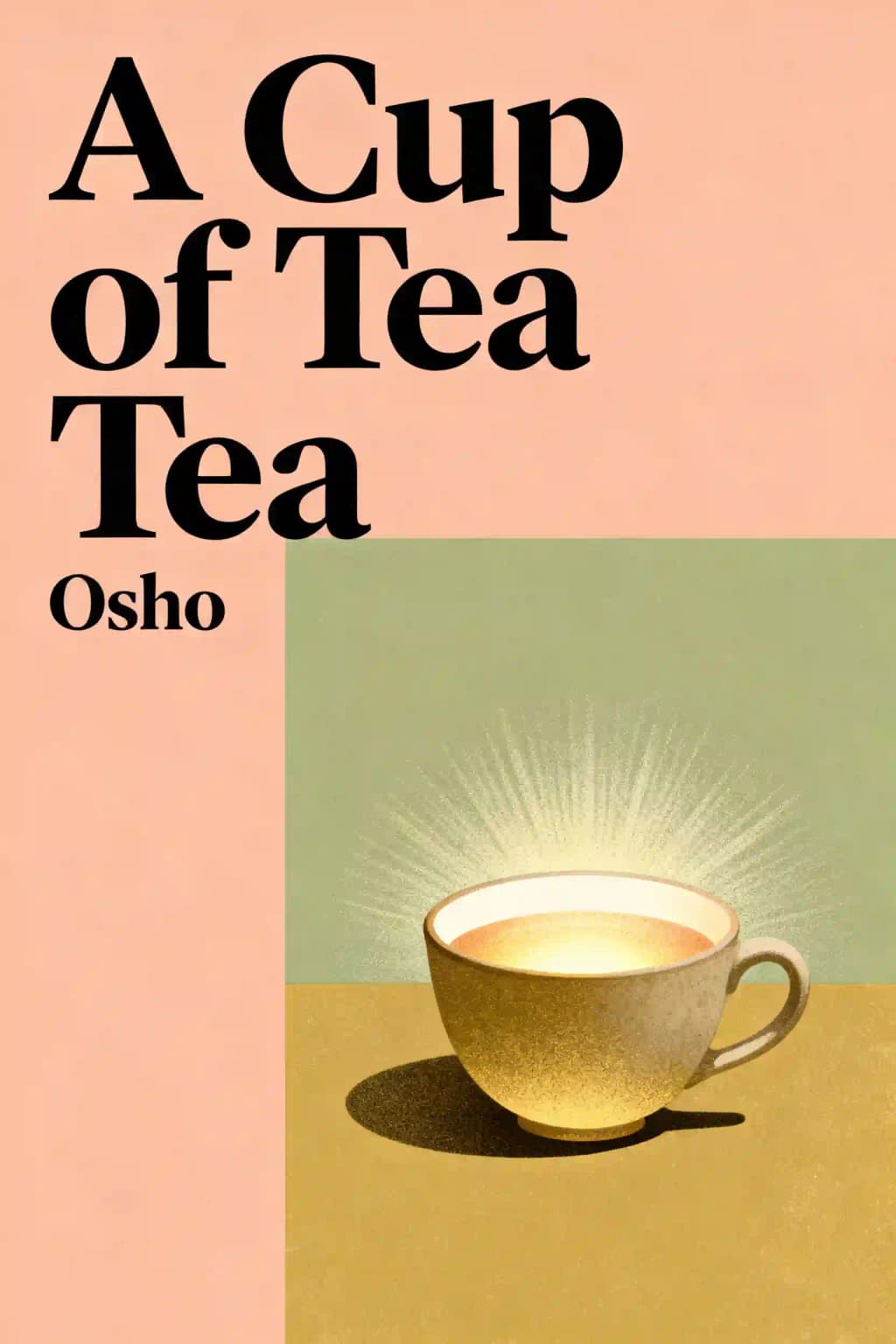
In a world increasingly dominated by noise and distraction, Osho's "A Cup of Tea" stands as a profound counter-cultural statement. This collection of letters, written between 1962 and 1971, has become a spiritual touchstone for seekers worldwide, with celebrities from Madonna to Russell Brand citing its influence on their personal journeys. Originally comprising 350 letters addressed to disciples, the collection (also known as "Flowers of Love") captures the essence of Osho's teachings before he became an international spiritual figure. What makes these writings particularly remarkable is their intimate nature-they weren't crafted for mass publication but as personal guidance, offering us a rare glimpse into the unfiltered mind of a mystic in direct communion with his students. Have you ever wondered what it would be like to receive personal spiritual instruction from a master? These letters open that very door.
Capitolo 2
The Paradox of Inner Silence: Living in Two Worlds
"I live two lives simultaneously-what drama!" Osho writes in his opening letter, immediately establishing one of his central themes: the paradox of existence. He describes living in deep emptiness while simultaneously engaging with the world. This duality isn't presented as a problem to solve but as the very nature of awakened life, comparing it to a wheel turning around an unmoving center or a dancer who remains internally still while in motion.
Osho reveals that despite his outward activities-speaking, working, interacting-he remains immersed in an inner silence where "nothing moves." This paradoxical state reflects his understanding of truth as "inaction in action, stillness in motion, eternity in change." He illustrates this through various metaphors: a mirror that reflects everything while remaining untouched, the sky that holds clouds without being affected by them, and the ocean's depths that remain calm despite surface storms. For Osho, real life dwells in this eternal dimension, while everything else is merely dreams, like ripples on the surface of a deep lake.
This perspective fundamentally challenges our conventional understanding of reality. We typically believe the physical world is most real, but Osho inverts this hierarchy, offering examples from quantum physics where solid matter dissolves into energy and space. "The world itself is a dream," he declares, suggesting that what we consider most solid is actually most ephemeral. However, he doesn't advocate abandoning the world-quite the opposite. "Awareness, not abandonment, is key," he writes, emphasizing that transformation comes through conscious presence rather than withdrawal. He often uses the analogy of a lotus flower: rooted in mud but blooming above water, participating in both realms simultaneously.
This awareness creates a profound shift in perception. "With awareness, everything transforms-the center shifts from body to soul." This movement from identifying with the physical to recognizing our essential nature represents the core of spiritual awakening. Osho describes this shift through various experiences: watching thoughts like clouds passing, feeling emotions without becoming them, and maintaining witness consciousness during daily activities. Yet he acknowledges the impossibility of fully articulating this experience: "What exists there cannot be told, has never been told, will never be told!" Some truths can only be known through direct experience, just as death is known only through dying and truth through diving deep within oneself.
The paradox of living simultaneously in silence and activity becomes a template for the spiritual life Osho advocates-fully engaged with the world while remaining centered in the timeless dimension of being. He demonstrates this through his own life, maintaining a schedule of public speaking and community building while describing an unchanging inner emptiness. This dual existence isn't just possible but natural, he argues, like a bird flying through the sky-both the movement and the space are essential aspects of reality.
Capitolo 3
Meditation: The Gateway to Inner Freedom
Throughout his letters, Osho returns repeatedly to meditation as the essential practice for transformation. Unlike many spiritual teachers who offer complex techniques, Osho's approach to meditation is refreshingly direct and often counterintuitive. "Abandon achievement in meditation," he advises, challenging our goal-oriented mindset. "Practice naturally and let things happen on their own."
This guidance strikes at the heart of why meditation often feels difficult. Our very effort creates tension, and even expecting peace brings restlessness. Osho points to a fundamental paradox: the harder we try to meditate, the more we strengthen the very ego-self that meditation aims to transcend. "Stop thinking 'I am doing it,'" he writes, "and instead surrender to 'that-which-is.'" This surrender leads to emptiness, which Osho describes not as a void but as a fullness beyond conceptual understanding.
Osho distinguishes between conventional approaches to meditation and what he considers its essence. "Meditation is peace and emptiness," he explains, "already present but concealed by thoughts." The practice isn't about adding something new but removing the obstacles to what's already there. As thoughts cease, emptiness naturally emerges.
This process begins with a simple but profound technique: witnessing. "Freedom from thoughts seems difficult but is simple," Osho writes. "The restless mind easily settles through witnessing-observing the mind." This witnessing stance creates a subtle separation between consciousness and mental content. We begin to recognize that we are not our thoughts but the awareness in which thoughts arise.
When this witnessing fully dawns, something remarkable happens-thoughts naturally vanish, "opening the door to bliss and transforming the world." This transformation isn't merely subjective but changes our entire relationship with reality. The same world appears entirely different when seen through awakened eyes.
Osho acknowledges that results come "slowly but certainly." This patience contrasts sharply with our culture's demand for immediate gratification. True meditation requires persistence and faith in the process, allowing inner flowering to occur in its own time. The practice gradually dissolves unconscious complexes that cause bondage, revealing them to be "mere dreams" rather than solid realities. Through this patient witnessing, meditation blossoms into samadhi-complete absorption in pure awareness.
Capitolo 4
The Paradox of Effort and Surrender
One of the most fascinating tensions in Osho's teaching concerns the relationship between effort and surrender. While many spiritual traditions emphasize one over the other, Osho integrates both in a dynamic balance that evolves as the seeker progresses.
"Truth is hidden under a golden lid," Osho writes, quoting an ancient rishi. This lid is our mind-the conceptual thinking that simultaneously helps us navigate the world and prevents us from seeing reality directly. Initially, effort is required to recognize how we're "smothered by mind" and identify with it, causing suffering and rebirth. We must "rise above it, recognize your distinction from it"-an active process requiring attention and discrimination.
Yet Osho also emphasizes that excessive striving creates its own problems. "Don't seek results in meditation or try repeating experiences-these block progress," he cautions. The paradox deepens when he states, "The path to God isn't in our control, so surrender to Him." This suggests that while effort is necessary, it must eventually give way to surrender.
This surrender isn't passive resignation but an active letting go. "Remember surrender always-sleeping or waking," Osho advises. "Surrender is the only door to God; emptiness the only boat sailing to Him." The image of a boat suggests movement and journey, yet one that happens through yielding rather than forcing.
Osho offers a beautiful resolution to this apparent contradiction: "What is sought totally is always attained." The key lies in the quality of our seeking-not grasping or demanding but a total engagement that paradoxically includes letting go. "The thirst must be intense, the work tireless, the waiting endless, the calling wholehearted-all contained in one word: prayer." This prayer isn't performed but felt-"a surrender without words or demands."
The ultimate surrender involves abandoning even spiritual ambitions. "Leave yourself to the unknown, accepting whatever comes, even if He breaks you." This complete yielding-where even the seeker dissolves-creates true freedom. As Osho puts it with characteristic directness: "To live so is freedom."
Through this dance of effort and surrender, the practitioner gradually discovers that "God is when you are not." The ego cannot see or be aware-"it exists only through unconscious living." The ultimate paradox is that our very sense of self blocks the realization we seek, yet this realization doesn't come through self-rejection but through self-awareness so complete that the self naturally dissolves.
Capitolo 5
Beyond Duality: Transcending Life's Opposites
Osho consistently challenges our tendency to divide reality into opposing categories-good and evil, sacred and profane, spiritual and worldly. "Samsara is nirvana, sound is mantra, all beings are God," he declares, suggesting that these distinctions exist only in perception, not reality itself. "The world is how one sees it. Open your eyes!"
This non-dual perspective extends to his view of spiritual practice. He rejects the traditional separation between worldly and spiritual life: "Don't seek nirvana as opposed to life-turn life itself into nirvana." Those who truly know don't escape from life but transform their relationship with it. Quoting Zen master Dogen, he advises: "Do not strive after moksha; allow all actions to become liberating."
Osho applies this integrative approach to our inner life as well, particularly regarding emotions and desires we typically judge as negative. "Don't fear sexual desire-fear begins defeat," he writes. "Accept it, be aware of it, bring it from unconscious to conscious." Condemnation leads to repression, creating the mind's division into conscious and unconscious-"the root of all conflict preventing totality."
Instead of fighting against aspects of ourselves, Osho recommends awareness and acceptance. "Meditate on desire when it arises; watch mindfully without resistance or escape." This approach doesn't indulge desires but transforms them through conscious attention. "Without integration, there's no path to peace."
Osho extends this principle to all emotions: "Don't fight thoughts, desires or instincts-that's negative and cannot help. Instead, grow in awareness through meditation." Fighting creates more conflict, while awareness naturally dissolves what's unnecessary. He illustrates this with the story of Chi Hsing Tzu's fighting cock who became so centered that other cocks fled without battle-"grow in inner awareness until negativity withers away by itself."
This transcendence of opposites culminates in Osho's understanding of life and death. "Life and death aren't two," he suggests, but aspects of a single process. Our fear of death stems from identifying with form, which is necessarily finite. "Remember the formless and know immortality," he advises, pointing to the dimension of existence that transcends both birth and death.
By embracing life's apparent contradictions rather than trying to resolve them, Osho offers a path to wholeness that doesn't require rejecting any aspect of human experience. "Existence balances opposites," he writes, creating "tension between poles, music from contrary notes." By recognizing and experiencing this duality while maintaining the witness state, we can transcend it-remaining in the world but not identified with its drama.
Capitolo 6
The Ego Illusion: Discovering the No-Self
Central to Osho's teaching is the understanding that our fundamental suffering stems from identification with a false self-the ego. "The 'I' cannot be dropped because it doesn't exist," he writes provocatively. "It must be understood, like bringing light to darkness." This insight challenges our most basic assumptions about who we are.
The ego, in Osho's view, isn't a thing but a process-a collection of thoughts, memories, and identifications that create the illusion of a separate self. "The mind has boundaries. Without thought, mind becomes infinite space," he explains. "In thoughtless awareness, one ceases being a drop and becomes oceanic."
This realization creates "great energy that effortlessly wipes out everything dead, including the entire karmic past." The dissolution of ego isn't achieved through self-denial but through understanding so complete that the illusion naturally falls away. "The greater absorbs the lesser and remains untouched."
Osho points to awareness as the key to this understanding. "Awareness of the present moment reveals there is no ME inside," he writes. "The me is the dead past, not living." This insight reveals a profound truth about the ego's nature: "The ego exists only in past or future (a projection of the past), never in the present. Awareness exists only in the present. They cannot exist simultaneously."
This explains why meditation focuses on present-moment awareness. By fully inhabiting the now, we naturally step out of ego-identification. "Ego is unawareness; awareness is egolessness."
The freedom from ego-identification transforms our relationship with everything. "Once ego surrenders, suffering ends, as ego causes all pain," Osho explains. "When everything is seen as God, complaints cease." This shift in perception marks the transition from complaint to gratitude, from struggle to acceptance, from separation to unity.
Osho doesn't present this as a philosophical position but as a lived experience. "I am one with all things-in beauty and ugliness," he writes. "Not only in virtue but in sin too I'm a partner. Buddha, Jesus, Lao Tzu-it's easy to be their heir, but Genghis, Taimur and Hitler are also within me! I am the whole of mankind!" This radical identification with all of humanity-both its light and shadow-reflects the expansiveness that comes when personal boundaries dissolve.
The ultimate paradox is that in losing the self, we find a deeper identity. "Search until the seeker vanishes. There you'll meet Him," Osho writes. "Where the 'I' is lost, there He is. Only the 'I' separates us from Him." What we discover in egolessness isn't annihilation but fullness-not absence but presence so complete it cannot be contained in a separate self.
Capitolo 7
Living in Timeless Presence: The Power of Now
Long before "living in the present moment" became a spiritual cliche, Osho emphasized the transformative power of full presence. "Life is always here and now," he writes, "and amazingly, since I stopped worrying about past and future, they worry about me." This playful observation points to a profound shift in orientation-from time-bound thinking to timeless awareness.
Osho identifies our preoccupation with past and future as the root of suffering. "The present must be discontinuous with the past to be truly present-young, fresh, new-not part of time but eternity itself," he explains. "The now is eternal, but we live in past or future." This creates a fundamental disconnection from reality, which only exists in the present moment.
When we're caught in time-bound consciousness, "our activity springs from past or for future, making the present false and dead." This has existential consequences: "If the present is false, we cannot be real; if dead, we cannot be alive." The solution is radical: "Live in the present, dying each moment to the past."
This present-moment awareness isn't merely a psychological technique but opens the door to a different dimension of existence. "Live atomically, moment to moment, for a divine quality of life," Osho advises. This atomic living-fully inhabiting each moment as a complete universe-transforms ordinary experience into something extraordinary.
The mind, by its very nature, pulls us away from this presence. "The past is not, nor is the future. The mind exists between these two non-existences-and therefore, misery," Osho explains with characteristic directness. "To live in mind is to live in hell. The mind is hell." The alternative emerges through awareness: "Be suddenly aware of this and a new opening appears: the opening of the present, of that-which-is."
This present-moment awareness isn't just psychologically beneficial but ontologically significant. "The present is the only existence. BE in it and you're liberated. Live in it and there is bliss." This suggests that the present moment isn't merely a point on a timeline but a doorway to the timeless.
Osho connects this understanding to traditional spiritual concepts: "God seems far because we don't see Him nearby. Nothing is closer than Him-He is the here and now." The divine isn't distant in time or space but immediate in presence. "'God' is just for those who can't find the here and now."
The practical application is straightforward but revolutionary: "Drop the distant. Drop future paradises and salvations. See the near in time and space. Be here now and see!" This seeing reveals something remarkable: "In the time moment, time ceases. In the space atom, space ceases. Here and now, no space or time exists." What remains is "truth, God, that"-and ultimately, "You too are that. TAT TWAM ASI-that art thou."
Capitolo 8
The Playfulness of Existence: Beyond Seriousness and Purpose
In stark contrast to the solemn religiosity often associated with spiritual practice, Osho champions playfulness as essential to awakening. "Meditation means: be playful and transcend seriousness," he declares. "Life isn't serious. Existence isn't serious." This perspective challenges centuries of religious tradition that equates spirituality with solemnity.
For Osho, only "disease is serious, and death, and death's exploiters: the priests!" True life is "purposeless and festive, not going anywhere because there's nowhere to go." This vision of existence as celebration rather than struggle offers a refreshing alternative to both religious asceticism and secular materialism.
Osho sees the universe as fundamentally playful rather than purposeful. "The universe cares for little but play, while humans do hardly anything but work," he observes. "The TAO of existence is play (leela), but human reason values only utility." This utilitarian mindset misses the essential nature of reality, which "exists beyond utility."
This understanding transforms our approach to spiritual practice. "The meditative person works that they may play-their work serves play," while "the unmeditative plays only to work better-their play serves work." This subtle distinction reflects a fundamental difference in orientation-whether we see life's purpose as its own joyful expression or as a means to some future end.
Osho challenges our obsession with finding meaning and purpose. "Don't seek purpose-live totally," he advises. "Make life a dance, not a grave affair." The search for meaning often creates a sense of meaninglessness, whereas accepting life's inherent purposelessness paradoxically fills it with joy. "Dance like sea waves, bloom like spring flowers, sing like birds-all without purpose. Then purpose appears and mystery dissolves."
This playfulness extends to spiritual practice itself. Osho advises approaching meditation with a light touch rather than grim determination. "God's temple opens only to dancing, singing, happy hearts," he writes. "Fill your heart with peacock-vivid colors, for no reason." This "for no reason" is crucial-"True happiness needs no reason."
The invitation is to "dance and sing for their own sake, not for others. Then life becomes divine prayer." This spontaneous celebration transforms existence into worship without the heaviness of religious obligation. "To live so is freedom."
Ultimately, Osho suggests that enlightenment itself has the quality of play rather than achievement. "Don't be a mind and you'll know it. Meditation is nomindedness, coming back home." This homecoming isn't a distant goal but an immediate possibility when we drop seriousness and embrace the playful, purposeless nature of existence. In that state, we discover "an ecstasy not of this world"-the natural joy of being fully alive without the burden of purpose or meaning.
Capitolo 9
The Ultimate Paradox: Finding by Not Seeking
Perhaps the most challenging aspect of Osho's teaching is his insistence that spiritual seeking itself can become an obstacle. "That which is never lost cannot be found; searching for it is absurd," he writes. "Yet when this absurdity is understood, seeking stops and what was never lost is found!" This circular logic points to a fundamental paradox at the heart of spiritual practice.
"SEEK AND YOU WILL NOT FIND," Osho declares, explaining that "seeking creates the barrier by forming the seeker, the ego, the illusion of 'I am.'" The very act of searching reinforces the sense of separation that prevents realization. "Do not seek and you'll find I-AM-NOTNESS. This nothingness is the gateless gate."
This paradox extends to all spiritual practices. "Don't desire bliss-desire itself blocks the way," Osho cautions. "Live unchained from desire, without fixating on goals." Even noble aspirations like enlightenment can become obstacles: "Refrain from seeking even Enlightenment, as any seeking activates thought and creates duality."
Osho illustrates this with the Zen story of "the goose in the bottle"-a koan where a disciple must free a goose from a bottle without breaking the bottle or harming the goose. The solution comes "with one shout, the goose is out!" suggesting that liberation happens instantaneously when we recognize the illusory nature of our entrapment.
This understanding transforms our approach to meditation. "Meditation requires no mental application or effort," Osho explains. "It descends effortlessly like sleep. You cannot try to sleep, nor try to meditate. Every effort hinders its smooth, silent coming." Instead of active striving, meditation requires "passive receptivity. Mind is aggressive, meditation is passive."
The instruction becomes paradoxically simple: "Be passive, receptive, open and vulnerable and WAIT. The real miracle happens through waiting. When waiting becomes total, the explosion happens." This waiting isn't passive resignation but alert receptivity-a readiness to receive what's already present.
Osho extends this understanding to all spiritual practices: "Meditation requires understanding, not effort. Understanding means living naturally." Yet even this creates a paradox: "You cannot try to be natural-that's self-contradictory! You can BE natural but cannot try to be natural." Quoting a Chinese Master, he explains: "When you try to be in accord with it, you deviate from it." Even "not trying is also trying."
The resolution comes not through solving the paradox intellectually but seeing it clearly: "See the dilemma clearly and you're out of it." This seeing isn't conceptual understanding but direct perception that transcends the duality of seeking and finding.
Ultimately, Osho's teaching points to the recognition that what we seek is already here. "Find that from which you have never departed and cannot depart-this is the divine," he writes. "Then laugh at the absurdity of the human mind and its efforts, as Buddha still laughs." This laughter reflects the joy of discovering that what we sought through endless effort was always present-our own true nature, hidden in plain sight.