Standard Error vs. Standard Deviation: The Common Mix-Up
Confusing data spread with average precision is a common trap. Learn why more data shrinks your error bars but not your actual variability.
Meilleure citation de Standard Error vs. Standard Deviation: The Common Mix-Up
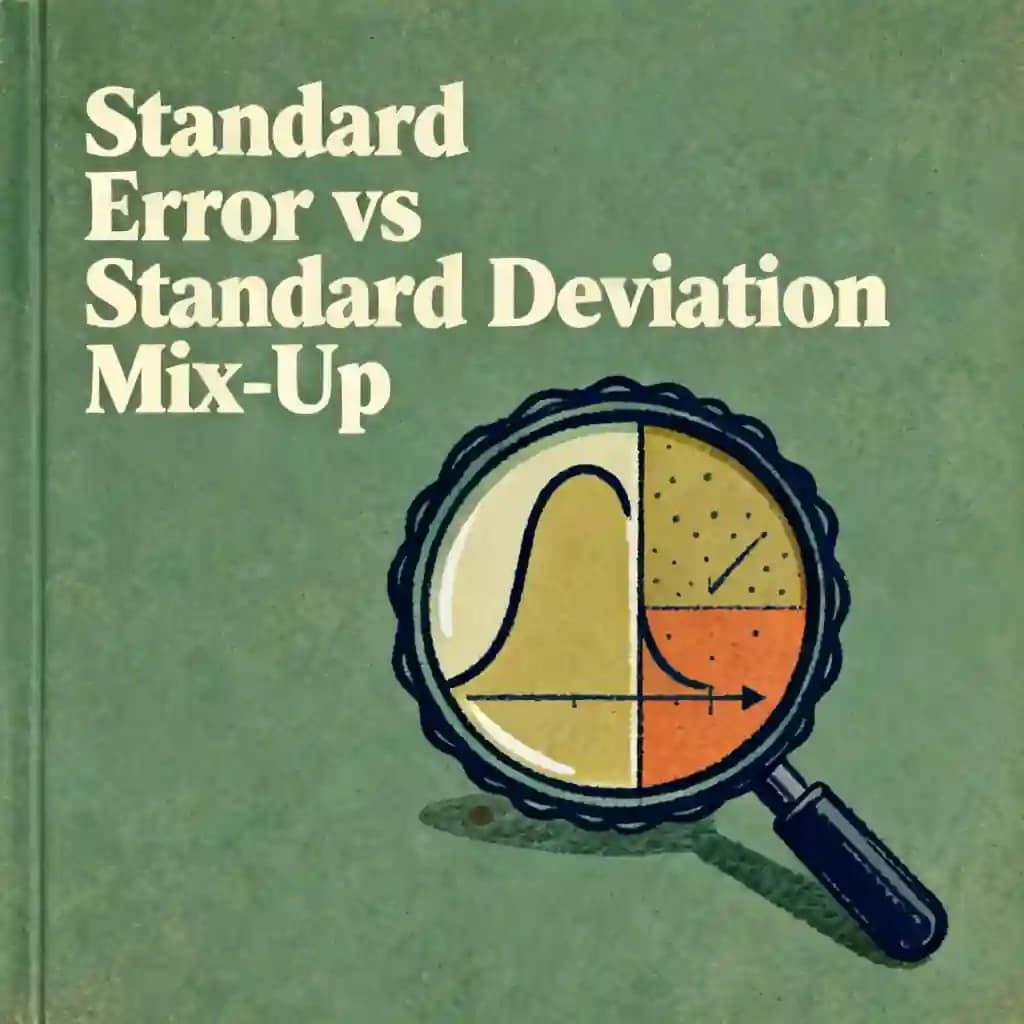
Standard deviation describes the 'texture' of your data—how spread out individual points are—while standard error measures the 'wobble' of your average, telling you how much you can trust your estimate.
Generated by Carl
Difference between standard error and standard deviation

Foire aux questions
In this context, "texture" refers to the standard deviation, which describes the inherent spread or "wildness" of individual data points, such as the variety of scores in a classroom. "Wobble" refers to the standard error, which measures the reliability or uncertainty of the calculated average. While standard deviation describes the system itself, standard error describes the precision of the researcher's estimate.
Error bars typically represent the standard error, which is calculated by dividing the standard deviation by the square root of the sample size (n). As the sample size increases, the "wobble" or uncertainty of the mean decreases, making the average feel more "rock-solid." However, this does not mean the actual data has become more consistent; the underlying standard deviation or "texture" of the system remains the same regardless of how many samples are taken.
Because the sample size (n) is under a square root in the standard error formula, there are diminishing returns on precision. To cut the standard error or "uncertainty" in half, a researcher must quadruple the sample size rather than just doubling it. This mathematical reality makes high-precision research expensive, as obtaining a slightly smaller margin of error requires a massive increase in data collection.
Yes, because statistical significance is driven by the standard error. With a large enough sample size, even a tiny difference in averages can become statistically significant. However, if the standard deviation (the real-world variability) remains high, that tiny difference might be invisible to the end-user. For example, a one-millisecond improvement in app speed might be statistically "real," but if the individual user experience varies by fifty milliseconds, the improvement has no practical impact.
A helpful gut check is that the standard error will almost always be smaller than the standard deviation. If the error bars on a chart look suspiciously tiny compared to the spread of the data, they are likely showing the standard error (the precision of the mean) rather than the standard deviation (the variety of individual experiences). Clear labeling is essential, as using the standard error as a "plus or minus" without a label can misleadingly make a noisy system look stable.
Cree par des anciens de Columbia University a San Francisco
"Instead of endless scrolling, I just hit play on BeFreed. It saves me so much time."


"I never knew where to start with nonfiction—BeFreed’s book lists turned into podcasts gave me a clear path."


"Perfect balance between learning and entertainment. Finished ‘Thinking, Fast and Slow’ on my commute this week."
"Crazy how much I learned while walking the dog. BeFreed = small habits → big gains."
"Reading used to feel like a chore. Now it’s just part of my lifestyle."

"Feels effortless compared to reading. I’ve finished 6 books this month already."
"BeFreed turned my guilty doomscrolling into something that feels productive and inspiring."

"BeFreed turned my commute into learning time. 20-min podcasts are perfect for finishing books I never had time for."
"BeFreed replaced my podcast queue. Imagine Spotify for books — that’s it. 🙌"

"It is great for me to learn something from the book without reading it."
"The themed book list podcasts help me connect ideas across authors—like a guided audio journey."
"Makes me feel smarter every time before going to work"
Cree par des anciens de Columbia University a San Francisco
"Instead of endless scrolling, I just hit play on BeFreed. It saves me so much time."
"I never knew where to start with nonfiction—BeFreed’s book lists turned into podcasts gave me a clear path."
"Perfect balance between learning and entertainment. Finished ‘Thinking, Fast and Slow’ on my commute this week."
"Crazy how much I learned while walking the dog. BeFreed = small habits → big gains."
"Reading used to feel like a chore. Now it’s just part of my lifestyle."
"Feels effortless compared to reading. I’ve finished 6 books this month already."
"BeFreed turned my guilty doomscrolling into something that feels productive and inspiring."
"BeFreed turned my commute into learning time. 20-min podcasts are perfect for finishing books I never had time for."
"BeFreed replaced my podcast queue. Imagine Spotify for books — that’s it. 🙌"
"It is great for me to learn something from the book without reading it."
"The themed book list podcasts help me connect ideas across authors—like a guided audio journey."
"Makes me feel smarter every time before going to work"
"Instead of endless scrolling, I just hit play on BeFreed. It saves me so much time."
"I never knew where to start with nonfiction—BeFreed’s book lists turned into podcasts gave me a clear path."
"Perfect balance between learning and entertainment. Finished ‘Thinking, Fast and Slow’ on my commute this week."
"Crazy how much I learned while walking the dog. BeFreed = small habits → big gains."
"Reading used to feel like a chore. Now it’s just part of my lifestyle."
"Feels effortless compared to reading. I’ve finished 6 books this month already."
"BeFreed turned my guilty doomscrolling into something that feels productive and inspiring."
"BeFreed turned my commute into learning time. 20-min podcasts are perfect for finishing books I never had time for."
"BeFreed replaced my podcast queue. Imagine Spotify for books — that’s it. 🙌"
"It is great for me to learn something from the book without reading it."
"The themed book list podcasts help me connect ideas across authors—like a guided audio journey."
"Makes me feel smarter every time before going to work"
"Instead of endless scrolling, I just hit play on BeFreed. It saves me so much time."
"I never knew where to start with nonfiction—BeFreed’s book lists turned into podcasts gave me a clear path."
"Perfect balance between learning and entertainment. Finished ‘Thinking, Fast and Slow’ on my commute this week."
"Crazy how much I learned while walking the dog. BeFreed = small habits → big gains."
"Reading used to feel like a chore. Now it’s just part of my lifestyle."
"Feels effortless compared to reading. I’ve finished 6 books this month already."
"BeFreed turned my guilty doomscrolling into something that feels productive and inspiring."
"BeFreed turned my commute into learning time. 20-min podcasts are perfect for finishing books I never had time for."
"BeFreed replaced my podcast queue. Imagine Spotify for books — that’s it. 🙌"
"It is great for me to learn something from the book without reading it."
"The themed book list podcasts help me connect ideas across authors—like a guided audio journey."
"Makes me feel smarter every time before going to work"