
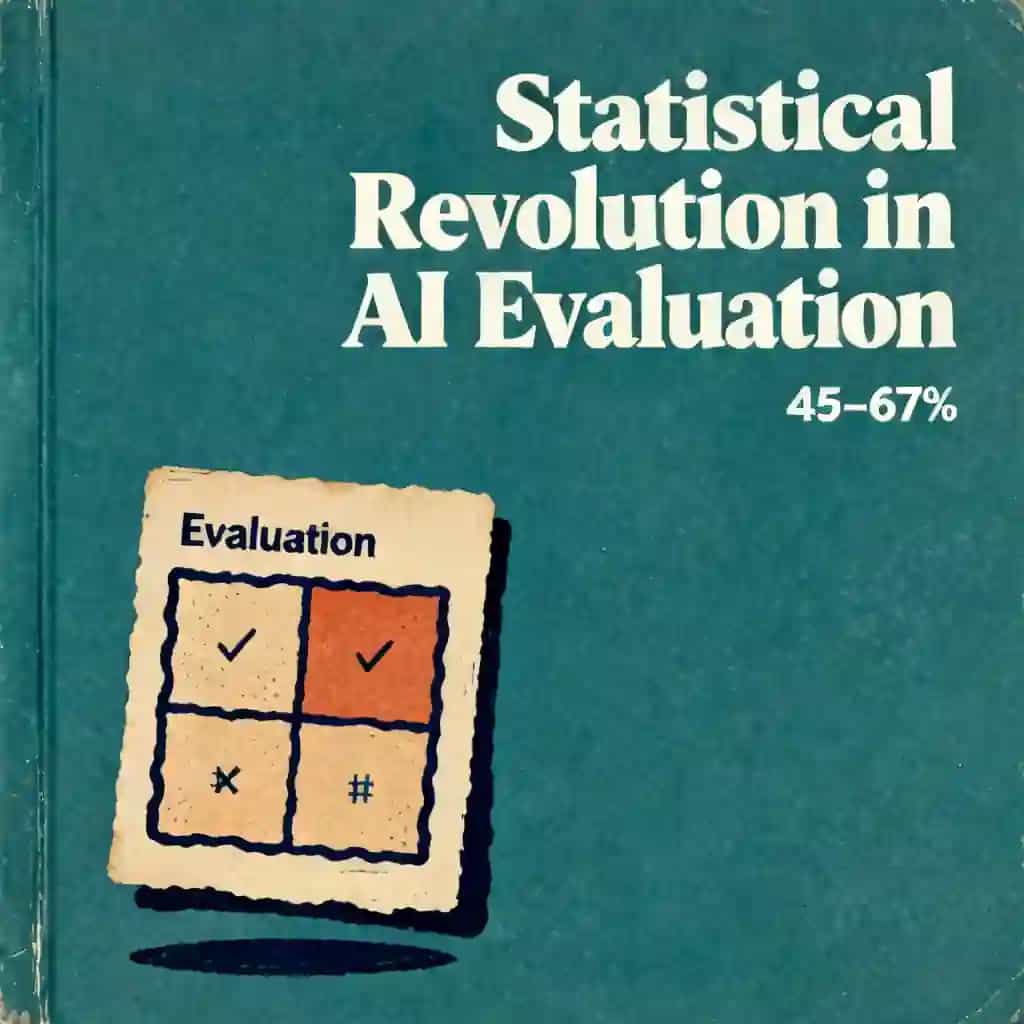
LLM evaluation is noisier than you think
Leaderboard rankings often mistake noise for progress. Learn how to use statistical tools to find real signals and build more reliable model benchmarks.

Meilleure citation de LLM evaluation is noisier than you think
Science isn't about being 100% sure; it’s about knowing exactly how 'not sure' you are. When we acknowledge the error bars, we’re actually being more rigorous, not less.

Cette leçon audio a été créée par un membre de la communauté BeFreed
https://cameronrwolfe.substack.com/p/stats-llm-evals



Foire aux questions
Relying on raw scores often leads to the "highest number is best" fallacy, where tiny performance gaps are mistaken for actual progress. Research indicates that many of these decimal-point differences are simply statistical noise rather than true improvements in model capability. Without calculating statistical significance or using error bars, it is impossible to know if a model's higher score is a repeatable result or just a random fluctuation based on a specific sample of questions.
Standard deviation measures the diversity or "spread" of individual data points, showing how much the scores for different questions vary from one another. In contrast, standard error measures the precision of the average score. It tells you how much the mean performance would likely vary if you ran the same evaluation multiple times with different sets of questions. A small standard error indicates that the calculated accuracy is a reliable estimate of the model's true performance.
Paired difference analysis is a statistical "cheat code" that compares two models on the exact same set of prompts. Because models often find the same questions difficult or easy, their scores are highly correlated. By focusing on the difference in performance for each specific question rather than comparing two independent averages, the shared noise caused by question difficulty cancels out. This shrinks the standard error and allows researchers to detect significant improvements that might be hidden by the overlapping error bars of independent tests.
When a dataset has fewer than a few hundred samples, the Central Limit Theorem (CLT) may provide a false sense of security by producing confidence intervals that are too narrow. Small datasets are also prone to the "small data trap," where a model getting a perfect score (100% or 0%) makes the variance appear to be zero, incorrectly suggesting there is no uncertainty. For these smaller, specialized benchmarks, experts recommend using Bayesian methods or increasing the number of samples to ensure the results are robust.
Most evaluations use binary "pass or fail" scoring, which discards the nuance of how confident a model was in its answer. By looking at the next-token probabilities (the "expected score"), you can distinguish between a lucky guess and a confident, correct answer. This approach removes "within-question variability," leading to a much higher Signal-to-Noise Ratio (SNR). This makes performance metrics more stable and allows engineers to track progress more steadily during model training.
Découvrir plus
Python programming for LLMs and evals
As AI integration becomes standard, the ability to both build and critically evaluate models is a vital technical differentiator. This path is ideal for developers and data scientists looking to transition from general programming to specialized LLM engineering and rigorous model benchmarking.

LLM Training: From Raw Text to Aligned Assistant
As the demand for custom AI grows, understanding the full lifecycle of model development is essential for engineers. This plan is ideal for data scientists and systems engineers looking to bridge the gap between raw data engineering and advanced model alignment at scale.

AI Myths: LLMs vs. True Sentience
This learning plan is essential for anyone looking to look past the headlines and understand the actual capabilities of modern AI. It is particularly valuable for tech enthusiasts, students, and professionals who want to ground their understanding of machine intelligence in both science and philosophy.

LLM personalization and memory
This learning plan is essential for AI engineers, ML practitioners, and developers who want to move beyond basic LLM usage to create truly intelligent, personalized applications. As businesses demand AI systems that understand context, remember user preferences, and adapt over time, the ability to implement memory systems and personalization techniques has become a critical competitive advantage in the AI space.

LSAT Logic & Games Mastery Foundation Program
This program is essential for law school applicants who need to transform their approach to the LSAT from intuition-based to strategy-driven. It bridges the gap between basic logic and the high-speed analytical demands of the actual exam, making it ideal for anyone aiming for a top-tier score.

Study Nate Silver's statistical methods
In an era of data overload, the ability to filter out noise is a critical competitive advantage. This plan is ideal for data analysts, political junkies, and sports bettors who want to adopt the rigorous, Bayesian-inspired framework that made Nate Silver a household name.

The Quiet Power of Contrarian Insight
This learning plan is designed for intellectual explorers and strategic thinkers who want to move beyond mainstream narratives. It provides a structured approach to analyzing anomalies in physics and biology, making it essential for those seeking a competitive edge through non-obvious insights.

Learn NotebookLM from Sabrina & 4 Top Experts
In an era of information overload, mastering AI-driven synthesis is essential for researchers and professionals. This plan, led by Sabrina and top experts, is designed for anyone looking to bridge the gap between traditional note-taking and advanced AI knowledge systems.
Cree par des anciens de Columbia University a San Francisco
"Instead of endless scrolling, I just hit play on BeFreed. It saves me so much time."


"I never knew where to start with nonfiction—BeFreed’s book lists turned into podcasts gave me a clear path."


"Perfect balance between learning and entertainment. Finished ‘Thinking, Fast and Slow’ on my commute this week."
"Crazy how much I learned while walking the dog. BeFreed = small habits → big gains."
"Reading used to feel like a chore. Now it’s just part of my lifestyle."

"Feels effortless compared to reading. I’ve finished 6 books this month already."
"BeFreed turned my guilty doomscrolling into something that feels productive and inspiring."

"BeFreed turned my commute into learning time. 20-min podcasts are perfect for finishing books I never had time for."
"BeFreed replaced my podcast queue. Imagine Spotify for books — that’s it. 🙌"

"It is great for me to learn something from the book without reading it."
"The themed book list podcasts help me connect ideas across authors—like a guided audio journey."
"Makes me feel smarter every time before going to work"
Cree par des anciens de Columbia University a San Francisco
"Instead of endless scrolling, I just hit play on BeFreed. It saves me so much time."
"I never knew where to start with nonfiction—BeFreed’s book lists turned into podcasts gave me a clear path."
"Perfect balance between learning and entertainment. Finished ‘Thinking, Fast and Slow’ on my commute this week."
"Crazy how much I learned while walking the dog. BeFreed = small habits → big gains."
"Reading used to feel like a chore. Now it’s just part of my lifestyle."
"Feels effortless compared to reading. I’ve finished 6 books this month already."
"BeFreed turned my guilty doomscrolling into something that feels productive and inspiring."
"BeFreed turned my commute into learning time. 20-min podcasts are perfect for finishing books I never had time for."
"BeFreed replaced my podcast queue. Imagine Spotify for books — that’s it. 🙌"
"It is great for me to learn something from the book without reading it."
"The themed book list podcasts help me connect ideas across authors—like a guided audio journey."
"Makes me feel smarter every time before going to work"
"Instead of endless scrolling, I just hit play on BeFreed. It saves me so much time."
"I never knew where to start with nonfiction—BeFreed’s book lists turned into podcasts gave me a clear path."
"Perfect balance between learning and entertainment. Finished ‘Thinking, Fast and Slow’ on my commute this week."
"Crazy how much I learned while walking the dog. BeFreed = small habits → big gains."
"Reading used to feel like a chore. Now it’s just part of my lifestyle."
"Feels effortless compared to reading. I’ve finished 6 books this month already."
"BeFreed turned my guilty doomscrolling into something that feels productive and inspiring."
"BeFreed turned my commute into learning time. 20-min podcasts are perfect for finishing books I never had time for."
"BeFreed replaced my podcast queue. Imagine Spotify for books — that’s it. 🙌"
"It is great for me to learn something from the book without reading it."
"The themed book list podcasts help me connect ideas across authors—like a guided audio journey."
"Makes me feel smarter every time before going to work"
"Instead of endless scrolling, I just hit play on BeFreed. It saves me so much time."
"I never knew where to start with nonfiction—BeFreed’s book lists turned into podcasts gave me a clear path."
"Perfect balance between learning and entertainment. Finished ‘Thinking, Fast and Slow’ on my commute this week."
"Crazy how much I learned while walking the dog. BeFreed = small habits → big gains."
"Reading used to feel like a chore. Now it’s just part of my lifestyle."
"Feels effortless compared to reading. I’ve finished 6 books this month already."
"BeFreed turned my guilty doomscrolling into something that feels productive and inspiring."
"BeFreed turned my commute into learning time. 20-min podcasts are perfect for finishing books I never had time for."
"BeFreed replaced my podcast queue. Imagine Spotify for books — that’s it. 🙌"
"It is great for me to learn something from the book without reading it."
"The themed book list podcasts help me connect ideas across authors—like a guided audio journey."
"Makes me feel smarter every time before going to work"




![[2411.00640] Adding Error Bars to Evals: A Statistical Approach to ...](/_next/image?url=https%3A%2F%2Fd1y2du6z1jfm9e.cloudfront.net%2Fassets%2Fpodcast%2Fyellow.png&w=1024&q=50)


