Chapitre 1
The Political Landscape That Made Trump Possible
In my final White House visit during Obama's presidency, I wasn't celebrating a triumphant conclusion to a historic era. Instead, I faced the sobering reality of Donald Trump's imminent inauguration. As I walked through those familiar doors one last time with my Pod Save America cohosts to interview President Obama, the weight of the moment was palpable. This would likely be my final time entering a White House staffed by friends with whom I'd worked tirelessly to make Hope and Change a reality.
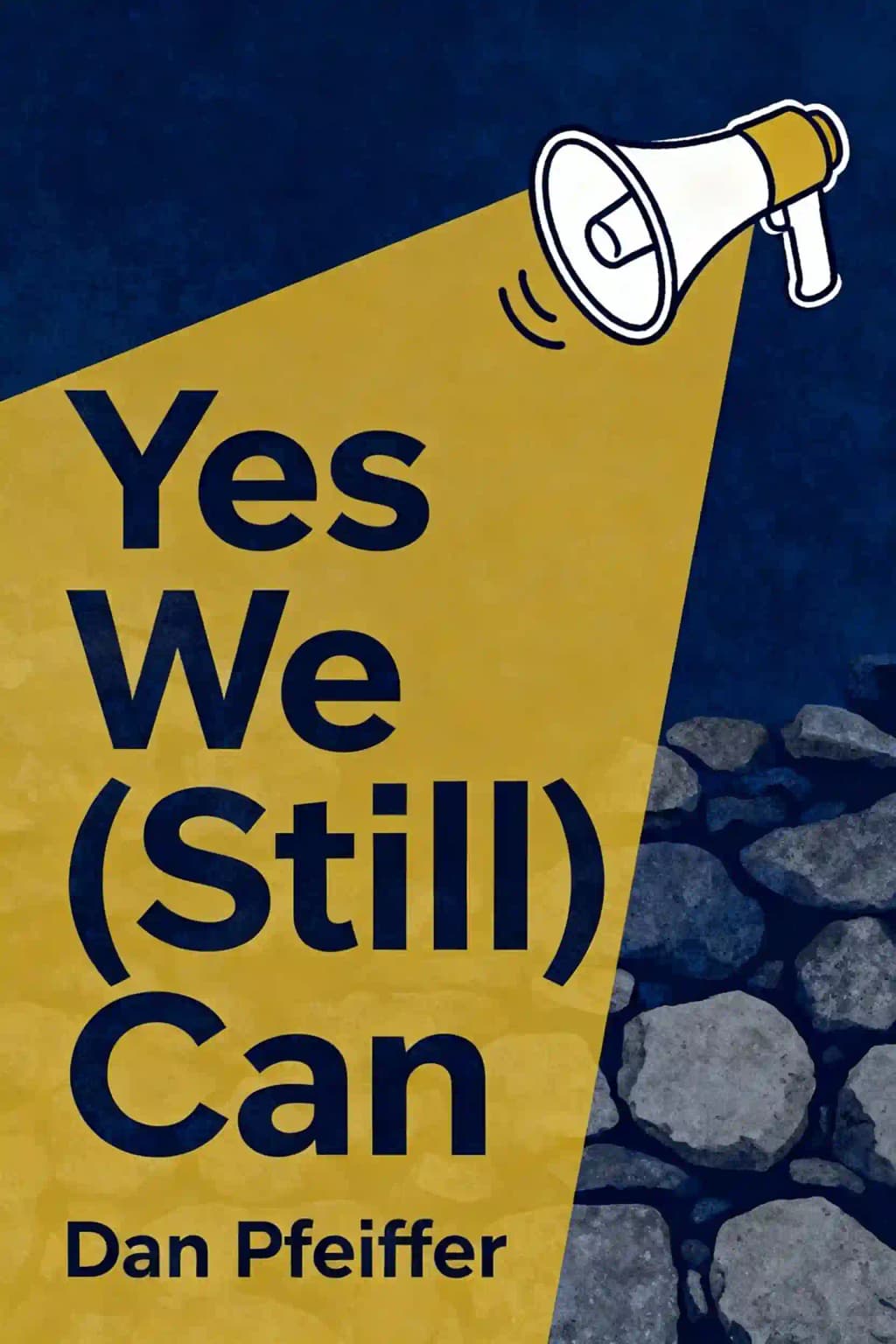
Obama's memoir "Yes We (Still) Can" has become a cultural touchstone in our politically divided times. When it was released, the book shot to the top of bestseller lists and was embraced by celebrities from Lin-Manuel Miranda to Oprah Winfrey, who praised its blend of political insight and personal narrative. The book's enduring popularity stems from its unique perspective - examining how the forces that shaped Obama's presidency ultimately enabled Trump's rise. For anyone seeking to understand America's political transformation over the past decade, this insider account provides essential context that goes beyond partisan talking points to reveal the deeper currents reshaping our democracy.
Chapitre 2
Finding Hope in a Broken Political System
I don't believe in fate, but meeting Barack Obama came at precisely the moment I needed someone like him. After a decade of Democratic defeats and growing disillusionment that had me considering leaving politics entirely, I approached my first meeting with Obama skeptically in early 2007. I doubted a rookie politician with a vague message of hope could survive presidential politics. I walked out with a new job and renewed hope.
My political journey began with defeat in seventh grade when I volunteered to play Michael Dukakis in a mock presidential debate at my American school in Japan. Despite knowing more about the issues and being better prepared than my opponent (who played Bush), I got crushed when she hammered me with simple messages about Dukakis being soft on crime and wanting to raise taxes while I responded with policy details. This early lesson - that being right on facts doesn't matter if your message isn't compelling - would take years to fully learn.
After high school in Delaware, I got into Georgetown University partly thanks to an alumni interview where my "bullshit abilities were at peak performance." Unlike many Georgetown students preparing for political careers through student government and campus activism, I spent my college years hanging with friends, drinking at bars, and playing pickup basketball. My path changed when I met Chad Griffin, a fellow Georgetown student who had worked in the Clinton White House starting at age nineteen. Chad's stories inspired me to consider politics before law school.
Through Chad's connections, I landed a White House internship in Vice President Gore's office. Though I started with mundane tasks like cutting newspaper articles, I found my niche helping the counsel's office organize documents for campaign finance investigations. This led to working on Gore's presidential campaign, where I learned campaigns were meritocracies where hard work trumped credentials. Unfortunately, the campaign ended with Gore's concession, leaving me unemployed and temporarily forced back to my parents' house.
After helping elect Democratic governors and working on Tim Johnson's shocking Senate victory in South Dakota, I joined Senator Tom Daschle's team, eventually running his reelection campaign - a brutal, exhausting affair that ended in defeat. Fed up with politics and considering law school, I got a call from Anita Dunn, an advisor to Indiana Senator Evan Bayh who was contemplating a 2008 presidential run.
My liberal idealism had been dulled by the Democratic Party's late 1990s strategy of dulling our liberalism and co-opting Republican issues to win swing voters - a strategy that proved ineffective in the 2000, 2002, and 2004 elections. After two years of preparation for Bayh's campaign, Barack Obama appeared on my radar, drawing huge crowds while campaigning for Democrats in 2006. This encounter would change everything.
Chapitre 3
The Revolutionary Campaign That Changed Politics Forever
The 2008 Obama campaign functioned like no political operation I'd ever seen before. Years later, Obama would declare it "the greatest start-up in history" - and he was right. While modern campaigns are now data-driven operations with tech incubator-style engineering teams, in 2008 we were traditional political operatives working for a nontraditional candidate who couldn't win using traditional methods.
Our success rested on five essential building blocks. First was attitude - Obama's declaration that "I have a great life. I don't need this" revealed a crucial strategic advantage. While he desperately wanted to win, he wasn't driven by the insatiable need for approval that plagues many presidential candidates. This freedom from fear permeated our campaign's thinking. Our unofficial motto was "WTF" - when faced with a choice between something safe and something high-risk/high-reward, we always chose the latter.
The second building block was scaling. Presidential campaigns require massive organizational efforts that grow exponentially with success. Unlike the Clinton machine or Edwards' four-year campaign preparation, we had weeks to prepare with a ragtag group of staffers. The enthusiasm for Obama's candidacy immediately overwhelmed our capacity, culminating in a near-riot at George Mason University where security lost control of the crowd. We were essentially bolting wings on a plane as it took off.
Third was culture - what became known as "No Drama Obama." Unlike the Kerry campaign's poisonous culture of leaks and backstabbing, we built a team defined by loyalty, commitment to the cause, and zero tolerance for internal politics. Our first rule was simple: No assholes allowed. No matter your pedigree or abilities, if you were an asshole, you weren't getting hired. We had other critical cultural rules: You had to be all in or out - working from Chicago with no commuting allowed and no salary negotiations. "Don't fuck the structure" meant respecting the chain of command. And perhaps most importantly, no leaks.
The fourth building block was strategic planning. Obama was a "Chess Player in a city of Checkers Players" - his ability to develop and stick to strategy set him apart. My case for why Obama could win rested on three pillars: enthusiasm matters, organization matters more, and the internet was changing the rules - democratizing politics and erasing institutional advantages. Our resulting strategy was beautifully simple: Win Iowa, place at least second in New Hampshire, survive Nevada, win South Carolina, and ride momentum into Super Tuesday.
The final building block was messaging. Obama recognized that political messaging in the social media age isn't about words but about the candidate's story. Most politicians make the mistake of starting with focus-grouped sound bites rather than narrative. Hillary Clinton's 2008 campaign exemplified this problem, changing messages constantly and culminating in the comically unfocused "Big Challenges, Real Solutions: Time to Pick a President Tour." Meanwhile, we eventually landed on "Change We Can Believe In" - effective because it connected to our core message while subtly contrasting with Clinton's trust issues.
On Election Day 2008, everything went right. By the old rules, Obama should never have won, but we had changed how the game was played. Standing in Grant Park that unseasonably warm night, possibilities seemed endless. Little did I know what awaited us - the easy part was over.
Chapitre 4
The Challenges of Presidential Communication
During the first week of Obama's presidency, he appeared in my doorway and casually remarked, "I just banned torture. That's pretty cool, huh." As he turned to leave, he encountered a reporter and seemed surprised to learn that press had traditional access to this area of the White House. With a parting thought, he said: "I guess we better figure out how to tell the country about what I just did." That's when I realized what my new job truly entailed - telling the country.
Despite having the prestigious role of deputy communications director, I had initially wanted the communications director position. I'd held that role during the campaign and transition, and at 33, thought I had a shot at it. The New York Times even named me as the leading contender. But I discovered I didn't get the job in the most unceremonious way - by seeing someone else's name announced for the position in an email I was reviewing for press releases. Though deputy communications director was ultimately the right role for me then, I entered the White House with a chip on my shoulder, determined to prove myself.
The presidential transition is jarring in its abruptness - the new president takes the oath, the old one leaves by helicopter, and suddenly an entirely new staff wanders through the White House looking for Post-it notes with their names, expected to run the country before they even know where the bathrooms are. I quickly learned the communications staff had three main responsibilities: managing the press, getting the message out, and responding to the crisis du jour.
Every White House exists in constant tension with its press corps - we wanted to control our message while reporters wanted maximum access and to cover what interested their audiences. Despite the media's apparent love for Obama during the 2008 campaign, the relationship cooled once we entered the White House. I learned several key lessons about managing the press-president dynamic: the press isn't your friend or enemy - assuming mutual good faith works best; the definition of "reporter" has fundamentally changed; and honesty remains the best policy.
Getting the president's message out is harder in the White House than during campaigns. When I suggested Obama appear on The Tonight Show, campaign veterans saw it as a perfect opportunity to reach passive news consumers, while traditionalists worried it wasn't "presidential" - with an unspoken concern about a young Black president appearing undignified. Not all boundary-pushing ideas worked as well. During a NASCAR drivers' White House event, I pushed for an ESPN interview that backfired spectacularly when Obama, who refuses to fake interest in things he doesn't know about, made it painfully clear he knew little about NASCAR.
Every White House communications plan regularly gets derailed by unexpected crises. On Christmas Day 2009, during my first real break in over a year, a terrorist attempted to detonate an underwear bomb on a Detroit-bound flight. When asked if Obama should make a statement, I argued against it until we had more information. This was a serious mistake. What I didn't understand then was that the president's role isn't just to inform but to comfort. Even people who disagree with the president want to hear from him during crises.
Chapitre 5
Navigating the New Media Wasteland
On my first day as White House communications director, Professor Martha Joynt Kumar sobered my celebration by informing me that historically, communications directors get fired or jailed more often than any other White House position except counsel. This warning seemed particularly ominous given the timing - Obama and I were navigating a media landscape undergoing revolutionary transformation that would diminish the presidential bully pulpit and media's role as arbiter of truth.
The media landscape transformed rapidly due to four key factors. First, the internet made information free, destroying newspaper subscription models. Second, smartphones enabled on-demand content, undermining television's scheduled programming. Third, the 2008 financial crisis devastated advertising revenue, forcing news organizations to replace experienced reporters with cheaper, younger journalists who produced more content with less experience and fewer editors. Fourth, public trust in media declined dramatically, partly due to institutional skepticism and partly due to media missteps.
Despite being the greatest communicator of the modern political era, Obama was frustrated by his inability to effectively tell his presidency's story. After Democrats lost the House in 2010, Obama publicly acknowledged this failure during a press conference, leaving me feeling personally responsible as his communications director. The hard truth was that the presidential bully pulpit had died. Unlike Reagan's era when Americans had few television channels and presidential addresses commanded national attention, Obama operated in a fragmented media landscape with countless entertainment options.
Political journalism has increasingly focused on horse-race coverage rather than substantive policy, treating politics like sports: who's winning, what were the highlights, what were the bloopers? This "SportsCenter Effect" creates a self-reinforcing incentive structure where politicians make outrageous statements to secure media attention. Media attention is oxygen for politicians, helping them build supporter and donor bases. Getting booked on cable news or gaining Twitter followers requires saying something more outrageous than everyone else, while thoughtful policy work and bipartisan compromise get ignored.
The media's obsession with political gaffes exemplifies the dumbing down of political discourse. When Obama said "the private sector is doing fine" during a 2012 press conference about the European financial crisis, his accurate statement about businesses recovering faster than families was immediately stripped of context and turned into a manufactured controversy. This pattern of prioritizing misstatements over actual policy positions denies voters the substantive discussions they deserve.
By late 2014, Obama recognized we had fallen behind the rapidly changing media landscape. Focus groups revealed a troubling shift - voters who previously knew nothing about Washington's trivial political crises were suddenly well-versed in them, often repeating Republican talking points verbatim. Their source? Facebook. The 2016 media ecosystem was unrecognizable compared to 2008, creating the perfect environment for Trump's rise.
Chapitre 6
The Rise of Fake News and Post-Truth Politics
In April 2011, I found myself at the White House podium not to announce policy, but to distribute copies of Barack Obama's birth certificate - a surreal moment that marked the rise of what would later be called "fake news." This wasn't just about responding to a reality TV star's conspiracy theory; it represented a fundamental shift in our political discourse toward post-truth politics.
Though "fake news" became ubiquitous in 2016, it had been evolving throughout the Obama era. It manifests in two primary ways: completely fabricated stories that received more engagement than factual reporting, and the reflexive labeling of unfavorable but true information as "fake" to signal to supporters they should dismiss it regardless of evidence.
The birther conspiracy wasn't new when Trump championed it - it began as malicious email chains during Obama's first campaign claiming he was born in Kenya, educated in a madrassa, or sworn into the Senate using a Koran. Initially, mainstream media responsibly refused coverage. When these rumors gained traction in Iowa, we reluctantly posted Obama's Certificate of Live Birth online, breaking the cardinal rule of not dignifying malicious rumors.
Trump, desperate for attention to boost his failing Celebrity Apprentice ratings, latched onto birtherism during a promotional tour. Suddenly the media couldn't stop asking about it, forcing Press Secretary Jay Carney to address Trump's claims almost daily. Obama eventually suggested releasing his birth certificate despite my objections. When Bauer and Plouffe informed me of the plan to release it within two days - with Obama himself planning to present it - I argued against it, feeling it was beneath the presidency.
We handed out copies at a routine briefing, causing reporters to gasp and scramble. Hours later, Obama addressed the nation, making the point that America couldn't solve real problems while distracted by "sideshows and carnival barkers." Yet despite all this, years later, 40% of Republican voters still refused to believe Obama was American-born, considering the certificate a forgery.
In 2009, mainstream Republican figures weaponized conspiracy theories during our healthcare reform push. When Sarah Palin posted about Obama's "death panels" on Facebook, I initially dismissed it as nonsense. She was distorting a provision funding voluntary end-of-life care consultations. But during Congress's August recess, the conspiracy spread like wildfire. Republican leaders eagerly amplified these lies. Despite our aggressive response, a significant portion of Americans remained unconvinced. Six years after the law passed, 29% of voters still believed death panels existed, even though none had ever convened.
The passage of healthcare reform and Trump's temporary humiliation over birtherism marked the beginning, not the end, of fake news. The situation worsened dramatically during the 2016 election and Trump's early presidency. This isn't because America is getting dumber, but because media and technology changes have weaponized our worst political impulses. Republican-sown distrust in mainstream media has undermined their ability to serve as factual referees. Meanwhile, Facebook's emergence as a primary news source has accelerated conspiracy theories' spread.
Chapitre 7
How Fox News Transformed American Politics
Fox News has been a destructive force in American politics since Obama's early campaign days. When I first joined Obama's campaign, Fox & Friends sparked a media firestorm by reporting a false claim that Obama had been educated in an Indonesian madrassa. Despite our protests, Fox executives dismissed the show as "entertainment programming" not subject to normal editorial standards.
While there's merit to the critique that individual journalists tend to be socially progressive, the mainstream media's primary bias isn't ideological but toward "conflict, controversy, clicks, and ratings." Fox News, however, isn't simply covering news from a conservative perspective - it's "a Republican propaganda machine masquerading as a news outlet." The network consistently flips positions based on which party holds power, defending Bush's anti-terrorism strategies then criticizing Obama's as too harsh, ignoring economic recovery under Obama while celebrating identical numbers under Trump.
During the 2008 campaign, the Obama team maintained a strategic engagement with Fox News despite incidents like Fox calling Michelle Obama "Baby Mama." However, once Obama took office, Fox declared all-out war, promoting conspiracy theories and celebrating the Tea Party. By 2009, the White House declared war on Fox, with Axelrod and Emanuel publicly stating Fox wouldn't be treated like other news organizations. This strategy backfired when the administration excluded Fox from interviews, as other media outlets rallied to Fox's defense, drowning out the White House's policy messages.
A year later, I arranged an interview with Bret Baier during the final health care push, hoping to show Democrats Obama could defend his bill in a conservative forum. The interview was a disaster, with Baier interrupting Obama sixteen times in twenty minutes, turning the interview into a spectacle rather than a substantive discussion about health care. This experience reinforced that Fox wasn't in the journalism business but was a Republican propaganda outlet with a specific political agenda.
Fox News created the conditions for Trump's rise, building an alternative reality for viewers that perverted politics and influenced both Republican voters and politicians. They established a "Cycle of Bullshit" where false information from dark corners of the internet gets amplified by Fox, then repeated by Republican politicians who cite Fox as their source. After Trump's election, Fox transformed from opposition force to state-run propaganda, with news departments functioning as extensions of the White House press office.
I outline a three-pronged strategy for dealing with Fox News and right-wing media. First, "Fox will never be your friend" - they lack shame and can't be influenced by media criticism. The Obama White House adopted "strategic ambivalence" - providing access while ignoring Fox's provocations to avoid making them martyrs. Second, "Talk to Fox News viewers-just don't do it on Fox." Democrats can't afford to cede rural voters who watch Fox, but must reach them through local TV, Facebook, and in-person campaigning. Third, "Build out a progressive media" to counter the right-wing advantage.
Chapitre 8
The Republican Party's Transformation
From day one, Republicans were determined to oppose Obama at all costs. Despite Obama's genuine efforts at bipartisanship - hosting McCain for advice, appointing Republicans like Gates and LaHood to his cabinet, and personally visiting Capitol Hill to pitch his economic stimulus plan - Republicans refused to cooperate. John Boehner announced Republican opposition to the stimulus before Obama even arrived at the Capitol, and not a single House Republican voted for the bill despite the economy teetering toward depression.
Republican hostility only escalated: they shut down government to fight Obamacare, nearly caused economic collapse by refusing to raise the debt ceiling, rejected previously supported legislation just to deny Obama victories, and made openly racist remarks. Republicans wouldn't even attend a White House dinner with Obama for fear their voters would punish them. As I note, "Their voters hated Obama so much that it paralyzed the Republican Party," and the establishment's failure to stand up to their fringe ultimately led to Trump.
During the 2012 campaign, Obama hoped his reelection would "break the fever" of Republican opposition. Initially after Obama's victory, there were promising signs: Boehner declared Obamacare "the law of the land," and Republicans shifted positions on immigration reform. The "fiscal cliff" loomed as the first test of this new dynamic - without congressional action, taxes would rise on nearly all Americans at year's end.
Obama adopted my aggressive strategy - proposing to immediately extend middle-class tax cuts while letting wealthy tax cuts expire, putting Republicans in the position of holding middle-class relief hostage. When Boehner attempted negotiations, offering tax increases on incomes over $1 million, I remained skeptical, having been burned before. Sure enough, Boehner's caucus revolted at the mere suggestion of working with Obama.
Though Obama typically prevailed in his battles with Republicans, each victory came at a long-term cost as the Republican base grew angrier and more radicalized. Republican leaders like Ryan and McConnell chose to accommodate rather than confront the extremism in their ranks. From these battles, I draw crucial lessons for fighting Trumpism:
First, "Can't join 'em, beat 'em" - after repeated failed attempts at bipartisanship, I wrote a memo that became the foundation for Obama's "Pen and Phone" strategy of executive action. The Republican Party, driven by its rabid base, had become incapable of compromise. Progress would only come by defeating Republicans at the ballot box.
Second, "Go high" - Democrats shouldn't emulate Trump's tactics. Beyond being morally wrong, such a strategy wouldn't work mathematically for Democrats, who need to inspire higher turnout rather than foster cynicism.
Third, "Don't cede the argument" - Democrats must show they're the true party of the working class who will fight corruption and special interests. The Republican Party's contradiction between its populist base and corporatist agenda creates an opportunity to peel away voters, especially in crucial Rust Belt states.
Chapitre 9
Twitter's Transformation of Political Discourse
Twitter functions as a performance-enhancing drug for politics - making the good aspects slightly better while making the bad parts exponentially worse. On the positive side, Twitter democratizes information by enabling citizen journalism and removing filters between politicians and the public. However, it simultaneously makes politics "louder, meaner, and faster," distorting reality by hyping trivial matters while obscuring important issues.
The Obama White House's relationship with Twitter evolved from skepticism to necessity, with Gibbs becoming the first senior staffer to get an account (@PressSec), accumulating over 100,000 followers. This allowed direct communication with the public, bypassing media gatekeepers. I initially restricted Twitter access among White House staff out of fear that missteps could damage careers or derail messaging, eventually loosening restrictions as I realized the political conversation had fully migrated to Twitter.
Initially, Twitter democratized political discourse, but I witnessed its disturbing transformation during Obama's first debate with Romney in 2012. While I thought Obama's performance was merely slow-starting, Twitter rapidly shaped a catastrophic narrative. Andrew Sullivan's meltdown tweet ("He choked. He lost. He may even have lost election tonight") shifted the entire conversation. In just thirty minutes, perception became reality, transforming Obama from cruising to reelection to potentially losing, with Twitter as a major contributor.
By 2015, most White House staff had Twitter accounts, but Barack Obama himself didn't. The @BarackObama handle belonged to his campaign, and legal concerns prevented him from using it as president. The digital team proposed creating an @POTUS account that would belong to the Office of the President and transfer to the next administration. I finally initiated the @POTUS account right before leaving the White House, partly motivated by "senioritis." The account proved hugely successful, changing presidential communication forever - though I lament we were "handing matches to a subsequent presidential baby to burn down the body politic."
Twitter has blurred traditional journalistic roles. Previously, there were clear distinctions between reporters (who provided facts), columnists (who offered opinions), and analysts (who provided expert interpretation). Twitter eroded these boundaries, allowing even junior reporters to offer opinions and analysis without editorial oversight. This blurring of lines between facts and opinions created openings for Trump and his supporters to attack factual reporting.
Despite these criticisms, I acknowledge Twitter's positive potential. I describe attending a spontaneous airport protest against Trump's Muslim ban, where people gathered quickly after learning about it on Twitter. This experience showed me how the platform could mobilize resistance and connect like-minded citizens fighting for equality and decency.
Chapitre 10
Understanding the 2016 Election and Finding Hope
On Election Day 2016, I woke up in a DC hotel, disoriented by the strange experience of sleeping soundly before an election. For the first time in my career, I wasn't heading to campaign headquarters or traveling with a candidate. Despite being on the sidelines, I felt absolute confidence in Hillary Clinton's victory. For months on the "Keepin' It 1600" podcast, I had been reassuring nervous Democrats, essentially providing "Xanax for nervous Democrats." That afternoon, a senior Clinton aide texted me they were even more confident than Obama's team had been on Election Day 2012.
As early results looked troubling, I contacted David Plouffe, whose initial optimism quickly faded. The worst sign came when Plouffe stopped responding to emails altogether. Shortly after, my phone exploded with notifications of the unthinkable outcome I had confidently assured everyone couldn't happen: Donald Trump had been elected president.
I couldn't have been more wrong about the 2016 election, though I wasn't alone. Hillary would have been a great president - qualified, empathetic, and intellectually curious. Without Russian intervention and Comey's announcement about reopening the email investigation, she likely would have won handily. To win future elections and fight Trumpism, Democrats need to understand what shifted politically and why we missed it.
I identified five critical factors I missed that contributed to this outcome. First, I underestimated Obama's unique appeal that transcended race and ideology, which had held onto conservative Democrats who might otherwise have left years earlier. Second, traditional notions of electability are dead - the internet has upended who can become president by allowing candidates to bypass political gatekeepers. Third, elections are about telling Americans a simple, compelling story about where we are, where we're going, and why you're the right person to take us there. Fourth, campaigns need science and tech, but will always be decided by who tells a more compelling story about America. Fifth, Democrats must explain why we're the right party to shepherd America through an uncertain economic future.
The path back for Democrats is clear: be audacious, authentic, and inspirational - an update of Obama's playbook. On Inauguration Day, hiding in my hotel from Trump supporters, I found hope in Obama's speech from the 50th anniversary of the March on Washington: "We are not trapped by the mistakes of history, that we are masters of our fate." The next day, I ventured out to find streets filled with pink-hatted Women's March participants - not angry or cynical, but hopeful and joyful. Millions marched across America, even in red towns. One day into the Trump era, we were already bending the arc toward justice.
Chapitre 11
The Obama Legacy and the Path Forward
After the political chaos of 2016 and Trump's early presidency, people constantly ask me two questions: What is Barack Obama really like, and how did he do it? I can confirm with absolute conviction that there is only one Barack Obama - the man singing "Amazing Grace" to heal a nation is the same man I sat through thousands of meetings with. As Obama often said in 2008, he's not perfect, but he's a better man than he was a president, and he was a pretty great president.
In March 2007, when Obama had been in the presidential race for less than a month, he interviewed with Nick Kristof from the New York Times. The column contained one concerning passage where Obama recited the Arabic call to prayer and called it "one of the prettiest sounds on Earth." When I reluctantly raised this concern with Obama, he responded: "I said it because it happened to be true. I'm not going to play the game where I edit what I say because I am afraid of Republican attacks. That's their game. If we play their game, we lose. We have to change the game."
During the Healthcare.gov crisis in late 2013, at Bradley Cooper's suggestion, we arranged for Obama to appear on Zach Galifianakis's web show "Between Two Ferns." Despite my initial skepticism, the president embraced the opportunity with enthusiasm. The interview went viral, driving substantial traffic to Healthcare.gov and helping us hit our signup targets. This success highlighted three key aspects of Obama's character: he's a methodical gambler who takes calculated risks; comedy is his superpower; and he's genuinely cool in a way most politicians aren't.
After Trump's election, Howli and I visited the White House one last time during Obama's presidency. Walking through DC felt dark and dreary, with depression palpable throughout the diverse, Democratic city now facing a president who had stoked racial fears. When I finally asked Obama how he was doing - essentially asking "How fucked are we?" - Obama sighed, called it "not an ideal situation to say the least," but then revealed his characteristic optimism: "Maybe I am just looking for a silver lining, but I am hopeful that this will be the clarifying event that will show the public the two different visions for the country." His eternal optimism and unending faith in the American people remained intact.
The America I saw traveling with Obama bears no resemblance to Trump's dark vision. The path back for Democrats is clear: be audacious, authentic, and inspirational - an update of Obama's playbook. We must be the party that stands against racism and misogyny while recognizing economic anxiety is real. We must explain why we're the right party to shepherd America through an uncertain economic future. Most importantly, we must never lose hope in the fundamental goodness of the American people and their ability to overcome even the darkest political moments. Yes, we still can.