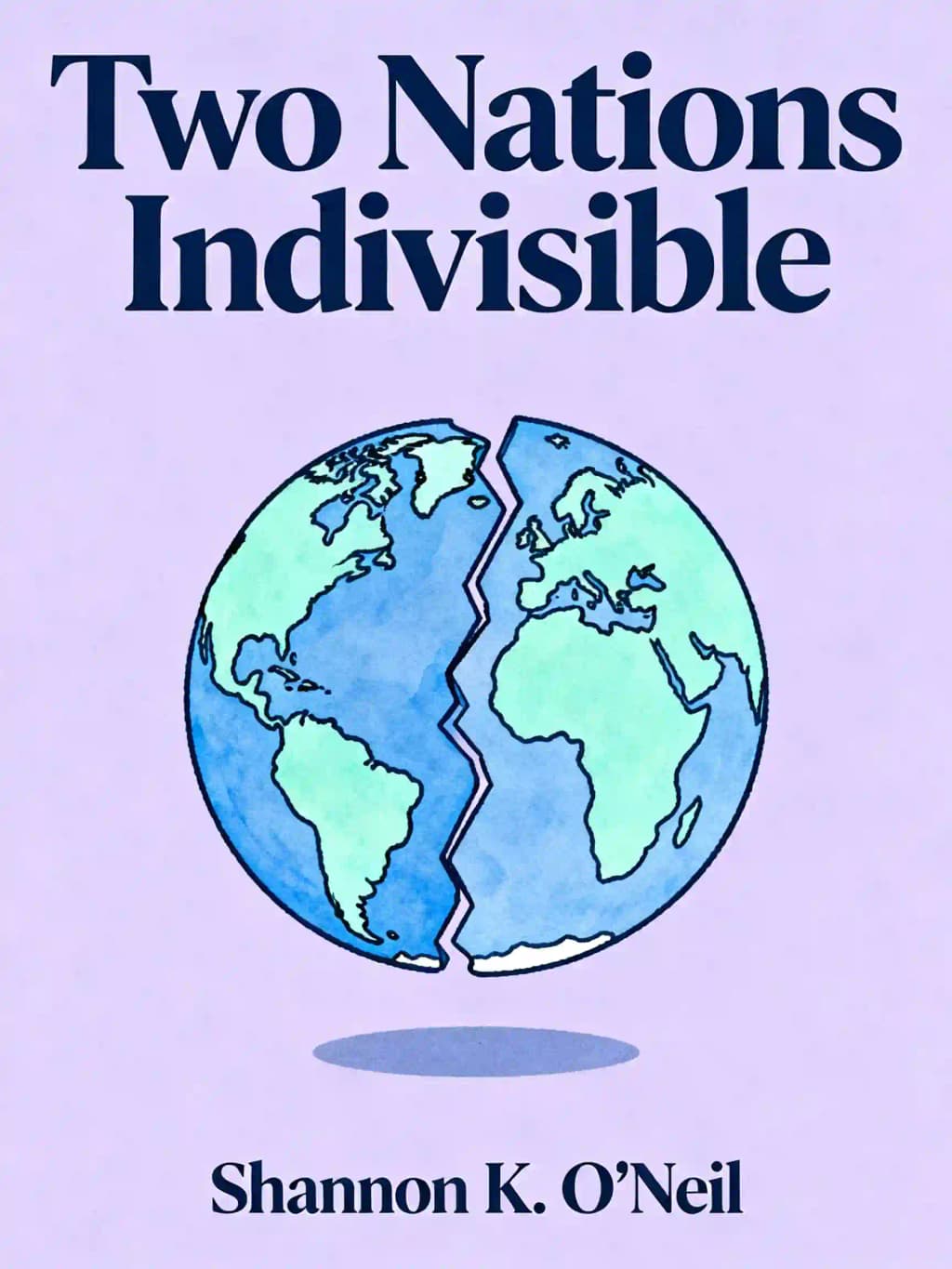
While headlines scream "drug violence," Shannon K. O'Neil reveals Mexico's overlooked economic renaissance. This Yale-Harvard scholar challenges media narratives, offering policymakers a roadmap beyond NAFTA. What if our closest neighbor isn't the crisis zone you've been led to believe?
Shannon K. O’Neil, author of Two Nations Indivisible: Mexico, the United States, and the Road Ahead, is a renowned Latin America expert and senior fellow at the Council on Foreign Relations. Her book, a seminal analysis of U.S.-Mexico relations, draws on decades of research into political reforms, economic integration, and cross-border challenges.
A Harvard-trained PhD in government and former Fulbright scholar in Mexico, O’Neil combines academic rigor with real-world insights from her early career as a Latin American equity analyst. She frequently contributes to Bloomberg Opinion, Foreign Affairs, and major media outlets like the Washington Post, while her expertise has shaped Congressional testimony and high-level policy discussions.
O’Neil’s work, including her widely cited The Globalization Myth: Why Regions Matter, bridges academia and public discourse through her influential blog Latin America’s Moment. A Columbia University lecturer and board member of the Tinker Foundation, she anchors her analysis in firsthand experience across government, finance, and international diplomacy. Published by Oxford University Press, Two Nations Indivisible remains a key text for understanding North American geopolitics and economic interdependence.
Two Nations Indivisible analyzes Mexico’s profound social, political, and economic transformations since the 1980s, challenging the U.S. media’s focus on violence and immigration. O’Neil highlights Mexico’s emergence as a democratic, globally integrated middle-class nation and argues for reimagined U.S. collaboration on trade, security, and immigration to reflect these changes.
This book is essential for policymakers, business leaders, and students of U.S.-Mexico relations. It offers actionable insights for those interested in North American trade dynamics, immigration reform, or Mexico’s democratic evolution, combining academic rigor with accessible analysis of binational interdependencies.
Yes – O’Neil’s data-driven perspective dismantles stereotypes, revealing a modernizing Mexico often overlooked in U.S. discourse. The book provides a roadmap for policymakers and counters fatalistic narratives with evidence of Mexico’s middle-class growth, economic diversification, and democratic progress since the 1990s.
O’Neil traces Mexico’s shift from oil-dependent isolation to a manufacturing powerhouse integrated into global supply chains. Key drivers include NAFTA, competitive industries like automotive and aerospace, and a growing middle class now comprising nearly 50% of the population – trends reshaping U.S. economic and immigration policies.
While acknowledging 60,000+ drug-war deaths (2006–2012), O’Neil contextualizes violence within Mexico’s economic modernization. She advocates for U.S. policy shifts – reducing drug demand, regulating firearms, and supporting judicial reforms – rather than militarized approaches that exacerbate instability.
The 2000 election ending PRI’s 71-year rule marked a turning point. O’Neil details subsequent reforms: independent electoral institutions, expanded press freedoms, and grassroots activism. However, she notes ongoing challenges like corruption and uneven security enforcement that test institutional resilience.
Proposals include expanding legal work visas, integrating Mexican immigrants via education/job programs, and jointly addressing Central American migration drivers. O’Neil argues current enforcement-focused strategies ignore economic interdependencies, with 80% of Mexican exports going to the U.S.
O’Neil criticizes Washington’s narrow focus on border security and drugs, urging recognition of Mexico as a strategic economic partner. The book highlights missed opportunities in energy collaboration, cross-border infrastructure, and joint innovation initiatives that could boost North American competitiveness.
Some scholars argue O’Neil underestimates structural issues like wealth inequality (45% poverty rate in 2013) and cartels’ infiltration of local governments. Critics note her pro-trade stance downplays environmental and labor concerns in manufacturing sectors.
While The Globalization Myth examines regional supply chains globally, Two Nations Indivisible focuses specifically on North America. Both emphasize regional economic integration, but the latter offers granular policy prescriptions for U.S.-Mexico collaboration missing from her broader work.
With Mexico now the U.S.’s top trading partner, surpassing China, the book’s insights on nearshoring, energy collaboration, and managed migration remain critical. Updated analyses might address López Obrador’s policies and shifting security dynamics under Biden’s administration.
Juárez – stereotyped as violent – is recast as a tech manufacturing hub. Pemex’s decline symbolizes Mexico’s shift from oil nationalism to diversified exports. These case studies illustrate systemic changes obscured by sensationalist media coverage.
Ressentez le livre à travers la voix de l'auteur
Transformez les connaissances en idées captivantes et riches en exemples
Capturez les idées clés en un éclair pour un apprentissage rapide
Profitez du livre de manière ludique et engageante
Mexico defies simple characterization.
Building a wall won't solve shared problems.
Achieving transformed relations remains elusive.
Mexicans seeing it as might triumphing over right.
Only partnership can address drug-related violence.
Décomposez les idées clés de Two Nations Indivisible en points faciles à comprendre pour découvrir comment les équipes innovantes créent, collaborent et grandissent.
Découvrez Two Nations Indivisible à travers des récits vivants qui transforment les leçons d'innovation en moments mémorables et applicables.
Posez vos questions, choisissez votre style d’apprentissage et co-créez des idées qui vous correspondent vraiment.

Cree par des anciens de Columbia University a San Francisco
"Instead of endless scrolling, I just hit play on BeFreed. It saves me so much time."
"I never knew where to start with nonfiction—BeFreed’s book lists turned into podcasts gave me a clear path."
"Perfect balance between learning and entertainment. Finished ‘Thinking, Fast and Slow’ on my commute this week."
"Crazy how much I learned while walking the dog. BeFreed = small habits → big gains."
"Reading used to feel like a chore. Now it’s just part of my lifestyle."
"Feels effortless compared to reading. I’ve finished 6 books this month already."
"BeFreed turned my guilty doomscrolling into something that feels productive and inspiring."
"BeFreed turned my commute into learning time. 20-min podcasts are perfect for finishing books I never had time for."
"BeFreed replaced my podcast queue. Imagine Spotify for books — that’s it. 🙌"
"It is great for me to learn something from the book without reading it."
"The themed book list podcasts help me connect ideas across authors—like a guided audio journey."
"Makes me feel smarter every time before going to work"
Cree par des anciens de Columbia University a San Francisco

Obtenez le resume de Two Nations Indivisible en PDF ou EPUB gratuit. Imprimez-le ou lisez-le hors ligne a tout moment.
Standing in Mexico City's airport in 1994, one could feel the optimism of a nation on the cusp of transformation. NAFTA was just beginning, the financial district buzzed with possibility, and Mexico seemed poised for prosperity. Yet by December, the peso had collapsed, businesses shuttered, and crime surged-the death throes of Mexico's once-dominant PRI political system. This rollercoaster journey reflects Mexico's complex reality-a country that defies simple characterization and has become increasingly vital to America's future. Mexico stands at a fundamental crossroads. Will it become a hub of North American prosperity with a thriving middle class like Spain, or will it succumb to violence and weak governance? Already ranking high on democracy indices and attracting substantial foreign investment, Mexico could leverage its U.S. ties to become a top-ten world economy. Alternatively, it could descend into a narco-state where cartels overwhelm democratic institutions. For the United States, the stakes couldn't be higher. A prosperous Mexico brings enhanced security, economic growth, and diplomatic partnership. A failed Mexico means waves of migrants fleeing north and massive security costs. What's certain is that building walls won't solve shared problems-our futures are permanently linked through deepening business, personal, and community relations that transcend politics.
When U.S. Ambassador Carlos Pascual resigned in 2011 following WikiLeaks revelations, it exemplified a historical pattern-U.S.-Mexico relations often begin with expansive promises but end in bitter divisions. This pattern has deep roots in a complex shared history. After gaining independence in 1821, Mexico claimed vast territories but exercised little control over them. Their fateful decision to grant land to American settlers willing to pledge loyalty to Mexico proved catastrophic. Within a decade, 25,000 American settlers overwhelmed the few thousand Mexican inhabitants, culminating in the 1836 Texas revolt. While Americans "remember the Alamo" as a heroic last stand, Mexicans view it as radical immigrants threatening sovereignty. This fundamental difference in historical perspective continues to color relations today. Yet significant cooperation has existed alongside conflict-Mexican federalists modeled their 1824 constitution after America's, and economic relations flourished under Porfirio Diaz, whose "Order and Progress" motto attracted American capital that built Mexico's industrial infrastructure. What's often forgotten is how the border itself evolved. For decades, neither central government controlled this frontier. Communities spanned both sides, with identities blurring-Mexicans became Americans when borders shifted, while American settlers moved south to start new lives. This shared borderland history reveals a more complex relationship than national narratives suggest.
Mexico's political landscape shifted dramatically from 1981, when President Lopez Portillo and the PRI held unchallenged power, to Mexico's bankruptcy in 1982. The 1988 presidential election severely damaged PRI's legitimacy, and by the late 1990s, the middle class had grown disillusioned, particularly after the 1995 peso crisis. The PRI's 71-year rule finally ended with Vicente Fox's victory in 2000. Fox's presidency brought significant reforms - dismantling repressive institutions, implementing financial and healthcare reforms, and establishing freedom of information laws. His successor, Felipe Calderon, proved effective at building congressional coalitions to reform pensions, taxes, and the state oil monopoly. By the 2010s, Mexico had established a functioning electoral democracy with three major parties competing in free elections. While the Federal Electoral Institute maintains independence and inter-branch relations follow democratic norms, challenges persist - particularly in economic accountability, with monopolies and oligopolies maintaining outsized political influence and driving up consumer costs.
The American dream of middle-class prosperity is increasingly becoming reality for Mexicans at home. Marco Aceo exemplifies this transformation - rising from a car washer at the U.S. Embassy to a fleet chauffeur able to own a home and fund his children's education. While poverty persists, Mexico now ranks in the top third globally for per capita wealth. Nearly sixty million of 110 million Mexicans belong to the middle and upper classes. Though the PRI era saw initial middle-class growth, the 1982 crisis dealt a setback. Economic reforms of the late 1980s eventually created foundation for broader prosperity. NAFTA proved beneficial despite controversy. Post-implementation, North American countries outpaced OECD growth averages, with significant increases in regional trade. For Mexico, NAFTA solidified economic reforms, drew over $150 billion in foreign investment, and shifted exports from oil dependency to 90% manufactured goods. This economic shift sparked social transformation. Family sizes dropped from nine children in the 1970s to two today. Female workforce participation doubled to 45%, increasing dual-income households. Education gained prominence, with nearly a third of young Mexicans pursuing college degrees.
Despite Mexico's economic and political progress, violence threatens these gains. The security crisis emerged from several factors: drug trafficking's shift from Colombia to Mexico, cartel militarization, and the breakdown of traditional arrangements between traffickers and the PRI government. The system unraveled as opposition parties won elections in the 1990s, culminating with Fox's 2000 presidential victory. Without established protocols, cartels violently competed for territory and influence. Though rooted in drugs, the violence has expanded as criminals diversify beyond narcotics. Corruption and impunity remain Mexico's greatest security weaknesses. From traffic police collecting bribes to officials favoring cronies in contracts, the problem pervades society. Transparency International reports Mexicans pay over 200 million bribes yearly for basic services. The federal government has initiated reforms, creating a new federal police headquarters with enhanced security measures. The 2008 judicial reforms introduced oral trials, presumption of innocence, and stronger due process - yet implementation remains slow. The United States shares responsibility through arms trafficking, money laundering, and drug demand. Despite restrictions on foreign gun sales, about 20,000 weapons cross south yearly. Billions in drug profits return to Mexico, funding bribes and weapons while sophisticated laundering schemes undermine legitimate businesses.
Beyond Mexico's visible challenges of poverty, corruption, and violence lies a nation transforming into a democracy with an open economy and growing middle class. Despite concentrated violence, Mexico is building democratic institutions and rule of law needed for lasting security. The U.S.-Mexico relationship is rooted in cross-border families and communities. The current immigration system fails despite massive spending - tearing apart communities without effectively controlling illegal entry. A more efficient system must recognize both family ties and labor market realities. Trade has doubled under NAFTA, yet border infrastructure lags. The U.S. must prioritize building bridges over walls and focus on North American competitiveness. Mexico needs support addressing its economic monopolies, limited credit access, and infrastructure gaps. U.S. southern strategy has long focused on deflecting Mexican threats. However, Mexico could follow Spain's path - evolving from a developing nation into a stable democracy and strong economy. This would ease tensions, reduce immigration, boost trade, and improve border security. We can either maintain mutual suspicion or embrace our shared destiny as neighbors and partners. Our futures are inextricably linked - two nations, indivisible, rising or falling together.