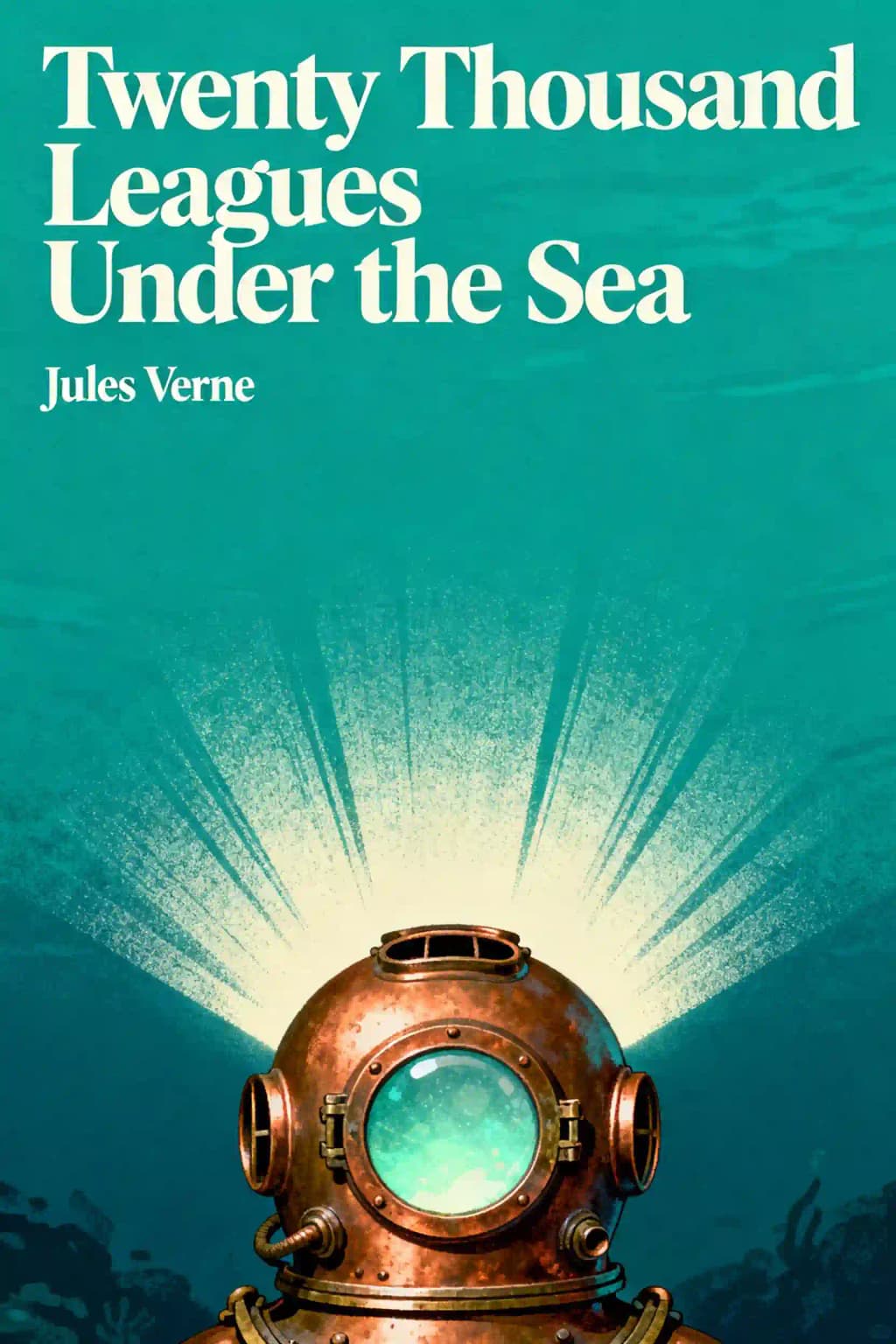
Twenty Thousand Leagues under the Sea
Jules Verne's Classic Adventure Tale
Aperçu de Twenty Thousand Leagues under the Sea
Journey 20,000 leagues with Captain Nemo, literature's first eco-terrorist, in Jules Verne's pioneering sci-fi masterpiece. Disney's adaptation won two Academy Awards, including Best Special Effects, with its giant squid battle becoming one of cinema's most unforgettable sequences. What underwater mysteries await you?

Thèmes clés dans Twenty Thousand Leagues under the Sea
- underwater exploration
- technological prescience
- marine biology
- man versus nature
- scientific discovery
Citations de Twenty Thousand Leagues under the Sea
The "question of the monster" inflamed minds everywhere.
The public demanded action.
They must admit the existence of a marine animal of enormous power.
Ned remained skeptical about the unicorn's existence.
The humiliated crew grew angry.
Personnages de Twenty Thousand Leagues under the Sea
- Captain NemoEnigmatic commander of the submarine Nautilus
- Pierre AronnaxProfessor at the Museum of Natural History
- Ned LandCanadian harpooner known for his skill and daring
- ConseilDevoted servant to Professor Aronnax
- Commander FarragutCaptain of the frigate Abraham Lincoln
À propos de l'auteur
À propos de l'auteur de Twenty Thousand Leagues under the Sea
Jules Gabriel Verne is the visionary French author of Twenty Thousand Leagues Under the Sea and a pioneering figure in science fiction literature. Born in 1828 in the maritime port city of Nantes, Verne channeled his fascination with seafaring and technological innovation into adventure novels that reimagined the scientific possibilities of the 19th century.
His collaboration with publisher Pierre-Jules Hetzel produced the Voyages Extraordinaires series, which included over 50 novels exploring uncharted territories, from the ocean depths to outer space.
Verne's other celebrated works include Journey to the Center of the Earth, Around the World in Eighty Days, and From the Earth to the Moon, many of which anticipated future inventions like electric submarines and lunar modules. His writing blended meticulous scientific research with thrilling narratives, establishing him as a master of combining adventure with technological speculation.
Often called the "Father of Science Fiction," Verne is the second most-translated author in history, ranking just behind Agatha Christie, with his works adapted countless times for film, television, theater, and other media worldwide.
Telecharger le resume de Twenty Thousand Leagues under the Sea
Obtenez le resume de Twenty Thousand Leagues under the Sea en PDF ou EPUB gratuit. Imprimez-le ou lisez-le hors ligne a tout moment.
FAQ sur ce livre
Twenty Thousand Leagues Under the Sea by Jules Verne follows Professor Pierre Aronnax, harpooner Ned Land, and servant Conseil as they join an 1866 expedition to hunt a mysterious sea monster. They discover the "monster" is actually an advanced submarine called the Nautilus, commanded by the enigmatic Captain Nemo. The novel chronicles their captive adventures exploring underwater worlds, visiting the South Pole, and witnessing marine marvels while Nemo pursues scientific knowledge and revenge against terrestrial civilization.
Jules Verne wrote Twenty Thousand Leagues Under the Sea, publishing it in 1870 as part of his Voyages Extraordinaires series. Born in 1828 in Nantes, France, Verne is considered the "father of science fiction" and ranks as the second most-translated author in the world since 1979. His visionary descriptions of submarine technology inspired real inventors like pioneering submarine designer Simon Lake. Verne died in 1905, leaving a legacy of adventure novels that predicted technological innovations years before they became reality.
Twenty Thousand Leagues Under the Sea appeals to science fiction enthusiasts, adventure lovers, and readers interested in early technological visionaries. The novel suits those fascinated by underwater exploration, submarine innovation, and Victorian-era scientific romance. History buffs exploring 19th-century literature and students studying the foundations of science fiction will find value in Verne's prescient imagination. The book also attracts readers who enjoy complex antiheroes like Captain Nemo and stories examining civilization, freedom, and scientific progress versus moral responsibility.
Twenty Thousand Leagues Under the Sea remains worth reading as a foundational science fiction work that accurately predicted submarine technology decades before its practical development. Jules Verne's vivid descriptions of marine biology, underwater exploration, and electrical propulsion demonstrate remarkable foresight that inspired real inventors. The novel's enduring popularity, evidenced by numerous adaptations including Disney's famous 1954 film, confirms its lasting cultural impact. Beyond historical significance, the story offers thrilling adventure, complex moral questions about revenge and isolation, and beautifully detailed oceanic imagery.
Captain Nemo is the mysterious constructor and commander of the Nautilus submarine who lives in self-imposed exile from terrestrial civilization. Jules Verne portrays Nemo as a genius inventor driven by dual motivations: pursuing advanced scientific knowledge and seeking revenge against an oppressive nation. Throughout Twenty Thousand Leagues Under the Sea, Nemo reveals his tortured past through emotional outbursts, particularly when standing before a portrait of a woman and two children. He describes himself as "the oppressed" and ultimately uses the Nautilus to destroy a warship, killing all aboard.
The Nautilus in Twenty Thousand Leagues Under the Sea represents Jules Verne's visionary prediction of advanced submarine technology and humanity's ability to conquer new frontiers. Built in secrecy, the electrically powered vessel allows Captain Nemo to conduct marine research beyond governmental reach. The submarine symbolizes both scientific progress and isolation from society, serving as Nemo's escape from terrestrial civilization while enabling unprecedented underwater exploration. Verne's detailed descriptions inspired real submarine designers like Simon Lake, demonstrating how Twenty Thousand Leagues Under the Sea bridged fiction and future technological reality.
Twenty Thousand Leagues Under the Sea explores themes of scientific discovery versus moral responsibility, as Professor Aronnax admires Captain Nemo's research while horrified by his ruthlessness. The novel examines freedom and captivity—the protagonists are physically trapped aboard the Nautilus while Nemo lives in self-imposed exile. Jules Verne develops themes of revenge and justice, with Nemo positioning himself as "the oppressed" against an "oppressor" nation. Additional themes include humanity's relationship with nature, technological progress, isolation from civilization, and the ocean as both wonder and danger.
Twenty Thousand Leagues Under the Sea concludes when Captain Nemo attacks and sinks a warship, then falls into hysterical sobbing before a portrait of a woman and two children. Professor Aronnax, Conseil, and Ned Land attempt escape approximately two weeks later as the Nautilus becomes caught in a massive whirlpool off Norway's coast—a treacherous phenomenon infamous for leaving no survivors. Jules Verne leaves the ending ambiguous, with the three men escaping but the fate of Captain Nemo and the Nautilus remaining unknown as they're swallowed by the maelstrom.
The protagonists in Twenty Thousand Leagues Under the Sea encounter multiple life-threatening dangers throughout their underwater journey. Jules Verne describes:
- attacks by giant squids that threaten to destroy the Nautilus
- collisions with icebergs in polar waters
- the risk of oxygen depletion during extended dives
Beyond physical perils, the characters face psychological dangers from permanent captivity and witnessing Captain Nemo's violent acts. The novel climaxes with the notorious Norwegian whirlpool (maelstrom) that catches the submarine during their escape attempt—a natural phenomenon feared for destroying all vessels it captures.
Twenty Thousand Leagues Under the Sea is considered groundbreaking because Jules Verne accurately described submarine technology—including electrical propulsion and diving suits—decades before practical implementation. Published in 1870, the novel's prescient vision directly inspired pioneering submarine designer Simon Lake and influenced real underwater exploration development. Verne's detailed marine biology descriptions and underwater exploration concepts established science fiction as a genre grounded in plausible scientific extrapolation rather than pure fantasy. The book helped earn Verne recognition as the "father of science fiction" alongside H.G. Wells.
Captain Nemo's revenge in Twenty Thousand Leagues Under the Sea stems from deep personal loss and oppression by an unnamed nation. Jules Verne reveals Nemo's anguish through his emotional breakdown before a portrait of a woman and two children, suggesting the loss of his family drove him to isolation and vengeance. When attacking the warship, Nemo declares himself "the oppressed" fighting against the "oppressor," indicating he suffered under a nation's tyranny. Throughout the novel, Nemo's dual nature—brilliant scientist and ruthless avenger—creates moral complexity that horrifies Professor Aronnax while demonstrating the psychological cost of trauma and exile.
Jules Verne predicted multiple revolutionary technologies in Twenty Thousand Leagues Under the Sea that later became reality. The novel accurately described:
- electrically powered submarines capable of extended underwater travel
- diving suits for undersea exploration
- advanced marine research vessels
decades before practical development. Verne's vision inspired real inventors: submarine designer Simon Lake credited Twenty Thousand Leagues Under the Sea as his direct inspiration, while the book's technological predictions influenced generations of engineers. These prescient descriptions of submarine warfare, underwater breathing apparatus, and oceanographic research established Verne's reputation as a visionary who anticipated 20th-century innovations.