Chapitre 1
America's Unapologetic Voice: A Trump Jr. Manifesto
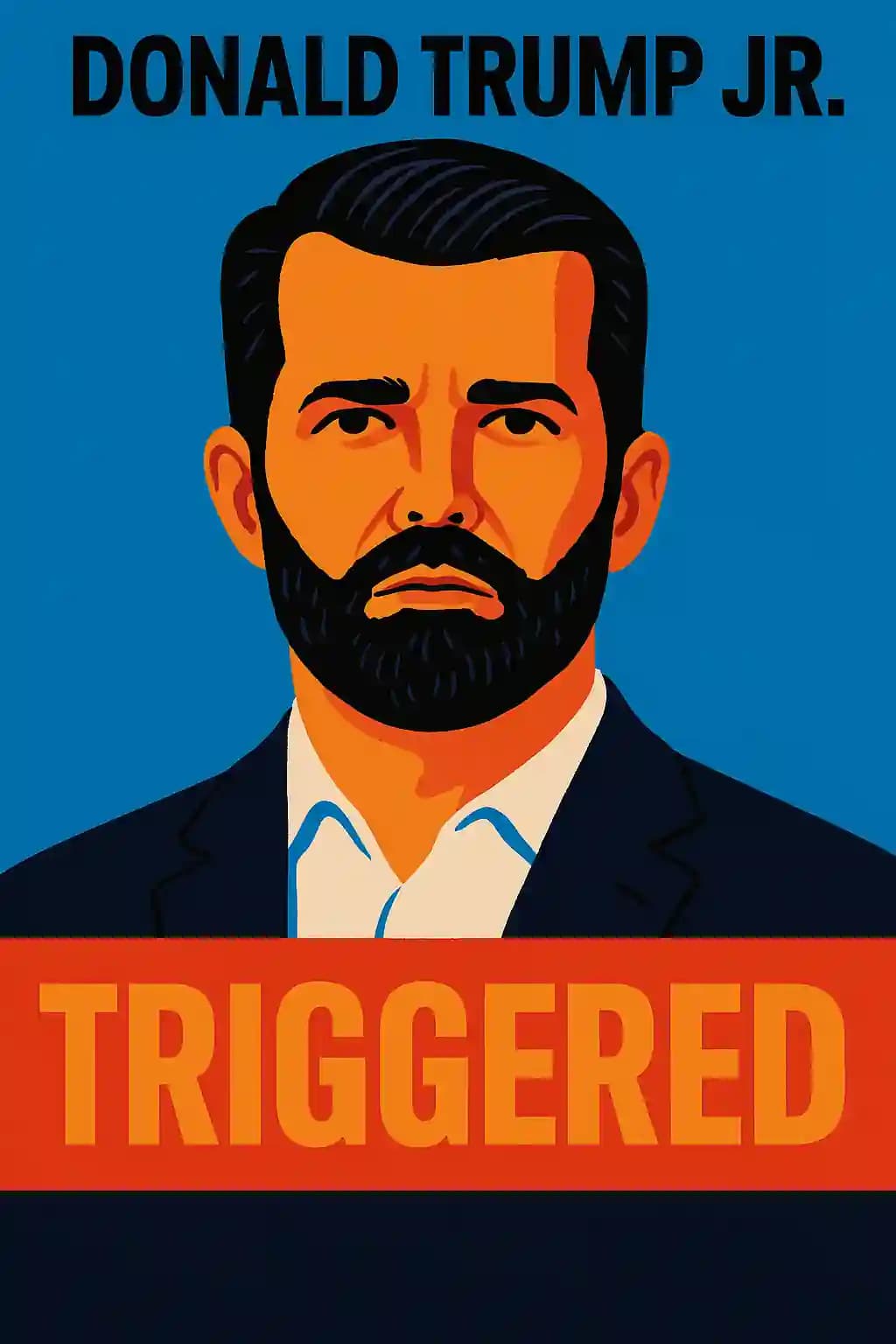
In a political landscape where authenticity often takes a backseat to polished talking points, Donald Trump Jr.'s "Triggered" bursts onto the scene like a chainsaw through political correctness. The book that liberal critics hoped would fade into obscurity instead became a #1 New York Times bestseller, resonating with millions of Americans tired of walking on eggshells in their own country. As the son of arguably the most polarizing president in modern history, Trump Jr. doesn't just embrace the controversy-he revels in it. "Anything that makes the veins in a few liberal foreheads bulge out is fine by me," he declares unapologetically. Whether you're a MAGA hat-wearing supporter or a progressive who views the Trump family as political kryptonite, "Triggered" offers something rarely found in today's political discourse: an unfiltered look inside the Trump universe from someone who has lived it from both business and campaign trenches.
Chapitre 2
The Mueller Myth: How Russia Became a Political Weapon
When Special Counsel Robert Mueller's investigation finally concluded after two years and $40 million, finding zero evidence of collusion between the Trump campaign and Russia, Donald Trump Jr. wasn't simply relieved-he was vindicated. The investigation that dominated headlines and fueled endless conspiracy theories had never really been about Russia at all. It was, as Trump Jr. puts it, about "taking down my father, the only president in modern history who was elected without the ruling class's stamp of approval."
Throughout the ordeal, while Democrats like Adam "FullofSchiff" Schiff spread what Trump Jr. calls outright lies about his family, he refused to remain silent. Even when his lawyers and father suggested he tone down his social media presence, he continued hitting back through television appearances and Twitter. "I knew that these congressional clowns would throw me in jail if they could," he writes, explaining his aggressive stance. The absurdity of the collusion narrative wasn't lost on him-as someone who was actively involved in the campaign, he knew they "couldn't have colluded to order a cheeseburger," let alone coordinate espionage with a foreign power.
For liberals, the Russia story served a dual purpose: it absolved them of responsibility for Hillary Clinton's defeat and provided justification for rejecting the election results. When Mueller's testimony before Congress turned into what Trump Jr. describes as "a complete disaster" that exposed the investigation as a politically motivated farce, Democrats simply pivoted to new accusations rather than accepting defeat.
What truly infuriates Trump Jr. is the hypocrisy. After the 2016 election, Democrats did precisely what they had accused Trump supporters of planning to do if Hillary won-they rioted, refused to accept election results, and formed what they proudly called "the Resistance." This wasn't just political opposition; it evolved into something far more dangerous. "Their hatred," Trump Jr. warns, "has evolved into actual violence," pointing to Antifa extremists who attack anyone who disagrees with their twisted sense of justice.
Chapitre 3
Socialist Cracks in America's Foundation: The Left's Dangerous Shift
When constructing the 98-story Trump International Hotel & Tower in Chicago, Trump Jr. learned a fundamental lesson in engineering: even the most impressive structure will fail without a solid foundation. This principle, he argues, perfectly illustrates the fatal flaw in modern Democratic politics. The party that once built itself on a foundation of Jim Crow racism, KKK support, and opposition to Lincoln has continually added unstable floors-widespread welfare dependency, business regulation, political correctness, and now, most dangerously, Soviet-style socialism.
"They are the party of dependence," Trump Jr. writes, contrasting their approach with his father's emphasis on self-reliance and opportunity. After the 2016 election, rather than moderating their positions, Democrats lurched even further left, embracing socialism, collectivism, class warfare, and politics of fear.
For Trump Jr.'s maternal grandmother, who grew up in Communist Czechoslovakia during its darkest period, his father's State of the Union declaration that America "would never become a socialist country" wasn't just a political statement-it was profound personal relief. Unlike the "Starbucks-chugging socialists in Brooklyn," she experienced socialism's horrors firsthand. Watching Bernie Sanders promote socialist ideas on CNN brought her to tears: "Don, don't these people understand? They don't know how bad it can be. Please do something. Don't they know this is all lies?"
The socialist movement hasn't emerged overnight. Trump Jr. traces its roots through decades of American politics, from the New Left campus movements of the 1960s through LBJ's socialist-leaning programs like food stamps and Medicaid. By the 1970s, these movements had evolved into terrorist organizations like Weather Underground and the Black Liberation Army. Though Reagan's presidency temporarily halted this socialist momentum, the cracks continued deepening beneath the surface.
Few noticed when Bernie Sanders visited the Soviet Union in 1988, ending up in a Russian sauna singing with bare-chested Communists. But by 2016, Sanders' campaign promising "free everything" nearly won him the Democratic nomination with 23 primaries and 13.2 million votes. This success, Trump Jr. argues, birthed a new generation of socialists who now threaten to completely take over the Democratic Party.
Chapitre 4
Lessons from Behind the Iron Curtain: A Child's View of Communism
When Donald Trump Jr. was just five years old, his grandfather took him to Communist Czechoslovakia-a trip his father approved to show his son life beyond their Fifth Avenue penthouse. Trump Jr.'s maternal grandfather ("Dedo"), a blue-collar electrician who had escaped communism, constantly reminded his grandson how fortunate he was to live in America where hard work brought rewards.
Their apartment in Zlin was a stark contrast to Trump Tower-a drab, cramped concrete building where young Don learned practical skills like butchering chickens, shooting bows, and exploring the woods. Though he initially resisted speaking Czech, these experiences taught him to value friendships over possessions. "In Czechoslovakia," he writes, "citizens relied entirely on the government-for housing, jobs, healthcare-receiving bare subsistence in exchange for minimal labor."
Without economic incentives, there was no growth. Only Communist Party members prospered, while others suffered. Trump Jr.'s grandparents, refusing to join the Party, lived under constant surveillance and always found themselves last in line for everything-his grandfather once waited eight hours for an orange.
One memory remains particularly vivid: arriving wearing a jacket with American flag stars, a customs agent immediately confronted him: "You can't wear that here." This early experience with state control left an indelible impression, as did the stark contrast between vibrant New York and the dull uniformity of Soviet life.
When the Berlin Wall fell in 1989, change came rapidly to Czechoslovakia. By 1992, the newly-named Czech Republic embraced democracy and capitalism. The transition proved challenging-many citizens had grown accustomed to receiving government handouts without working. Learning to start businesses and earn their own money was difficult but ultimately beneficial. "As long as a country moves away from socialism and toward free markets," Trump Jr. observes, "it will always be better off."
Chapitre 5
From Trump Tower to Hunting Grounds: The Unexpected Education of a Billionaire's Son
Growing up as Donald Trump's son meant business lessons started early. Instead of playing catch in the backyard, young Don Jr. accompanied his father to construction sites, watching him inspect every detail with remarkable precision. Rather than enjoying a pampered upbringing, Trump Jr. started working at 15 as a dock attendant at his father's Atlantic City casino before being "promoted" to clearing land with chainsaws.
These hands-on experiences taught valuable lessons about hard work and negotiation, especially when he approached his father for a raise and was firmly told: "You don't get anything you don't ask for." Though he acknowledges his privileged upbringing in Trump Tower and Mar-a-Lago (which he describes as a palatial 58-bedroom mansion his father acquired for $7 million), Trump Jr. and his brother Eric pride themselves on being "the only sons of billionaires who could drive D-10 Caterpillars and run chainsaws."
Moving to Mar-a-Lago at age seven was like living in "Night at the Museum." He and his siblings explored every inch of the mansion, playing epic hide-and-seek games in spaces large enough to fit full-grown palm trees. During parties, he would climb into the rafters and drop raisins into guests' drinks, making them think spiders were falling from the ceiling. Despite the opulence, Trump Jr. felt uncomfortable around wealthy circles, preferring to befriend security staff and chefs rather than celebrities (though he did play video games with Michael Jackson and vacation with Herschel Walker).
His Czech grandfather ("Dedo") became his anchor and mentor, teaching him independence and outdoor skills during their time together fishing at Mar-a-Lago's seawall and riding dirt bikes around their Greenwich estate. Dedo instilled in him that "a man shouldn't get used to being dependent on anything or anyone-not the government, not his company, and certainly not his father."
When Dedo died suddenly of a heart attack in 1990, it devastated Trump Jr., who felt "as though Mike Tyson had punched me in the gut." This loss left him feeling adrift, especially as his parents' divorce was playing out in the tabloids.
Following the divorce, Trump Jr. attended The Hill School in Pennsylvania, where being Donald Trump's son earned him no favors-in fact, it got him "his ass kicked more than usual." There, Dean Gordon McAlpin introduced him to shooting sports and hunting, sparking a lifelong passion for the outdoors. His father's challenge that his "average" grades weren't good enough transformed him academically-he went from cramming an hour for tests to studying eight hours, eventually rising to the top of his class and gaining admission to Wharton.
Chapitre 6
The Road Less Traveled: From Bartender to Business Executive
Born on December 31, 1977, Trump Jr. jokes that his birth timing was perfect for his father to claim him as a tax dependent. Despite following in his father's footsteps in many ways, after graduating from Wharton, he decided to take a gap year rather than immediately joining the family business.
When Trump Jr. told his father about his plans to bartend in Aspen after college, he was cut off financially, keeping only a forgotten Mobil card. He worked at The Tippler, a former celebrity hangout that had become a dive bar. During this time, he recognized his all-or-nothing personality wasn't compatible with alcohol, eventually leading him to give up drinking completely. He spent his free time hunting and fishing in the Colorado mountains, briefly considering staying in that lifestyle.
After hearing about the 9/11 attacks while hunting in Colorado, Trump Jr. immediately packed up and returned to New York. His first real estate job was working on Trump Place along the Hudson River, where he learned about ground-up construction. Taking on tasks others avoided, he embodied the philosophy that "responsibility is taken, not given," eventually working on projects like the Trump International Hotel & Tower in Chicago.
His interest in politics was mostly local, fiscally conservative, and business-focused. He'd support politicians who could help Trump projects, regardless of their politics-after all, in New York City, he rarely agreed with them anyway. It was "strictly business," as Michael Corleone would say.
Fortunately for Trump Organization, NYC mayors in the 1990s-2000s were business-friendly. Rudy Giuliani inherited a crime-ridden city from Democrat David Dinkins (with 2,200 murders in 1990) and transformed it-cleaning up Times Square, reducing crime, and becoming builder-friendly. Michael Bloomberg continued this business-friendly approach in 2002, once calling them "the great Trump Org" before Donald Trump's presidential run apparently triggered his jealousy.
Around 2008, after completing the Chicago tower, the Trump Organization launched their branding business, offering their name and expertise to developers worldwide. Starting with successful ventures in Sunny Isles, Florida, they realized their brand could sell globally. This gave Trump Jr., Ivanka, and Eric opportunities to make international deals on their own, and Trump Jr. built a major book of business over the next decade.
Chapitre 7
Immigration Reality: Beyond Political Correctness
Throughout the 2016 campaign, legal immigrants repeatedly approached Trump Jr. to express support for his father's immigration stance. One Ethiopian woman in Colorado whispered that she and her husband had voted for Trump, saying, "People who think they can just come into America and get whatever they want makes it so much harder for people like me."
Unlike liberals who make no distinction between legal and illegal immigrants, Trump Jr. comes from a family of legal immigrants-his mother escaped Communist Czechoslovakia and his great-grandfather Frederick Trump came from Germany with nothing but worked tirelessly, eventually becoming a citizen.
Today's illegal immigration hurts working-class Americans through strained healthcare, overcrowded classrooms, and wage competition. Ted Kennedy's immigration reform in 1965 eliminated the quota system and enabled chain migration, deliberately creating a dependent voter base for Democrats by prioritizing immigrants from poorer countries who would rely on welfare programs.
The cost of illegal immigration is staggering-up to $250 billion annually according to some estimates. The opioid crisis, with 90% of heroin coming from Mexico and causing 72,000 deaths yearly, is directly connected to border security. Violent cartels and gangs like MS-13 have infiltrated American communities, yet when Donald Trump called them "animals," Democrats like Pelosi defended them.
The hypocrisy is stunning-Democrats like Obama, Pelosi, and Clinton all supported border walls and strict immigration policies until Trump became president. Now they oppose the same policies they once championed, showing they care more about opposing Trump than protecting Americans.
Even celebrities demonstrate this hypocrisy. In 2017, Cher urged Hollywood to open homes as mini-sanctuaries for Dreamers, but by 2019 she tweeted that Los Angeles "ISN'T TAKING CARE OF ITS OWN." This exemplifies how Democrats want to appear compassionate about immigration while avoiding the burden themselves.
The wall is actually part of a compassionate strategy. We can't solve immigrants' problems-those must be addressed in their home countries. America can't afford to care for the world when we can't even care for our veterans. We don't need to shut down immigration-we need merit-based systems like H-1B visas that bring qualified professionals.
Chapitre 8
Breaking the Union Mold: How Trump Won the Working Class
Trump Jr. has learned important lessons in politics: never trust polls, don't believe newspapers, and never underestimate voters in Michigan, Pennsylvania, or Ohio. Most importantly, there's no substitute for meeting real people.
He recounts meeting "Rusty," a union carpenter whose grandfather "would roll over in his grave" knowing he'd vote Republican. Rusty came from generations of automatic Democrat voters since FDR's time. When Trump Jr. asked what modern Democrat policies his grandfather might have supported-from socialized medicine to amnesty for illegals-Rusty couldn't name one. Trump Jr. asked him how much more of his paycheck he wanted the government taking, and Rusty said "None." Trump Jr. told him, "Today's party is not your grandfather's Democrat Party." The realization was visible in Rusty's eyes.
Union leadership has become corrupt and part of the Washington establishment. Take John "Johnny Doc" Dougherty, boss of Philadelphia's Building & Construction Trades Council, awaiting trial on 116 federal counts including embezzling $600,000 in union funds. He had workers power wash his sidewalk, water his tomato garden, and make sports bets. For fifteen years, he practically ran the Democrat Party in Philadelphia. Since 2001, union leaders have embezzled more than $100 million in dues while spending another $100 million on Hillary Clinton's campaign.
Donald Trump broke through with unprecedented union support because, unlike the "experts" with Ivy League degrees, he genuinely connected with workers. At Trump Organization, they've hired thousands of union workers who bought homes and sent kids to college thanks partly to Trump's developments.
At Trump Turnberry in Scotland, Trump Jr. witnessed the disconnect between media elites predicting Brexit would fail and the actual workers who knew with certainty they'd vote to leave. After three years of tax cuts, wage increases, and historically low unemployment, there's no defensible reason for working-class voters to support Democrats who've shipped jobs overseas and embraced socialism and open borders.
Chapitre 9
Campus Thought Police: The Death of Free Expression
Disagreement and debate are what made America great. Without them, we'd still be a British colony learning to curtsy to the monarch. But in today's America, the rules of debate have changed dramatically. If you're white, straight, male, Christian, or "cisgender," you're expected to shut up. And if the person you disagree with belongs to any minority group, is female, Muslim, Democrat, poor, transgender, stressed, or an illegal immigrant-you're also expected to shut up.
The left controls most of the public square through major news organizations, social media, and universities, ensuring the next generation is properly indoctrinated. They've even created "safe spaces" where feelings can be expressed in designated campus boxes.
The Erika Christakis incident at Yale exemplifies campus intolerance. After merely suggesting students should decide for themselves about Halloween costumes rather than following administration guidelines, she faced a mob that vandalized her home and screamed threats. Despite her diplomatic email promoting free speech, students demanded her resignation, claiming she "enabled violence." The faculty, fearing student backlash, remained silent, forcing Christakis to resign while her husband took a sabbatical.
Campus absurdities continue with professors claiming math is racist because it "operates as whiteness," and Oberlin students petitioning to make C the lowest possible grade so no one feels "below average." A 2017 survey revealed 58% of college students (68% of liberals) want campuses free from "intolerant and offensive ideas." Meanwhile, university administrators have exploded in number-the UC system went from 3,000 to 12,183 administrators between 1975-2008, many being "diversity officers" policing "microaggressions."
Despite these challenges, campus visits during the campaign had bright spots. At Florida State, Trump Jr. experienced overwhelming support at a rowdy frat party with 1,300 students, eventually escaping over a fence when enthusiastic coeds threatened to swarm him. At Michigan, despite 750 protestors and police warning they couldn't guarantee their safety, they had one of their best events. And at Ohio State, a massive football player silently stood guard, ensuring "no bullshit happens" during Trump Jr.'s appearance.
Chapitre 10
Media Manipulation: The Truth Behind the Headlines
When Donald Trump visited England, protesters flew a diapered baby Trump balloon over London, which the liberal media gleefully featured on front pages with snarky commentary. Had this happened to Obama, liberal Twitter would have exploded in outrage. Yet when a balloon depicting London's liberal mayor Sadiq Khan appeared, the UK's Metro newspaper warned it wasn't free speech but "a party for bigots." This hypocrisy perfectly illustrates the media's double standard.
Before running for president, Trump had a good relationship with the press-they knew he'd give them great quotes anytime. But everything changed when he announced his candidacy. While the media initially covered him for ratings, they didn't take him seriously. When his popularity surged, the propaganda machine kicked into high gear.
Trump Jr. witnessed firsthand how the press manipulates news-using anonymous sources, creative editing to remove context, and outright lies. The infamous "very fine people" quote about Charlottesville was deliberately taken out of context when Trump explicitly condemned neo-Nazis and white nationalists. The media also targeted Trump's children, especially Ivanka, who went from magazine darling to villain overnight.
After Election Day, journalists literally cried on air, then participated in spreading the phony Steele dossier that James Comey legitimized through an official intelligence briefing. Social media platforms have since turned against conservatives, shadow-banning them through mysterious algorithms and selectively enforcing their terms of service. In an age when social media is the new public square, this amounts to suppression of free speech.
The double standard is staggering. Sarah Jeong's blatantly racist tweets against white people remained on Twitter while Candace Owens was immediately banned for posting the exact same tweets with "white" changed to "Jewish." Kathy Griffin holds up Trump's severed head and gets rewarded with career advancement, while conservative voices get silenced for far less.
According to Columbia University research, over 95% of Twitter bans target conservatives, especially Trump supporters. These tech giants have become monopolies that control the national conversation, silencing right-wing voices while claiming to be neutral platforms. If they can minimize the President of the United States, imagine what they can do to ordinary citizens.
Chapitre 11
The 2020 Stakes: Promises Made, Promises Kept
Trump Jr. concludes his book by emphasizing what's at stake in the 2020 election. He notes that unlike 2016, when his father asked voters "What do you have to lose?", Americans now have tangible gains that could be lost.
He catalogs his father's achievements, focusing primarily on economic gains: record-low unemployment for multiple demographics, six million new jobs, manufacturing revival (which he contrasts with Obama's "magic wand" comment), and 6.2 million people no longer needing food stamps. He accuses the media of hoping for economic recession to hurt Trump politically and help implement "socialist plans."
Additional accomplishments include regulatory cuts, energy production increases, diplomatic efforts with North Korea, withdrawal from international agreements like the Paris Climate Accord and Iran nuclear deal, and healthcare reforms. FDA approval of generic drugs, Medicare reforms saving seniors money, Right to Try legislation, $6 billion to fight the opioid epidemic, VA reforms, moving the US embassy to Jerusalem, and appointing Supreme Court Justices Gorsuch and Kavanaugh round out the list.
Beyond policy achievements, Trump Jr. argues that his father's greatest legacy is showing Americans their principles are worth fighting for. He contrasts Trump's decision-making with career politicians, noting Trump acts on decades of business experience rather than polling data.
Looking toward 2020, he warns the campaign will face greater challenges than in 2016-with multiple "socialist" Democratic candidates rather than just Bernie Sanders, and opponents now fully aware of the movement Trump has created. Despite these challenges, Trump Jr. embraces the fight ahead with characteristic family bravado: "We'll do what we always do: hit back twice as hard. Fight or flight is a basic component of human evolution. What can I say? I guess in the Trump family, the flight instinct never really developed."
Moving beyond his typically sarcastic tone, he expresses his genuine love for America and ends with the campaign slogan "Let's keep it great."