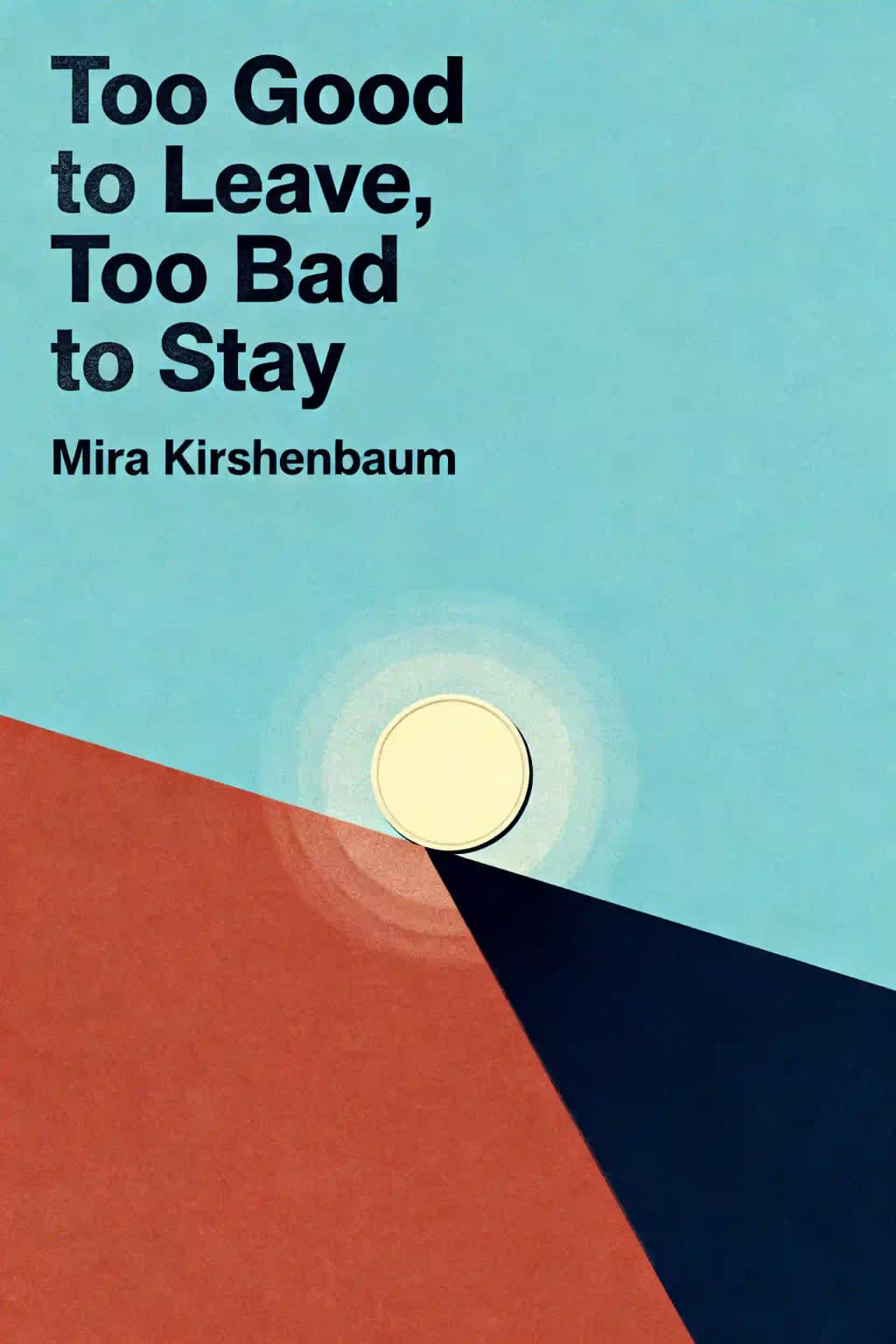
Trapped in relationship limbo? "Too Good to Leave, Too Bad to Stay" offers a revolutionary diagnostic approach that's guided indecisive couples for 25+ years. Rabbi Harold Kushner called it "wise, compassionate" - the book that transformed relationship ambivalence into clarity for thousands.
Mira Kirshenbaum is the internationally bestselling author of Too Good to Leave, Too Bad to Stay and a pioneering psychotherapist specializing in relationship dynamics and decision-making. As clinical director and co-founder of the Chestnut Hill Institute in Boston, she draws from over 25 years of experience counseling couples and individuals, with her work deeply rooted in feminist therapy and family systems.
Her expertise extends to other acclaimed books like Parent-Teen Breakthrough and The Weekend Marriage, which tackle communication and life transitions.
Kirshenbaum's media prominence includes frequent appearances on the Today Show, CNN, and interviews with Oprah Winfrey, bolstering her reputation in self-help and psychology. Her practical frameworks for resolving relational conflicts, such as the "1-2-3 method" for constructive arguments, reflect her focus on actionable solutions. Too Good to Leave, Too Bad to Stay has been translated into over 20 languages, solidifying its status as a globally trusted resource for relationship evaluation.
Too Good to Leave, Too Bad to Stay by Mira Kirshenbaum is a step-by-step guide for individuals experiencing relationship ambivalence. It uses diagnostic questions—like past happiness, affection, communication, and self-respect—to help readers decide whether to stay and work on the relationship or leave. The approach prioritizes prognosis over pros/cons, replacing indecision with clarity.
This book is ideal for those stuck in "iffy" relationships—feeling conflicted about staying or leaving. It suits anyone seeking objective criteria to evaluate their partnership, especially if they feel trapped between hope and frustration. The diagnostic framework helps readers move beyond emotional paralysis to make confident decisions.
Yes, it provides practical tools for relationship decision-making. Readers gain actionable insights through structured self-reflection, though some note limitations in neurodiverse contexts (e.g., ADHD) where effort may outweigh immediate results. Overall, it’s praised for reducing ambiguity and empowering choices.
Mira Kirshenbaum is a therapist and author specializing in relationship dynamics. Her expertise informs the book’s clinical yet accessible approach, blending diagnostic rigor with real-world examples. She emphasizes prognoses over vague feelings to resolve ambivalence.
The book’s pivotal questions include:
It advises identifying non-negotiable needs (e.g., respect, support) and assessing if they can be met. If core needs remain unfulfilled despite communication, leaving may yield greater happiness. The book stresses that persistent frustration signals incompatibility, not personal failure.
Sustained loss of self-respect—feeling controlled, humiliated, or invisible—signals a relationship is “too bad to stay.” The book argues this erosion indicates toxicity, making leaving essential for long-term well-being. Self-respect is non-negotiable for viable partnerships.
Yes. Some readers find it less applicable to neurodiverse relationships (e.g., ADHD), where intent may outweigh immediate change. Others note its 1996 publishing date makes certain examples feel dated. However, the core diagnostic approach remains widely valued.
It explicitly states that any physical violence or persistent power imbalances (e.g., humiliation, control) mean the relationship is “too bad to stay.” These red flags indicate toxicity, and leaving is strongly advised for safety and happiness.
Yes. If diagnostics show salvageability (e.g., fun shared, mutual respect), it guides strengthening the relationship. The book includes resources for improving communication and rebuilding connection, emphasizing that both partners must invest effort.
Unlike Gottman’s Seven Principles (focused on repair) or Perel’s erotic exploration, Kirshenbaum’s book first answers whether to stay. It’s a diagnostic prequel to those works—determining feasibility before solutions. Many pair it with Gottman for holistic growth.
Ambivalence persists in modern relationships, amplified by evolving dynamics like remote work or mental health awareness. The prognosis-focused framework adapts to contemporary stressors, offering timeless clarity for decisive action amid complexity.
Ressentez le livre à travers la voix de l'auteur
Transformez les connaissances en idées captivantes et riches en exemples
Capturez les idées clés en un éclair pour un apprentissage rapide
Profitez du livre de manière ludique et engageante
Relationship ambivalence is one of life's most painful states, and we desperately need a way out.
You can often fix what was broken, but rarely fix what never worked.
Abuse that happens more than once will escalate.
You can't fall in love with somebody you find fundamentally repulsive.
Décomposez les idées clés de Too Good to Leave, Too Bad to Stay en points faciles à comprendre pour découvrir comment les équipes innovantes créent, collaborent et grandissent.
Condensez Too Good to Leave, Too Bad to Stay en indices de mémoire rapides mettant en évidence les principes clés de franchise, de travail d'équipe et de résilience créative.

Découvrez Too Good to Leave, Too Bad to Stay à travers des récits vivants qui transforment les leçons d'innovation en moments mémorables et applicables.
Posez n'importe quelle question, choisissez la voix et co-créez des idées qui résonnent vraiment avec vous.

Cree par des anciens de Columbia University a San Francisco
"Instead of endless scrolling, I just hit play on BeFreed. It saves me so much time."
"I never knew where to start with nonfiction—BeFreed’s book lists turned into podcasts gave me a clear path."
"Perfect balance between learning and entertainment. Finished ‘Thinking, Fast and Slow’ on my commute this week."
"Crazy how much I learned while walking the dog. BeFreed = small habits → big gains."
"Reading used to feel like a chore. Now it’s just part of my lifestyle."
"Feels effortless compared to reading. I’ve finished 6 books this month already."
"BeFreed turned my guilty doomscrolling into something that feels productive and inspiring."
"BeFreed turned my commute into learning time. 20-min podcasts are perfect for finishing books I never had time for."
"BeFreed replaced my podcast queue. Imagine Spotify for books — that’s it. 🙌"
"It is great for me to learn something from the book without reading it."
"The themed book list podcasts help me connect ideas across authors—like a guided audio journey."
"Makes me feel smarter every time before going to work"
Cree par des anciens de Columbia University a San Francisco

Obtenez le resume de Too Good to Leave, Too Bad to Stay en PDF ou EPUB gratuit. Imprimez-le ou lisez-le hors ligne a tout moment.
Have you ever felt trapped in relationship purgatory? That painful state where you're not happy enough to stay but not miserable enough to leave? This emotional limbo is what Mira Kirshenbaum addresses in her groundbreaking work. The traditional pros-and-cons approach to relationship decisions often keeps us stuck in endless loops of indecision. We pile up good qualities, hopes, and fears on one side, and relationship problems on the other-like trying to weigh puppies on a teeter-totter. No wonder we remain paralyzed! What makes this ambivalence so destructive is how it manifests in our daily lives: mood swings about the relationship, denial of problems, obsessive analysis, or the exhausting cycle of breaking up and reconciling. We create emotional distance, communicate less meaningfully, and develop ritualistic interactions. In essence, we're having an intense affair with our own indecision while the actual relationship withers.