Chapitre 1
A Lighthouse in the Storm of Consciousness
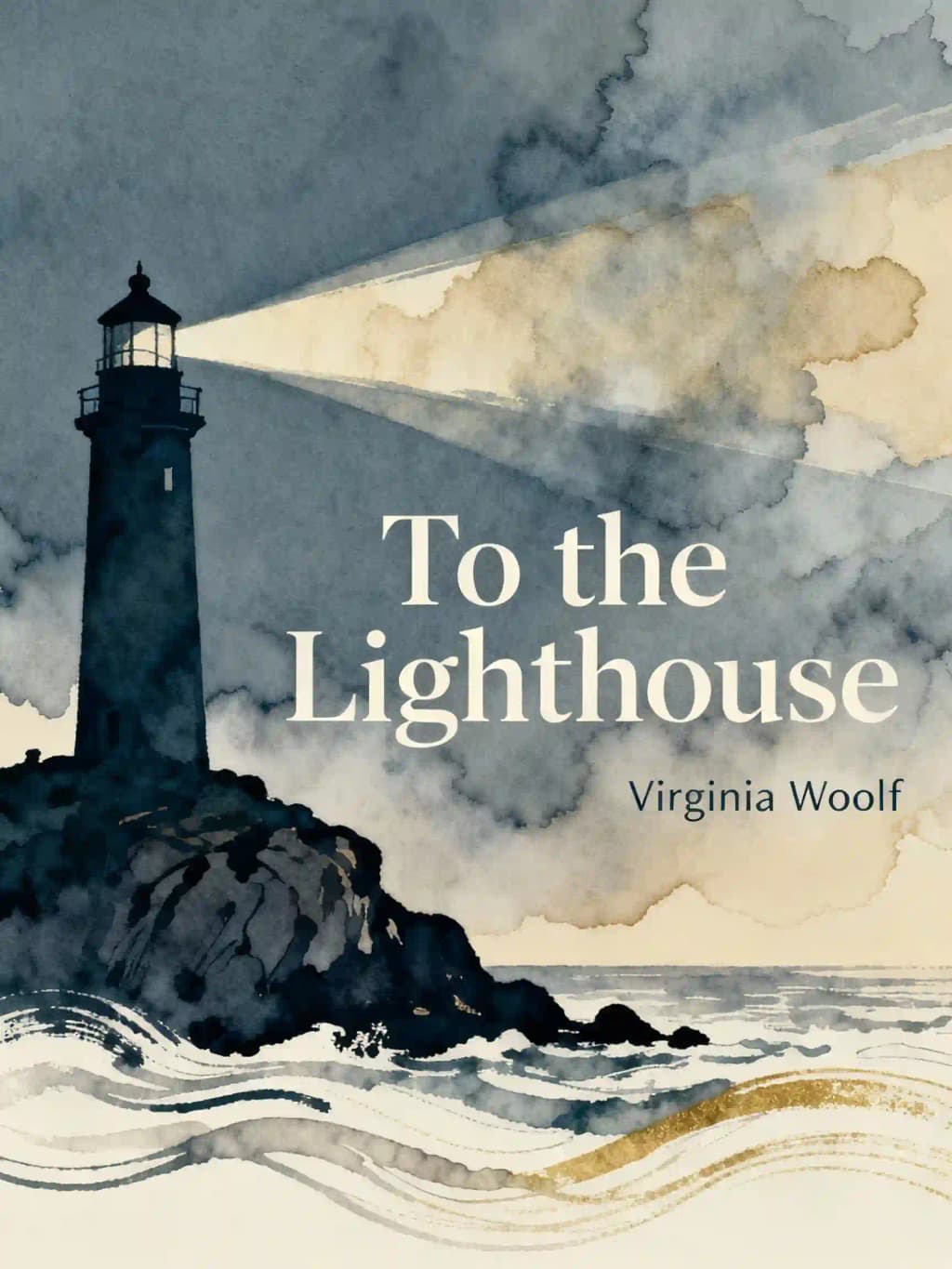
Virginia Woolf's "To the Lighthouse" stands as one of the most influential modernist novels ever written, a book that transformed the landscape of 20th-century literature with its revolutionary stream-of-consciousness technique. Published in 1927 during the interwar period, the novel has captivated readers for nearly a century, including notable admirers like Patti Smith and Michael Cunningham, who cited it as inspiration for his Pulitzer Prize-winning novel "The Hours." Beyond its literary significance, the book represents Woolf's most autobiographical work, drawing heavily from her childhood summers spent in Cornwall and her complex relationship with her parents. When Time magazine compiled its list of the 100 best English-language novels, "To the Lighthouse" earned its place among the greatest works of fiction, cementing Woolf's reputation as one of the most innovative voices in literary history.
Chapitre 2
The Ramsay Family: A Microcosm of Human Connection
At the heart of "To the Lighthouse" lies the Ramsay family-a sprawling, vibrant household headed by the philosophical Mr. Ramsay and his beautiful, intuitive wife. The novel opens with Mrs. Ramsay promising her youngest son James that they'll visit the nearby lighthouse the following day if weather permits. This simple premise becomes the framework for exploring the family's intricate dynamics and the visitors who orbit around them at their summer home on the Isle of Skye.
Mrs. Ramsay emerges as the novel's emotional center-a woman of extraordinary beauty and social grace who creates harmony among the disparate personalities in her household. She possesses an almost supernatural ability to understand others, particularly those who struggle socially. When she invites the awkward Charles Tansley to accompany her on errands, we witness her talent for drawing people out of themselves. Despite his working-class background and social discomfort, Tansley experiences a moment of transcendence in her presence, suddenly seeing her as "the most beautiful person he had ever seen." This transformative effect Mrs. Ramsay has on others appears repeatedly throughout the novel's first section.
In contrast, Mr. Ramsay represents intellectual rigor and emotional need. A philosopher who measures his intellectual achievements through the alphabet (reaching Q but struggling with R, while only the rarest minds reach Z), he constantly seeks reassurance about his work's significance. When he crushes James's hopes by insisting the weather will prevent their lighthouse trip, we see how his brutal honesty conflicts with his wife's nurturing approach. Their contrasting worldviews create a fascinating tension-he demands truth at all costs, while she prioritizes kindness and emotional well-being.
What makes the Ramsays so compelling is how their marriage, despite its tensions, contains moments of profound connection. After dinner, when Mrs. Ramsay silently communicates her love to her husband without speaking the words he craves, Woolf demonstrates how even the most intimate relationships contain spaces that words cannot bridge. Their silent communion reveals more about love's complexity than any conventional romantic scene could achieve.
Chapitre 3
The Window: Perception and Perspective
The novel's first section, "The Window," establishes Woolf's revolutionary approach to narrative. Rather than presenting events chronologically through an omniscient narrator, she filters everything through the consciousness of her characters, creating a kaleidoscopic view of reality where perception matters more than objective truth. This technique, known as stream of consciousness, allows readers to experience the rich inner lives of multiple characters simultaneously, revealing how individual perspectives shape and color our understanding of shared experiences.
The dinner party scene stands as arguably one of the most masterful passages in English literature, demonstrating Woolf's virtuosity in managing multiple viewpoints. As Mrs. Ramsay serves her boeuf en daube (a dish she's been anxious about throughout the day), Woolf orchestrates a complex symphony of consciousness, weaving together external dialogue with internal monologues. The seemingly simple act of serving dinner becomes a prism through which we witness the intricate social dynamics at play. When Mr. Ramsay bristles at a mention of Shakespeare, Minta Doyle's tactical intervention - claiming no one truly enjoys reading Shakespeare - showcases how social harmony often depends on small acts of diplomatic deception, a nuance Mrs. Ramsay appreciates with visible relief.
The dinner scene brilliantly illuminates how we exist simultaneously in shared social space and in our private mental worlds. While the characters exchange surface-level pleasantries about books and food, their minds race with judgments, memories, and anxieties that reveal their true preoccupations. Lily Briscoe, for instance, outwardly participates in dinner conversation while internally grappling with Charles Tansley's dismissive attitude toward women artists, her thoughts circling back to her unfinished painting and her artistic ambitions. Mrs. Ramsay, while masterfully orchestrating the social dynamics of the evening, privately worries about her children's futures and contemplates the transient nature of happiness. Mr. Bankes observes the scene with scientific detachment, his analytical mind categorizing and evaluating the social interactions before him like specimens under a microscope.
This multiplicity of perspectives creates a rich tapestry of human experience that conventional linear narrative couldn't possibly capture. The technique reveals how a single moment contains countless interpretations and emotional resonances. When Augustus Carmichael rises at dinner's end, continuing Mr. Ramsay's poetic recitation with his napkin held "like a white robe," the moment transcends its simple physical reality. For Mrs. Ramsay, it becomes a moment of profound connection, feeling Carmichael likes her better than ever before. As she crosses the threshold with Minta, her recognition that the scene "had become already the past" speaks to Woolf's larger preoccupation with time, memory, and the way moments of beauty and connection can achieve a kind of permanence through art and remembrance. The dinner party scene thus serves as a microcosm of the novel's larger themes: the tension between permanence and transience, the complexity of human connection, and the way art can preserve and illuminate the seemingly ordinary moments of life.
Chapitre 4
Lily Briscoe: The Artist's Vision
Through Lily Briscoe-an unmarried painter struggling to realize her artistic vision-Woolf explores the challenges of female creativity in a patriarchal world. Lily's determination to paint despite Charles Tansley's whispered assertion that "women can't paint" represents a quiet rebellion against societal expectations. This dismissive comment haunts her throughout the novel, symbolizing the broader cultural resistance to women's artistic ambitions in early 20th century Britain.
Her painting becomes a central metaphor for the novel's exploration of art's purpose and the nature of perception itself. When William Bankes examines her canvas, questioning the purple triangular shape representing Mrs. Ramsay and James, Lily struggles to articulate her artistic choices. She explains she's not attempting literal likeness but trying to capture the relationship between light and shadow-the essence rather than the appearance. This conversation reveals how art transforms lived experience into something both personal and universal. The purple triangle becomes a symbol of modern art's movement away from representation toward abstraction, challenging conventional notions of what constitutes "good" art.
Lily's relationship with Mrs. Ramsay is particularly complex, embodying the tension between traditional feminine roles and artistic ambition. While she admires Mrs. Ramsay's beauty and social grace, she resists her matchmaking efforts with Paul Rayley and others. Mrs. Ramsay's insistence that unmarried women "miss the best of life" represents the conventional wisdom Lily must overcome to pursue her art. Yet Lily also recognizes something profound in Mrs. Ramsay's ability to create moments of connection-a different kind of artistry that Lily both envies and questions. This ambivalence reflects the broader struggle of women artists to find models for their creative lives.
What makes Lily such a compelling character is her honesty about her limitations and her persistent self-doubt. She acknowledges her painting is "infinitely bad" yet continues anyway, driven by an inner necessity rather than external validation. Her struggle embodies the modernist conviction that meaning comes not from adhering to established forms but from the honest expression of subjective experience, however imperfect. Throughout the novel, Lily's artistic journey parallels her emotional one, as she grapples with questions of memory, perception, and the possibility of truly knowing another person.
In the novel's final scenes, Lily's completion of her painting coincides with her acceptance of Mrs. Ramsay's death and her own path in life. The single line down the center of her canvas becomes both an artistic solution and a metaphysical one, suggesting that art can bridge the gap between past and present, life and death, self and other. Her triumph is not in creating a masterpiece but in remaining true to her vision despite doubt, criticism, and social pressure.
Chapitre 5
Time Passes: The Indifference of Nature
The novel's middle section, "Time Passes," represents one of literature's most innovative treatments of time. In roughly twenty pages, Woolf compresses ten years, using the deteriorating summer house as a metaphor for time's relentless progression. The section begins with nightfall on the evening of the dinner party and concludes with Lily Briscoe's return to the house a decade later.
What makes this section so powerful is Woolf's decision to relegate major life events-including Mrs. Ramsay's sudden death, Andrew's death in the war, and Prue's death in childbirth-to parenthetical asides. By contrast, she lavishes poetic attention on the empty house's gradual decay: "Night after night, summer and winter, the torment of storms, the arrow-like stillness of fine weather, held their court without interference."
This inversion of conventional narrative priorities suggests that human drama, however significant to us, represents merely a blip in the larger rhythms of nature. The house, once animated by human presence, becomes "a shell filled with dry sea-sand" as nature reclaims it-toads nosing in, swallows nesting in the drawing room, thistles thrusting between tiles.
The section's power comes from its unflinching portrayal of entropy. Without human intervention, civilization quickly surrenders to nature's forces. Only Mrs. McNab's intervention-her "creaking and groaning" labor to restore order-prevents complete dissolution. Her character, with her "witless" eyes and lurching movements, embodies the persistent, unglamorous work required to maintain human spaces against time's assault.
This section also contains some of Woolf's most haunting imagery. The nights grow "full of wind and destruction," and Mr. Ramsay, after his wife's death, "stumbled along a passage stretching his arms out one dark morning, but Mrs. Ramsay having died the night before, he stretched his arms out. They remained empty." The stark simplicity of these lines, reporting devastating loss with such restraint, creates an emotional impact that more elaborate description couldn't achieve.
Chapitre 6
The Lighthouse: Reconciliation and Revelation
The novel's final section brings us full circle as Mr. Ramsay finally makes the journey to the Lighthouse with his children James and Cam. Ten years have passed since the promised trip, and James's childhood excitement has hardened into resentment toward his father. The journey becomes a metaphor for reconciliation and acceptance-not just between father and children but between past and present.
James's perspective reveals the complexity of father-son relationships. He harbors a childhood fantasy of striking his father with a knife, "not the old man himself" but the "tyrannical" force he represents. Yet as they sail, James recognizes two versions of his father-the domineering presence and the reasonable man who helps others. Similarly, he sees two versions of the Lighthouse-the distant, misty tower with a "yellow eye" from his childhood imagination and the stark, whitewashed rocks now visible up close. This dual vision suggests how our perception of both people and symbols evolves as we mature.
Meanwhile, Lily remains on shore, finally completing the painting she began ten years earlier. As she works, memories of Mrs. Ramsay flood back-sitting beside her on the beach, their silent communion, the perfection of those moments. She reflects on how we "know" people by constructing scenes about them, remembering Paul and Minta Rayley's troubled marriage and how Mrs. Ramsay's matchmaking ultimately failed.
The novel's final moments bring a sense of completion without artificial closure. When Mr. Ramsay reaches the Lighthouse, Lily declares, "He has landed," and feels relieved-"whatever she had wanted to give him when he left that morning, she had finally given." Returning to her canvas, she makes one decisive stroke: "With sudden intensity, as if she saw it clear for a second, she drew a line there, in the centre." The novel ends with her simple declaration: "I have had my vision."
Chapitre 7
The Art of Memory and Loss
Memory functions as both subject and technique throughout "To the Lighthouse." Woolf doesn't just depict characters remembering; she shows how memory itself works-fragmentary, associative, emotionally charged. When Lily returns to the summer house after ten years, her memories of Mrs. Ramsay appear not as coherent narratives but as vivid sensory impressions-the feel of sitting beside her on the beach, the sound of her voice reading poetry in the garden, the way she would arrange flowers in the evening light. These memories surface unpredictably, triggered by mundane objects: a green shawl draped over a chair, the pattern of light on the stairs, or the distant sound of waves that once formed the backdrop to their conversations.
The novel suggests that our memories of others are necessarily incomplete, a mosaic of moments rather than a complete picture. Lily reflects that to truly know Mrs. Ramsay, "one would need fifty pairs of eyes" to capture all her aspects-as hostess, mother, wife, friend, and the private self she rarely revealed. Our understanding of others comes not from comprehensive knowledge but from significant moments preserved in memory-what Woolf elsewhere called "moments of being." These crystallized instances-Mrs. Ramsay reading to James, measuring the stocking against his leg, or silently watching the lighthouse beam-become touchstones of meaning that the characters return to repeatedly.
Loss permeates the novel, most profoundly in Mrs. Ramsay's absence. Her death, reported in parentheses in "Time Passes," creates a void at the novel's center that the characters must navigate. The casual brutality of this literary technique-relegating a central character's death to a parenthetical aside-mirrors the arbitrary nature of loss itself. When Lily cries out for Mrs. Ramsay in the final section, her pain transforms into a vision of Mrs. Ramsay "wearing a wreath of white flowers"-an image that appears whenever Lily thinks of her death. This suggests how we transform loss into art, creating images that help us continue living with absence. The painting Lily struggles to complete becomes both a memorial to Mrs. Ramsay and a means of processing grief through artistic creation.
The novel's treatment of World War I-obliquely referenced through Andrew's death when "a shell exploded" in France-reflects the modernist challenge of representing historical trauma. Rather than directly depicting the war, Woolf shows its effects through subtle intrusions into domestic life: the "ominous sounds like hammer blows" that disturb the summer's peace, the "ashen-coloured ships" appearing and vanishing on the horizon, the gradual decay of the summer house during the war years. This indirect approach captures how historical events intrude upon private consciousness, altering perception even at a distance. The war's presence is felt most keenly in absences-empty chairs at dinner, unfinished conversations, and the loss of potential represented by Andrew's death, which ends Mrs. Ramsay's hopes for his brilliant academic future.
Through these layered explorations of memory and loss, Woolf creates a narrative that mirrors the way we actually experience remembrance-not as a linear story, but as a complex web of associations, images, and emotions that continue to shape our present moment.
Chapitre 8
The Lighthouse: Symbol and Reality
The Lighthouse stands as the novel's central symbol, its meaning morphing and refracting through different characters' perspectives like the very beam of light it casts across the waters. For young James, it embodies the realm of adventure and infinite possibility, a magical destination that captures his childhood imagination. His father's stern prohibition of the trip therefore becomes more than a simple denial - it represents the crushing of dreams and the first harsh collision between childhood fantasy and adult authority. This early disappointment shapes James's relationship with both the Lighthouse and his father for years to come.
For Mr. Ramsay, the Lighthouse represents something entirely different - a practical destination to be reached through logical navigation, much like his philosophical pursuits. His view of it as merely a physical objective reflects his character's tendency to strip away sentiment in favor of stark reality. This approach both defines and limits him, showing how his rational mindset both serves and constrains his understanding of the world and his relationships.
Lily Briscoe's perspective adds another layer of meaning, as she views the Lighthouse from her position on shore. For her, it becomes both a physical anchor point for her composition and a metaphorical focal point around which she can organize her artistic vision. Through her eyes, we see the Lighthouse as a fixed point in a world of flux, helping her to finally complete the painting that has haunted her for ten years.
The power of the Lighthouse as a symbol stems from its dual nature - its concrete physical presence and its shimming symbolic significance. It exists in the material world as a functional structure, maintained by keepers who receive the Ramsays' practical gifts of supplies. Yet simultaneously, it radiates different meanings for each character who contemplates it, much like its beam sweeping across the waters, touching each observer differently.
James's eventual dual vision of the Lighthouse near the novel's conclusion masterfully captures this essential duality. He recognizes both the misty, romantic lighthouse of his childhood dreams - tall, mysterious, and promising - and the stark, whitewashed tower of adult reality. This double perspective suggests a maturation that doesn't entirely discard childhood vision but rather incorporates it into a more complex understanding.
The long-delayed journey to the Lighthouse becomes a powerful metaphor for the gap between human intention and accomplishment, between youthful dreams and adult compromise. When Mr. Ramsay finally reaches its rocky base, springing "lightly like a young man," the moment carries both triumph and subtle disappointment. The achievement matters not because the Lighthouse itself holds some inherent significance, but because the journey represents a form of emotional closure - healing James's childhood wound, offering Mr. Ramsay a way forward from grief, and bringing the narrative full circle to its resolution.
Chapitre 9
The Revolutionary Style: Stream of Consciousness
Woolf's narrative technique represents perhaps her most significant contribution to literary history. Rather than using conventional plot development, she creates a narrative composed primarily of internal monologues, sensory impressions, and shifts in perspective. This approach, known as stream of consciousness, attempts to capture the way consciousness actually works-associative rather than linear, subjective rather than objective.
Consider how Woolf depicts Mrs. Ramsay's mind while she knits and reads to James: her attention moves fluidly between the story, her concerns about Paul and Minta's relationship, memories of her own youth, and observations about the room around her. This mental movement feels authentic precisely because it's not organized into neat paragraphs of thought but flows naturally between concerns, just as our own minds do.
The novel's style also reflects its philosophical interests. By showing how differently each character perceives the same events-the dinner party, the summer house, the Lighthouse itself-Woolf suggests that objective reality matters less than subjective experience. When Lily and William Bankes observe the Ramsays from across the lawn, they momentarily see them as symbols of marriage before they return to being "ordinary people." This shifting between symbolic and literal perception characterizes how we actually experience the world-finding meaning in ordinary moments before returning to practical concerns.
What makes Woolf's technique so revolutionary is how it dissolves the boundary between character and environment. When Mrs. Ramsay sits alone knitting, experiencing a profound sense of peace, she becomes "a wedge of darkness" where personality dissolves. The lighthouse beam, searching into her mind, seems to purify lies from existence. This fusion of consciousness with surroundings creates moments of transcendence where individual identity temporarily merges with something larger-what Lily calls "being in love" not with a person but with existence itself.
Chapitre 10
The Triumph of Art and Vision
Ultimately, "To the Lighthouse" celebrates the human capacity for creation and connection despite time's ravages and death's finality. The novel suggests that art-whether Lily's painting, Mrs. Ramsay's dinner parties, or the novel itself-provides a way of ordering experience that resists chaos and meaninglessness.
When Lily finally completes her painting in the novel's final moments, she achieves what she calls her "vision"-not a perfect representation but an honest expression of her subjective truth. Her simple declaration, "I have had my vision," suggests that meaning comes not from external validation but from the integrity of the creative act itself. The painting may end up "in attics" or be destroyed, but this doesn't diminish its significance for Lily.
Similarly, though Mrs. Ramsay dies midway through the novel, her creative acts endure in memory. The dinner party she orchestrates achieves a kind of permanence through its effect on others. When Lily remembers how Mrs. Ramsay made ordinary moments significant, she acknowledges a different kind of artistry-the ability to transform daily life into something meaningful through attention and care.
The novel's structure itself-beginning with the anticipated lighthouse trip and ending with its completion-creates a sense of artistic closure while acknowledging life's messiness. The ten-year gap between intention and fulfillment, with its losses and changes, represents how human plans interact with time's unpredictability. Yet the journey happens eventually, suggesting that meaning persists even when delayed or transformed.
Through its revolutionary style and profound exploration of consciousness, "To the Lighthouse" offers not just a story but an experience-one that continues to illuminate how we perceive, remember, and create meaning nearly a century after its publication. Woolf's masterpiece reminds us that though time passes and people die, vision endures-in art, in memory, and in moments of connection that transcend ordinary existence.