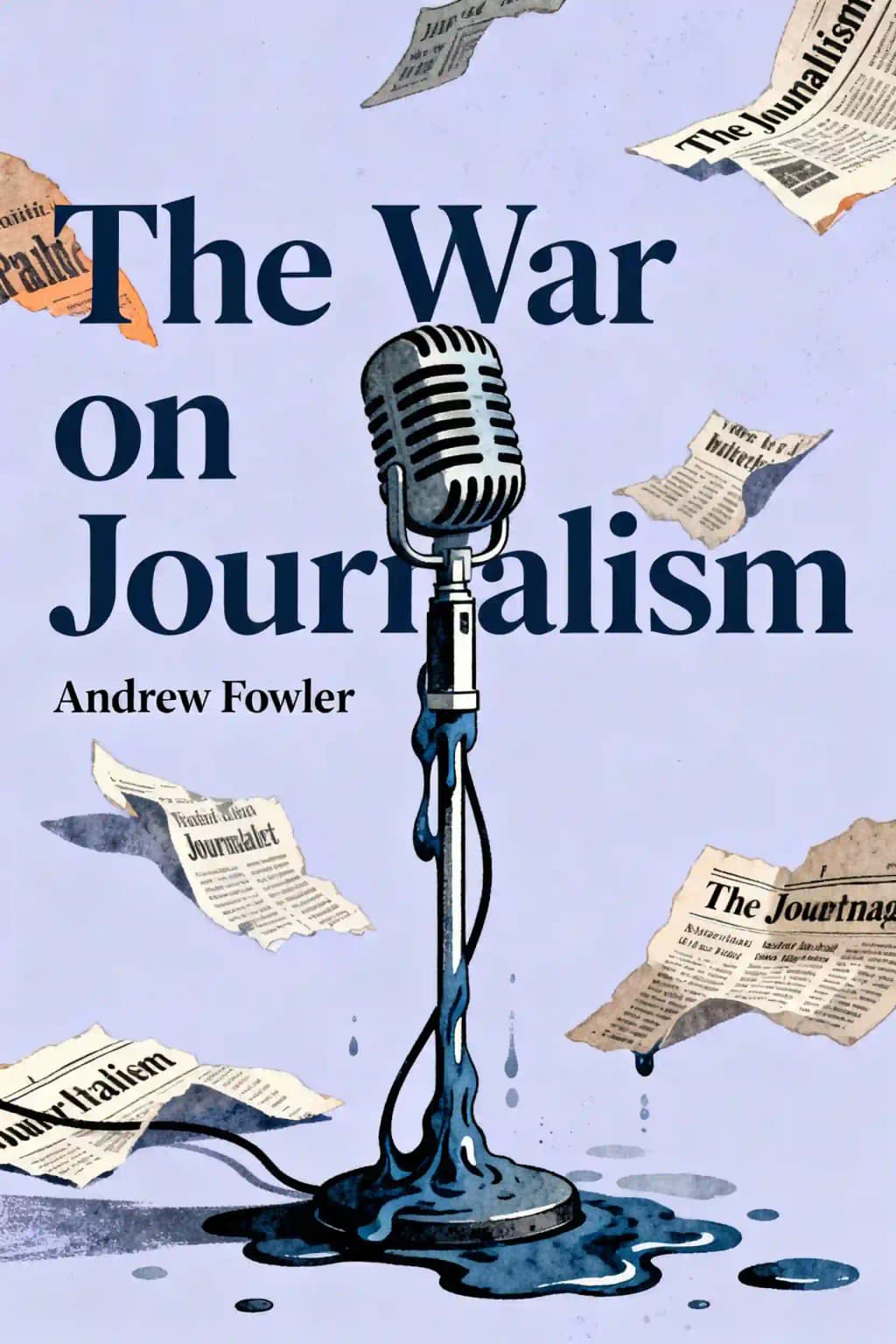
In "The War on Journalism," investigative veteran Andrew Fowler exposes how governments silence truth-seekers in our post-Snowden world. What's the real cost when whistleblowers are hunted and media moguls control the narrative? Democracy's watchdogs are under fire - and we're all paying the price.
Ressentez le livre à travers la voix de l'auteur
Transformez les connaissances en idées captivantes et riches en exemples
Capturez les idées clés en un éclair pour un apprentissage rapide
Profitez du livre de manière ludique et engageante
Picture a 26-year-old tech worker sitting in a Hawaiian office, watching in real time as his government vacuums up the private communications of millions of innocent people. Edward Snowden faced a choice that summer of 2012: stay silent and complicit, or risk everything to expose the truth. He chose the latter, but not before carefully considering where to take his evidence. The New York Times? They'd previously sat on explosive national security stories after "consulting" with officials. The Washington Post? When they finally published some of Snowden's documents, they admitted to clearing it with the government first and only printed four of the 41 slides he'd provided. This wasn't journalism-it was stenography with a permission slip. Snowden's decision to bypass establishment media and reach out to filmmaker Laura Poitras and blogger Glenn Greenwald marked a watershed moment. Traditional gatekeepers had failed so spectacularly that a whistleblower risking life imprisonment trusted independent outsiders more than Pulitzer-winning institutions. Intelligence agencies undermining elected governments sounds like conspiracy theory material until you examine the historical record. In 1960s Britain, roughly 30 MI5 officers actively plotted against Prime Minister Harold Wilson, convinced without evidence he was a Soviet spy. This wasn't passive suspicion-it was an organized campaign involving military leaders and media barons. General Sir Walter Walker assembled a private army while Lord Mountbatten reportedly stood ready to have the Queen request military intervention during manufactured "breakdowns in law and order." The media's role proved essential to this shadow coup. Mountbatten cultivated journalists like Chapman Pincher, inviting him to his palatial estate for exclusive access. Pincher specialized in flattering intelligence agencies, becoming what historian E.P. Thompson brilliantly described as "a kind of official urinal where high officials of MI5 and MI6 stand side by side patiently leaking." Meanwhile, "Clockwork Orange"-a black propaganda operation-planted forged documents through journalists suggesting Labour ministers were communists or IRA sympathizers. Australia experienced similar interference when Prime Minister Gough Whitlam questioned US military bases on Australian soil. Rupert Murdoch's newspapers turned viciously against him, declaring the country was "Spinning Out of Control." When Whitlam threatened to close the Pine Gap surveillance facility, former CIA officer Victor Marchetti later admitted it "caused apoplexy in the White House." On November 11, 1975, Governor-General Sir John Kerr-who had CIA connections-dismissed the elected government.
Décomposez les idées clés de The War on Journalism en points faciles à comprendre pour découvrir comment les équipes innovantes créent, collaborent et grandissent.
Condensez The War on Journalism en indices de mémoire rapides mettant en évidence les principes clés de franchise, de travail d'équipe et de résilience créative.

Découvrez The War on Journalism à travers des récits vivants qui transforment les leçons d'innovation en moments mémorables et applicables.
Posez n'importe quelle question, choisissez la voix et co-créez des idées qui résonnent vraiment avec vous.

Cree par des anciens de Columbia University a San Francisco
"Instead of endless scrolling, I just hit play on BeFreed. It saves me so much time."
"I never knew where to start with nonfiction—BeFreed’s book lists turned into podcasts gave me a clear path."
"Perfect balance between learning and entertainment. Finished ‘Thinking, Fast and Slow’ on my commute this week."
"Crazy how much I learned while walking the dog. BeFreed = small habits → big gains."
"Reading used to feel like a chore. Now it’s just part of my lifestyle."
"Feels effortless compared to reading. I’ve finished 6 books this month already."
"BeFreed turned my guilty doomscrolling into something that feels productive and inspiring."
"BeFreed turned my commute into learning time. 20-min podcasts are perfect for finishing books I never had time for."
"BeFreed replaced my podcast queue. Imagine Spotify for books — that’s it. 🙌"
"It is great for me to learn something from the book without reading it."
"The themed book list podcasts help me connect ideas across authors—like a guided audio journey."
"Makes me feel smarter every time before going to work"
Cree par des anciens de Columbia University a San Francisco

Obtenez le resume de The War on Journalism en PDF ou EPUB gratuit. Imprimez-le ou lisez-le hors ligne a tout moment.