Chapitre 1
The Insatiable Quest for Knowledge: A Journey Through Human Thought
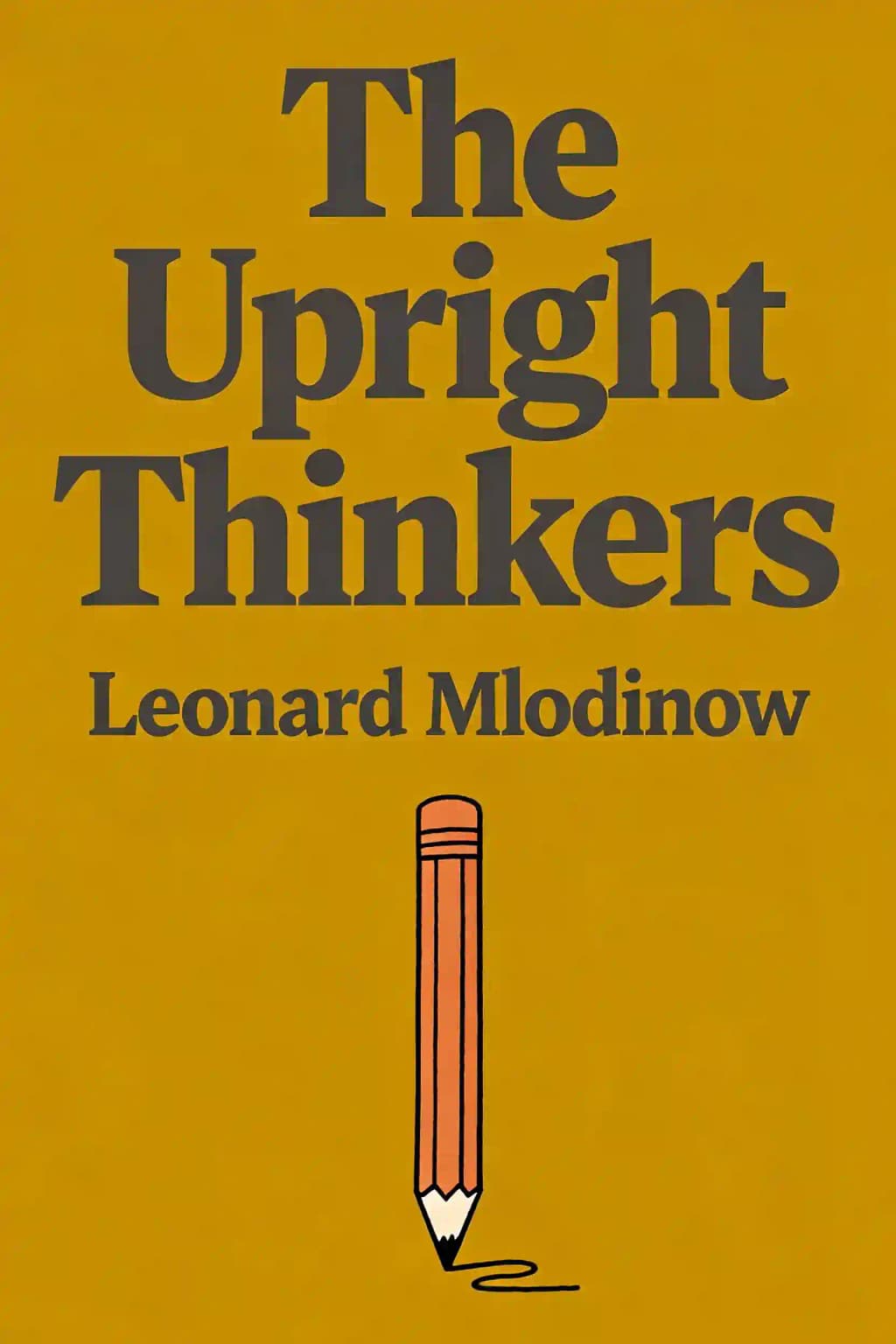
In a Nazi concentration camp, a starving prisoner traded his precious bread ration for the solution to a math puzzle. This was my father - demonstrating humanity's extraordinary drive for knowledge even in the most desperate circumstances. What makes this story so powerful is how it captures our unique identity as "upright thinkers." Unlike other species that merely react to their environment, humans possess an insatiable curiosity about the universe and our place within it. This intellectual hunger has propelled us from primitive cave dwellers to space explorers in a remarkably short evolutionary timespan. Leonard Mlodinow's "The Upright Thinkers" has become a cultural touchstone for understanding this journey, praised by figures from Bill Gates to Neil deGrasse Tyson for its illuminating exploration of how human knowledge evolved. The book's enduring popularity stems from its ability to connect our ancient quest for understanding with the cutting-edge science that shapes our modern world.
Chapitre 2
From Survival Instinct to Scientific Inquiry
What fundamentally separates humans from other animals isn't just our physical attributes but our relationship with knowledge itself. While a lizard freezes then flees when approached - following instincts that served its species for millions of years - humans question, analyze, and seek to understand potential dangers. This intellectual curiosity has allowed us to shape our environment rather than being shaped by it.
Our evolutionary journey began with tiny, furry-tailed mammals that emerged after the asteroid impact eliminated dinosaurs 66 million years ago. Nature needed 60 million years to produce our ape ancestors, a few million more for our physical evolution, but cultural evolution took merely 10,000 years - an extraordinary acceleration. Lucy (Australopithecus afarensis), discovered in Ethiopia in 1974, represents a critical transition point from 3.2 million years ago - upright-walking but with a brain only slightly larger than a chimpanzee's. About two million years ago, Homo habilis ("Handy Man") emerged with a brain twice Lucy's size, using intelligence to survive on dangerous African savannas as forests receded.
The Paleolithic era saw humans living as nomads, with women gathering plants and men hunting, moving seasonally to follow food sources. The land could support only about one person per square mile, so people lived in small wandering groups of fewer than a hundred. But something remarkable happened around 12,000 years ago - the Neolithic revolution marked humanity's transition from this lifestyle to settling in villages and shifting from gathering food to producing it.
Instead of merely reacting to nature, humans began actively shaping their environment - building homes, forging tools, weaving baskets, creating pottery, and storing surplus food. While archaeologists once viewed this transition as a mere adaptation to climate change, recent discoveries suggest a deeper transformation in human thinking - one that would ultimately lead to the development of cities, specialized knowledge, and the foundations of scientific thought.
Chapitre 3
The Birth of Urban Knowledge
The first cities emerged gradually around 4000 BC in the Near East, with Uruk in southeastern Iraq becoming particularly prominent. Despite the surrounding desert, settlers were drawn to Mesopotamia ("between the rivers") where the Tigris and Euphrates created a fertile plain. Initially limited by natural boundaries, communities learned to dig extensive irrigation canals and reservoirs, enabling population growth and eventual urbanization.
These irrigation projects required extraordinary effort - canals stretching miles and measuring up to seventy-five feet wide, all dug with crude tools. Such massive undertakings required hundreds or thousands of workers plus planners and supervisors. The resulting food surpluses allowed families to support more children, accelerating population growth. By 4000 BC, villages had grown into cities, with Uruk housing between fifty and a hundred thousand inhabitants.
Specialized professions flourished, with evidence showing the development of textile industries, pottery production, and various crafts. This specialization represented a magnificent milestone in human intellectual history. Though practical knowledge remained entangled with myth and ritual (beer recipes included instructions for currying favor with goddesses), the combined expertise of these specialists generated an unprecedented explosion of knowledge.
Beyond material production, new intellectual professions emerged to organize urban life. Cities required exchange systems, communal storage, militias, and coordination of massive public works. As settlements grew from hundreds to thousands, interactions between strangers became common, necessitating formal conflict resolution methods and policing. From these first bureaucracies emerged humanity's most important mental technologies: reading, writing, and arithmetic.
Chapitre 4
The Power of Written Knowledge
Unlike other animals who can only communicate simple signals, humans uniquely influence each other's thoughts through complex language. While chimps can identify objects and parrots can repeat phrases, they cannot master grammar or syntax. Language evolved as a biological adaptation in humans because complex cooperative behavior was essential for survival.
Spoken language appears to have developed independently in every human group, but written language required invention and marks a defining trait of civilization. Writing allowed communication across space and time, enabling knowledge accumulation beyond individual memory. Despite thousands of spoken languages worldwide, only about a hundred have been written down, with writing independently invented just a few times in human history.
The earliest writing emerged in Sumer on clay tablets from Uruk, primarily serving mundane accounting purposes - 85% of excavated tablets recorded transactions like grain sacks and cattle counts. These utilitarian records enabled urban civilization by facilitating the complex relationships essential to city life. Early writing systems began with simple slashes representing quantities, evolving to include pictograms and eventually compound signs and verbs. This cuneiform system's complexity necessitated a privileged scholarly class - the first professional thinkers.
Around 2500 B.C., the first schools appeared - "tablet houses" where aspiring scribes spent years memorizing thousands of characters. This development marked a crucial innovation: society creating a profession devoted to passing knowledge to the next generation. Over time, the Sumerians simplified their writing system from two thousand to about five hundred pictograms. As writing became more flexible, schools expanded beyond basic skills to include specialized vocabulary for astronomy, geology, biology, and medicine. The greatest breakthrough came with the Phoenician script around 1200 B.C. - the first true alphabet using only a couple dozen symbols, which would eventually spread through the Middle East and into Europe via Greece.
The practice of mathematics also emerged as an art expressed through symbolic language. Unlike ordinary language, mathematical symbols precisely express relationships between ideas. Babylonian mathematics suffered from poor notation - all calculations were expressed in ordinary language, making logical analysis inefficient. Notational innovation emerged during the classical age of Indian mathematics around 500 A.D., introducing the base ten system, zero as a number, negative numbers, and symbols for unknowns.
Before scientific laws could be theorized, the concept of "law" itself needed to be invented. The Code of Hammurabi established basic rules of justice for Babylonian society. The Babylonians believed their god Marduk created laws not just for humans but for nature itself - the first "scientific laws," though unlike modern laws, they were commands that nature must follow rather than descriptions of natural behavior. Not until Kepler in the early seventeenth century did "law" begin to mean observation-based generalizations describing natural phenomena without purpose or motive.
Chapitre 5
The Greek Revolution in Thought
In 334 B.C., twenty-two-year-old Alexander of Macedon led an army to conquer the Persian Empire. The Near Eastern cities he conquered were ancient and magnificent - had Uruk been America, we would now be on our six hundredth president. Yet these cultures had been intellectually surpassed by the Greek-speaking world, which had developed a new, rational approach to understanding the universe.
In early Greece, understanding of nature mirrored Mesopotamian beliefs - Zeus's indigestion might explain bad weather, and poor harvests were attributed to angry gods. For us moderns, beneficiaries of scientific thought, it's difficult to grasp how differently the ancients perceived nature. Where we see order, causality, and mathematical precision, they saw divine whim and chaos.
The revolutionary shift to viewing the universe as ordered (Cosmos) rather than random (Chaos) began in sixth century B.C. in Ionia, along the Aegean shores of present-day Turkey. Miletus, situated on the Gulf of Latmus with access to the Mediterranean, became the vanguard of Greek enlightenment. By 600 B.C., it had grown into an ancient New York City of 100,000 people, attracting refugees from across Greece. Its cosmopolitan environment, where diverse cultures met and argued, created openness to new thinking and willingness to question conventional wisdom.
Thales, born around 624 B.C., was the first of these revolutionary thinkers. He used his wealth to travel extensively, particularly to Egypt where he applied geometric techniques to calculate pyramid heights and determine ships' distances at sea. Upon returning to Greece, he transformed Egyptian mathematics into something more profound: a body of theorems connected by logical deduction. But Thales's true revolutionary contribution was his approach to explaining physical phenomena through natural principles rather than supernatural intervention.
While Thales pioneered natural explanations, Pythagoras promoted the revolutionary idea that the cosmos was structured according to numerical relationships. The Pythagoreans believed number is the essence of reality - a concept that profoundly influenced later Greek thinkers, especially Plato, and scientists throughout European history.
Aristotle (384-322 B.C.) took a different approach, favoring detailed natural observation over abstract laws. His approach to science centered on understanding change, which he divided into natural change (originating within objects themselves) and violent change (caused by external forces). Aristotle understood movement not as something to be measured but as a phenomenon whose purpose could be discerned. He believed the universe was one large ecosystem designed to function harmoniously, seeing purpose everywhere - rain falls because plants need water; plants grow so animals can eat them. This teleological approach would endear him to Christian philosophers but impede scientific progress for nearly two thousand years.
Chapitre 6
The Long Path to Modern Science
The first great stumbling block in scientific development was the Roman conquest of Greece in 146 B.C. The rise of Rome began centuries of declining interest in philosophy, mathematics, and science because practical-minded Romans placed little stock in theoretical pursuits. During the thousand-year Roman period, they produced not one mathematician of note - an astounding fact showing the enormous effect of culture on intellectual development.
After the Western Roman Empire's dissolution in A.D. 476, things worsened as cities shrank, feudalism arose, and intellectual life centered in monasteries focused on religious issues. Fortunately, the Muslim ruling class valued Greek learning and funded translations of Greek science into Arabic. For hundreds of years, medieval Islamic scientists made great progress in optics, astronomy, mathematics, and medicine, overtaking the dormant Europeans.
The revival of science in Europe began toward the end of the eleventh century when Benedictine monk Constantinus Africanus began translating ancient Greek medical treatises from Arabic to Latin. In 1085, during the Christian reconquest of Spain, whole libraries of Arabic books fell into Christian hands, and over the next decades, large numbers were translated. The impact was profound - like a contemporary archaeologist discovering ancient tablets containing advanced scientific theories beyond our own.
The development of universities transformed Europe and drove scientific advancement. Growing affluence and career opportunities for the educated drew students and teachers to centers of learning like Bologna, Paris, Padua, and Oxford. Initially organizing as voluntary associations modeled after trade guilds, these "universities" eventually became permanent institutions where natural science became the focus and scholars stimulated one another through interaction.
The scientific revolution that transformed our view of nature didn't emerge suddenly with Copernicus or culminate neatly with Newton. Rather, it built upon gradual changes and the foundational work of medieval thinkers at Europe's early universities. The greatest of this work came from mathematicians at Merton College, Oxford, between 1325 and 1359. Though medieval science is often dismissed, these forgotten heroes of physics made remarkable progress despite their cultural limitations.
The Merton scholars identified motion as the most fundamental type of change - a profound insight, as most changes are specific to particular substances, while the laws of motion apply universally to all matter. Their task was challenging not only because of primitive mathematics but because they had to overcome a worldview where time was experienced subjectively rather than as the objective, measurable framework we take for granted today.
Chapitre 7
Galileo's Experimental Revolution
Though medieval scholars had advanced rational and empirical scientific methods, the grand explosion of European science didn't immediately follow. Instead, inventors and engineers transformed European society during the early Renaissance, creating the first great civilization not powered primarily by human muscle. Waterwheels, windmills, and new mechanical linkages powered sawmills and flour mills, generating wealth that fostered learning and literacy.
The printing press, invented around 1450, revolutionized the circulation of ideas throughout Europe. Within decades, more books were printed than scribes had produced in all preceding centuries combined. Knowledge became available to a wider citizenry, with nearly a thousand mathematics texts published by 1600.
Into this intellectual climate, Galileo was born in Pisa in 1564. Though sent to study medicine at the University of Pisa, he gravitated toward mathematics, studying Euclid and Archimedes. By the time he arrived at the University of Padua, he had grown disenchanted with Aristotelian physics. While Aristotle's approach consisted of observation and theorizing, Galileo added a crucial third step: experimentation.
Two aspects of Galileo's experimental approach proved revolutionary. First, when results surprised him, he questioned his own thinking rather than rejecting the evidence. Second, he made his experiments quantitative, measuring rather than merely observing. Working without modern equipment - not even a clock - Galileo improvised ingenious solutions, such as creating a water clock to measure time intervals.
Galileo employed this water clock to investigate free fall, a phenomenon Aristotle had claimed was governed by an object's weight - heavier objects supposedly falling faster than lighter ones. Unable to directly measure the rapid motion of falling objects, Galileo brilliantly slowed the process by rolling polished bronze balls down smooth inclined planes at various angles. He discovered that regardless of weight, the balls traveled distances proportional to the square of the time elapsed - indicating constant acceleration. Through this elegant reasoning, Galileo replaced Aristotle's law of free fall with his own revolutionary principle: in the absence of air resistance, all objects fall with the same constant acceleration.
Beyond his physical experiments, Galileo employed thought experiments to challenge Aristotelian physics. One persistent question had troubled natural philosophers: what keeps a projectile moving after the initial force is applied? Galileo addressed this through an elegant thought experiment involving a ship at sea, reasoning that objects in uniform motion tend to maintain that motion just as objects at rest tend to remain at rest. This insight led to Galileo's most profound break with Aristotelian physics: the law of inertia.
Chapitre 8
Newton's Mechanical Universe
When Galileo published his Discourses, he had brought humanity only to the threshold of a new intellectual world. It would be Isaac Newton who would take the final giant steps, completing the blueprint for an entirely new way of thinking. Newton's work marked the definitive abandonment of the Aristotelian view of nature driven by purpose, replacing it with a Pythagorean universe governed by numbers.
Newton's thinking permeates modern culture - from America's founding fathers invoking "the Laws of Nature" in the Declaration of Independence to our everyday language about forces of character, mental inertia, and momentum of teams. Though Newton's laws seem simple to modern students, they represented an astonishing intellectual achievement that required breaking free from centuries of established worldviews.
Despite his intellectual triumphs, Newton was a deeply isolated figure whose childhood shaped his personality. Born premature on December 25, 1642, to a widowed mother who later abandoned him for a new husband, young Isaac once threatened "to burne them and the house over them." After being banished to his grandmother and later boarding with an apothecary, Newton was eventually sent to Cambridge in 1661. There, despite his lowly status as a "subsizar" performing menial duties for wealthier students, he rejected the Aristotelian curriculum and began studying Kepler, Galileo, and Descartes.
The storybook image of Newton suddenly discovering gravity from a falling apple is destructive, implying physicists make progress through sudden insights rather than gradual understanding. Newton's breakthroughs during the plague years (1664-1666) weren't immediate revelations - his complete understanding of force and motion would take nearly twenty more years to perfect. His revolutionary development of calculus introduced the concept of instantaneous speed by imagining infinitesimally small time intervals - creating mathematics that could describe change at any specific moment.
All scientists have more wrong ideas than right ones, with the best innovations often starting as seemingly crazy notions. During a decade of isolation in his thirties, Newton devoted himself to biblical analysis and alchemy - not as irrational diversions, but as part of his unified quest to understand the world's truths. He believed ancient wisdom was encoded in religious texts and alchemical writings, requiring careful decoding by the pious.
Chapitre 9
Chemistry and the Material World
Newton's alchemical pursuits, far from being mere superstition, represented a systematic approach to understanding matter's composition. He spent thirty years conducting meticulous alchemical experiments, believing ancient practitioners had discovered profound chemical truths encoded in Greek myths. His willingness to explore unorthodox ideas demonstrates that even brilliant minds can be led astray, especially when working in intellectual isolation.
The late eighteenth century marked the beginning of the industrial revolution, when science and manufacturing began spurring each other to greater accomplishments. Joseph Priestley, supported by the Earl of Shelburne, conducted experiments with mercury oxide and discovered oxygen, which intensified flames and allowed mice to survive longer in sealed containers. He even sampled it himself, noting his "breast felt peculiarly light and easy."
Despite these discoveries, Priestley misinterpreted his findings, subscribing to the popular "phlogiston" theory that burning released something rather than absorbed oxygen. It was Antoine Lavoisier who correctly explained that respiration and combustion involved absorbing oxygen from air. Lavoisier transformed chemistry through meticulous measurement and theoretical insight, establishing the law of conservation of mass - that the total mass of products in a chemical reaction equals the mass of initial reactants. This milestone marked the shift from alchemy to modern chemistry by identifying chemical change as the combining of elements.
Though Lavoisier scorned the concept of atoms as impractical, John Dalton, a methodical Quaker schoolteacher, later developed a way to calculate atomic weights from laboratory measurements. Dalton assigned hydrogen a weight of "1" and calculated all other elements relative to it. Though his assumption that elements combine in the simplest proportions led to some errors, his work created a quantitative language for chemistry that revolutionized chemists' ability to understand chemical reactions.
Chapitre 10
The Living World and Darwin's Revolution
While chemistry revealed the composition of matter, another revolution was unfolding in our understanding of living organisms. Antoni van Leeuwenhoek's microscopes achieved magnifications ten times those of Robert Hooke through superior craftsmanship. His instruments were simple devices with single lenses ground from glass fragments or sand grains, mounted on gold and silver plates. With these instruments, Leeuwenhoek discovered entire previously unknown microorganisms - "animalcules" thousands of times smaller than anything visible to the naked eye.
Charles Darwin, fittingly buried near Newton in Westminster Abbey, became biology's Newton despite initial skepticism about his work. His publisher gave On the Origin of Species a modest first printing of 1,250 copies, with one early reviewer suggesting Darwin write about pigeons instead. Darwin's doubts proved unfounded - the book sold out immediately and has remained in print ever since, validating his twenty-year effort accumulating evidence for his ideas.
Before Darwin, biologists had gathered extensive descriptive details about life forms but lacked understanding of what drove species' characteristics. The field was constrained by biblical creation stories suggesting species were fixed and unchangeable. Darwin changed this fundamentally. His theory towered over previous speculations like a majestic specimen of careful science, offering a hundred pieces of evidence for every one his precursors supplied. Most importantly, he discovered natural selection as the mechanism behind evolution, making the theory testable and scientifically respectable.
Born in Shrewsbury in 1809 to a wealthy family, Charles Darwin was a poor student who claimed to have "no special talents" despite recognizing his "great curiosity about facts and their meaning." His opportunity arose when Professor John Henslow recommended him as naturalist for the HMS Beagle's voyage around the world. The five-year voyage (1831-1836) was physically uncomfortable but provided extraordinary experiences: Darwin witnessed Carnival in Brazil, volcanic eruptions in Chile, earthquakes, and political revolutions while collecting specimens and fossils.
Darwin's examination of his specimens yielded surprising revelations: South American fossils suggested a "law of succession" where extinct mammals had been replaced by similar species; Galapagos mockingbirds proved to be island-specific species; and a partially-eaten rhea specimen revealed a new species competing with common rheas in intermediate zones. After reading Malthus's Essay on Population, Darwin realized that while organisms reproduce exponentially, limited resources mean only the best-adapted individuals survive - a process he called "natural selection."
Chapitre 11
Beyond Human Experience: The Quantum Revolution
Two million years ago, humans created our first innovation by turning stone into cutting tools. A century ago, we made an equally significant discovery concerning something invisible but omnipresent: the atom and its quantum laws. This shift created new demands on scientists. While Newton's science relied on sensory perception, twentieth-century physics accepted a broader definition of "seeing" that includes indirect statistical evidence.
The physicists studying atoms in the late nineteenth century had no idea of the coming revolution. Astonishingly, they viewed physics as essentially complete, with department heads at Harvard and Munich famously discouraging students from entering the field because "everything important had already been discovered." Max Planck, a thin, serious young man from a family of scholars and pastors, ignored this advice and enrolled in Munich's physics program.
After years of fruitless work starting in 1897, Planck finally created an ad hoc formula combining two existing equations for blackbody radiation. When experimentalist Heinrich Rubens tested this formula against his data, he discovered it matched with uncanny accuracy across all frequencies. Applying Ludwig Boltzmann's statistical methods, Planck discovered he could derive his formula, but only by assuming energy comes in discrete packages rather than being infinitely divisible. He called these fundamental units "quanta."
In 1905, a twenty-five-year-old Albert Einstein became the first to recognize the profound implications of Planck's quantum idea. Einstein proposed that light itself consisted of quantum particles (later named photons), effectively treating light as particles rather than waves. This directly contradicted Maxwell's established wave theory of light, though Einstein suggested that light's wavelike properties emerge from the collective behavior of many photons.
The years preceding Niels Bohr's work saw remarkable experimental breakthroughs, including Ernest Rutherford's discovery that atoms contain a tiny, dense nucleus. Bohr proposed that atoms could only possess certain discrete energy values, meaning electrons could only orbit at specific radii - their energy and orbital distances were "quantized." This restriction meant an atom couldn't continuously spiral inward toward the nucleus as classical theory predicted; instead, it could only lose energy in "clumps" by jumping between allowed orbits.
Quantum theory, while not altering our description of macroscopic physics, has revolutionized modern society as profoundly as the industrial revolution. Its laws underlie all information and communication technologies: computers, the Internet, satellites, cell phones, and all electronics. Beyond practical applications, quantum theory fundamentally changed our understanding of nature and science itself. The Newtonian worldview had promised that with proper calculations, mankind could predict and explain all natural phenomena. Quantum physicists extinguished these aspirations, revealing a truth both empowering and humbling - empowering because we can understand and manipulate an unseen world beyond our experience, but humbling because there are limits to what we can know and control.
Chapitre 12
The Endless Frontier of Knowledge
Throughout history, from Babylonian creation myths to Greek elements to Newtonian physics, humans have mistakenly believed they stood at knowledge's apex. Today's mysteries include life's origins, the evolutionary advantage of sexual reproduction, consciousness, water's hydrogen bonding, protein folding, and physics' "standard model" limitations. Dark matter and dark energy constitute 95% of the universe yet remain undetected.
Human understanding advances through what we might call a "succession of fantasies" - the ability to look at problems differently. From Galileo imagining objects falling without air resistance to Heisenberg conceiving bizarre atomic laws, progress comes from thinkers who span the spectrum between "crackpot" and "visionary."
Scientific thinking applies to everyday life - we all form theories to guide decisions about investments, health, and happiness. Life's challenges require the same flexible thinking, patience, unconventional approaches, and faith in finding answers that scientists employ. Despite enormous advances in the 20th century - quantum theory, electron microscopes, lasers, computers, artificial materials, genetic engineering, brain imaging - we're far from final answers.
The journey from our earliest ancestors puzzling over natural phenomena to today's scientists probing quantum reality represents an extraordinary intellectual adventure. What makes us uniquely human isn't just our ability to walk upright but our insatiable drive to understand the universe and our place within it. This quest for knowledge persists even in the darkest circumstances - as my father demonstrated in that concentration camp, trading his precious bread for the solution to a math puzzle. The desire to know, to understand, to explain - this is what makes us human. This is what makes us upright thinkers.