Chapitre 1
The Quest for Meaning: Humanism's Journey Through Seven Centuries
What does it mean to be human? This question has captivated minds across cultures and eras, but perhaps none have pursued it more deliberately than humanists. Sarah Bakewell's "Humanly Possible" takes us on a remarkable journey through seven centuries of those who placed human experience at the center of their worldview. The book has garnered praise from luminaries like Yuval Noah Harari, who called it "a masterful account of humanity's quest to make sense of itself," and has become a favorite among those seeking to understand the intellectual foundations of our modern values. Beyond academic circles, its accessibility has made it a surprise bestseller, demonstrating our collective hunger for understanding our place in a world increasingly dominated by technology and ideological polarization. As we navigate today's complex moral landscape, this exploration of humanism's evolution from Renaissance Italy to modern global movements offers both historical perspective and practical wisdom.
Chapitre 2
The Birth of Modern Humanism in Renaissance Italy
In the perilous landscape of fourteenth-century Italy, amid political conflicts between Guelfs and Ghibellines and the looming shadow of plague, an extraordinary intellectual movement began to take shape. Two Tuscan writers, Francesco Petrarca (Petrarch) and Giovanni Boccaccio, essentially invented what we now recognize as the humanist way of life by rebelling against their fathers' career plans and choosing literature instead.
Petrarch's discovery of Cicero's letters to Atticus in Verona's cathedral library revealed a more personal side to the revered Roman orator and inspired his own letter collections. At forty, he began compiling his correspondence into the Familiares (Familiar Letters) and later Seniles (Letters of Old Age)-works that combined apparent spontaneity with careful editing. These collections showcase his wide-ranging interests, literary allusions, and personal reflections. Some letters address classical authors as friends, signed "From the land of the living," while one final letter speaks directly "To posterity." For Petrarch, books created "a certain living and penetrating intimacy" with ancient authors, whom he treated as companions in his home, even playfully scolding Cicero for his political choices.
Boccaccio shared Petrarch's passion for classical learning but took a more practical approach to overcoming obstacles. When they discovered no Latin translations of Homer existed, Petrarch could only embrace his Greek copy of the Iliad without understanding it, taking "pleasure in his mere presence." Boccaccio, however, persuaded Florence to create western Europe's first Greek professorship in 1360, appointing the difficult but knowledgeable Leontius Pilatus. Despite Leontius's "rough manners" and wild appearance, Boccaccio hosted him in his home while he produced word-for-word Latin translations of Homer's works. The arrangement proved challenging-after three years, Leontius left for Constantinople, later changed his mind about returning, and ultimately died when lightning struck the ship's mast during his journey back to Italy.
Their scholarly pursuits were dramatically interrupted by the arrival of bubonic plague in 1347. Gabriele de' Mussi described its horrific progression: chills, swollen lymph nodes forming buboes, fever, and often death. Florence lost approximately two-thirds of its 100,000 residents. Boccaccio vividly described the city's collapse-abandoned children, piled corpses, and abandoned funeral rituals-in his introduction to The Decameron, whose storytellers flee to country estates. The plague challenged both Christian faith and classical ideals of human capability, as "all the wisdom and ingenuity of man were unavailing."
Petrarch lost many loved ones, including his patron Cardinal Colonna, his beloved Laura, his son Giovanni, and numerous friends. When he received one of his own letters to Angelo di Pietro returned unopened, he understood his friend of thirty-four years had died too. Writing to Boccaccio, he confessed being "too numbed even to feel grief."
Petrarch's response to crisis was always literature. After the first plague outbreak in 1349, he began collecting his letters and continued his Secretum (Secret Book), a dialogue between himself and Augustine. The consolation genre-popular in both Christian and classical traditions-became his refuge. Even in his most grief-stricken correspondence, Petrarch maintained attention to literary technique, believing Latin eloquence strengthened moral resolve rather than diminishing emotional authenticity. Against fortune's vagaries, he and Boccaccio worked to retrieve and preserve classical wisdom, seeing themselves as bridges between ancient illumination and future radiance, spanning what they perceived as their own dark age.
Chapitre 3
Rescuing Knowledge from Darkness
As the fourteenth century ended, Italian "humanists" continued Petrarch and Boccaccio's mission of excavating ancient wisdom. These manuscript hunters, scholars, and writers studied classical texts, applied them to contemporary questions, and created new works inspired by classical excellence.
The humanists' vision of emerging from a "dark age" was both accurate and oversimplified. While knowledge declined after Rome's fall - with lost literary works and forgotten techniques - monasteries preserved many classical texts through copying. Irish and British monasteries excelled at preservation, while the Arabic world safeguarded Greek texts on mathematics, medicine, and philosophy. Charlemagne's educational reforms and the "twelfth-century Renaissance" had already begun revitalizing learning before the humanists.
After Petrarch and Boccaccio's deaths in the 1370s, preserving their book collections became crucial. Florence's chancellor Coluccio Salutati advanced their mission, maintaining an extensive lending library and bringing Greek scholar Manuel Chrysoloras to Florence. Later, Niccolo Niccoli, the Medici librarian, rescued Boccaccio's books and hosted scholarly gatherings, embodying learning through conversation.
Niccoli's friend Poggio Bracciolini made remarkable manuscript discoveries while working at the Council of Constance (1414-1418). In surrounding monasteries, he found lost works of Cicero, Vitruvius's architectural treatise, Quintilian's complete "Institutes of Oratory," and most notably, Lucretius's "On the Nature of Things" - an Epicurean poem on atoms and religious skepticism.
The humanists developed a simpler "humanistic hand" writing style, rejecting elaborate medieval scripts as "Gothic." They saw their work through powerful metaphors: Biondo likened historical reconstruction to salvaging planks from shipwrecks, while others described freeing manuscripts as rescuing prisoners from dungeons. These images of light versus darkness and freedom versus imprisonment reflected their mission to illuminate the world through ancient wisdom.
Chapitre 4
Challenging Authority: The Provocateurs of Humanism
The humanist movement wasn't just about preservation-it produced bold thinkers who challenged authority and conventional wisdom. Lorenzo Valla exemplified this approach in his famous debunking of the "Donation of Constantine," a document purportedly showing that Emperor Constantine had granted the Western Roman Empire to Pope Sylvester I. With methodical precision and rhetorical flair, Valla dismantled this foundation of papal temporal power.
Valla combined scholarly precision with what contemporaries called "intellectual violence." He took pride in showing "that I alone knew what no one else knew." His Latin style manual, "Elegances of the Latin Language," influenced generations of students by "scraping off the medieval barnacles" from ancient Latin. Despite risking the Inquisition's wrath for his unorthodox views, Valla was protected by his patron King Alfonso of Naples, and later found employment with Pope Nicholas V.
The humanists fiercely debated whether Cicero should be the only model for Latin style. Some were so devoted to Cicero they used only words found in his works. Petrarch mocked a friend who called Cicero "a god of eloquence," while Jerome reportedly had a dream where Jesus called him "not a Christian but a Ciceronian." Erasmus later satirized extreme Ciceronians like Christophorus Longolius, noting the irony that his Christian name itself was a word Cicero could never have used.
Christians faced a complex relationship with pre-Christian "pagan" traditions. Though early Christians attempted to stamp out Roman temples and statues, the relationship evolved as it became clear pagan traditions were deeply interwoven with European Christian culture. This required mental gymnastics-Petrarch convinced himself Cicero would have been a good Christian given the chance, while others reinterpreted classical works as Christian prophecies. Virgil's Fourth Eclogue, mentioning a special boy's birth, was interpreted as foretelling Jesus.
In 1460s Rome, a group of scholars formed an "Academy" inspired by Plato's school in Athens. Led by Giulio Pomponio Leto (who chose the name meaning "happy"), these intellectuals combined serious historical scholarship with provocative evening rituals-wearing laurel wreaths amid ruins, reciting love poetry to each other, and staging ancient plays. Though many worked for the papal court, they were suspected of denying God's existence and harboring revolutionary intentions. Initially protected by the humanist Pope Pius II, they faced persecution under Pope Paul II, who abolished their Vatican positions and had about twenty members arrested in 1468. Charges included conspiracy, heresy, and sodomy. When Sixtus IV became pope, their fortunes improved-they regained positions and resumed meetings, though more discreetly.
While Roman humanists remained entangled with church affairs, Tuscan humanists typically worked as tutors, secretaries, or civic officials in cities that prized freedom and harmony. Marsilio Ficino, supported by the Medici, translated Plato and merged Christianity with Platonism, making bold claims about human potential. Giovanni Pico della Mirandola wrote what would later be titled "Oration on the Dignity of Man," portraying humans as uniquely free to determine their own nature. In his creation story, God tells Adam that unlike other beings with fixed places, humans can choose which "seeds" to cultivate-becoming animal-like, angelic, or fulfilling their variable human nature.
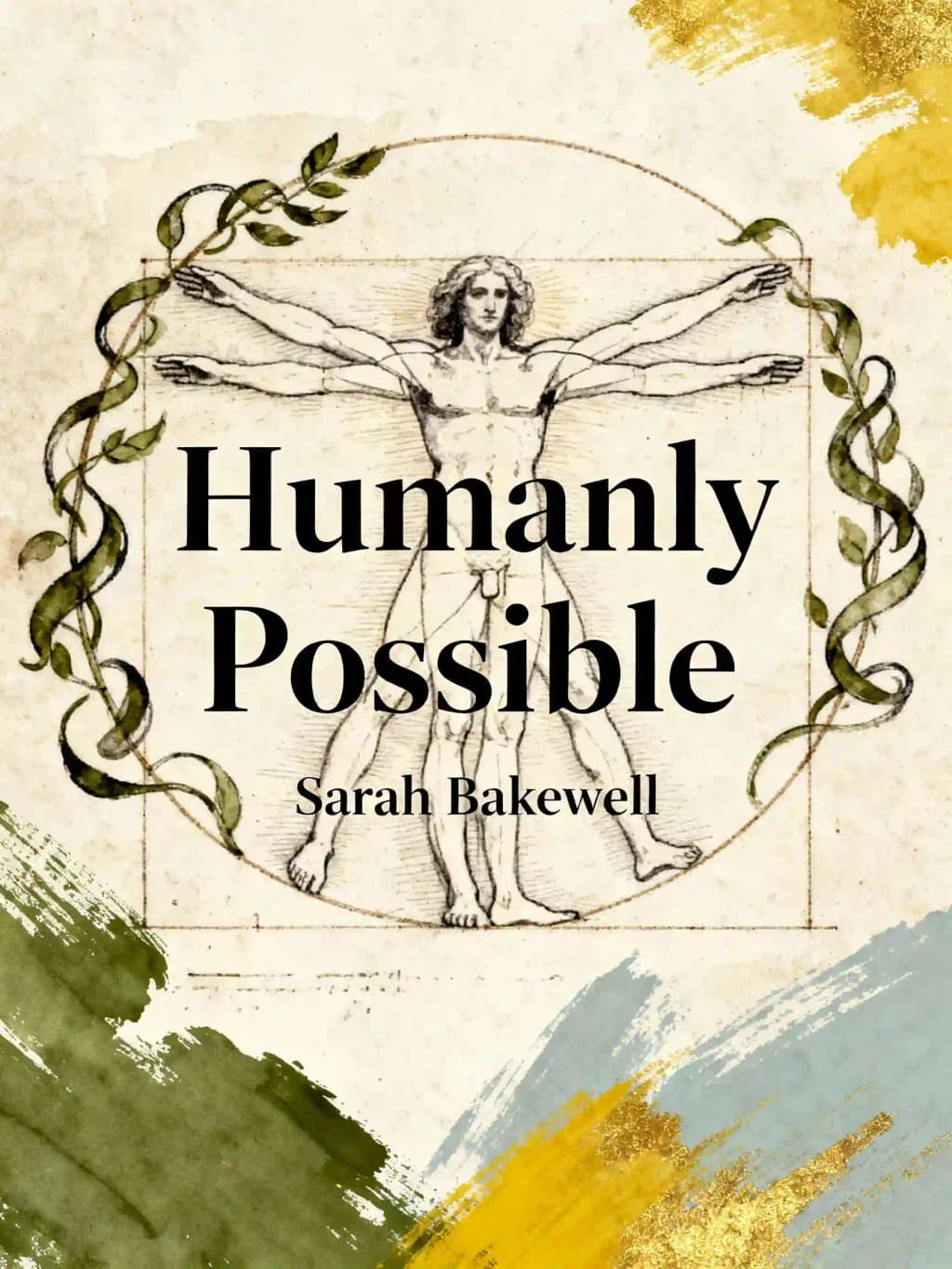
The ideal of the versatile "universal man" (uomo universale) found embodiment in figures like Leonardo da Vinci and Leon Battista Alberti. Alberti-according to an autobiography likely written by himself-excelled in architecture, painting, sculpture, mathematics, surveying, poetry, and athletics. He could throw an apple over a church, jump over a man from standing, and endure pain with remarkable composure. This ideal of human perfection was visually represented in the "Vitruvian Man"-Leonardo's famous drawing showing a perfectly proportioned male figure within a circle and square.
Chapitre 5
Medicine, Science, and the Human Body
Humanist ideas transformed medicine and science by challenging ancient authorities and emphasizing direct observation. Girolamo Fracastoro's 1530 poem "Syphilis, or The French Disease" exemplifies the era's characteristic blend of genuine scientific inquiry with literary elegance, using magical imagery of mercury rivers and gold-dusted beaches to present possible syphilis cures.
Medicine fundamentally straddles science and humanistic study, using quantifiable research while relying on patients' personal accounts and requiring good communication skills. As Edmund Pellegrino wrote, medicine "stands at the confluence of all the humanities," with T.H. Huxley recommending physiology as the foundation for any education.
Despite medicine's aim to reduce suffering, historically it often failed or even made things worse through practices like bloodletting or prescribing disgusting substances like "mummy." No wonder Petrarch scorned physicians who showed off humanistic learning while "killing quite artistically." Medical humanists of the 1400s-1500s applied philological skills to retranslate ancient medical texts, recognizing the life-or-death importance of accuracy. Niccolo Leoniceno's 1492 work "On the Errors of Pliny" boldly criticized the ancient authority for botanical misidentifications that could harm patients. Like Valla before him, Leoniceno urged readers to use their own senses rather than blindly following authorities: "Why did nature grant us eyes and other senses, if not that we might see and investigate the truth with our own resources?"
While philologist-botanists compared plants to ancient texts, others began comparing anatomical books to actual human bodies. Though Galen had advocated looking inside bodies, religious and political authorities long prohibited human dissection, forcing him to use animals instead. By the late thirteenth century, some began defying the ban, notably Mondino dei Liuzzi in Bologna who used executed criminals for anatomical demonstrations. Purpose-built theaters were created, like the surviving one at Padua with its motto "Where death delights in helping life."
Initially, the corpse was expected to defer to the book-a barber would cut, an "ostensor" would point, and the professor would recite from Galen. But discrepancies emerged, like Galen's description of the nonexistent human rete mirabile ("marvelous network"). The brilliant Andreas Vesalius, born in Brussels in 1514, would deliver the final blow to blind adherence to ancient anatomical texts. As a student in Louvain, he collected body parts from execution victims for study while also writing commentaries correcting errors in translated medical texts. Later at Padua, Vesalius insisted on doing the cutting himself while lecturing.
His masterwork, De humani corporis fabrica (1543), repudiated the notion of a human rete mirabile and urged students to rely on their own observations. The Fabrica was also a triumph of humanistic book production with its clear typography and eighty-three magnificent plates drawn by Jan van Calcar, showing dignified human figures in heroic poses despite their likely origins as executed criminals or destitute corpses. These anatomical investigations reinforced the Lucretian view that both mind and body are in constant flux throughout life, with no single static model of human form.
Chapitre 6
Northern Humanists: Expanding the Movement
Northern humanists created a vibrant exchange with Italy, bringing back scholarly methods and cultural polish to apply to their own histories and cultures. Conrad Celtis (born Konrad Pickel in 1459) exemplified the northern humanist journey. After escaping his tiny Bavarian hometown on a timber raft, he studied at German universities before spending two years among Italian humanists. Returning north, he taught at various universities, established Academies, and scolded students for their drunkenness while urging professors to speak properly instead of "honking like geese."
Northern humanists advocated for broader learning beyond literary studies. Celtis urged investigation into natural phenomena-from chaos to wind patterns, mineral formations to medicinal springs-alongside study of diverse peoples and languages. Similarly, Rodolphus Agricola (born Roelof Huysman) recommended students explore geography, natural history, and "things themselves" simply because they were interesting.
Desiderius Erasmus emerged as the most eminent northern humanist of his century. Unlike Agricola who died young at forty-two, Erasmus lived to become a prolific author of translations, dialogues, theological tracts, and countless letters, developing a correspondence network rivaling Petrarch's. Though devoutly Christian, he emphasized living wisely in this world through education, literature, and civilized behavior.
Born illegitimately in Rotterdam around 1466, Erasmus suffered through monastic education that traumatized him with arbitrary beatings and irrelevant pedantry. This experience instilled in him a lifelong aversion to cruelty and a belief that education should prepare one to be at home in the world, not contemptuous of it. Escaping monastic life through his writing talents, he adopted the life of a traveling humanist scholar, teaching at Oxford and Cambridge while developing friendships with luminaries like Thomas More.
Erasmus believed good manners were vital expressions of consideration for others. His 1530 work "On Good Manners for Boys" offered practical advice: use handkerchiefs rather than sleeves, step away when passing gas, maintain a cheerful brow showing "good conscience and an open mind." Unlike Castiglione's emphasis on personal polish, Erasmus saw manners as making life pleasant for others-a way of not separating oneself from society but participating humanely within it.
In Basel, Erasmus found his intellectual home and undertook a new Latin translation of the New Testament, believing improved scholarship would invigorate rather than undermine Christian faith. Working with publisher Johannes Froben, he revisited the original Greek texts, following Lorenzo Valla's earlier critical work. As Europe fractured into religious conflict following Luther's break with Rome, Erasmus maintained a middle position, sympathizing with some criticisms of the church while rejecting Luther's aggression. Above all, Erasmus despised war as contrary to our true humanity, arguing that nature gave us soft skin, embracing arms, and "friendly eyes" for cooperation rather than conflict.
Michel de Montaigne embodied a unique form of humanism, simultaneously embracing and dismantling humanist traditions. Living through France's religious wars, he preferred discretion over dogma, retreating to his stone tower to write while fulfilling duties as magistrate, mayor, and estate manager. His philosophy centered on playing "the man well and properly" while recognizing human fallibility. Though steeped in classical learning (with quotations adorning his tower beams), he irreverently dismissed boring books-even calling Cicero "nothing but wind." Montaigne pioneered the personal essay, celebrating human diversity while insisting on our shared humanity.
Chapitre 7
Enlightenment Humanism: Reason and Natural Morality
The devastating Lisbon earthquake of November 1, 1755, which killed 30,000-40,000 people, sent psychological shockwaves across Europe. People throughout the continent struggled to make sense of such sudden destruction, including six-year-old Johann Wolfgang von Goethe in Frankfurt, who was frightened by adults' discussions of the disaster.
In the aftermath, theologians rushed to provide explanations. Jesuit Gabriel Malagrida claimed it was divine punishment for attending theater and bullfights, while Jansenist Laurent-Etienne Rondet argued it was God punishing the Jesuits. Philosophers offered theodicy-justifying God's actions within a cosmic plan. Gottfried Leibniz had formalized this in 1710, arguing this must be "the best of all possible worlds," an idea Alexander Pope distilled as "Whatever is, is RIGHT."
Francois-Marie Arouet (Voltaire) responded to the Lisbon disaster with empathetic horror, rejecting attempts to explain away such suffering. His poem "On the Disaster of Lisbon" and later his "Philosophical Dictionary" defended the human right to protest against suffering rather than accepting it as divine plan. His masterful novella "Candide" (1759) satirized optimistic philosophy through the character of Pangloss, who maintains "all is for the best" despite experiencing earthquake, near-hanging, and enslavement.
Voltaire's philosophy embodied "meliorism"-the belief that while the world is neither perfect nor hopeless, it can be improved through human effort. This attitude connected Enlightenment thinking to humanism, valuing human agency over mystical submission. The Enlightenment's monumental Encyclopedia project, launched by Diderot and d'Alembert in 1751, exemplified this spirit by placing "man at the center" while documenting all knowledge.
Enlightenment thinkers took varied positions on religion. Some embraced atheism, others remained religious while questioning orthodoxy, and many like Voltaire adopted deism-the belief in a Creator who takes no interest in human affairs. Deists argued that while the universe needed a Creator, this Being neither responds to prayers nor sends disasters as punishment. Instead of expecting divine intervention, humans must take responsibility for reducing suffering themselves.
Humanists and Enlightenment thinkers embraced the idea that moral behavior springs from our natural capacity for empathy-what Condorcet called "a delicate and generous sensibility which nature has implanted in the hearts of all." The Earl of Shaftesbury developed these ideas into an ethical system based on fellow feeling and moral "good taste," arguing that our interconnectedness allows us to respond sympathetically to one another without requiring religious belief.
Proposing human-based morality was dangerous in Catholic, authoritarian France. When authorities couldn't arrest Pierre Bayle, they imprisoned his brother Jacob, who died after five months in terrible conditions. Enlightenment authors faced constant threats-Voltaire was imprisoned and exiled, while Diderot served time in Vincennes fortress. These thinkers developed ingenious methods to evade censorship, publishing works abroad with false names and smuggling books in false-bottomed suitcases.
David Hume presented a confounding example to those who believed irreligious people couldn't be good-he was both intellectually merciless and personally kind. His "Treatise of Human Nature" systematically demolished certainties about causation, personal identity, and the reliability of experience. Despite his caution, Hume was known throughout Edinburgh and France as "the Atheist" and "the Great Infidel," costing him academic positions. Yet those who met him were amazed by his good nature, earning him another nickname: "le bon David." James Boswell, visiting the dying Hume in 1776, was astonished to find him facing death without religious fear, cheerfully discussing his impending end.
Chapitre 8
Expanding the Circle: The Fight for Universal Humanity
Despite their virtues, Hume and most humanists discussed thus far shared a severe limitation: they applied their ideas of humanity almost exclusively to white, able-bodied, gender-conforming males. Only this subset could aspire to be "universal man," with other types treated as deficient or less than human. Hume himself asserted in a notorious footnote that non-white people were "naturally inferior," producing "no ingenious manufactures... no arts, no sciences."
Enlightenment thinkers often failed their own ideals when discussing human differences. Rousseau, radical in politics, became deeply conservative when writing about girls' education, claiming they needed only to learn how to please husbands. Even Voltaire, who studied with mathematician Emilie du Chatelet, considered it a compliment to call her "a great man, whose only defect was being a woman."
Despite these failures, some Enlightenment voices advocated true universalism. Four key humanistic ideas emerged: first, universal humanity where "nothing human is alien"; second, respect for diversity and cultural differences; third, critical thinking that questions tradition and authority; and fourth, moral connection through communication.
For marginalized groups to claim equal humanity was revolutionary. Mary Wollstonecraft's 1792 Vindication demanded women be considered "in the grand light of human creatures" with access to full human virtues and education. John Stuart Mill later asked men to imagine women's permanent exclusion from the exhilarating freedom of adulthood, arguing this denied them the chance to be "fully human."
Frederick Douglass embodied humanist critical analysis through lived experience. Born to an enslaved mother and separated from her in childhood, he escaped brutal conditions to become a powerful writer and orator. At age seven or eight, he lived with the Auld family in Baltimore, where Sophia Auld taught him basic reading until her husband forbade it. This prohibition revealed to Douglass "the pathway from slavery to freedom." He continued learning secretly and discovered The Columbian Orator, which taught him eloquence and convinced him of the power of truth. Douglass understood that language is humanity's essential element-enabling critical thinking, moral reasoning, and connection with others.
While anti-humanists claimed "Whatever is, is right," humanists embraced E.M. Forster's principle: "Only connect!" In his 1910 novel Howards End, Forster contrasts the judgmental, oblivious Henry Wilcox with Margaret Schlegel, who urges him to see the connections between his actions and their consequences for others. This echoes Frederick Douglass's challenge to his former master to recognize the parallels between enslaved people's suffering and his own family's privilege.
Chapitre 9
Education as the Path to Human Flourishing
The concept of becoming human through education has deep roots. When Simone de Beauvoir wrote "One is not born, but rather becomes, a woman," she echoed Erasmus's idea that humans are "not born, but made." Immanuel Kant promoted the view that good education helps to "unfold humanity from its seeds," advancing progress with each generation.
The 19th century saw the emergence of two key German concepts: Bildung, meaning education with an emphasis on forming a complete person, and Humanismus, which initially described classical education but expanded to encompass history, arts, and moral thinking.
Wilhelm von Humboldt, tasked with redesigning Prussia's educational system in 1809, believed human character develops best when "unfolded from the inner life of the soul" rather than imposed externally. His reforms insisted that all boys (girls weren't included) should receive the same foundational education focused on character development rather than vocational training. Higher education emphasized independent research over passive learning, with university meant to be "an emancipation from being actually taught."
Humboldt's commitment to freedom extended to his personal life. Though happily married to Caroline von Dacheroden ("Li"), their arrangement was unconventional-she took other lovers while he pursued his own fantasies. Their frequent separations produced a rich correspondence filled with reflections on humanity and education. As he wrote to Caroline: "The more in life one searches for, and finds, human beings... the more humanized, more readily touched by all that is human one becomes."
John Stuart Mill's liberalism built directly on Humboldt's foundation, emphasizing that freedom, diversity, and human development nourish each other. For Mill, the state's role was not to define a perfect form of life but to create space for individuals to develop without harming others.
Mill and Harriet Taylor's relationship echoed the Humboldts' unconventional arrangement. They fell in love while she was married to John Taylor and maintained a discreet relationship for twenty years until her husband's death. When they finally married, Mill publicly rejected the legal rights husbands had over wives, promising never to exercise them-choosing their own principles over state-defined paths.
At twenty, Mill fell into a depression that challenged utilitarian principles-what good was counting happiness units if one couldn't feel happiness? His path to recovery came partly through poetry, especially Wordsworth, whose emotional depth and love of nature offered fulfillment beyond his father's rationalism. This experience led Mill to recognize that humans need deeper satisfactions than other animals-we crave meaning, beauty, love, and cultural engagement.
Mill credited Harriet with much of the thinking in his works including "On Liberty" and "Subjection of Women," though he didn't formally list her as co-author. Tragically, she died of tuberculosis in 1858 in Avignon while they were seeking healthier air. His tomb inscription praised her intellect and heart, noting that with more people like her, earth would become "the hoped-for heaven"-the only afterlife a humanist could expect was to exist in human memory through their deeds and writings.
Chapitre 10
Science, Faith, and the Victorian Crisis of Belief
As cheap books and lending libraries flourished in the 19th century, they provided access to radical ideas-from skeptical investigations of God to Marxist economics and scientific reevaluations of Earth's origins. Charles Darwin's 1859 "On the Origin of Species" presented his elegant theory of natural selection, implying humanity's animal origins without stating it explicitly until his 1871 "Descent of Man."
Thomas Henry Huxley became Darwin's most effective champion, bringing together two nineteenth-century currents: the boom in education and freethinking, and science-based ways of understanding humanity. Unlike the gentlemanly Darwin who avoided confrontation, Huxley relished intellectual combat. He promoted Darwinism through dramatic reviews, lectures with live demonstrations, and famously sparred with Bishop Wilberforce at Oxford's Museum of Natural History in 1860.
Huxley advocated for science as the foundation of education, arguing it taught not just physical knowledge but also humanistic inquiry skills. After an 1880 lecture, Matthew Arnold responded with "Literature and Science," contending that humanities were essential for making human sense of scientific discoveries. Arnold warned that without ethical guidance, evolutionary theory might lead to moral nihilism. This eloquent debate captured a pivotal moment when scientific humanism joined the older humanities-based and Enlightenment forms of humanism.
Darwin recognized his theory of natural selection didn't provide a direct basis for morality, but in The Descent of Man, he proposed a humanistic explanation for ethical development. Drawing from Enlightenment thinkers like Hume, Darwin suggested morality emerged from our social nature and capacity for sympathy. As group animals with language, humans could express feelings through praise or blame, reflect on past actions, and develop shared ethical opinions.
Huxley popularized the term "agnostic" in an 1889 essay, choosing it as an alternative to labels like atheist, theist, or freethinker. For him, agnosticism meant refusing to claim certain knowledge about metaphysical matters. Leslie Stephen, another notable agnostic (and Virginia Woolf's father), preferred the term over "atheist" which still carried threatening connotations. In his essay "A Bad Five Minutes in the Alps," Stephen recounted a near-death experience that prompted philosophical reflection. Hanging from a cliff face, he considered various religious positions before finding moral grounding in his sense of duty-a concept many Victorians like George Eliot and Darwin held sacred even without belief in God.
The Victorian era witnessed a profound withdrawal of religious certainty from the mental landscape. Thomas Hardy captured this in poems like "God's Funeral" and "A Plaint to Man," depicting God fading like a magic-lantern image when the human-generated light dims. Matthew Arnold similarly evoked this sense of loss in "Dover Beach," hearing the Sea of Faith receding and leaving only human fidelity as consolation.
For many Victorians, religious doubt caused profound disorientation-J.A. Froude described his generation finding "the lights all drifting, the compasses all awry." The consequences were often severe: clergymen lost livelihoods, scholars were denied fellowships, and family relationships fractured.
Chapitre 11
Humanists in a Century of Crisis
The late 19th and early 20th centuries saw the emergence of several remarkable humanist figures characterized by their optimism and hope. Ludwik Lejzer Zamenhof, born in 1859 to a Jewish family in Biaystok, witnessed firsthand how language barriers exacerbated prejudice between the Russian, Polish, German and Jewish communities in his city. As a teenager, he conceived of creating a neutral bridge-language that would help people communicate without threatening cultural identities. Despite a setback when his father burned his early notes, Zamenhof, who became an ophthalmologist, recreated his language and published the first Esperanto primer in 1887 under the pseudonym "Doktoro Esperanto" (Doctor Hopeful).
Robert G. Ingersoll developed his ideas after extensively educating himself through reading philosophical works. Horrified by the persecution of freethinkers, he began defending blasphemy cases in court with a distinctive rhetorical style. Ingersoll became a celebrated lecturer, speaking on topics like progress, happiness, and the limitations of conventional religion. His happiness credo became his trademark: "Happiness is the only good. The time to be happy is now. The place to be happy is here."
Bertrand Russell, born in 1872 to freethinking aristocratic parents who died when he was very young, grew up to become a philosopher, logician, mathematician and political activist who lived until 1970. From birth, he "looked around himself in a very energetic way"-a trait that defined his ninety-seven years of intellectual exploration. Though driven by logic and reason (discovering mathematics at eleven was "delicious" to him), Russell's life was also marked by emotional complexity-he suffered from depression, experienced mystical epiphanies, and had a tumultuous romantic life spanning four marriages and numerous affairs.
The rise of fascism and totalitarianism in the 20th century posed a profound challenge to humanist ideals. Thomas Mann, reflecting on Stefan Zweig's biography of Erasmus, noted a disturbing truth: not only could humanism not assert itself, but many people seemed to long for violence and unreason. In a 1935 lecture, Mann identified humanism's fatal weakness: its tendency to be too flexible. Humanists "abandon position after position" and try to see both sides even when facing murderous fanaticism.
The exodus of European humanist scholars to America included Renaissance expert Paul Oskar Kristeller, who initially received help from the Fascist philosopher Giovanni Gentile to remain in Italy after losing his German position in 1933. When Mussolini enacted anti-Jewish laws in 1938, Kristeller fled to America, joining other intellectual refugees like philosopher Ernst Cassirer, political theorist Hannah Arendt, historian Hans Baron, and art historian Erwin Panofsky.
From his California exile, Thomas Mann continued writing both fiction and polemics against Nazism. Beginning in October 1940, Mann broadcast monthly messages to Germans via an elaborate BBC transmission system. He reported on Nazi atrocities unknown to German listeners and repeatedly emphasized that the Reich didn't represent true Germany or humanity. "Mankind cannot accept the ultimate triumph of evil," he insisted in May 1941, expressing certainty that humanity would revolt against "a world which would find it totally impossible to believe in the higher and better in man any longer."
Chapitre 12
Humanism Today: Challenges and Possibilities
After World War II, humanist organizations flourished globally. The 1952 Amsterdam congress established the International Humanist and Ethical Union (now Humanists International), with its Declaration evolving through several updates. The 2022 version emphasizes ethical focus, personal fulfillment, scientific inquiry, and explicitly acknowledges diverse humanist traditions while rejecting prejudice and claiming greater epistemological modesty.
Modern humanist organizations prioritize inclusivity and positive values over anti-religious rhetoric. Groups like African Americans for Humanism and various identity-focused alliances demonstrate how diverse perspectives enrich humanist thought. Meanwhile, the fight against blasphemy laws remains crucial, with organizations like "End Blasphemy Laws Now" and "Secular Rescue" supporting those persecuted for their beliefs.
Recent humanist outreach employs gentle messaging like "Don't believe in God? You're not alone," focusing on connecting with potential humanists rather than challenging religious beliefs. The movement recognizes that its true adversaries are not supernatural beliefs but threats to humanistic values: cruelty, intolerance, and suppression of freedom.
Contemporary challenges include questions about artificial intelligence and human consciousness. While some embrace posthumanism or transhumanism - seeking either human extinction or technological immortality - true humanism maintains faith in our current humanity, despite its flaws. As James Baldwin noted, we are "responsible to life," negotiating our passage for future generations.
Robert G. Ingersoll's simple creed remains relevant: "Happiness is the only good. The time to be happy is now. The place to be happy is here. The way to be happy is to make others so." Though straightforward, this philosophy demands our full human capacity to achieve.