Chapitre 1
A Feminist from the Cradle: Isabel Allende's Revolutionary Journey
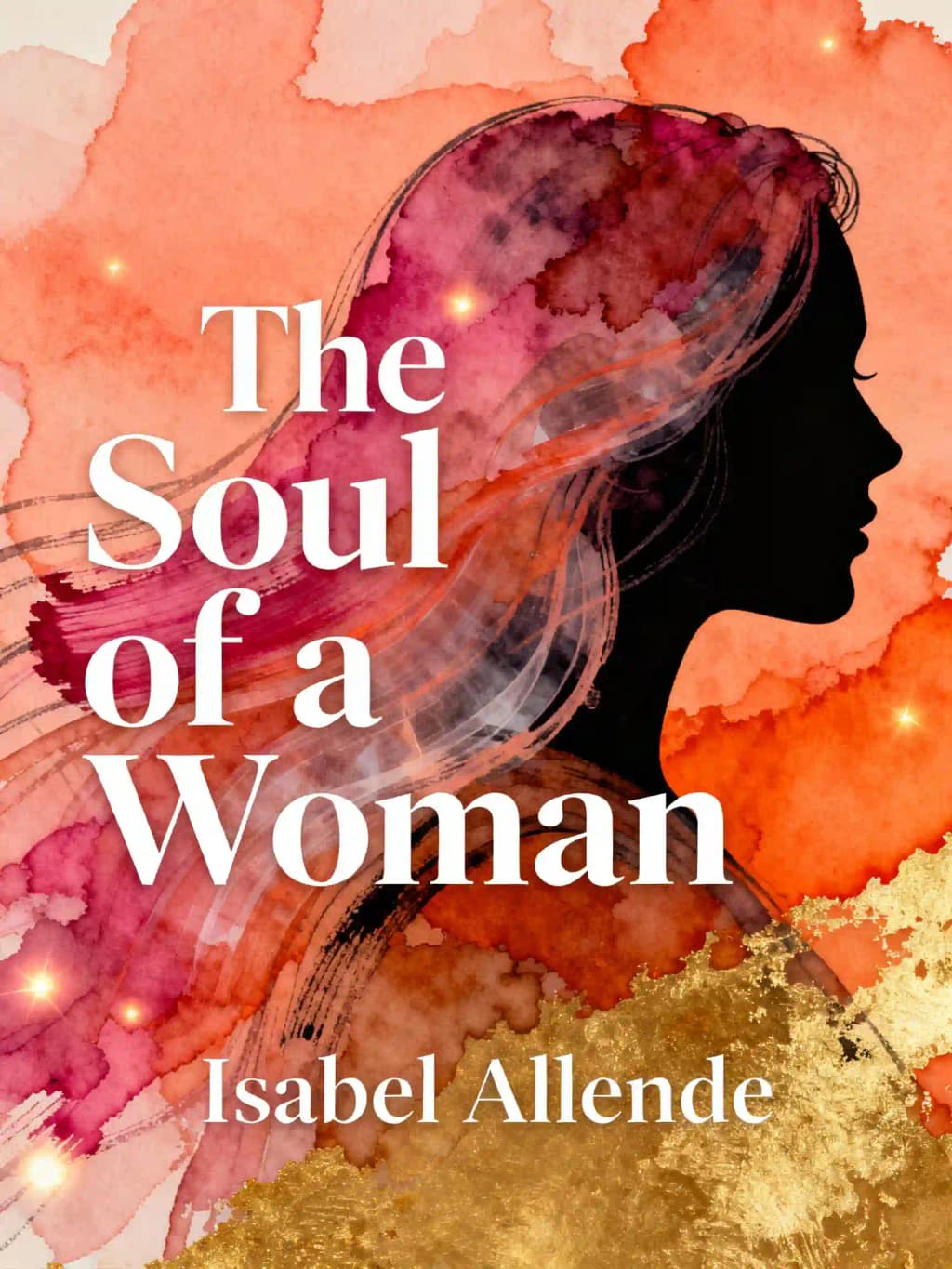
In "The Soul of a Woman," Isabel Allende delivers a powerful feminist manifesto drawn from her eight decades of life experience. This intimate memoir, which has captivated readers worldwide since its 2021 release, reveals how Allende's feminist consciousness emerged in childhood and evolved throughout her remarkable life. The book has garnered praise from influential figures like Gloria Steinem, who called it "a bold exploration of womanhood, feminism, and the power of storytelling." Allende's unflinching examination of patriarchy resonates across generations, making this slim volume a cultural touchstone that bridges the gap between early feminist movements and today's gender equality conversations. With her characteristic blend of personal narrative and social commentary, Allende invites readers into her journey from rebellious girl to renowned author, all while illuminating the universal struggles and triumphs of womanhood.
Chapitre 2
The Roots of Rebellion: A Childhood Shaped by Injustice
My feminism began in kindergarten, born from witnessing my mother's vulnerability after my father abandoned us in Peru. Returning to my grandparents' home in Chile, I observed how my beautiful young mother had no training for work, no money, no freedom, and faced constant gossip for being separated. The neighbors whispered behind closed doors, and even family friends treated her differently, as if divorce was contagious. This sparked my lifelong rage against machismo and obsession with justice. While my brothers could run wild in the streets, start fights, and talk back to adults - behavior celebrated as natural masculine spirit - my similar actions were deemed pathological and dangerous. By age six, I was expelled from Catholic school for "insubordination" after questioning why girls couldn't be altar servers - a pattern of challenging authority that would define my life.
My grandfather Agustin, though a traditional patriarch who ruled our household with iron discipline, understood women's disadvantages in ways that surprised me. During our long walks through Santiago's parks, he taught me self-reliance and critical thinking. "Be independent," he counseled, "because no one else will fight your battles." He instilled in me his stoic philosophy: avoid ostentation, don't complain, help others without boasting, and never expect gratitude. Despite his severity and clear preference for grandsons at family gatherings, he developed a special bond with me because I reminded him of his late wife - strong-willed and unafraid to speak truth to power.
My mother Panchita, scarred by her own experiences, repeatedly warned that my feminist ideas would prevent marriage - considered a terrible fate for women of her generation. She would say, "Men don't like women who think too much." While she believed the patriarchal world was fixed and unchangeable, my voracious reading of history and philosophy convinced me that humanity constantly evolves through struggle and resistance. I particularly identified with what I call the "transitional generation" between mothers and daughters that propelled feminism forward - "the most important revolution of the twentieth century." We were the ones who refused to accept our mothers' resignation and fought for change.
This revolution wasn't welcomed by the men in my life, though their reactions varied significantly. My stepfather "Uncle Ramon," though eventually becoming my best friend and intellectual sparring partner, found feminism tediously boring despite enjoying heated debates about politics and philosophy. When I sought his help for a Pakistani schoolmate forced into marriage with an older man, he refused, citing diplomatic complications and cultural differences - a stance that deeply disappointed me. My grandfather, who often declared that marriage was "convenient for men but a bad deal for women," still expected women to behave like proper ladies and not express strong opinions in public. Through persistent effort, I managed to expose him to feminist literature like Simone de Beauvoir's "The Second Sex," though my mother constantly urged handling these discussions "elegantly and without noise." This maternal advice led to one of my core realizations: "there's no feminism without noise" - change requires disruption of the comfortable status quo.
Chapitre 3
Finding My Voice: Journalism as Liberation
Everything changed in 1967 when I began working as a journalist at Paula, a newly launched feminist magazine headed by Delia Vergara. With three other young women in our twenties - all of us burning with passion and determination - we set out to shake up Chilean prudery. I found my voice through humor, writing a weekly column called "Civilize Your Troglodyte" that mocked machismo culture with sharp wit and biting satire. The column resonated deeply with women who saw their daily frustrations reflected in my words. For the first time, I felt comfortable in my skin, channeling my lifelong restlessness into meaningful action.
At Paula, we fearlessly tackled previously forbidden topics - from women's sexual pleasure to discriminatory marriage laws, domestic violence to female infidelity. We wrote "with a knife between our teeth," refusing to soften our message or apologize for our boldness. Our articles exposed the double standards women faced in Chilean society, from workplace discrimination to unequal treatment under the law. With youthful arrogance, we thought we could change the world in ten or fifteen years. More than half a century later, I still haven't lost faith that it can be achieved, though I recognize how much remains to be done in the fight for true equality.
Despite my feminist preaching and growing professional success, I still feared spinsterhood - a common anxiety among women of my generation. I married Miguel at twenty, trying to balance my emerging identity as a writer with traditional expectations. I attempted to fulfill my prescribed role as wife and mother to our two children, Paula and Nicolas, cooking elaborate meals and maintaining an orderly home. But inside I carried "a burning restlessness" despite deeply loving my family. Those early years were happy in many ways, filled with children's laughter and domestic contentment, but I felt my "brain was turning into noodle soup" from the intellectual isolation and monotony.
Sylvia Plath famously called being born a woman her greatest tragedy, but for me it's been an unexpected blessing and source of strength. I've had the privilege of participating in the women's revolution that's slowly but fundamentally changing civilization. Though as a girl I desperately wanted to be male, watching enviously as my brothers were granted freedoms and opportunities I couldn't access, I eventually came to embrace and celebrate womanhood. Most women I know today are deeply satisfied being female despite the systemic injustices and challenges they continue to face. When I asked my female friends and colleagues why they appreciated their gender, they consistently cited greater emotional intelligence, resilience in the face of adversity, and natural nurturing qualities compared to men. These conversations helped me recognize that what society often dismissed as feminine weakness was actually profound strength.
Chapitre 4
Beauty's Double Edge: Vanity, Aging, and Women's Worth
A woman's value worldwide is tied to youth and beauty - a shipwreck most of us barely survive. For my first fifty years, I considered myself unattractive, constantly comparing myself to gorgeous colleagues. It's impossible to fit the market-enforced mold that sells products by cultivating our insecurities. We escape this objectification only with age or tragedy, as happened when my daughter died.
I inherited my mother's vanity but kept it hidden for years, trying to escape my grandfather's mockery of pretension. At twenty-three, when I got highlights, my grandfather asked if a cat had urinated on my head. After avoiding him briefly, I realized I didn't need to heed everything he said. Since then, I've cultivated vanity not as a sin but as a harmless pleasure. Without my mother Panchita's natural beauty, my vanity requires discipline - rising early to apply makeup that transforms my "defeated boxer" morning face, wearing clothes that conceal my body's collapse.
As I've aged, my concept of sensuality has shifted. In 1998, I wrote "Aphrodite," a memoir about aphrodisiacs. At fifty-six when I wrote that book, I was more interested in erotic passion than now. These days, sensuality means a long shower before watching TV with my husband Roger and our dogs between ironed sheets - no need for silk lingerie to cover my cellulite.
Sexuality today has fewer rules and classifications. My grandchildren identify as nonbinary, and I've learned to ask their friends about preferred pronouns - not easy for someone speaking English as a second language. Language matters because it shapes thinking - patriarchy benefits from categorizing people by gender, race, and age, but young people now challenge these divisions.
The dark forces of religion and tradition deny women sexual agency and pleasure through hymen obsession, enforced fidelity, and genital mutilation. Sexual women frighten men who need control to ensure paternity. Though Western societies have improved, I grew up amid rampant machismo where desire and promiscuity belonged exclusively to men.
Chapitre 5
Love in the Later Years: Finding Connection When Least Expected
After divorcing Willie after 28 years of marriage, I firmly ruled out remarriage - the prospect of starting again with an ailing old man seemed nightmarish, and attracting a lover at my age seemed impossible. While well-meaning friends persistently suggested online dating platforms like Match.com and eHarmony, I could barely navigate Amazon's website. I laughed imagining my brutally honest personal ad: "73-year-old grandmother, documented Latina immigrant, feminist, short of stature with no domestic skills seeks clean, well-mannered companion for restaurants and movies. Must appreciate strong opinions and accept minimal cooking."
The dating scene for seniors is cruelly imbalanced - beer-bellied 60-year-olds routinely expect busty women decades younger, while older women with younger men remain a cultural taboo. Senior dating websites revealed a landscape of misleading profiles and predatory scammers targeting vulnerable widows. My journalistic curiosity led me to investigate dating sites and matchmaking agencies, uncovering disappointing stories of catfishing, financial exploitation, and cruel encounters that left many elderly women heartbroken and sometimes penniless. Fortunately, I didn't need these digital matchmakers as heaven had other plans, sending me an unexpected troubadour through more traditional channels.
In May 2016, everything changed when Roger, a widowed New York lawyer with salt-and-pepper hair and kind eyes, heard my interview on public radio and began writing to me daily for five months. His letters were thoughtful, witty, and revealed a sharp mind with progressive values. My protective assistant Chandra investigated him thoroughly - checking credentials, speaking to colleagues, and verifying his background before our first meeting in October. When we finally met at a San Francisco cafe, I bluntly asked his intentions: "I am seventy-four and I don't have time to waste on games or uncertainty." Though I initially rejected his marriage proposal, offering only a long-distance relationship, the exhaustion of cross-country visits and growing attachment eventually led Roger to sell his home of thirty years and move to California. After testing our compatibility for nearly two years through daily life's challenges and joys, we married in an intimate ceremony surrounded by our children and grandchildren from both families.
I've grown to depend on Roger for tasks I once handled easily but now find challenging - filling gas tanks, changing lightbulbs, reaching high shelves. With his "heavy peasant hands and mellow character," this Bronx-raised son of Polish immigrants helps me navigate life's inconveniences without condescension or complaint. He brings both practical support and emotional richness to my life, sharing everything from intellectual discussions to silent companionship. When young people express amazement that I can still fall in love at my age, I tell them it's exactly like falling in love at seventeen, but with greater urgency and appreciation. Roger and I are acutely aware that we have limited time remaining together, making every minute precious and meaningful. We can't waste our golden years on petty misunderstandings, jealousy, or trivial arguments. This awareness brings a special sweetness and intensity to our late-life romance, proving that love knows no age limit when hearts remain open to its possibilities.
Chapitre 6
Aging with Grace: Embracing the Final Chapters
Love rejuvenates - I'm enjoying a relationship that makes me feel thirty years younger, filled with endorphins. Though we all feel younger than our chronological age, I've learned to accept my limitations while refusing to surrender to them. I do less than before, taking longer for tasks and avoiding unappealing commitments like unnecessary travel and large social gatherings.
With age come more losses - people, pets, places, and youthful energy. Before seventy, I could multitask, work on minimal sleep, and write for ten hours straight. Now I carefully crawl out of bed, have just one obligation - writing - and can only manage four or five hours of it with coffee and willpower.
The quest for eternal youth dates back to Herodotus in the fifth century BC. While Spanish conquistadors searched for both El Dorado and the Fountain of Youth, today only the latter persists as a mirage, supported by an arsenal of anti-aging resources for those who can afford them. Though we now live thirty years longer than our grandparents, extended longevity doesn't necessarily mean better quality of life.
My secret for a full life and happy old age is to emulate my friend Olga Murray. At ninety-four, she wears no glasses or hearing aids, dresses in vibrant colors with tennis shoes, and still drives. After breaking her ankle while trekking in Nepal as a widow in her sixties, Olga witnessed agents buying young girls from poor villages. Determined to help, she established the Nepal Youth Foundation, which has rescued fifteen thousand girls from domestic bondage and changed Nepal's culture. Despite her age, she travels between Nepal and California multiple times yearly, working tirelessly with unfailing cheerfulness and passion.
Unless we discover how to remain healthy until 120 as Professor Sinclair proposes, we must confront longevity's challenges. Society needs better elder care systems and access to assisted death - death with dignity should be a universal human right. As Lincoln supposedly said, "It's not the years in your life that count, it's the life in your years."
Chapitre 7
The Violence Epidemic: Confronting Patriarchy's Darkest Legacy
The level of violence against women serves as the most telling barometer of a society's propensity for violence, as it normalizes and enables all other forms of aggression. In Mexico, the brutal reality of approximately ten women murdered daily, predominantly by intimate partners or acquaintances, illustrates this crisis. These femicides represent the extreme end of a spectrum where hypermasculinity and rigid gender roles create deadly consequences. Similar patterns emerge globally, with rates increasing in regions where traditional patriarchal values remain strongest.
Violence against women transcends cultural and temporal boundaries, as ancient as civilization itself. The language we use reveals our societal biases: when men experience systematic abuse, it's labeled torture and treated as a human rights violation. Yet when women face similar brutality, it's diminished as "domestic violence" - relegated to the private sphere and often ignored by law enforcement and judicial systems. Honor killings claim an estimated 5,000 women yearly in the Middle East and South Asia, though experts believe the real numbers are far higher. In America, the statistics are equally shocking: a woman is raped every six minutes, with the FBI estimating that only 20% of assaults are reported. Domestic violence occurs every nine seconds, affecting women across all socioeconomic backgrounds. This pervasive violence isn't an aberration but a fundamental feature of patriarchal systems.
The psychological impact of this reality manifests in women's daily lives. Fear becomes instinctive, passed down through generations like a genetic warning system. Women routinely modify their behavior: taking longer routes home, avoiding certain areas after dark, clutching keys between fingers as makeshift weapons. Even in supposedly safe institutional spaces like universities or military bases, women remain vigilant. Prevention programs continue to focus on teaching women avoidance strategies rather than addressing male behavior, perpetuating the idea that violence is inevitable. Eduardo Galeano's insight about "men's fear of women without fear" reveals how female empowerment threatens patriarchal control.
The connection between misogyny and mass violence is stark. American mass shooters, overwhelmingly white men, frequently share two common traits: a history of domestic violence and explicit hatred of women. Margaret Atwood's observation that "Men are afraid women will laugh at them. Women are afraid men will kill them" captures this power dynamic perfectly. While not every man is violent, studies suggest that between 25-33% of women worldwide will experience intimate partner violence, making this arguably humanity's most persistent crisis. These perpetrators aren't obvious monsters but often respected community members, highlighting how deeply normalized such violence has become.
War represents the ultimate expression of patriarchal violence, with civilian women and children comprising 80% of casualties in modern conflicts. Violence kills more women aged 14-44 than cancer, malaria, and accidents combined globally. Kavita Ramdas's call for global demilitarization through women's leadership stems from understanding that women, historically excluded from military power structures and less invested in weapons culture, might chart a different course. The path forward requires not just policy changes but a fundamental restructuring of power relationships between genders.
Chapitre 8
The Power of Women's Circles: Connection as Revolution
Connection between women represents what Adrienne Rich called "the most feared and potentially most transforming force on the planet," explaining men's historical discomfort with female gatherings and their attempts to control women's associations. Since ancient times, women have congregated in sacred circles, marketplaces, and domestic spaces to share stories, wisdom, and support one another. Our vulnerability in isolation contrasts sharply with our strength in community, yet millions of women worldwide remain confined without the freedom to move beyond their homes, denied basic rights of assembly and sisterhood.
In Kenya, I visited Kibisom, where Esther Odhiambo had returned after her successful career to find her village devastated by AIDS. Following the undulating chant of female voices through narrow dirt paths, we discovered a clearing where women gathered to cook, sew, and learn together. Their cooperative supported over fifty families affected by the epidemic. Despite their tragic stories of loss and hardship, the women laughed, joked, and sang constantly, their voices rising in harmony as they worked. As Esther simply stated: "When women are together, they get happy." These circles extend beyond mere social gathering - they become spaces of healing, economic empowerment, and quiet revolution. I imagine these circles of women worldwide, from village councils to corporate boardrooms, as an interconnected force that could fundamentally transform patriarchal systems if properly connected and supported.
Economic independence forms feminism's foundation - a truth I witnessed painfully through my mother's financial dependency in her marriage. Women need their own income streams and financial literacy, requiring education, vocational training, and supportive environments that enable work-life balance. Globally, two-thirds of illiterate people are women, with girls comprising most children without access to schooling. Even when educated, women consistently earn less for equal work across all sectors, while traditionally female occupations like caregiving, teaching, and nursing remain systematically undervalued and underpaid.
After publishing Paula in 1994, I received countless letters from readers deeply touched by my daughter's story and her commitment to social justice. This outpouring inspired me to create a foundation in her name specifically focused on investing in vulnerable women and girls - continuing her life's mission. My foundation addresses four critical pillars: health (including comprehensive reproductive rights and maternal care), education access, economic independence through entrepreneurship and job training, and protection from gender-based violence. Research consistently shows that investing in women creates efficient global impact. In developing regions, mothers typically spend 90% of their income on family needs like food, education and healthcare, while men spend only one-third of their earnings on family welfare. This multiplier effect makes women's economic empowerment one of the most effective strategies for lifting entire communities out of poverty.
Chapitre 9
The Unfinished Revolution: Looking Forward with Hope
Rebecca Solnit observes that feminism aims to transform something deeply embedded in most cultures, institutions, and minds worldwide. The significant progress made in just four or five decades is remarkable, though the work remains unfinished. Dismantling the patriarchal system takes time - we advance two steps forward, fall one back, stumbling through disenchantment and celebrating small victories.
I may witness profound change before I die because young people share our urgency - they're frustrated with economic inequality, environmental destruction, corrupt governance, and discrimination. They recognize they're inheriting a damaged world. Our first task is dismantling patriarchy - that ancient system exalting masculine values while repressing half of humanity. We must question everything from religion and laws to science and cultural norms.
When my daughter was twenty, she suggested I shouldn't talk so much about feminism because it was "dated" and "not sexy." We had a monumental argument. I explained feminism, like all revolutions, evolves with time. As soon as Paula graduated and started working, she enthusiastically embraced feminist ideas. Though Paula died long ago, I think of her daily and know she would have celebrated today's defiant, creative young feminists with their refreshing sense of humor.
This is a happy time for me - happiness being not exuberant like joy but silent, calm, and soft; an internal feeling of well-being starting with self-love. I'm free, with no need to prove anything. Old age is a precious gift. My brain still works, and I feel lighter, free of self-doubt, irrational desires, and useless complexes. I've chosen a simpler life with fewer material things, more leisure, fewer worries, more fun, fewer social commitments, more true friendship, less fuss, and more silence.
Writing in March 2020, I'm locked at home with Roger due to coronavirus. At our age, catching the virus would be devastating, though we're far more fortunate than frontline workers, the elderly living alone, the homeless, families in crowded tenements, and refugees. No one alive remembers a global catastrophe of this magnitude. Extreme situations reveal both heroes and villains, and the character of nations. The world has transformed in days, yet pollution has diminished, Venice's canals are clear, Beijing's sky is blue, and birds sing in New York. Suddenly we realize what truly matters is love.