Chapitre 1
When the East Ruled the World
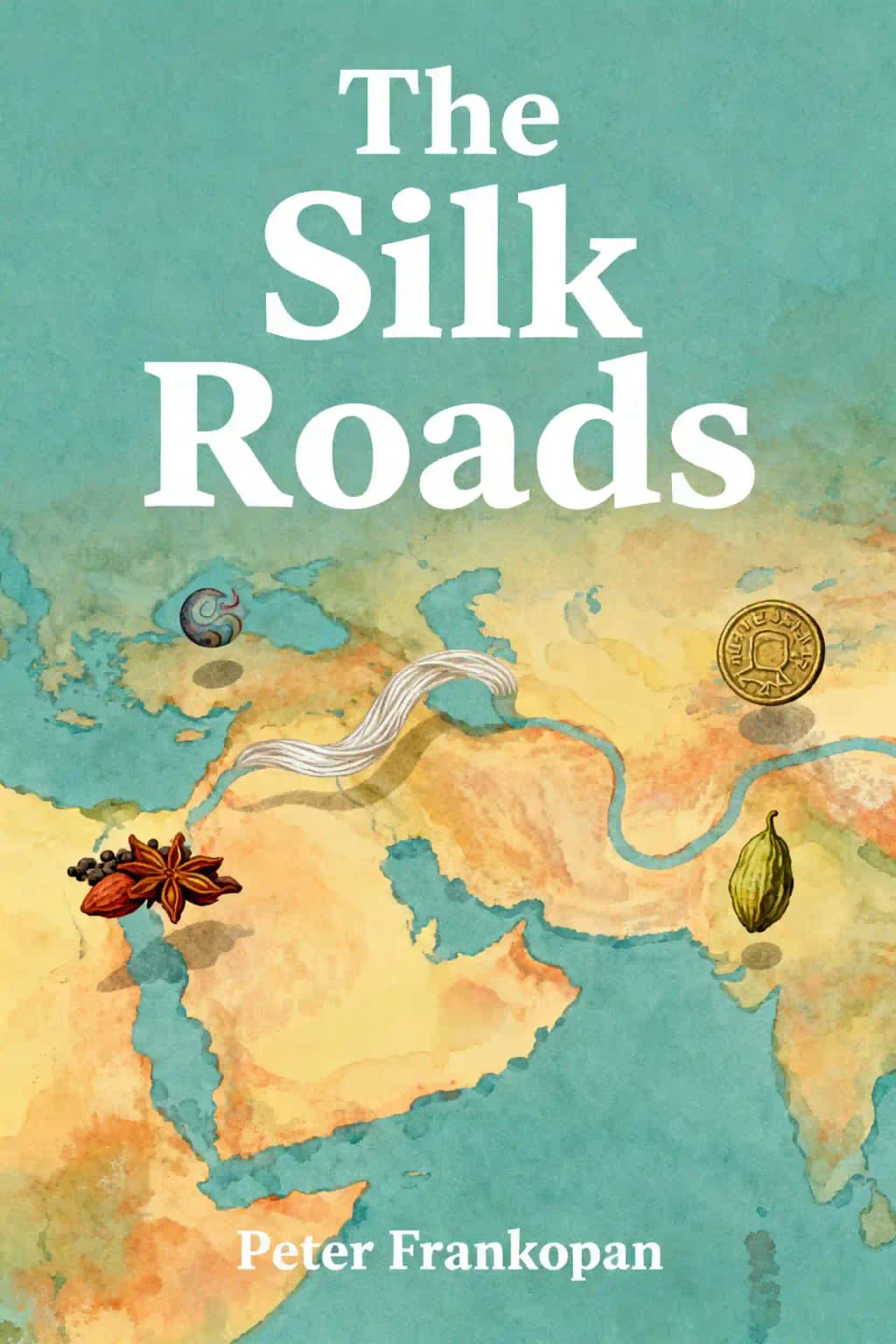
The Silk Roads have always been the world's central nervous system. While we often think of them as mere trade routes carrying exotic goods, they were actually something far more profound - the planet's primary arteries of ideas, religions, technologies, diseases, and cultural exchange. Peter Frankopan's masterful work has become a global sensation, translated into over 30 languages and celebrated by figures from Hillary Clinton to Chinese President Xi Jinping. What makes this book revolutionary is how it completely reorients our understanding of history away from the traditional Western-centric narrative. As Frankopan shows us, for most of human history, the world's center of gravity wasn't London, Paris, or Rome - it was the vast stretch of territory spanning from the Mediterranean to China, where civilizations rose and fell, ideas flourished, and the true engines of human progress operated for millennia.
Chapitre 2
The Cradle of Civilization and Early Exchange
From the dawn of recorded history, Asia's heartland served as civilization's crucible. The fertile lands between the Tigris and Euphrates gave birth to the first cities, organized agriculture, and written laws. While many kingdoms emerged here, the Persian Empire stood supreme, expanding rapidly from southern Iran in the sixth century BC to encompass territories from the Aegean to the Himalayas. Their success stemmed largely from their remarkable openness to foreign customs and ideas.
The Persians created an administrative marvel - a highly educated bureaucracy overseeing everything from worker payments to market regulation, alongside a road network spanning 1,600 miles that could be traversed in just a week. Their tolerance extended even to minorities, with one ruler called the "Messiah" for policies including releasing Jews from Babylonian exile. Trade flourished under their rule, funding military campaigns and extravagant palaces built with materials from across their domains.
When Alexander of Macedon looked for conquest, he turned eastward - never toward Europe, which offered nothing of value. After defeating Persia, he showed surprising political acumen, respecting local practices, adopting Persian clothing and titles, and founding numerous cities bearing his name - now known as Herat, Kandahar, and Bagram. His conquests broadened minds across continents as ideas, images, and concepts spread through newly connected lands.
The collision of Europe and Asia produced astonishing cultural exchanges. The earliest Buddha statues emerged only after Apollo's cult reached western India, with Buddhists adopting visual representation in response to Greek religious practices. Literary influences flowed both ways - some scholars suggest the Sanskrit epic Mahabharata borrowed themes from Homer, while others argue the Aeneid was influenced by Indian texts.
Under the Han dynasty, China's ambitious expansion pushed frontiers westward, eventually reaching Xinjiang. This expansion connected China to wider Asian networks through the treacherous Gansu corridor linking to Dunhuang, a crucial desert crossroads. Chinese demand for horses was insatiable, needed for military readiness. The finest horses came from the Fergana valley beyond the Pamir mountains, admired for their strength and distinctive "sweating blood" characteristic. Some exceptional specimens became celebrities, immortalized in poems and sculptures as tianma (heavenly horses).
Chapitre 3
The Birth of Global Trade Networks
The Silk Roads were born from China's westward expansion and complex relations with nomadic tribes. Initially, China paid expensive tribute to nomadic Xiongnu in the form of silk, which they treasured for its texture and lightness. These payments were substantial - in 1 BC, the Xiongnu received 30,000 rolls of silk and similar amounts of raw material. Eventually, Han rulers took decisive military action, gaining control of the agriculturally rich Gansu corridor and opening doors to trans-continental networks beyond the Pamir mountains.
China's westward expansion sparked intense interest in lands beyond its borders. Officials like Sima Qian compiled detailed reports about distant regions, noting that Central Asian kingdoms were militarily weak but "clever at commerce" with flourishing markets. Trade developed gradually along treacherous routes, passing through the frontier Jade Gate toward oasis towns. Given these dangers, only high-value goods justified such journeys. The Chinese established sophisticated systems to regulate foreign merchants, as evidenced by 35,000 texts showing visitors were issued passes, restricted to designated routes, and carefully tracked.
Silk served multiple crucial functions beyond mere luxury. Under the Han dynasty, it functioned alongside coins and grain as military payment, often proving the most reliable currency. Bolts of raw silk became standard currency for payments and fines, eventually evolving into an international medium of exchange.
While China opened eastward, Rome's dramatic eastern expansion created enormous demand for luxury goods. After conquering wealthy Egypt, Rome's prosperity exploded - Augustus boasted of transforming Rome from brick to marble. Trade with India exploded, with 120 Roman ships sailing annually from Myos Hormos. Archaeological evidence shows Roman goods throughout India, while Tamil literature enthusiastically records western traders bringing "cool and fragrant wine" and returning with pepper.
Chinese silk particularly scandalized Roman traditionalists like Seneca, who complained it barely qualified as clothing and undermined Roman morality. Pliny lamented that 100 million sesterces annually - nearly half the empire's mint output - flowed east for luxuries. This massive outflow transformed economies along trade routes, turning villages into towns and towns into cities, with Palmyra becoming "the Venice of the sands."
Chapitre 4
Faith Flows Along the Silk Roads
The ancient Silk Roads carried not just goods but powerful ideas - particularly religious concepts that flowed in all directions across the interconnected world. The intellectual spaces of the Silk Roads became crowded with competing deities, cults and religions, with high political stakes. The equation was simple: societies protected by the right god(s) thrived, while those following false idols suffered.
Buddhism spread rapidly along trade routes from northern India during the first century AD. In the Deccan plateau, cave temples proliferated, while to the north and east, Sogdian merchants - middlemen whose close-knit networks dominated long-distance trade - transmitted Buddhist teachings with growing energy. These merchants carved their names alongside Buddha images in the Hunza valley of northern Pakistan, seeking spiritual protection during their journeys.
Magnificent monasteries appeared throughout the region, including one near Kabul with onyx pavements, marble walls, gold doors, silver floors, and a golden idol "as beautiful as the moon." Buddhism soon penetrated the Pamir mountains into China, establishing sacred sites across Xinjiang province by the fourth century, including the spectacular cave complex at Qyzyl with worship halls, meditation spaces, and living quarters.
As commercial exchange deepened, Persia experienced a renaissance that transformed its economy, politics, and culture. A distinctively Persian identity reasserted itself, leading to persecution rather than emulation of Buddhists. The decisive moment came with the Sasanian dynasty's rise to power in 224 AD. Ardashir I and his successors transformed the state by asserting a strident identity linking to the ancient Persian Empire. They fused contemporary landscapes with historical ones, appropriating sites like Persepolis for cultural propaganda.
The coinage was overhauled, replacing Greek script and Alexander-style busts with a distinctive royal profile and provocative fire altar, signaling new identity and religious attitude. While previous rulers had shown religious tolerance, the Sasanians promoted Zoroastrianism at the expense of other faiths. This cosmology, teaching that the universe was divided between Ahura Mazda (Illuminating Wisdom) and Angra Mainyu (Hostile Spirit), provided both connection to ancient Persia and a moral framework for military expansion.
Though Christianity is associated with the Mediterranean and western Europe due to church leadership locations, every aspect of early Christianity was Asian. Its geographic focal point was Jerusalem; its original language Aramaic; its theological backdrop Judaism; its stories shaped by Near Eastern deserts, floods, and famines. Christianity's early progress was far more spectacular and promising eastward than in the Mediterranean basin.
Chapitre 5
The Rise of Islam and Its Golden Age
The rise of Islam emerged from a century of turmoil, beginning with the catastrophic bubonic plague of 541 that devastated cities across the Mediterranean and east to China. This disaster fundamentally altered the geopolitical landscape, affecting how emperors conducted foreign policy.
In this context, around 610, a Meccan trader named Muhammad from the Quraysh tribe retreated to a cave and began receiving revelations from God through the angel Jibril (Gabriel). These recitations, later compiled as the Qur'an, warned of apocalypse while promising God's mercy to believers. Muhammad preached to a society suffering economic contraction from the Persian-Roman wars. His warnings of doomsday resonated in this atmosphere of upheaval.
Muhammad offered a coherent explanation for the upheaval, promising economic rewards and spiritual salvation to believers - gardens with pure water, wine, honey and fruits in Paradise. Those rejecting his teachings faced eternal torment. This radical message enraged Mecca's elite, forcing Muhammad to flee to Yathrib (later Medina) in 622 - the hijra that became year zero in the Islamic calendar.
Central to Muhammad's message was unity. He sought to fuse Arabia's tribes into a single bloc, offering a faith delivered in Arabic yet incorporating loan-words from Greek, Aramaic, Syriac, Hebrew and Persian. From precarious beginnings in Yathrib, Muhammad's followers grew through armed resistance and caravan raids. Victory against superior numbers at Badr in 624 suggested divine protection, while spoils attracted attention.
Muhammad brilliantly exploited Persia's dramatic collapse between 628-632, when six to eight rulers (including two queens) claimed authority. Arab forces swiftly conquered unprepared towns along Persia's southern frontier. While spiritual rewards attracted many to Islam, Muhammad's innovative economic structure proved equally compelling. He sanctioned material gain, declaring that goods seized from non-believers belonged to the faithful. Early converts received proportionately greater shares in this pyramid system.
Strategic genius, tactical acumen, and support from Christians and Jews enabled Muhammad's stunning successes. When Muhammad was cornered in Yathrib in the 620s, soliciting Jewish help became a key strategy in this Judaism-steeped region. Jewish elders pledged support in exchange for guarantees of mutual defense. Muhammad's revelations seemed familiar to Jews, sharing much with the Old Testament, particularly veneration of prophets and Abraham.
Early Muslims saw themselves not as rivals to Christians and Jews but as heirs to the same legacy. The Quran explicitly states that Muhammad's revelations had been "revealed to Abraham and Ishmael, to Isaac and Jacob and the tribes" and entrusted to Moses and Jesus too, declaring "We discriminate against none of them."
Despite some clergy painting Arabs in the worst light, archaeological evidence shows little violence during conquests across Syria and Palestine. Damascus surrendered quickly after reasonable terms were negotiated: churches remained open, Christians unmolested, and inhabitants simply paid taxes to new masters rather than Constantinople.
Chapitre 6
The Intellectual Flowering of Islamic Civilization
Alongside material prosperity came an intellectual revolution. Wealthy patrons funded one of history's most astonishing periods of scholarship, drawing brilliant minds - many non-Muslim - to Baghdad and centers across Central Asia. Texts on mathematics, philosophy, physics, and medicine were translated from Greek, Persian, and Syriac into Arabic.
Families like the Buddhist-origin Barmakids championed Sanskrit translations and established paper mills. The Christian Butiu family produced generations of physician-scholars. Polymaths flourished: Ibn al-Haytham revolutionized optics, al-Biruni established that Earth revolves around the sun, and Ibn Sina (Avicenna) mastered multiple disciplines with awe-inspiring intelligence, even as he humbly admitted struggling forty times through Aristotle's Metaphysics before finding clarity through al-Farabi's analysis.
Indian texts brought mathematical innovations like the concept of zero, enabling leaps in algebra, trigonometry and astronomy. Scholars took pride in gathering and translating knowledge from all corners, while brilliant women like poet Rabia Balkhi and Mahsati Ganjavi also emerged. As Muslim civilization embraced innovation and curiosity, much of Christian Europe languished, with St. Augustine even dismissing investigation as a "disease" - a stark reversal of today's perceptions.
The intellectual enlightenment was mirrored in treatment of minority religions. In Muslim Spain, Visigothic architectural influences were incorporated in non-triumphalist ways. Timothy, head of the eastern church in Baghdad, maintained positive relations with the Caliph while dispatching Christian missions to India, China, Tibet and the steppes. Christian and Jewish communities survived and sometimes flourished across North Africa long after Muslim conquests.
Maritime commerce boomed, creating what scholars call "the world's largest maritime trading system." A single shipwreck from the ninth century contained 70,000 ceramic items plus precious metals and ornamental boxes. So much merchandise flowed into Persian Gulf ports that professional divers were employed to salvage items around harbors. The port of Siraf featured palatial residences with extraordinary price tags, while local craftsmen imitated Chinese white-glazed porcelain, eventually developing distinctive "blue and white wares" that would later influence Chinese pottery itself.
Chapitre 7
The Mongol Storm and Its Aftermath
The Mongols, once merely one of many tribes living on China's northern steppe frontier, transformed from a people described as "living like animals" into architects of history's largest land empire through ruthless planning, streamlined organization, and clear strategic objectives. Temujin, known as Genghis Khan, built his power methodically, selecting allies and enemies strategically. He surrounded himself with devoted warriors (nokurs) in a meritocratic system valuing ability and loyalty above tribal connections.
The timing for Mongol expansion proved perfect. Central authority in the Muslim world had weakened, creating a patchwork of unstable states. When the Mongols defeated the ruler of Khwarazm in 1219, the door to Central Asia lay wide open. Their attacks were described with horrific imagery - they "sapped, burned, slew, plundered and departed." Yet Genghis Khan used violence selectively and deliberately, making examples of cities like Nishapur where every living being was slaughtered and corpses piled in pyramids as warnings.
Despite their reputation for brutality, the Mongols weren't always seen as oppressors. They often invested lavishly in infrastructure of captured cities, bringing in craftsmen and revitalizing neglected regions. Money poured into rebuilding towns with particular attention to arts, crafts and production.
The Mongols' greatest commercial contribution was establishing unprecedented stability across Asia. Despite internal rivalries, they fiercely protected commercial law and security. China's road system impressed visitors like Ibn Battuta, who noted one could travel "nine months alone with great wealth and have nothing to fear." This security, combined with nomadic hospitality traditions and deliberate policies encouraging trade, transformed commerce.
Silver became the lubricant of Eurasian trade, functioning as a single currency across continents. Chinese financial innovations including bills of exchange and paper money, adopted and improved by the Mongols, liberated enormous amounts of silver into the monetary system. The precious metal's value plunged, losing more than half its worth against gold in Europe between 1250-1338.
But the Mongol conquests' most devastating impact came through disease. The Eurasian steppe, a perfect breeding ground for Yersinia pestis bacteria, became the source of catastrophic plague. In 1346, a Mongol army besieging the Genoese trading post of Caffa unknowingly deployed biological warfare by catapulting plague-ridden corpses into the city. The Black Death then spread along trade routes to Constantinople, Genoa, Venice, and beyond, devastating populations across Europe, the Middle East and Africa.
Paradoxically, the plague became the catalyst for profound social and economic change that marked Europe's making rather than its death. Massive depopulation sharply increased wages due to labor scarcity, with workers able to demand "triple wages" for their services. This empowered previously marginalized groups - peasants, laborers, and women - while weakening the propertied classes, who were forced to accept lower rents and offer better terms.
Chapitre 8
Europe's Rise Through Maritime Exploration
The world transformed in the late fifteenth century as Spanish and Portuguese expeditions connected the Americas to Africa, Europe and Asia. New trade routes were established, propelling Europe to center stage and blessing it with golden ages of prosperity. However, this European rise came at a terrible price paid by populations across the oceans, as military and naval technological superiority enabled unprecedented domination.
Columbus's 1492 journey was filled with both excitement and anxiety as he ventured west toward Asia, hoping to find the Great Khan and ultimately help liberate Jerusalem. His expedition built upon earlier Iberian explorations seeking access to West Africa's legendary gold markets. This gold trade was controlled by Wangara traders who established trading bases across the Sahara, leading to flourishing cities like Djenne, Gao and Timbuktu - centers not just of commerce but of scholarship and art around magnificent mosques.
The real transformation of European fortunes came not from gold but from human trafficking. The African slave trade exploded in the fifteenth century, proving immensely profitable from the start. Portuguese households soon overflowed with enslaved people, allowing owners to invest capital elsewhere. Despite occasional expressions of empathy for separated families, neither buyers, sellers, nor the Portuguese crown showed moral qualms. Raids to capture people were conducted like animal hunts, with ships even bearing crosses of the Order of Jesus Christ, sanctifying human trafficking with royal and divine approval.
Exploration quickly turned to conquest as Europeans exploited their technological superiority. Columbus had noted the natives' lack of weapons and suggested they could be "ordered about and made to work." Violence became standard practice - villages bringing gifts were massacred "without the slightest provocation." The conquistadors, led by men like Hernan Cortes who claimed to "suffer from a disease of the heart that can be cured only with gold," dismantled sophisticated states like the Aztec Empire through ruthless force and strategic alliances.
The native populations collapsed catastrophically. Within decades, the Taino people fell from half a million to barely 2,000. European diseases like smallpox and measles, to which natives had no resistance, proved even more devastating than violence. The sea lanes to Europe became thick with treasure ships carrying "scarcely imaginable quantities of silver, gold, precious stones." This wealth transfer transformed Spain from "a provincial backwater" into a global power.
Chapitre 9
The Road to Northern European Dominance
The shift in power to northern Europe left some regions unable to compete. In the Ottoman world, cities stagnated between 1500-1800, with inefficient tax collection and agricultural production. Ottoman bureaucrats, once skilled administrators, struggled when expansion slowed due to military costs and climate change. Islamic societies distributed wealth more evenly through Quranic inheritance laws, benefiting women but preventing capital accumulation across generations - unlike Europe's primogeniture system that concentrated wealth.
For those embracing the new global connections, the East offered opportunity. The East India Company (EIC), granted royal monopoly in 1600, slowly established footholds at Bandar Abbas and Surat, though initially dwarfed by the Dutch VOC. England's relationship with the Dutch was complex - commercial rivals yet sometimes allies against Spain.
The rivalry with the Dutch sparked nothing less than a maritime revolution in England. Naval expenditure surged to nearly a fifth of the national budget, with Samuel Pepys overseeing systematic reforms. Three key observations drove this transformation: heavy vessels with concentrated firepower proved more effective than light cruisers; learning from battle experiences led to systematic tactical evaluation; and institutional reforms created a meritocratic promotion system based on ability rather than patronage, with rewards proportional to seniority and service.
That an isolated North Atlantic island would come to dominate global affairs would have astonished earlier historians who considered Britain inhospitable and peripheral. Yet these perceived weaknesses became strengths. Britain's success stemmed from multiple factors: lower social inequality, higher calorie consumption among the lower classes, increased work efficiency, abundant innovation, and lower fertility levels that concentrated resources in fewer hands. But geography proved the ultimate advantage - the sea provided natural protection while eliminating the need for expensive land defenses.
European rivalries had far-reaching consequences across the globe. Disputes over the Austrian succession in the 1740s sparked fighting from the Americas to India, while settlements of European wars resulted in territorial exchanges worldwide. European rivalries initially benefited eastern rulers as competing delegations lavished gifts to secure trading privileges. The British operated on the principle that "everything and everyone had a price," leading to extravagant gift-giving to figures like the Mughal Emperor Jahangir, who had "a heart so insatiable" for treasures.
Chapitre 10
The Age of Oil and Imperial Competition
Few expected William Knox D'Arcy, who left London's prestigious Westminster School in 1866 when his bankrupt father relocated the family to Queensland, Australia, would reshape the world. After qualifying as a lawyer in Rockhampton, D'Arcy's fortunes changed dramatically in 1882 when he invested in the Morgan brothers' gold mining venture at Ironside Mountain. Now among the world's wealthiest men, D'Arcy returned triumphantly to England, where he was approached by Antoine Kitabgi, a well-connected Persian customs official introduced to him in 1900.
When Kitabgi approached Knox D'Arcy, he targeted Persia's mineral wealth - specifically its oil deposits, which had been known since antiquity when Byzantine writers described the destructive "Median fire." D'Arcy struck deals with those who could help win the Shah's favor, then approached the Foreign Office for support. After tortuous negotiations with constant demands for more money, the Shah suddenly signed the agreement. For 20,000 upfront, an equal amount in shares, and 16% of future profits, D'Arcy received "special and exclusive privilege" to exploit petroleum throughout Persia for sixty years.
Progress was painfully slow due to harsh climate, religious festivals, mechanical failures, and tribal hostility. D'Arcy grew desperate as his funds drained away, cabling his team: "Delay serious; pray expedite." His Lloyds bankers grew increasingly concerned about his mounting overdraft, forcing him to seek additional investors or buyers for his concession.
When D'Arcy approached Baron Alphonse de Rothschild as a potential investor, alarm bells rang in London. Admiral Sir John Fisher, convinced that "oil fuel will absolutely revolutionize naval strategy," feared losing Persian oil to foreign hands. The Admiralty brokered an agreement between D'Arcy and the Burmah Oil Company. By May 1908, at four in the morning, they struck the motherlode - a massive oil gusher. Lieutenant Arnold Wilson sent a coded cable home citing Psalm 104: "oil to make faces shine with happiness," announcing a discovery that promised fabulous rewards for Britain.
When Anglo-Persian faced cash flow problems in 1912, Admiral Fisher intervened, fearing acquisition by competitors like Royal Dutch/Shell. Fisher convinced Winston Churchill, First Lord of the Admiralty, of oil's strategic importance - it could be stored in quantity, was economical, and most crucially, enabled ships to move faster. By summer 1914, Britain had purchased a 51% stake in Anglo-Persian, securing operational control. Eleven days after Parliament approved this purchase, Franz Ferdinand was assassinated in Sarajevo.
Chapitre 11
The Road to Catastrophe
The Iranian Revolution toppled America's regional house of cards. Warning signs had long been visible - corruption, economic stagnation, political paralysis and police brutality created fertile ground for reform-promising critics. The Soviets actively sought advantage, intensifying operations even after losing their top Iranian agent. American officials like Ambassador Sullivan urged Washington to prepare contingency plans and establish communication with Khomeini before his takeover, but the White House clung to delusions of control.
The revolution's global impact was devastating. Oil prices nearly tripled, threatening runaway inflation in developed economies. Service stations across America closed from lack of supply, while President Carter's approval ratings plummeted to Watergate-era levels. Beyond soaring oil prices, mass contract cancellations and nationalizations hammered Western companies. BP lost 40% of its global production overnight, while manufacturers faced $9 billion in canceled U.S. purchases.
Soviet anxiety about Afghanistan intensified after President Taraki was overthrown by Hafizullah Amin in September 1979. Moscow viewed Amin with deep suspicion, denouncing him in Pravda as "a spy for American imperialism." Soviet leadership became increasingly paranoid about Amin's frequent meetings with American officials, interpreting them as signs that Washington was repositioning itself after its catastrophic failure in Iran. Operation Storm 333 began on Christmas Eve 1979, with Soviet forces streaming across the border.
The Soviet invasion couldn't have come at a worse time for Washington, already reeling from the Iranian hostage crisis. After the Shah was admitted to the US for medical treatment in autumn 1979, militant Iranian students seized the American embassy in Tehran on November 4, taking sixty diplomatic staff hostage. Ayatollah Khomeini inflamed the situation by calling America "the great Satan" and demanding the Shah's extradition to face justice.
Saddam Hussein's invasion of Iran was driven by twisted logic connecting Israel and Iran. His grandstanding rhetoric positioned Iraq as the leader of Arabs, claiming the 1975 territorial settlement reversal would inspire Palestinians to reclaim their lands. For the United States, Iraq's initial attack on Iran seemed a blessing. Carter's National Security Advisor Brzezinski saw it as leverage to free American hostages, suggesting spare military parts might be provided if Iran released them.
The invasion of Kuwait in 1990 triggered an extraordinary sequence of events that would define the late twentieth and early twenty-first centuries. Saddam Hussein, once viewed favorably by Western powers as a "presentable young man" with an "engaging smile" who spoke "without beating about the bush," had transformed into a pariah after seizing Kuwait - an action he justified to his advisers as self-defense following American betrayal during Irangate.
Chapitre 12
The New Silk Roads Emerge
The Silk Roads are rising again, largely unnoticed by many observers. While economists focus on artificial groupings like BRICS or MIST countries, the true Mediterranean - the "center of the world" - is re-emerging before our eyes. Cities are booming with new airports, luxury hotels and landmark buildings. Ashgabat boasts a new presidential palace and winter sports arena costing hundreds of millions, Baku's international airport and Crystal Hall showcase Azerbaijan's wealth, and Iraqi Kurdistan's Erbil charges hotel rates higher than most European capitals.
Kazakhstan's new capital Astana has risen from dust in less than twenty years, featuring Norman Foster's Palace of Peace and the 330-foot Bayterek tower. The region's billionaires appear seemingly from nowhere to buy premium art and real estate globally, with former Soviet republic buyers spending nearly three times more than American or Chinese buyers in London's property market.
Pipelines now crisscross the region in all directions, linking the port of Ceyhan in Turkey to sprawling networks across Central Asia that feed China's growing economy. New collaborative projects between Afghanistan, Pakistan and India are developing, including a pipeline carrying 950 billion cubic feet of natural gas yearly from Turkmenistan's fields through ancient trade routes familiar to Sogdian merchants, medieval poets, and Victorian planners alike.
Transport links across Eurasia have expanded dramatically in recent decades. The 7,000-mile Yuxinou International Railway now connects China to Germany, with half-mile-long trains carrying millions of products in both directions on a sixteen-day journey - significantly faster than sea routes from China's Pacific ports.
China's western provinces are experiencing remarkable revival as businesses relocate from coastal regions to interior cities near the ancient Dzungarian gate. With lower labor costs inland, Hewlett Packard has shifted from Shanghai to Chongqing, now producing 20 million laptops and 15 million printers annually and shipping millions by rail to western markets.
New intellectual centers are emerging across a region that once produced the world's greatest scholars. Persian Gulf campuses administered by Yale, Columbia and others have been generously endowed by local rulers and magnates. China has established Confucius Institutes throughout the region to promote Chinese language and culture, demonstrating Beijing's goodwill.
Both East and West recognize the emergence of a new Silk Road. In 2011, the US Secretary of State called for setting sights on "a new Silk Road" to help the region flourish. Similarly, Chinese President Xi Jinping declared in Astana in 2013 that for over 2,000 years, peoples across this region connecting east and west have coexisted and flourished despite differences in race, belief and culture. He announced China's "foreign policy priority" to develop cooperative relations with Central Asian countries and build a "Silk Road Economic Belt" - a New Silk Road.
As Western dominance faces increasing pressure, creating uncertainty about religious extremism and international law violations, networks are quietly being restored across Asia's spine. The world is changing profoundly around us. The Silk Roads are rising again.




![[the-silk-roads-by-peter-frankopan:c0000] The Silk Roads p1-1](/_next/image?url=https%3A%2F%2Fd1y2du6z1jfm9e.cloudfront.net%2Fassets%2Fpodcast%2Fpurple.png&w=1024&q=50)
![[the-silk-roads-by-peter-frankopan:c0001] The Silk Roads p1-1](/_next/image?url=https%3A%2F%2Fd1y2du6z1jfm9e.cloudfront.net%2Fassets%2Fpodcast%2Fyellow.png&w=1024&q=50)
![[the-silk-roads-by-peter-frankopan:c0002] The Silk Roads p1-1](/_next/image?url=https%3A%2F%2Fd1y2du6z1jfm9e.cloudfront.net%2Fassets%2Fpodcast%2Fblue.png&w=1024&q=50)