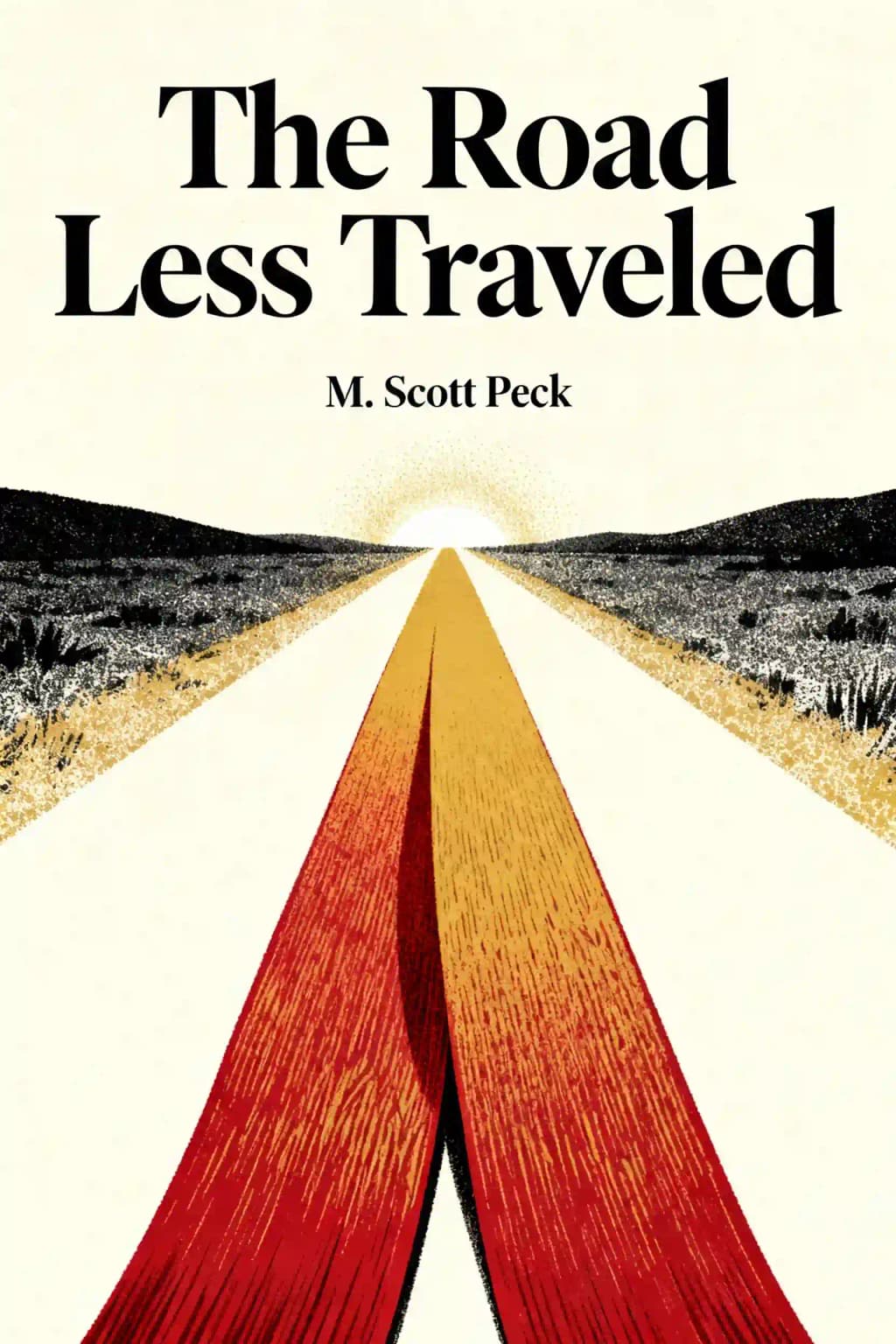
Chapitre 1
Life's Hard Truth: The Journey Worth Taking
What if the first noble truth wasn't that life is suffering, but that life is *difficult* - and most of us waste our lives trying to pretend otherwise? When psychiatrist M. Scott Peck published these words in 1978, he couldn't have imagined his spiritual psychology manifesto would remain on the New York Times bestseller list for an astonishing 13 years, selling over 10 million copies worldwide.
"The Road Less Traveled" isn't just another self-help book; it's the rare work that transforms the psychology genre by blending profound spiritual wisdom with clinical insight. Peck's revolutionary proposition that mental health requires confronting life's difficulties rather than avoiding them resonated so deeply that the book is now required reading in many psychology programs.
Between these pages lies the roadmap to authentic growth through four deceptively simple disciplines: delaying gratification, accepting responsibility, dedication to truth, and balancing. For anyone tired of quick fixes and shallow solutions, Peck offers something far more valuable: the courage to travel the difficult but ultimately rewarding path toward genuine fulfillment.
Chapitre 2
Embracing Life's Difficulties: The Foundation of Growth
Life is difficult. This simple truth, once accepted, transforms everything. Most of us spend our lives trying to avoid this reality, seeking shortcuts around pain and discomfort. But what if these difficulties aren't obstacles to happiness but the very path to it?
Discipline provides the tools to solve life's problems and find meaning through necessary suffering. When we avoid problems, we invite mental illness; when we face them, we cultivate courage and wisdom. Think about it-haven't your most significant periods of growth followed your greatest challenges? That promotion you earned after months of stretching beyond your comfort zone, or the relationship that deepened after working through a painful conflict?
The first tool of discipline is delaying gratification-facing pain first to enjoy greater pleasure later. Children who learn this skill early gain a tremendous advantage in life. Remember the famous marshmallow experiment? Children who could resist eating one marshmallow to get two later showed better outcomes throughout their lives. This capacity develops primarily through quality parenting that balances love with consistent discipline.
Parents who model self-discipline profoundly influence their children's development. When discipline comes from love rather than anger, children internalize proper behavioral norms. Genuine love involves devoting time to understand and meet children's subtle needs, creating a willingness to face necessary suffering together. This approach builds a child's sense of value and trust in the world's safety, enabling them to delay gratification and face challenges with resilience.
Why do so many adults struggle with self-discipline? Often, it's because they never developed the ability to delay gratification. When we rush through problems or assume they'll resolve themselves, we miss opportunities for growth. Consider how often you've made a situation worse by trying to find the quickest solution rather than taking time to understand the real issue. The path to growth isn't about speed-it's about patience and persistence in facing what's difficult.
Chapitre 3
Taking Responsibility: The Heart of Problem-Solving
To effectively tackle life's problems, we must first acknowledge them as our own. Many people evade this crucial step by attributing their troubles to external factors or other people. Have you noticed how easy it is to find someone or something to blame when things go wrong?
Consider this: a sergeant stationed in Okinawa complained bitterly about his assignment, blaming the military, his superiors, and even the local culture for his unhappiness. Yet he refused to recognize how his own choices and attitude contributed to his situation. How often do we do the same-looking everywhere but inward for the source of our discontent?
This pattern reveals two distinct approaches to responsibility. Those with neuroses take on too much responsibility, blaming themselves even when unwarranted. In contrast, people with character disorders deflect responsibility, seeing external factors as the source of all problems. Most of us fall somewhere on this spectrum, sometimes owning too much and other times too little.
The connection between responsibility and freedom is profound. When we relinquish responsibility, we surrender control and freedom along with it. Think about times you've handed decisions over to others-didn't you also give away your power? Taking responsibility may be painful, but it's essential for personal development and effective problem-solving.
What areas of your life are you avoiding responsibility for right now? Your health? A struggling relationship? Career dissatisfaction? Consider how shifting from "It's happening to me" to "I have choices in how I respond" might transform your situation. This isn't about blame but about reclaiming your power to effect change.
Chapitre 4
Mapping Reality: The Discipline of Truth
Creating an accurate map of reality is essential for navigating life wisely. Like a detailed geographical map, our mental maps guide our decisions and actions. Yet many resist refining their understanding of reality because doing so requires effort and often discomfort.
The world constantly changes, and so must our perspectives. Those who persevere in updating their mental maps gain true discovery, while those who cling to outdated views often deny new truths, complicating their progress. Have you ever held onto a belief simply because changing it would be uncomfortable or inconvenient?
Transference illustrates how outdated childhood perceptions misapplied in adulthood cause dysfunction. One man, haunted by distrust from an uncaring childhood, damaged adult relationships and career stability because he couldn't update his view of the world. His childhood map told him people couldn't be trusted, and he applied this belief indiscriminately throughout his life.
Embracing a life dedicated to truth requires openness to challenge. Only through critique and confrontation from others can we ensure our understanding of reality is accurate. Both individuals and organizations must foster environments open to scrutiny to grow effectively. Think of a time when feedback-though painful-helped you see something you were missing. That discomfort was the feeling of your map being updated.
Truth-telling itself requires nuance. While speaking falsehoods should be avoided, selective withholding of truth is sometimes necessary. The key is withholding only for the other's benefit, never for personal protection. A mature approach involves understanding the other's capacity to handle truth and acting from love rather than fear.
Living openly and embracing challenges to your personal maps fosters growth through honesty and reduces fear. Which areas of your life might benefit from a more accurate map? Where might you be operating on outdated information about yourself, others, or the world?
Chapitre 5
The Art of Balancing: Flexibility in Life's Journey
Balancing requires navigating between conflicting needs and goals with flexibility. Consider how we handle anger-effective management demands a responsive system that can adapt to different situations. Some respond with immediate aggression, others suppress all anger, but balance lies in appropriate expression based on context.
Psychotherapy aims to improve this flexibility, highlighting the necessity of giving up parts of the self for growth. This 'giving up' can be painful but is crucial for progress. Think about learning to ride a bike-you had to let go of the security of training wheels to gain true balance and freedom.
Depression, often associated with this giving-up process, serves as a natural and healthy phase in personal growth. When approaching significant change, we typically struggle with releasing aspects of our past selves. The depression becomes problematic only if interrupted, hindering the completion of this necessary evolution.
Life's inevitable losses require relinquishment that leads to rebirth and genuine joy. Religious wisdom has long recognized that temporary self-abandonment supports learning and spiritual progression. Embracing pain transforms into self-discipline, bringing growth and new understandings. Life is a continuous cycle of death and rebirth intertwined with joyful renewal.
What might you need to relinquish to move forward in your life? An outdated self-image? A relationship that no longer serves growth? A career that once fit but now constrains? The willingness to let go often precedes our most significant advances.
Chapitre 6
Love Beyond Feeling: The Act of Will and Extension
What we commonly call love often bears little resemblance to true love. Real love is rooted in conscious or unconscious purposes that drive individuals, serving as an act of will that fosters both self-evolution and others' growth. It demands effort and conscious choice, moving beyond mere desire to encompass determined action.
The fallacy of equating 'falling in love' with real love is widespread. Falling in love temporarily collapses ego boundaries, mimicking infantile unity with the mother. It entices individuals into relationships with an illusion of ecstasy and omnipotence. Yet, as reality reasserts itself in daily life, individual identities resurface, collapsing this illusion and paving the way for the potential of real love.
The myth of romantic love induces a belief in a predetermined perfect partner, fostering illusions of eternal happiness. When reality doesn't align, it mistakenly suggests a failed match, overlooking the chance for genuine, mature love. How many relationships have ended because the initial ecstasy faded, with both partners believing they'd chosen wrong rather than recognizing the opportunity to develop something deeper?
True love extends beyond the self, incorporating beloved objects into one's identity, leading to a blurred distinction between self and world. This gradual merging forms a stable, lasting connection, contrasting the fleeting ecstasy of falling in love. Have you experienced this deeper connection-where another's joy and pain feel like your own, not from dependency but from genuine extension of yourself?
Dependency may masquerade as love due to its intense attachment, yet it's fundamentally antilove. It stems from unmet needs in childhood, manifesting as an empty inner feeling and unhealthy relationships marked by clinging and manipulation. The cycle can only be broken by recognizing one's own worth and practicing self-discipline over the craving for external validation.
Chapitre 7
Love as Work: Attention and Risk
Love involves dedication, often opposed to laziness and fear. It demands active attention to others' growth. True love is work requiring focused intent, and attention manifests primarily through listening. Most fail to listen well, not recognizing the challenge it presents. When was the last time you gave someone your complete, undivided attention-no phone, no mental planning, just presence?
Listening with full attention is an act of love, both toward others and oneself. Parenting exemplifies this, where listening signals to children their inherent value and encourages their development. True listening demands complete focus and bracketing personal biases, fostering a dance of reciprocal growth and unity.
Embracing love requires moving against the inertia of laziness and overcoming fear, dismantling the fortress built against the risks of change. A life devoid of risk and connection ultimately becomes empty. Accepting the inevitability of loss or rejection through love enriches life with meaning, as growth incites inevitable pain alongside joy.
Adults face a persistent ambivalence toward risk-the simultaneous craving for growth and retreat to safety. Growing involves relinquishing hand-me-down values and pursuing unknown futures with courage. Genuine maturity demands profound risks, freeing individuals to venture on spiritual journeys only achievable through true selfhood and independence from external expectations.
Confrontation in love entails expressing displeasure and asserting moral or intellectual correctness, posing a risk of arrogance. Yet genuine love respects unique individual paths and guides with humility. True confrontation requires scrupulous self-examination of one's wisdom and motives, avoiding the pitfall of arrogance.
What risks have you avoided in your relationships? Have you withheld honest feedback out of fear? Have you maintained emotional distance to protect yourself from potential loss? Consider how these self-protective measures might actually be preventing the deeper connections you desire.
Chapitre 8
The Discipline of Love: Order and Separateness
Love fuels the rigorous work of self-discipline and requires ordering behavior to enrich the beloved's spiritual growth. Passionate love without discipline leads to chaos, whereas disciplined love fosters deeper bonds and meaningful growth. Just as a balanced, respectful dynamic improves productivity in any relationship, disciplined love requires managing and respecting one's feelings, creating harmony and depth.
Within relationships, particularly parent-child bonds, recognizing separateness is crucial. Parents often view children as extensions of themselves, driven by narcissistic tendencies that deny individuality. True love recognizes separateness, nurturing empathy and distinct identities. As Kahlil Gibran wrote: "Your children are not your children. They are the sons and daughters of Life's longing for itself."
Within marriages, a similar appreciation of separateness is necessary; partnerships thrive when both individuals are recognized as independent entities with their own paths. Love should not conflate into oneness but support the unique journeys of each partner. Only in such bonds can genuine spiritual and personal growth occur.
Countering the longstanding tradition of emotional detachment in therapy, genuine love and care are essential for healing. Authentic love, rather than expertise, drives significant psychotherapeutic success. While professional boundaries must be maintained, the therapeutic relationship thrives on genuine care and respect for the patient's separate identity.
How might your relationships change if you fully embraced the separateness of those you love? Would you feel less responsible for their choices? More respectful of their unique path? More supportive of growth that might take them in directions different from what you'd choose?
Chapitre 9
The Mystery of Love: Beyond Psychology
Examining love's origins unveils its profoundly enigmatic nature, challenging our fundamental understanding of human consciousness and connection. Love serves as a powerful catalyst for self-discipline and personal growth, yet its true genesis remains one of humanity's most perplexing mysteries. The paradox becomes particularly apparent when studying individuals who flourish despite growing up in emotionally barren environments, demonstrating remarkable resilience that defies conventional psychotherapeutic explanations. These cases challenge our assumptions about the necessity of early nurturing and raise questions about innate human capacity for emotional development.
Beyond psychology's limited analytical framework, these mysteries point toward deeper truths potentially accessible through religious and philosophical contemplation. The inexplicable allure of beauty, the sacred quality felt in moments of genuine intimacy, and our profound emotional responses to art and nature suggest dimensions of experience that transcend scientific explanation. Consider how a sunset can evoke deep spiritual feelings, or how music can trigger profound emotional responses that seem to reach beyond mere neurological processes. Have you ever experienced a moment of profound connection or beauty that seemed to transcend ordinary explanation? These experiences often feel more aligned with spiritual or mystical understanding than psychological theory.
Growing in love and self-discipline gradually expands one's worldview, essentially forming what could be called a personal religion - a unique framework for understanding existence. This concept of religion extends far beyond traditional notions of worship or belief in deities; it encompasses the entire constellation of beliefs, values, and assumptions through which an individual interprets their life experiences. When we acknowledge that each person essentially operates within their own religious framework, it opens new pathways for meaningful dialogue and deeper interpersonal understanding.
A person's worldview often develops unconsciously, shaped by cultural inheritance, family dynamics, and formative experiences. Even those who explicitly reject formal religious systems inevitably construct their own philosophical framework, built upon deeply held beliefs about reality, meaning, and purpose. In therapeutic contexts, understanding these hidden influences becomes crucial, as they fundamentally shape an individual's sense of self-worth, life purpose, and relationship patterns. For instance, someone raised in a highly achievement-oriented family might unconsciously equate personal value with professional success, while another might view life through a lens of collective responsibility based on their cultural background.
Science emerges as a sophisticated tool for reexamining religious and philosophical concepts, offering methods to transcend inherited cultural biases and superstitions. This scientific worldview promotes systematic questioning, healthy skepticism, and disciplined inquiry in the pursuit of truth. It suggests that spiritual and psychological evolution mirror scientific exploration - both requiring courage to venture beyond comfortable certainties into unknown territory. This parallel becomes evident in how both scientific discovery and personal growth often involve challenging established beliefs, embracing uncertainty, and remaining open to new understanding. The integration of scientific thinking with spiritual inquiry offers a more complete approach to understanding love's mysteries, acknowledging both empirical evidence and transcendent experience.
Chapitre 10
Grace: The Unseen Force in Human Growth
Grace manifests as an unseen nurturing force supporting growth and life enhancement. It operates beyond complete human understanding, frequently occurring yet outside conscious decision-making. This force parallels phenomena like dreams and serendipity, believed by many to be manifestations of divine love.
Miracles may be misconstrued due to dramatic expectations, yet grace often manifests in the ordinary. Psychiatry repeatedly uncovers grace through patient resilience, defying typical psychological projections. Some patients display remarkable recovery despite traumatic backgrounds, suggesting an intrinsic grace safeguarding the human spirit from total breakdown.
Examining serendipity and synchronicity uncovers the improbable timing of life events appearing more often than random chance would suggest. From near-miss accidents to chance meetings yielding profound insights, such events speak to a deeper fabric of existence. Have you experienced moments of "meaningful coincidence" that seemed too perfect to be mere chance?
Evolution itself defies natural entropy, with life developing from simplicity towards complex organization, paralleling spiritual growth. Despite contradicting natural law, a greater force appears essential in propelling both physical evolution and spiritual transformation. From viruses to humans, the progression underscores the miraculous nature of evolving complexity against nature's innate pull toward chaos.
The journey of spiritual evolution suggests humanity is progressing. Despite today's chaos, a sense of dissatisfaction arises from expecting more. Love, defined as extending oneself for spiritual growth, drives this evolution. The idea that a caring force nurtures humanity toward greater consciousness is daunting, requiring profound dedication and effort.
Chapitre 11
Confronting Evil and Evolving Consciousness
Evil stands as a real force, not just a myth. Some individuals and institutions, blind to their own malevolence, work destructively against goodness. True evil extends beyond mere laziness; it is active, exhibiting antilove by protecting laziness to extremes, even harming others to preserve self-serving ideas. Though inevitable in human evolution due to free will, evil is ultimately weak as a social force.
Awareness marks spiritual advancement, defining growth as consciousness's evolution. Consciousness-'to know with'-partners with the unconscious, which harbors hidden truths. As consciousness expands, a more mature, conscious ego emerges, facilitating love and advancing human evolution by lifting awareness and creating grace in the world.
Power has two distinct forms: political and spiritual. Political power is defined by coercion and external attributes, whereas spiritual power is an intrinsic capacity rooted in consciousness and awareness. True spiritual power involves making decisions with maximum awareness, aligning conscious will with divine intention.
Mental illness and symptoms such as anxiety or depression prompt self-awareness and healing. This is seen as grace, a divine nudge toward growth. The myth of Orestes illustrates acceptance of personal responsibility for one's mental state, leading to transformative healing. It's vital to recognize and embrace the symptoms, without blaming others, as the route to wellness.
Despite the evident power of grace to heal and transform, many resist its call due to deep-seated laziness or entropy. The journey towards healing requires immense effort. This inner will is akin to love-a commitment to extend oneself spiritually, defying the odds shaped by childhood or circumstances.
The journey of spiritual growth, much like the experience of grace, is both a personal choice and an unexpected gift. While grace cannot always be sought out directly, individuals can open themselves to its possibility through disciplined and loving living. The spiritual path calls for courage and initiative, demanding personal navigation and the cultivation of inner strength as one aligns with the greater forces of life.