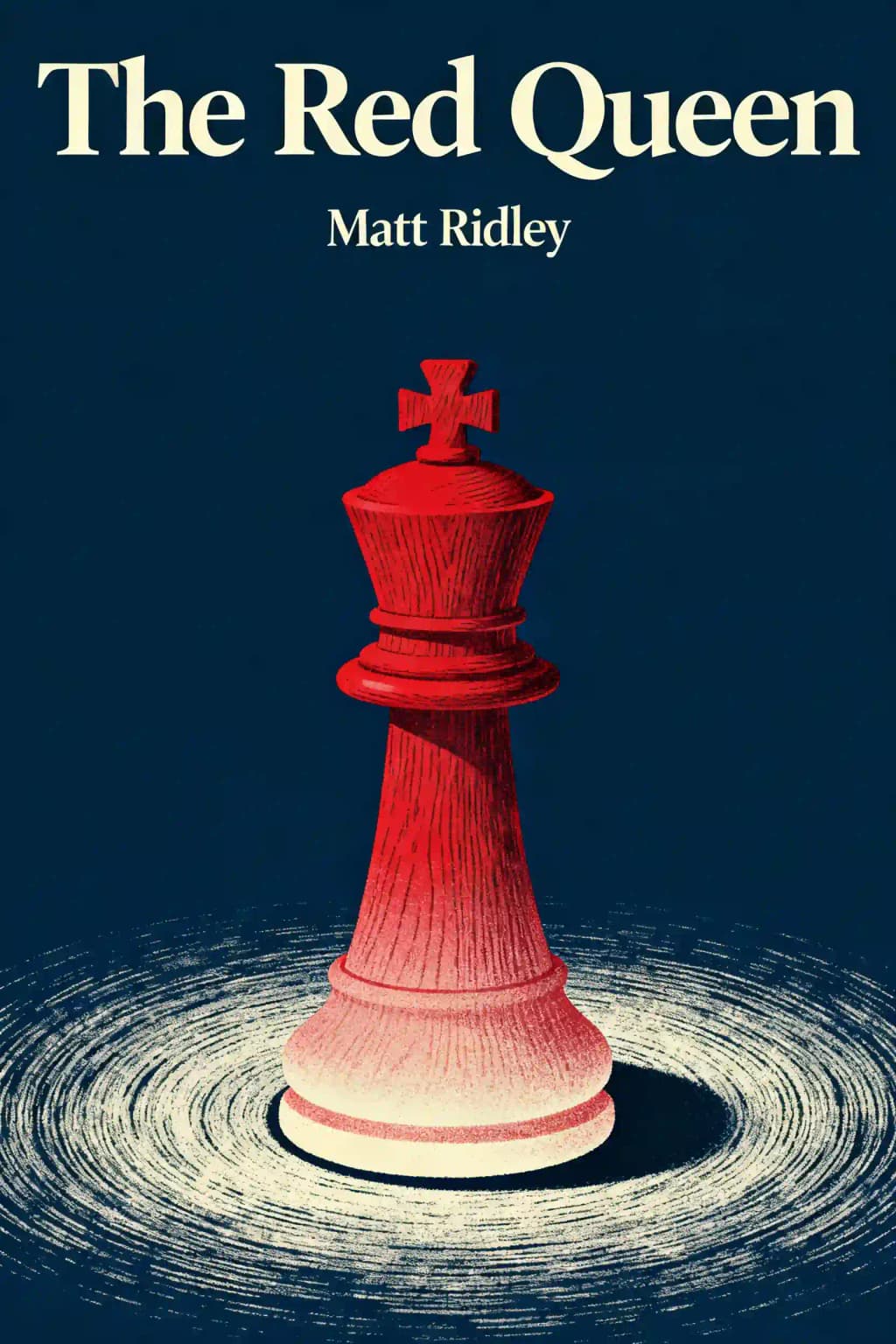
Red Queen
Sex and the Evolution of Human Nature
Aperçu de Red Queen
Why do we have sex? Ridley's evolutionary masterpiece reveals how sexual selection drives human behavior, from mating strategies to gender differences. Endorsed by Dawkins and referenced in "The Game," this provocative theory explains why beauty matters and how our genes wage constant evolutionary warfare.
Thèmes clés dans Red Queen
- sexual selection
- evolutionary arms race
- genetic parasite defense
- intragenomic conflict
- reproductive biology
Citations de Red Queen
Standing still means extinction.
Evolution isn't progressive or directional.
Inside every organism, a hidden war rages between genes.
Sperm practice 'safe sex' that prevents cross-infection.
Females need no better reason for preferring long tails than that other females also prefer them.
Personnages de Red Queen
- Matt RidleyAuthor and science writer who synthesized the work
- John Maynard SmithBiologist who identified the two-fold cost of sex
- Harris BernsteinScientist who proposed the genetic repair theory
- Hermann MullerGeneticist who theorized how mutations accumulate
- Alexey KondrashovBiologist who studied how sex purges mutations
À propos de l'auteur
À propos de l'auteur de Red Queen
Matthew White Ridley, 5th Viscount Ridley, is the bestselling author of The Red Queen: Sex and the Evolution of Human Nature and a renowned science writer specializing in evolutionary biology and genetics.
A zoology PhD from Oxford University, Ridley combines rigorous academic insight with accessible storytelling, exploring themes of human behavior, cooperation, and evolutionary strategies in this influential work on sexual selection. His expertise is underscored by decades of science journalism at The Economist, The Times, and The Wall Street Journal, where his “Mind and Matter” column analyzed interdisciplinary intersections of science and society.
Ridley’s authoritative works include Genome: The Autobiography of a Species in 23 Chapters and The Rational Optimist: How Prosperity Evolves, both acclaimed for bridging scientific rigor with economic and social analysis. A fellow of the Royal Society of Literature and the Academy of Medical Sciences, he has shaped public discourse through media appearances and podcasts, including discussions on energy policy and scientific inquiry. The Red Queen, celebrated for its provocative examination of evolutionary theory, was shortlisted for multiple literary awards and remains a cornerstone in evolutionary psychology literature.
Telecharger le resume de Red Queen
Obtenez le resume de Red Queen en PDF ou EPUB gratuit. Imprimez-le ou lisez-le hors ligne a tout moment.
FAQ sur ce livre
The Red Queen explores evolutionary biology through the lens of sexual selection and the Red Queen hypothesis, which argues that species must continually adapt to survive in a competitive environment. Ridley examines why sexual reproduction evolved over asexual methods, how human mating strategies (like male polygamy and female selectivity) developed, and the evolutionary roots of attraction, infidelity, and gender differences.
This book is ideal for students of biology, anthropology, or psychology, as well as readers curious about the evolutionary drivers behind human behavior. Its blend of scientific theory and engaging storytelling appeals to those interested in mating strategies, sexual selection, and the paradox of why sex exists despite its inefficiencies.
Yes—Ridley’s compelling synthesis of evolutionary theory, genetics, and human behavior offers fresh insights into topics like infidelity, beauty standards, and gender dynamics. While some theories remain debated, the book’s accessible explanations of complex concepts (e.g., parasite-driven evolution) make it a thought-provoking read for science enthusiasts.
The Red Queen hypothesis, derived from Lewis Carroll’s Through the Looking-Glass, posits that species engage in an endless evolutionary “arms race” to outcompete rivals and survive. Ridley uses this metaphor to explain why sexual reproduction evolved: genetic diversity from sex helps hosts resist parasites, which continually adapt to exploit them.
Ridley attributes the persistence of sex to its role in combating parasites. Asexual reproduction clones genes, making populations vulnerable to pathogens. Sexual reproduction shuffles genes, creating diverse offspring that are harder for parasites to target—a critical advantage in the Red Queen’s evolutionary race.
Men evolved to seek multiple partners to spread their genes, while women prioritize mates with resources or status to ensure offspring survival. Ridley ties this to evolutionary logic: women invest more in pregnancy and childcare, driving selectivity, while men maximize reproductive success through polygamy.
Ridley links preferences for traits like height, wealth, or symmetry to evolutionary fitness signals. For example, women’s attraction to status reflects ancestral needs for reliable providers, while men’s focus on youth and beauty correlates with fertility cues—patterns rooted in sexual selection.
The metaphor illustrates evolution’s treadmill: just as the Red Queen runs endlessly without progressing, species must keep adapting merely to survive. Ridley applies this to host-parasite dynamics, sexual competition, and the futility of “progress” in evolution.
Some critics note Ridley’s delayed focus on humans (starting in Chapter 6) and his speculative links between animal behavior and human culture. Others argue his emphasis on genetic determinism oversimplifies the role of social and environmental factors.
The book suggests evolutionary impulses still shape behavior: men may subconsciously seek multiple partners, while women balance long-term stability with clandestine liaisons for genetic diversity. Ridley argues these instincts persist despite modern societal norms.
- Evolution is a treadmill: Survival requires constant adaptation, not linear progress.
- Sexual selection drives diversity: Mating preferences shape physical and behavioral traits.
- Two sexes optimize genetic exchange: More would complicate reproduction without clear benefits.
Ridley’s assertion that adultery can be a strategic reproductive choice for women with “mediocre” mates sparked debate. Similarly, his defense of polygamy as evolutionarily logical challenges monogamous cultural norms.