Chapitre 1
Democracy's Uncomfortable Truth: Why Voters Choose Bad Policies
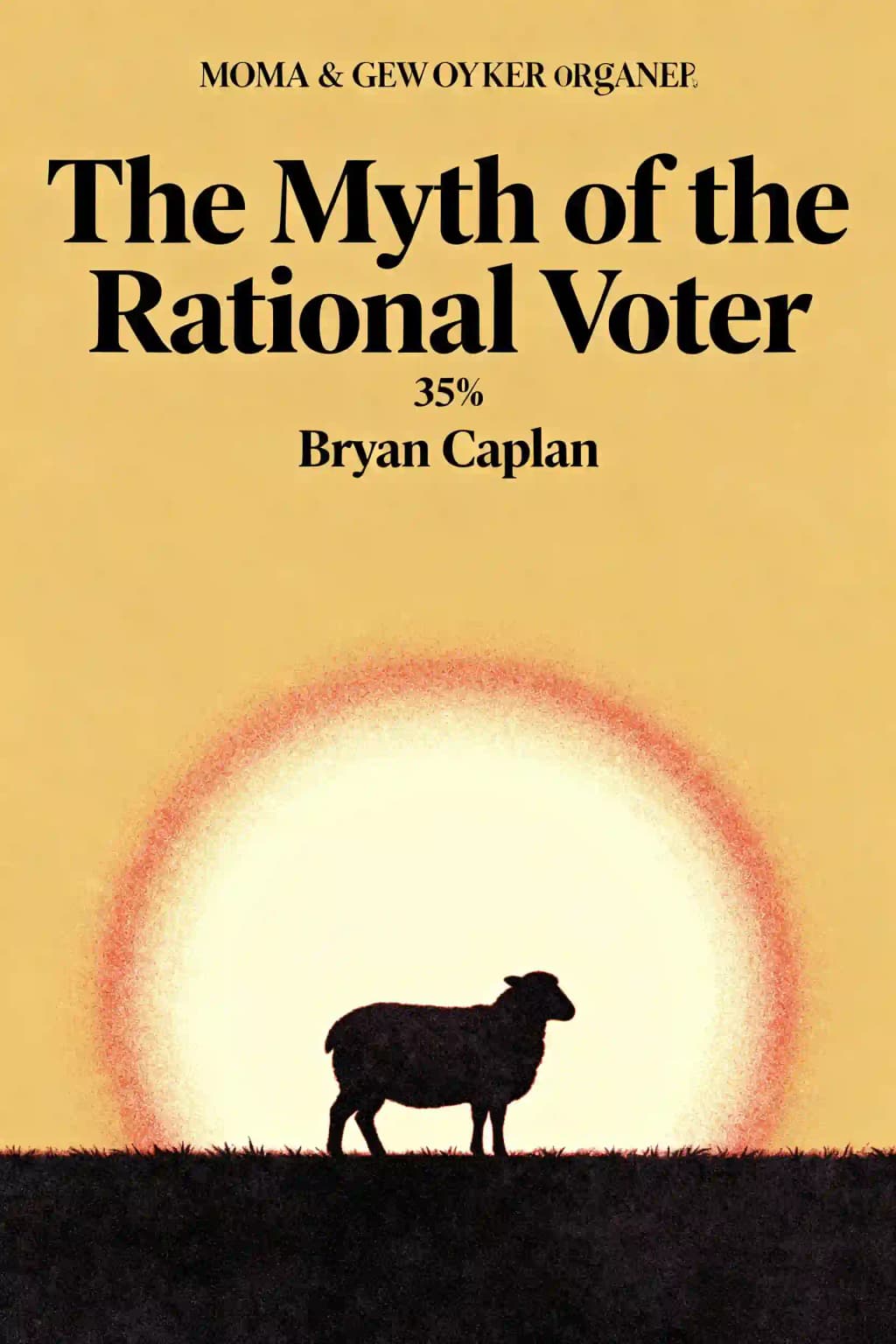
The Myth of the Rational Voter has become something of a modern classic in political economy since its 2007 publication. Bryan Caplan's provocative thesis struck a nerve in both academic and policy circles, earning praise from The Economist and The New York Times despite challenging democracy's most sacred assumptions. What makes this book particularly fascinating is how it bridges disciplines - economists found it refreshingly candid about voter behavior, while political scientists discovered economic insights that explained persistent policy failures. Even celebrities like tech entrepreneur Peter Thiel and behavioral economist Dan Ariely have cited it when discussing the limitations of democratic systems. The book's cultural impact continues to grow as polarization and populism have intensified in the years since its publication, making its central insights more relevant than ever.
Chapitre 2
The Paradox That Haunts Democracy
Democracy presents us with a perplexing puzzle: why do democratic societies consistently implement policies that harm the very citizens who voted for them? Consider trade protectionism. For centuries, economists across the political spectrum have demonstrated that restricting imports typically harms a nation's economy. Yet almost every democracy maintains significant trade barriers.
The standard explanations for this paradox fall short. Some blame special interests capturing the political process, but this doesn't explain why harmful policies often enjoy broad public support. Others point to voter ignorance - citizens simply don't know enough about their representatives or policies. Democracy's defenders either insist the public is right while experts are wrong, or they attack the mechanisms of alleged democratic failure without addressing specific policies.
Caplan offers a more troubling explanation: voters aren't merely ignorant but systematically irrational. They allow emotion and ideology to override factual information when forming political opinions. Protectionism persists because it feels good to believe in it, regardless of the economic reality. When voters operate under false but emotionally satisfying beliefs, democracy delivers bad policies - garbage in, garbage out.
This irrationality creates an externality - voters' poor decisions harm everyone subject to resulting misguided policies. Since most costs of voter irrationality are external (shared by society), while the psychological benefits are internal (enjoyed by the individual), voters have little incentive to overcome their biases. When enough citizens think this way, harmful policies win by popular demand.
While democracies deliver historically impressive living standards compared to authoritarian alternatives, we must examine how they disappoint. As Churchill famously noted, democracy may be "the worst form of government, except all those other forms," but this overlooks that government varies in scope as well as form. In democracies, the main alternative to majority rule isn't dictatorship but markets - which economists typically find work better than the general public believes.
Chapitre 3
Beyond the Miracle of Aggregation
Voter ignorance runs deep. Less than 40% of Americans know both their senators' names, and only about half know each state has two senators. This ignorance isn't merely unfortunate but rational - since one vote rarely affects outcomes, self-interested individuals have little incentive to become politically informed.
However, democracy can function surprisingly well despite voter ignorance through what's called the "Miracle of Aggregation." When voters make random errors rather than systematic ones, these errors cancel each other out in large numbers. With just 1% of voters well-informed and 99% voting randomly, the informed 1% determines the outcome - meaning whoever has support from the majority of well-informed citizens prevails.
This statistical miracle works in many domains. In a contest to guess an ox's weight, the average of 787 guesses was off by just one pound. On "Who Wants to Be a Millionaire," audience polls were correct 91% of the time. Financial markets and betting odds consistently outperform individual experts.
But here's the problem: the Miracle of Aggregation only works if voter errors are random, not systematic. Caplan argues that beliefs about economics - among the most politically relevant beliefs - are riddled with systematic errors. Voters consistently display four biases:
1. Antimarket bias (failing to understand how markets harmonize private interests with public welfare)
2. Antiforeign bias (underestimating benefits of foreign interaction)
3. Make-work bias (equating prosperity with employment rather than production)
4. Pessimistic bias (believing economic conditions are worse than they are)
When voters have systematic biases, democracy produces suboptimal policies. If voters systematically overestimate protectionism's benefits, politicians will implement excessive trade barriers - giving voters what they ask for rather than what would actually benefit them.
Chapitre 4
The Rational Irrationality Framework
When people simultaneously hold both material prosperity and ideological worldviews as values, they make calculated trade-offs between them based on the relative costs. In a democratic system, the price of maintaining ideological loyalty approaches zero because any single vote rarely determines electoral outcomes. For example, if restricting foreign workers from agricultural jobs costs society $1,000 per person annually in higher food prices, but there's only a 0.1% chance your vote will influence this policy, you effectively pay just $1 to indulge your protectionist beliefs.
This mechanism creates a dangerous disconnect between private and social costs - voters collectively sacrifice $1,000,000 in social wealth for ideological satisfaction worth merely $501 to them individually. The problem compounds because, unlike consumers in markets who directly face the consequences of their choices through prices and product quality, voters face virtually no personal cost for embracing economic or political delusions. This leads them to "satiate" their demand for comforting political beliefs, whether about immigration, trade policy, or government intervention.
The framework explains why education levels and economic literacy often fail to predict voting patterns on economic issues. Contrary to the cynical view of voters as purely self-interested "pocketbook" voters who support policies benefiting them personally, empirical evidence shows surprisingly little connection between personal economic interests and political opinions. A wealthy person may support higher taxes on the rich, while a low-income worker might oppose minimum wage increases.
Instead, voters typically support policies they genuinely perceive to be in the national interest - but rarely invest time questioning whether these policies effectively achieve their stated goals. This rational ignorance persists because the cost of thoroughly researching complex policy issues far exceeds the microscopic chance of casting a decisive vote. Politicians must therefore cater to these voter beliefs and misconceptions to win elections, rather than pursuing optimal policies. This creates a political system primarily driven by voter misconceptions about economics and policy effectiveness, rather than special interests directly subverting democratic processes through lobbying or campaign contributions.
The framework helps explain persistent support for policies like agricultural subsidies, trade restrictions, and price controls, despite widespread agreement among economists about their inefficiency. When the personal cost of ideological beliefs approaches zero, voters rationally choose to maintain comforting but incorrect views about how the economy works.
Chapitre 5
The Four Horsemen of Political Irrationality
Antimarket bias is the tendency to underestimate the economic benefits of the market mechanism. The public focuses on business motives rather than competitive discipline, viewing profit-seeking as inherently harmful. As Schumpeter captured perfectly: "Capitalism stands its trial before judges who have the sentence of death in their pockets."
This bias manifests in several ways: equating market payments with transfers while ignoring incentives; viewing profits as gifts to the rich rather than rewards for serving consumers; misunderstanding interest as exploitation rather than compensation for delayed consumption; opposing tradable pollution permits despite their efficiency; and attributing prices to monopoly or CEO greed rather than supply and demand.
Antiforeign bias is the tendency to underestimate the economic benefits of interaction with foreigners. People instinctively view foreign trade as a form of competition or warfare rather than mutual benefit. Popular metaphors embed this suspicion in our language, treating foreigners as inherently exploitative.
This bias has been economists' most enduring opponent since Adam Smith admonished his countrymen to buy foreign goods when cheaper than domestic production. The Law of Comparative Advantage demonstrates that mutually beneficial trade is possible even when one nation is less productive in every way. When an American switches from wheat to cars and three Mexicans switch from cars to wheat, world output increases by two cars plus one bushel.
Make-work bias is the tendency to underestimate the economic benefits of conserving labor. The public perceives saving labor - producing more goods with fewer man-hours - as threatening rather than progressive. They believe prosperity comes from having jobs rather than creating value.
Economists have battled this fallacy for centuries. Bastiat ridiculed it as "Sisyphism" after the mythological Greek eternally condemned to roll a boulder uphill. The public equates wealth with effort, while economists understand wealth increases when the ratio of results to effort improves. Society prospers not when people merely have jobs, but when they create goods and services others want.
Pessimistic bias persists despite rising living standards. Herbert Spencer observed that "while elevation of the masses is going on far more rapidly than ever before... there swells louder the cry that the evils are so great that nothing short of a social revolution can cure them." This paradox continues today - as conditions improve, people become increasingly convinced things have never been worse.
Even intellectuals who've predicted Western civilization's collapse for over 150 years have watched its influence grow faster than ever during that period. The gap between objective conditions and subjective perceptions has arguably widened. As Gregg Easterbrook notes, our ancestors "might be dismayed to observe how acidly we deny we now are" free, comfortable, healthy and educated.
Chapitre 6
The Evidence: Economists versus the Public
The 1996 Survey of Americans and Economists on the Economy (SAEE) provides ideal data to test for systematic belief differences between experts and the public. It interviewed 1,510 randomly selected Americans and 250 economics Ph.D.s with identical questions.
When examining whether economists' views reflect bias rather than expertise, Caplan tests two main criticisms: self-serving bias (economists favor policies benefiting their affluent position) and ideological bias (economists are blinded by free-market fundamentalism).
To address these concerns, he creates the concept of the "Enlightened Public" - what the average person would believe if they had a Ph.D. in economics, or what economists would believe if their finances and ideology matched the average person's. By controlling for income, job security, race, gender, age, and political ideology, we can determine whether differences between economists and the public persist.
The results are striking: the Enlightened Public's views consistently align much closer to economists than to the general public. Self-serving and ideological bias combined explain less than 20% of the lay-expert belief gap. The remaining 80% is best attributed to economists' greater knowledge, not bias.
The largest belief gaps concern foreign aid spending (the public sees it as a serious economic problem, while economists unanimously consider it insignificant), immigration (the public fears foreigners "stealing" jobs and depressing wages, while economists recognize immigrants' economic benefits), and business profits (the public dramatically overestimates typical business profit rates and views profit as a zero-sum transfer rather than a driver of progress).
When asked about family incomes over the past 20 years, economists believe they've generally risen while the public overwhelmingly thinks they've fallen behind the cost of living - one of the largest belief gaps in the survey. This reflects genuine pessimistic bias rather than semantic differences.
Chapitre 7
From Irrationality to Policy
How exactly do voter misconceptions translate into harmful policies? When voters have biased beliefs about policy effectiveness but judge politicians on both policies and outcomes, politicians face a perverse trade-off: ignore public policy preferences and be thrown out regardless of good outcomes, or implement those preferences and become scapegoats for poor performance. This dilemma creates a fundamental tension in democratic governance where elected officials must choose between following public opinion and implementing more effective but unpopular policies.
Historical examples illustrate this dynamic clearly. President Clinton's support for NAFTA despite widespread public opposition exemplifies a leader choosing optimal policy over popular demand. Similarly, Federal Reserve chairs often maintain tight monetary policy despite public pressure for easier money. These cases demonstrate how politicians sometimes must risk their popularity to implement policies they believe will produce better outcomes.
The mechanism helps explain why voter dissatisfaction with elected officials remains chronically high - politicians are effectively "damned if they do and damned if they don't." When they implement policies aligned with expert consensus but contrary to public opinion, they face accusations of elitism and ignoring the will of the people. When they bow to popular demands for ineffective policies, they're blamed for the poor results. The public often calls them venal for failing to deliver what experts know to be impossible outcomes.
Counter-intuitively, voter unselfishness can actually worsen policy outcomes. When voters genuinely aim to maximize social welfare rather than pursue narrow self-interest, the only source of conflict becomes disagreement about how to achieve that welfare. This creates a particularly dangerous dynamic - when voters have systematic biases while being unselfish, democracy can produce worse outcomes than with selfish voters. Their shared irrationality points them in the wrong direction while their unselfishness keeps them marching in formation, amplifying rather than moderating harmful policy choices.
Empirical research reveals four key factors that predict greater agreement with economic experts: education level (the strongest predictor), personal income growth (a close second), job security, and male gender. Notably, neither absolute income level nor ideological conservatism significantly predict economic literacy. This pattern suggests that personal experience with economic progress and stability, rather than static economic position or political orientation, helps people recognize broader economic patterns and align more closely with expert consensus.
These findings have important implications for improving democratic outcomes. They suggest that expanding access to economic education, fostering conditions for broad-based income growth, and enhancing job security could help bridge the gap between voter beliefs and economic reality. However, the persistence of systematic biases even among educated voters highlights the ongoing challenge of achieving optimal policy outcomes in democratic systems.
Chapitre 8
The Political Marketplace: Competing for Irrational Voters
When rational politicians compete for irrational voters' support, mendacity becomes inevitable. Politicians have strong incentives to think rationally about their electoral prospects, campaign financing, and media relations, but not necessarily about policy effectiveness. If voters care only about policy positions rather than outcomes, politicians gain nothing from correctly diagnosing how policies actually work.
Instead, they "flatter prejudices to betray interests," catering to and even steering voters toward appealing misconceptions. Politicians may even have perverse incentives to sincerely believe voters' misconceptions, as genuine belief appears more authentic than cynical pandering. Successful politicians therefore need a blend of naive populism and realistic cynicism - explaining why so many are lawyers (trained to argue cases persuasively regardless of merit) rather than economists.
Leaders often inspire blind faith in their followers. As Robert Michels observed, people frequently believe their leaders "belong to a higher order of humanity," evidenced by veneration, docile obedience, and indignation toward criticism. This faith gives leaders "wiggle room" - public opinion becomes partly a function of politicians' own choices. While this faith creates dangerous slack for corrupt politicians to shirk their duties, it also potentially neutralizes public irrationality, allowing educated leaders to implement wise policies despite popular misconceptions.
Voter irrationality about delegation creates strange new political opportunities. When voters underestimate politicians' control over subordinates, politicians can publicly support popular but foolish policies while privately encouraging subordinates to implement unpopular but sensible alternatives. U.S. antitrust laws exemplify this perfectly - their sponsors won credit for "fighting the trusts" with ambiguous laws, while judges and regulators made the tough decisions and risked embarrassment.
Chapitre 9
Market Fundamentalism versus Democratic Fundamentalism
"Market fundamentalism" has become a popular accusation against economics. Critics claim economists dogmatically believe almost everything should be marketized regardless of evidence. This charge is absurd. The typical economist readily identifies areas where markets work poorly: public goods, externalities, monopoly, imperfect information. These concepts weren't forced upon economists from outside - they developed internally through self-criticism.
The accusation likely stems from projection. The most vocal critics of "market fundamentalism" often subscribe to "democratic fundamentalism" - the belief that "all the ills of democracy can be cured by more democracy." Unlike market fundamentalism, democratic fundamentalism is widespread and socially acceptable. Journalists, politicians, social scientists, and philosophers publicly profess it without embarrassment.
The 2003 Policy Analysis Market (PAM) controversy perfectly illustrates democratic fundamentalism in action. This Department of Defense program aimed to create prediction markets for national security questions, allowing people to bet on events like terrorist attacks to harness collective intelligence. When Senators discovered the program, they condemned it as "repugnant" without investigation. The media piled on, public opinion turned hostile, and the Secretary of Defense killed the program within a day of the publicity - despite solid evidence about prediction markets' accuracy and careful design to address obvious objections.
Undemocratic politics isn't the only alternative to democratic politics. Many areas stand outside "collective choice," where decisions are "up to the individual" or "left to the market." This private choice offers a third way between democracy and dictatorship. Religion exemplifies this shift - once a state responsibility, now individuals choose their faith regardless of majority opinion.
Chapitre 10
Correcting Democracy
If we accept democracy's inherent flaws, can we still improve outcomes? The answer depends on how flexibly we define "democracy" and what mechanisms we're willing to consider. While perfect solutions may not exist, several approaches could enhance democratic decision-making.
One controversial proposal involves restricting voting to those who demonstrate basic economic literacy. Just as we require drivers to prove competency before operating vehicles, proponents argue that voters should demonstrate understanding of fundamental economic principles before participating in decisions that affect the entire economy. A voter who doesn't grasp concepts like opportunity cost, inflation, or trade-offs might be likened to a driver who doesn't understand traffic signals - both pose risks to others. However, this approach raises serious concerns about disenfranchisement and equality.
Plural voting offers a more nuanced alternative, as historically practiced in Britain until 1949. This system awarded additional votes to university graduates and business owners, operating on the premise that those with more education or practical economic experience might make more informed decisions. Research consistently shows that voters with higher education levels tend to think more like economists, understanding concepts like comparative advantage and unintended consequences. Modern versions might consider expanding criteria beyond traditional education to include various forms of expertise.
A more moderate reform involves reconsidering aggressive voter turnout initiatives. Data shows that education levels correlate strongly with both voluntary turnout and economic literacy. Therefore, the current median voter actually demonstrates better economic understanding than the median citizen. Universal turnout, while democratically appealing, could paradoxically lower the quality of collective decision-making by including more voters with limited economic understanding.
Educational reform represents another promising avenue. Current curricula often prioritize traditional subjects over practical knowledge that helps citizens evaluate policy proposals. A revised approach would emphasize economics, evolutionary biology, statistics, and probability - tools that help students identify and correct cognitive biases. For instance, understanding basic statistics helps voters better evaluate claims about immigration's economic impact or assess the true risks of various policy proposals.
The economics profession itself could improve its public communication. Many economists retreat into technical language or academic journals rather than engaging with public discourse. Following Frederic Bastiat's example, they should actively contrast popular misconceptions with economic truths using clear, engaging language. This might include explaining how minimum wage laws can affect employment, how trade benefits both parties, or why price controls often backfire. Public intellectuals like Steven Pinker demonstrate how complex ideas can be communicated effectively to general audiences.
Implementation of any these reforms would require careful consideration of both practical and ethical implications. The goal isn't to create barriers to democratic participation but to enhance the quality of collective decision-making while preserving democratic principles.
Chapitre 11
Democracy as a Commons
Democracies have many counterproductive policies. How are these possible? Three basic responses exist: defend the policies on their merits, blame politicians and special interests for subverting democracy, or explain how policies can be both popular and counterproductive.
The first response rarely convinces - most policy proponents can't even state experts' main objections. The second is intellectually satisfying but flawed: theoretically, majorities could reassert dominance cheaply, and empirically, counterproductive policies enjoy broad popular support.
This leads to the third response. While it seems paradoxical for harmful policies to be popular, the paradox fades when we recognize that democracy is a commons, not a market. Voters don't "buy" policies with votes but toss their vote into a common pool where outcomes depend on average content. Democracy suffers from the mental pollution of systematically biased beliefs.
People care about their worldview as a consumption good. Few relish discovering their religious or political convictions are wrong. Rational irrationality follows: the quantity of irrationality demanded decreases as its material price rises. In daily life, reality gives us incentives to restrain irrationality. But with politics, there's almost no incentive to think rationally.
Democracy lets individuals enjoy psychological benefits of irrational beliefs at no personal cost, overemphasizing psychological payoffs at the expense of material well-being. The study of this political folly isn't merely academic - it's essential for improving democratic outcomes in a world where voter irrationality shapes the policies we all must live with.