Chapitre 1
The Illusion That's Costing You a Week Each Month
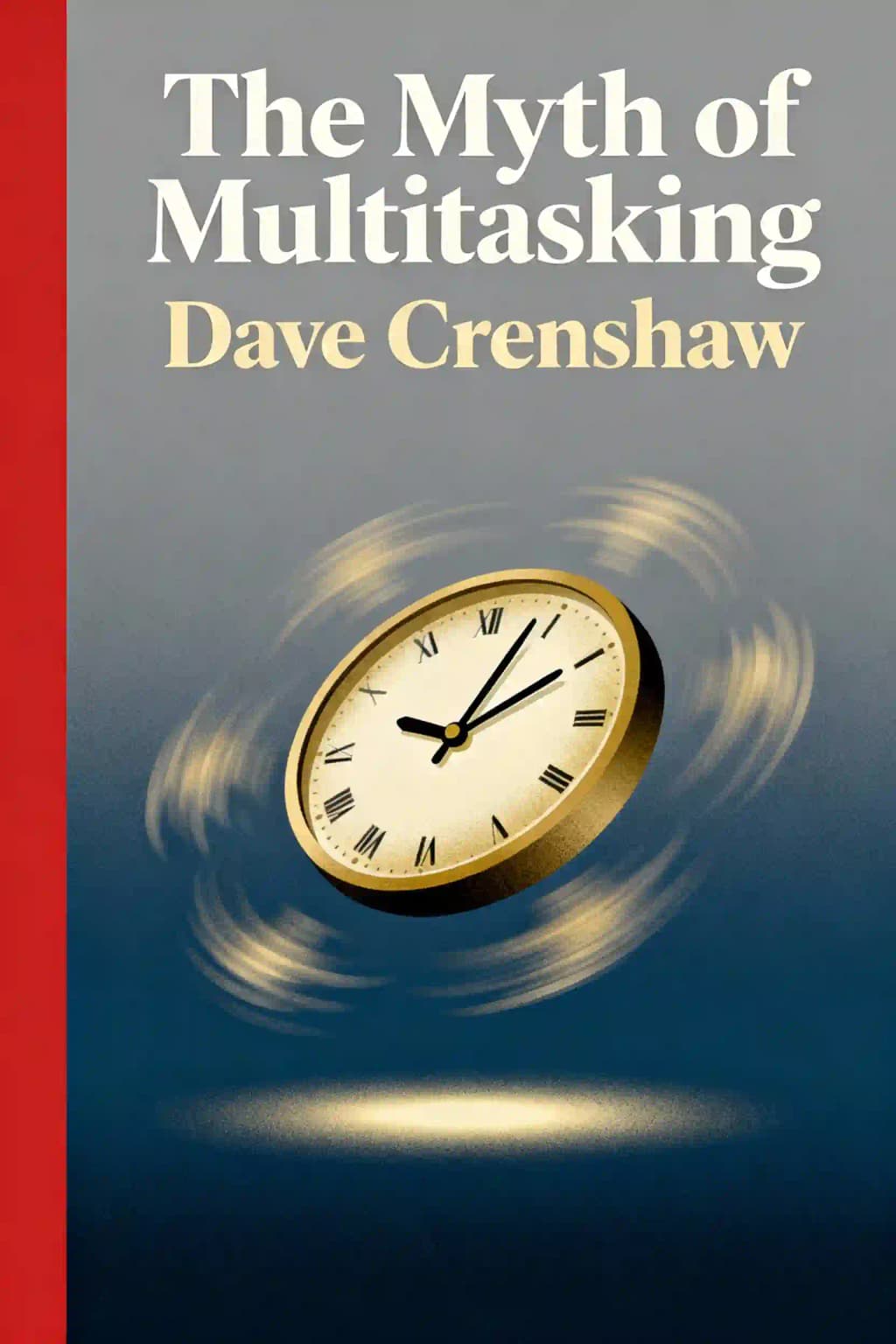
Imagine you're driving down a busy highway while texting, adjusting the radio, and trying to eat lunch. Suddenly, you look up to see traffic stopped ahead. This scenario-which we've all experienced in some form-perfectly captures the central deception explored in "The Myth of Multitasking." Since its publication in 2008, this book has become a staple in productivity circles, with over a million copies sold worldwide. Celebrated by figures like Tim Ferriss and featured in courses at Harvard Business School, Dave Crenshaw's business fable challenges our most fundamental assumptions about efficiency. The book's cultural impact extends beyond business-it's been cited in psychology research, parenting guides, and even mindfulness programs. What makes this slim volume so powerful is its counterintuitive premise: the very skill most of us list proudly on our resumes might actually be our greatest productivity saboteur.
Chapitre 2
The Multitasking Mirage: How We Deceive Ourselves
We've all heard someone proudly declare, "I'm an excellent multitasker!" Perhaps you've said it yourself. This perceived ability to juggle multiple tasks simultaneously has become a badge of honor in our hyper-connected world. When consultant Phil meets Helen Whitman, the overwhelmed CEO of the successful eco-clothing company GreenGarb, she proudly proclaims herself the "Queen Mother of Multitasking." She even requires this "skill" from all her employees, making it a core requirement in job postings and performance reviews.
But Phil challenges this pride with a provocative statement: "There are lies, damned lies, and...multitasking." This isn't just clever wordplay-it's the fundamental truth that most productivity experts now acknowledge. What we call multitasking is actually "switchtasking"-rapidly shifting our attention between multiple activities, never fully focusing on any single one. Research from Stanford University has shown that heavy multitaskers are actually less productive than those who focus on one task at a time, and they struggle more with organizational and filtering tasks.
The distinction is crucial. True multitasking would mean performing two cognitively demanding tasks simultaneously with full attention-something the human brain simply cannot do. When we attempt to multitask, we're actually forcing our brains to constantly switch contexts, creating significant mental friction with each transition. Think about it: have you ever tried to write an email while participating in a conference call? You might physically manage both, but your attention is ping-ponging back and forth, never fully engaged with either task. Studies show that this type of task-switching can reduce productivity by as much as 40%.
This isn't just inefficient-it's exhausting. Each switch requires our brains to reorient, recall where we left off, and rebuild momentum. It's like constantly hitting the mental reset button throughout your day. The cognitive cost is similar to losing a night's sleep, with some studies suggesting that multitasking can temporarily lower IQ by up to 15 points. Even brief interruptions, like checking a text message while working on a report, can double the number of errors made on the primary task.
The real danger lies in how multitasking creates an illusion of productivity. We feel busy and engaged, switching between tasks with a false sense of accomplishment. However, like Helen at GreenGarb, many leaders mistake this constant activity for effective work. The truth is that focused, single-tasking produces better results in less time. When Phil helped Helen implement "focus blocks" - 90-minute periods of uninterrupted work on single tasks - her team's productivity increased by 27%, while stress levels noticeably decreased.
Chapitre 3
The Hidden Cost: Your Missing Workweek
The productivity cost of switchtasking is staggering and far more pervasive than most realize. When Phil analyzes Helen's workday, he discovers she's interrupted roughly every ten minutes by emails, in-person visits, and phone calls. Through a simple diagram, he shows her that in a typical hour, she loses 32 minutes to switching costs, leaving only 28 minutes of actual productive time-and even that comes in short, interrupted bursts. These interruptions include responding to "urgent" emails, answering quick questions from team members, checking notifications, and jumping between multiple ongoing projects.
Research backs this up with alarming statistics. The average worker loses about 28% of their workday to interruptions, with executives losing closer to 50%. For Helen's company, this translates to approximately one entire workweek of productivity lost every month. In practical terms, this means that out of a typical 40-hour workweek, nearly 11 hours are lost to task switching. Multiply that across her entire organization of 200 employees, and the financial impact becomes enormous - potentially millions in lost productivity annually.
The costs extend far beyond mere efficiency metrics. When we switchtask, we make more errors - studies show error rates can increase by up to 50% when frequently switching between tasks. Our memory suffers, as our brains never fully engage with any single task long enough to transfer information from short-term to long-term memory. Our stress levels increase significantly, as the constant context switching triggers our body's stress response system. The mental fatigue from continuous task switching can persist for hours after work, affecting our personal lives and recovery time.
Perhaps most importantly, our relationships deteriorate. As Phil explains to Helen, "When we give people partial attention, it makes them feel unimportant-like saying 'Hi, you're unimportant.'" This manifests in numerous subtle ways: checking emails during meetings, glancing at phones during conversations, or mentally preparing responses to other matters while someone is speaking. Each instance sends a clear message that the person in front of you is less important than potential interruptions.
Consider what happens when you check your phone during a conversation. The message you're sending is clear: whatever might be happening on that screen is potentially more valuable than the person in front of you. Research shows that even the mere presence of a phone on a table during a conversation reduces the perceived quality of the interaction and the level of empathy between participants. We've normalized this behavior to such an extent that we barely notice it anymore, but the cumulative effect on our professional and personal relationships is profound, leading to decreased trust, reduced collaboration, and weakened team bonds.
The irony? People who claim to be "good at multitasking" are statistically worse at it, scoring 15-20% lower on performance tests. They're simply less aware of the switching costs they're incurring. The confidence in their multitasking ability actually blinds them to their inefficiency, creating a dangerous feedback loop where they continue to engage in increasingly counterproductive behavior while believing they're being more productive.
Chapitre 4
From Computers to Chaos: The Misapplication of a Technical Term
How did we come to embrace such a counterproductive habit? The term "multitasking" wasn't originally applied to humans at all. It originated in computing, where processors rapidly switch between programs to create the illusion of simultaneous operation. In the 1990s, this computer terminology was misapplied to human behavior, coinciding with the rise of personal computers and the increasing pressure to maximize productivity in the workplace. This misappropriation of technical language helped normalize a fundamentally flawed approach to human attention and productivity.
When Helen looks up the definition, she discovers that even in computers, multitasking involves interrupting one program to run another-never truly simultaneous processing. The human brain works similarly but with a crucial difference: computers don't experience attention residue or emotional costs when switching between tasks. While a computer can switch between processes in microseconds with perfect accuracy, human transitions are messier, slower, and carry cognitive penalties that can last for 15-23 minutes after each switch. Research from the University of California found that it takes an average of 23 minutes to fully regain focus after an interruption.
Not all multiple activities are harmful, however. Phil introduces "backtasking" as the productive alternative: doing multiple things when only one requires attention. Examples include printing documents while working on something else, jogging while listening to music, or letting laundry run while reading. These activities don't compete for the same cognitive resources. Other effective examples include downloading files while writing emails, cooking dinner while listening to podcasts, or folding laundry while watching television. The key is that one activity must be largely automatic or mechanical.
But many activities we think we can combine actually demand the same mental bandwidth. Talking while driving, for instance, creates risks comparable to driving under the influence-especially complex conversations that pull our attention from the road. Studies show that even hands-free phone conversations significantly impair driving performance because they compete for the same cognitive resources needed to navigate safely. Research from the Transport Research Laboratory found that drivers using hands-free phones had reaction times 50% slower than normal drivers. Similar cognitive conflicts occur when people attempt to read emails during meetings, write reports while participating in conference calls, or study while texting.
The fundamental problem is that our brains are designed for focused attention, not constant switching. Each time we interrupt ourselves or allow an external interruption, we pay a price in mental energy, time, and quality of work. The more complex the tasks, the higher the switching cost. Studies from the American Psychological Association demonstrate that multitasking can reduce productivity by up to 40% and increase errors by 50%. This cognitive toll is particularly severe for knowledge workers engaging in complex mental tasks, where context and deep focus are essential for quality output. The brain's prefrontal cortex, responsible for executive function and decision-making, becomes increasingly taxed with each task switch, leading to mental fatigue and decreased performance across all tasks.
Chapitre 5
The Demonstration: Twice the Time, Half the Quality
To demonstrate the real cost of switchtasking, Phil conducts a simple but powerful exercise with Helen and her assistant Sally. First, they write the sentence "Multitasking is worse than a lie" followed by numbers 1-27 sequentially. Working continuously on each task, they complete this straightforward assignment in about 29 seconds, with clear handwriting and few errors.
Then they alternate writing one letter of the sentence and one number, mimicking the kind of switchtasking many people do throughout their workday. This second round takes more than twice as long-60 seconds for Helen and 63 seconds for Sally. Not only does it take longer, but the quality of their writing deteriorates significantly: letters become messy, spacing becomes irregular, and some numbers are transposed. Both participants report feeling frustrated and mentally exhausted, despite the task's apparent simplicity.
This simple demonstration reveals three key costs of switchtasking:
1. Time: It takes significantly longer to complete the same amount of work, with the switched version requiring more than double the time
2. Quality: The work product suffers, with more errors, inconsistencies, and general sloppiness becoming evident
3. Stress: The mental effort required increases substantially, leading to frustration, anxiety, and mental fatigue
The exercise proves particularly effective because it makes the abstract concept of switching costs tangible and measurable. Helen and Sally can see and feel the difference in their performance in real-time. The revelation hits home: if switching between simple tasks like writing letters and numbers creates such a dramatic efficiency loss, imagine the cumulative effect of switching between complex business tasks throughout the day, such as writing reports, attending meetings, responding to emails, and managing projects.
What makes this exercise so powerful is its universal applicability and reproducibility. When conducted with executives, middle managers, or entry-level employees, the results are remarkably consistent. Even those who pride themselves on being excellent multitaskers show similar performance degradation. The exercise has been replicated across different industries, cultures, and age groups, always yielding similar results: switchtasking significantly impairs performance.
The demonstration also highlights the hidden costs of interrupted work. Each time participants switch between writing letters and numbers, they must mentally reorient themselves to the new task, consuming valuable cognitive resources. This mirrors the workplace reality where employees typically take 23 minutes to fully regain focus after an interruption. The exercise serves as a microcosm of our daily work habits, revealing how seemingly innocent task-switching can substantially impact productivity and well-being.
Try replicating this exercise with colleagues or team members. The results consistently prove eye-opening, even for the most skeptical participants who believe they're exceptional multitaskers. The human brain simply isn't wired to rapidly switch contexts without incurring significant performance penalties, regardless of intelligence, experience, or determination.
Chapitre 6
The Relationship Factor: When Half Attention Equals No Respect
Beyond efficiency, switchtasking damages our relationships in profound ways. Phil illustrates this through a scene Helen and Sally observe outside the office window. Tracy, an employee, attempts to focus on her computer while giving half attention to Jason, an intern. When Tracy walks away mid-conversation to take a cell call, Jason stands dejected before shuffling away.
"People deserve our full attention," Phil explains. "When we give them partial attention, it makes them feel unimportant." Helen realizes this pattern is constant throughout her organization-and in her personal life as well. Later, she has a painful realization that she's been switchtasking during family time, merely being physically present with her children while mentally focused on work.
This relationship cost extends to customers too. Helen makes the connection that switchtasking with customers could hurt sales by making them feel unvalued. In a world where customer experience increasingly differentiates businesses, this insight is particularly valuable.
The relationship damage occurs because humans are remarkably perceptive about attention. We can tell when someone is truly present versus when their mind is elsewhere. Even subtle cues-glancing at a phone, scanning the room during conversation, or delayed responses-signal divided attention. Over time, this erodes trust and connection.
Consider how this plays out in meetings. When participants are checking email or messaging, the quality of discussion suffers, decisions take longer, and follow-through is compromised. What might seem like efficient use of time actually creates more work and confusion later.
The solution is deceptively simple but challenging to implement: give people your full attention when you're with them. This means putting away devices, maintaining eye contact, and truly listening. The productivity gains from focused interactions far outweigh any perceived efficiency from trying to do multiple things at once.
Chapitre 7
The "When" Question: Creating Predictable Access
After observing Sally's habit of trying to cover everything while she has Helen's attention, Phil identifies a key organizational problem with one word: "When?" Employees don't know when they'll next have access to Helen, so they cling to her attention once obtained, creating a cycle of constant interruptions.
This uncertainty drives what Phil calls "impatientcies"-issues that aren't true emergencies but feel urgent because of access anxiety. To break this cycle, Phil offers two powerful solutions:
1. Set recurring meetings with key team members
2. Establish clear "open-door" hours
Recurring meetings function as "workplace magic" by creating predictable access points. When employees know they'll have Helen's undivided attention at 10 AM every Tuesday, they can save non-urgent matters for that time rather than interrupting her workflow. This doesn't mean filling Helen's calendar with endless meetings-only people who directly report to her or have regular questions need these standing appointments.
The frequency of these meetings should correspond to the frequency of interruptions. Someone who typically interrupts daily might need a quick daily check-in, while others might need only weekly or monthly meetings. The key is creating predictability that alleviates the anxiety driving constant interruptions.
For those without recurring meetings, clear "open for business" hours establish when Helen is available for drop-in conversations. Just as retail stores post their hours, leaders should communicate when they're available for unscheduled interactions. This simple practice dramatically reduces the stress of uncertainty.
Phil demonstrates this principle with his own voicemail message, which clearly states when he returns calls (noon and four o'clock). His clients appreciate this reliability-they may not always get immediate responses, but they know exactly when to expect one.
By implementing these practices, Helen transforms from being constantly interrupted to having focused blocks of time for both deep work and meaningful interactions. The result is better decisions, improved follow-through, and significantly reduced stress for everyone.
Chapitre 8
The Reality Check: There Are Only 168 Hours
One of the most powerful exercises Phil gives Helen is the "Truth of Time" worksheet. This simple tool forces her to confront the mathematical reality of time-there are only 168 hours in a week, no matter how efficiently we try to use them.
When Helen estimates how much time she spends on various activities, her total comes to 190 hours-22 hours more than actually exist in a week. This impossible math reveals the fundamental flaw in her approach: she's been mentally double-counting time, assuming she can be fully present for her family while also thinking about work, or fully focused on a project while also handling emails.
Phil writes at the top of her worksheet: "There is only one timeline. There is only one you." This simple truth hits Helen hard. She realizes she's been living in denial about the finite nature of time and her own capacity. No amount of switchtasking can create more hours in the day or allow her to be in two places at once.
This realization leads to a crucial shift in perspective. Instead of trying to do more things simultaneously, Helen needs to make conscious choices about how she allocates her limited time. This means:
1. Defining clear boundaries between activities
2. Being fully present for whatever she's doing
3. Making deliberate choices about what deserves her time
4. Saying no to things that don't fit within her 168 hours
The worksheet guides Helen to create a realistic time budget for the future that respects the 168-hour limit. Phil suggests implementing changes gradually over the next month, starting with small adjustments and building toward a sustainable schedule.
This exercise is transformative because it shifts the focus from efficiency to effectiveness. Rather than trying to squeeze more activities into each hour through multitasking, Helen learns to make better decisions about which activities deserve her limited hours in the first place.
Chapitre 9
From Personal Systems to Cultural Transformation
Phil explains that lasting change requires addressing both personal systems and organizational culture. He draws a diagram showing how business systems prevent chaos and ensure consistency, while personal systems (managing email, calendar, workspace) prevent individuals from being at the mercy of interruptions.
Most importantly, he emphasizes that a company's culture reflects its leader's habits-Helen's switchtasking has created a stressed company culture throughout GreenGarb. Rather than just adding fun perks to improve the environment, Helen needs to change her personal systems first, as this will naturally influence the entire organization.
Three months after their initial meeting, the transformation is remarkable. Phil helped Helen build her personal systems and establish a time budget before helping her schedule recurring meetings with key employees. After Helen mastered her systems, they began training the management team. The company culture shifted as leaders began truly listening and giving employees their full attention. Project follow-through improved, and sales increased as customers felt more valued.
The change begins with Helen's personal revelation at a family dinner where she bans phones and stays fully present. Her family is initially shocked by her behavior change, with her daughter asking, "Who are you and what have you done with my Mom?" As they realize Helen is genuinely giving them undivided attention, they open up and everyone enjoys themselves.
This ripple effect-from personal habits to family dynamics to organizational culture-illustrates the book's central message: meaningful productivity improvement doesn't come from working harder or multitasking better. It comes from making fundamental changes to how we manage our attention and time.
Chapitre 10
The Path Forward: Practical Steps to Reclaim Your Attention
The book concludes with a comprehensive "switchbuster" list of strategies to combat multitasking:
1. Recognize multitasking as a lie and understand the distinction between harmful switchtasking and productive backtasking
2. Know your true weekly time usage through the Truth of Time exercise
3. Create realistic schedules that respect the 168-hour limit
4. Set regular appointments with key people to reduce random interruptions
5. Establish personal "store hours" for availability
6. Resist active switches (self-initiated task changes)
7. Minimize passive switches (external interruptions)
8. Define communication channels and expected response times
9. Give people your full attention during interactions
10. Schedule buffer time between appointments
11. Never commit without checking your calendar first
These strategies aren't about working more hours-they're about reclaiming the hours you already work. By eliminating the productivity tax of constant switching, you can accomplish more while actually working less.
The transformation isn't immediate. As Phil cautions Helen about implementing these changes at GreenGarb, her managers still see multitasking as a badge of honor. He advises showing rather than telling, noting that Helen's own perspective shift required understanding the truth step by step before changing behavior.
This gradual approach is crucial. Trying to change everything at once is overwhelming and unsustainable. Instead, start with awareness, then make small adjustments to your systems and habits. As these changes take hold, you'll naturally influence those around you through example rather than mandate.
The ultimate promise of abandoning multitasking isn't just greater productivity-it's a more present, intentional, and satisfying life. By giving our full attention to what truly matters, we not only accomplish more but experience deeper connection and meaning in both our work and personal lives.