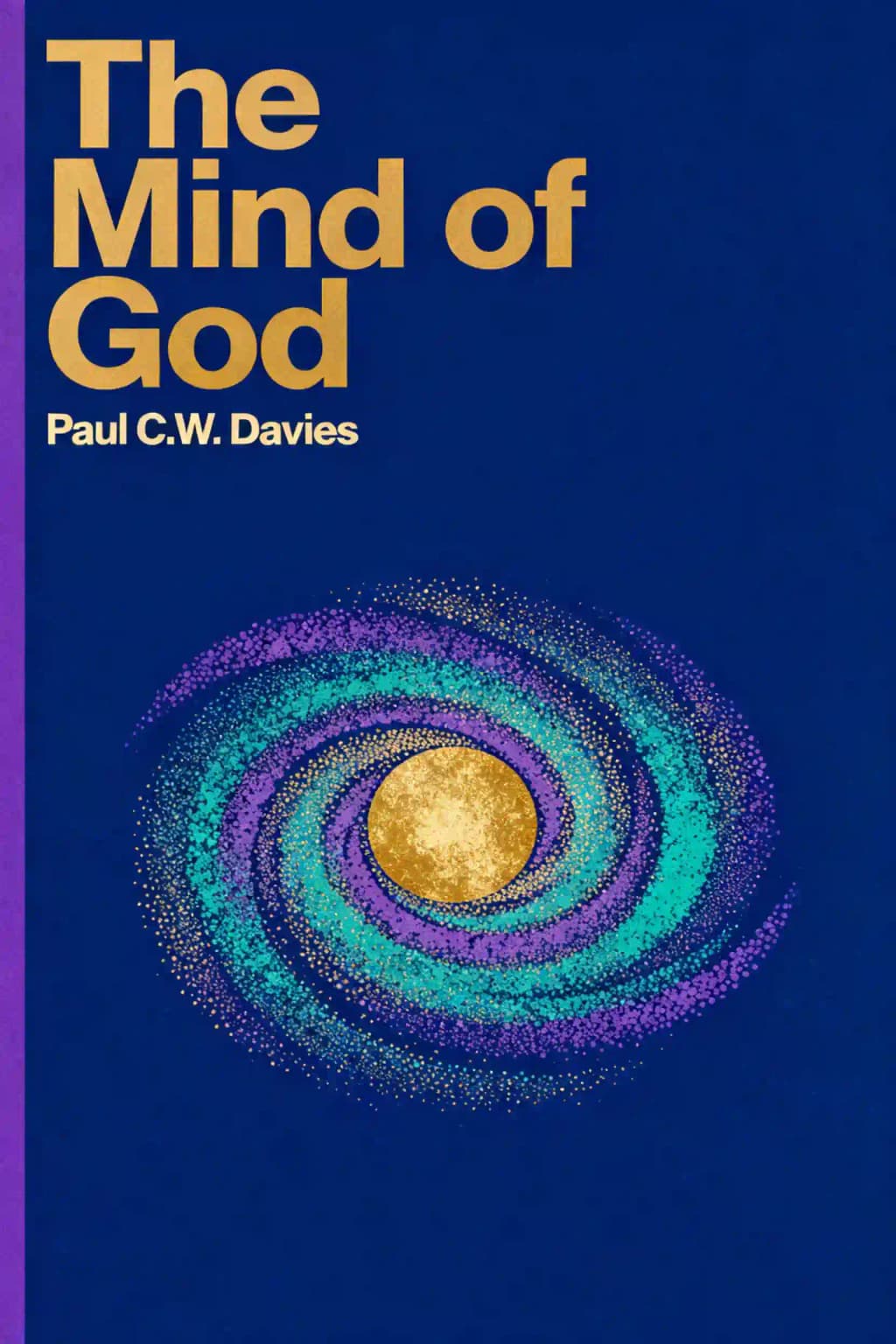
In "The Mind of God," physicist Paul Davies bridges science and spirituality, asking: Can quantum physics reveal divine purpose? This Templeton Prize-winning exploration earned Davies $1 million and sparked debates between scientists and theologians about whether we can truly "glimpse the mind of God."
Ressentez le livre à travers la voix de l'auteur
Transformez les connaissances en idées captivantes et riches en exemples
Capturez les idées clés en un éclair pour un apprentissage rapide
Profitez du livre de manière ludique et engageante
Have you ever wondered why the universe makes sense at all? As children, we pester our parents with endless "whys," but as adults, we rarely pause to consider the most profound question: why does the universe follow comprehensible rules? The greatest miracle of science isn't any particular discovery but the astonishing fact that science works in the first place. We take for granted that we inhabit a cosmos governed by precise mathematical laws that human minds can somehow decipher. This "unreasonable effectiveness of mathematics" presents a philosophical puzzle that has troubled brilliant minds from Einstein to Hawking. Our brains evolved primarily for finding food and avoiding predators, yet somehow they can comprehend quantum mechanics and general relativity. We can predict the motion of galaxies billions of light-years away and understand subatomic particles we'll never directly observe. This deep resonance between mind and cosmos seems almost suspiciously convenient - as if the universe were designed to be understood. What separates humans from other animals is precisely this power of abstract reasoning. A chimpanzee might learn to use a stick as a tool, but it won't develop theories about leverage and force. The mathematics we discover in our minds somehow matches the mathematics governing reality - from the golden ratio in nautilus shells to the wave functions of quantum mechanics. This correspondence between thought and reality remains one of science's most profound mysteries.
Décomposez les idées clés de The Mind of God en points faciles à comprendre pour découvrir comment les équipes innovantes créent, collaborent et grandissent.
Condensez The Mind of God en indices de mémoire rapides mettant en évidence les principes clés de franchise, de travail d'équipe et de résilience créative.

Découvrez The Mind of God à travers des récits vivants qui transforment les leçons d'innovation en moments mémorables et applicables.
Posez n'importe quelle question, choisissez la voix et co-créez des idées qui résonnent vraiment avec vous.

Cree par des anciens de Columbia University a San Francisco
"Instead of endless scrolling, I just hit play on BeFreed. It saves me so much time."
"I never knew where to start with nonfiction—BeFreed’s book lists turned into podcasts gave me a clear path."
"Perfect balance between learning and entertainment. Finished ‘Thinking, Fast and Slow’ on my commute this week."
"Crazy how much I learned while walking the dog. BeFreed = small habits → big gains."
"Reading used to feel like a chore. Now it’s just part of my lifestyle."
"Feels effortless compared to reading. I’ve finished 6 books this month already."
"BeFreed turned my guilty doomscrolling into something that feels productive and inspiring."
"BeFreed turned my commute into learning time. 20-min podcasts are perfect for finishing books I never had time for."
"BeFreed replaced my podcast queue. Imagine Spotify for books — that’s it. 🙌"
"It is great for me to learn something from the book without reading it."
"The themed book list podcasts help me connect ideas across authors—like a guided audio journey."
"Makes me feel smarter every time before going to work"
Cree par des anciens de Columbia University a San Francisco

Obtenez le resume de The Mind of God en PDF ou EPUB gratuit. Imprimez-le ou lisez-le hors ligne a tout moment.