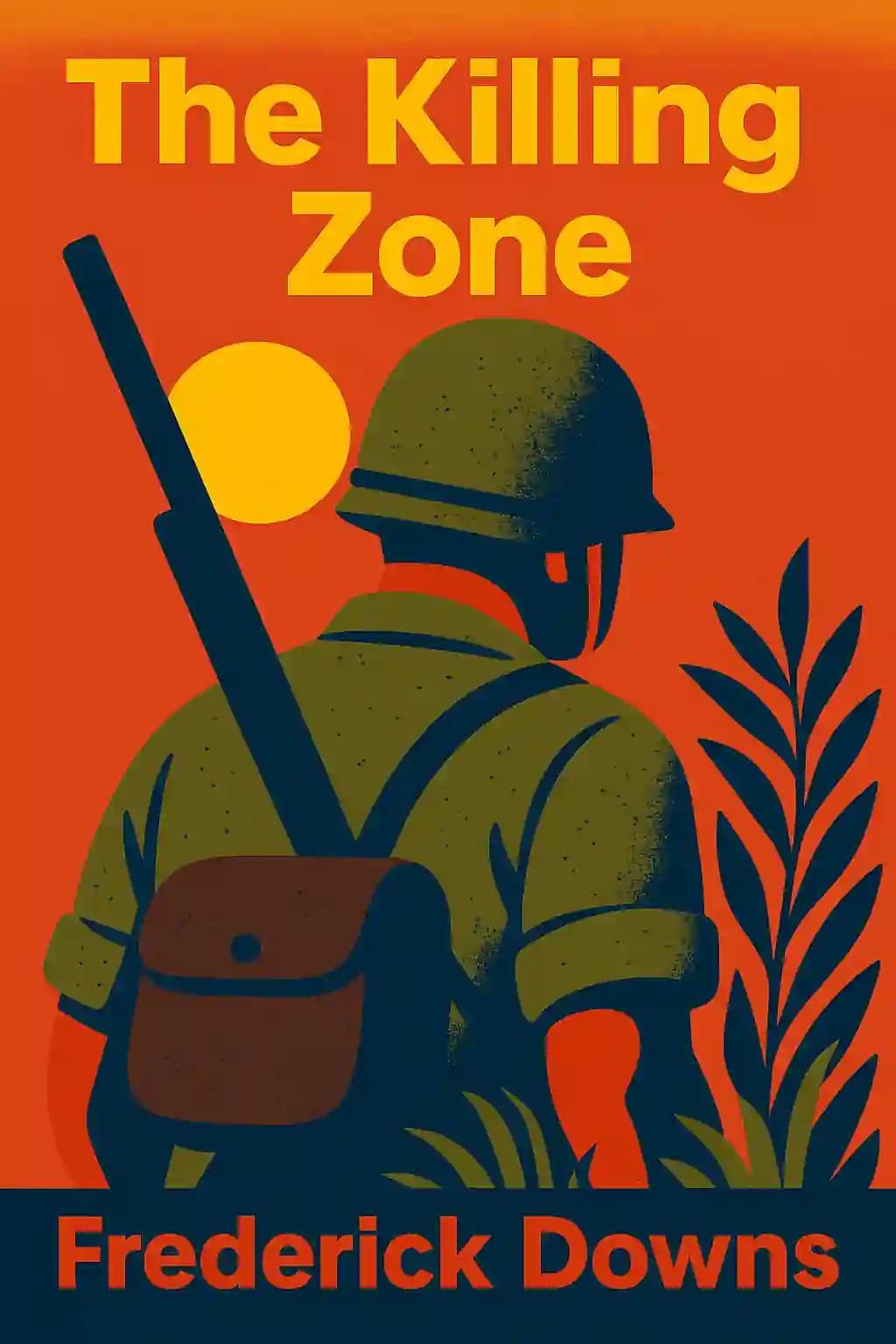
Frederick Downs Jr.'s raw Vietnam War memoir takes readers into infantry combat where morality blurs and survival haunts every step. Hailed by Army Times as "the best damned book from infantrymen's view," this four-time Purple Heart recipient's account reveals war's psychological wounds beyond physical scars.
Frederick Downs Jr. is the author of The Killing Zone: My Life in the Vietnam War, a decorated U.S. Army veteran, and an acclaimed chronicler of wartime resilience. His 1984 memoir is widely regarded as one of the most visceral accounts of infantry combat in Vietnam, drawing from his harrowing service as a platoon leader in the Central Highlands.
Downs was awarded four Purple Hearts, the Silver Star, and the Bronze Star with Valor. His writing is steeped in firsthand experience, particularly his catastrophic injury from a landmine in 1968, which left him with a permanent prosthetic arm.
A sought-after commentator on military history, Downs has appeared on PBS, NPR, and the Larry King Show. His sequel, Aftermath: A Soldier’s Return from Vietnam (1984), details his physical and psychological recovery, cementing his reputation as a voice for veterans’ lived experiences.
Beyond writing, he served as Chief Consultant of the Prosthetic and Sensory Aids Service at the U.S. Department of Veterans Affairs, advocating globally for amputees. The Killing Zone remains a staple in Vietnam War literature, praised for its unflinching authenticity and journal-like immediacy.
The Killing Zone is Frederick Downs Jr.'s visceral memoir of his 1967–1968 Vietnam War service as a U.S. Army lieutenant. It chronicles the brutal realities of guerrilla warfare, from ambushes and booby traps to the psychological toll of combat, while detailing his leadership of a platoon in the Central Highlands. The book emphasizes survival, camaraderie, and the surreal transition from civilian life to a warzone.
This book is essential for military history enthusiasts, veterans, and readers seeking unfiltered insights into frontline Vietnam War experiences. Its raw portrayal of combat and leadership under extreme pressure also appeals to those studying wartime psychology or counterinsurgency tactics.
Yes—it’s hailed as one of the most authentic Vietnam War memoirs for its unflinching honesty and vivid storytelling. Downs’ perspective as a wounded veteran and his later advocacy for prosthetics innovation add depth to his combat narrative, making it a critical read for understanding soldiers’ lived experiences.
Downs portrays combat as chaotic and unpredictable, dominated by guerrilla tactics. Firefights erupt suddenly in dense jungles, soldiers face hidden traps, and distinguishing enemies from civilians becomes nearly impossible. His accounts highlight the physical strain of humidity, leeches, and exhaustion alongside the adrenaline of survival.
In January 1968, Downs triggered a “Bouncing Betty” landmine during an ambush, losing his left arm above the elbow. This injury ended his combat service but fueled his postwar advocacy for veterans’ healthcare and prosthetic technology advancements.
Unlike broader political analyses, Downs focuses on daily infantry life, offering granular details of patrols, firebase logistics, and soldier interactions. This contrasts with memoirs like Matterhorn (fiction) or Dispatches, which blend reportage with existential reflection.
The “killing zone” refers to ambush sites where enemy forces trapped U.S. troops. Symbolically, it represents Vietnam itself—a place where danger lurked everywhere, and survival depended on split-second decisions.
Downs discusses his struggle with physical disability and postwar alienation, later finding purpose in VA work improving prosthetics. His return to Vietnam for reconciliation trips adds a poignant layer to his journey.
Some readers note its graphic violence and military jargon may overwhelm casual audiences. However, these elements reinforce its authenticity, offering a stark contrast to sanitized war narratives.
Its firsthand account of counterinsurgency tactics, soldier morale, and the war’s psychological impact provides invaluable primary-source material. Historians praise its unvarnished depiction of leadership challenges in asymmetric warfare.
Ressentez le livre à travers la voix de l'auteur
Transformez les connaissances en idées captivantes et riches en exemples
Capturez les idées clés en un éclair pour un apprentissage rapide
Profitez du livre de manière ludique et engageante
"IT'S A LICK" - referring to the punishment one receives when things go wrong.
His men were evaluated solely on their ability to help the platoon survive.
"My first test of command had been a miserable failure," Downs reflects.
Survival became the only thing of value.
The ballet of helicopters over the landing zone was both beautiful and terrifying.
Décomposez les idées clés de The Killing Zone en points faciles à comprendre pour découvrir comment les équipes innovantes créent, collaborent et grandissent.
Découvrez The Killing Zone à travers des récits vivants qui transforment les leçons d'innovation en moments mémorables et applicables.
Posez vos questions, choisissez votre style d’apprentissage et co-créez des idées qui vous correspondent vraiment.

Cree par des anciens de Columbia University a San Francisco
"Instead of endless scrolling, I just hit play on BeFreed. It saves me so much time."
"I never knew where to start with nonfiction—BeFreed’s book lists turned into podcasts gave me a clear path."
"Perfect balance between learning and entertainment. Finished ‘Thinking, Fast and Slow’ on my commute this week."
"Crazy how much I learned while walking the dog. BeFreed = small habits → big gains."
"Reading used to feel like a chore. Now it’s just part of my lifestyle."
"Feels effortless compared to reading. I’ve finished 6 books this month already."
"BeFreed turned my guilty doomscrolling into something that feels productive and inspiring."
"BeFreed turned my commute into learning time. 20-min podcasts are perfect for finishing books I never had time for."
"BeFreed replaced my podcast queue. Imagine Spotify for books — that’s it. 🙌"
"It is great for me to learn something from the book without reading it."
"The themed book list podcasts help me connect ideas across authors—like a guided audio journey."
"Makes me feel smarter every time before going to work"
Cree par des anciens de Columbia University a San Francisco

Obtenez le resume de The Killing Zone en PDF ou EPUB gratuit. Imprimez-le ou lisez-le hors ligne a tout moment.
A 23-year-old lieutenant steps off a helicopter into Vietnam's humid air, physically prepared but mentally unprepared for what awaits. Within sixteen days, Frederick Downs Jr. would command a platoon of men whose lives depended on his split-second decisions. Within four months, a buried mine would tear his body apart, ending his combat service but beginning a lifelong reckoning with war's true cost. The Killing Zone stands apart from other Vietnam narratives not because it offers grand strategic insights or political commentary, but because it refuses to look away from the intimate brutality of small-unit combat. Tim O'Brien called it "the finest account of small-unit combat I've ever read"-praise that carries weight precisely because it comes from someone who lived the same nightmare and spent decades trying to articulate it. Downs' first night in the field shattered any illusions officer training might have created. Automatic rifle fire ripped through the darkness as a Vietcong fighter attacked a neighboring position, leaving two men severely wounded. The next day brought punji pits-sharpened bamboo stakes hidden in camouflaged holes-wait-a-minute vines that snagged equipment, and oppressive heat that transformed seventy-pound packs into instruments of torture. Within days, he witnessed burning villages, survived sniper fire, and watched in surreal awe as an enemy fighter continued shooting at a jet even as napalm descended upon his position. This wasn't the sanitized warfare of training films; this was chaos with consequences measured in blood.
Downs inherited First Platoon, Delta Company, with its unofficial motto: "IT'S A LICK"-the punishment received when things go wrong. His first major test came while guarding bridges on Highway 1, where static electricity from a thunderstorm detonated a claymore mine, severely wounding three men. In his panic, Downs gave incorrect medevac coordinates that would have placed them in the South China Sea. The lesson was brutal: command failures have faces, names, and families waiting back home. The enemy rarely showed themselves. They struck through mines and booby traps, then vanished. Downs watched a truck hit a mine that demolished the cab, throwing the passenger fifty feet with his leg blown off while the driver died instantly. No enemy to fire at-just the grim task of collecting remains. This psychological burden weighed on every patrol, each step potentially triggering an explosion. The war's moral complexity revealed itself when, after shooting a troublesome village dog, Downs was invited to dinner by the chief-only to discover they were cooking the dog he'd killed. Despite his apprehension, he couldn't refuse without causing offense.
November thrust the platoon into the Central Highlands jungle. Helicopters dropped them twenty kilometers west of Due Pho, soldiers jumping from five to ten feet into elephant grass with seventy-pound packs. They established a firebase on a ridge honeycombed with enemy tunnels, wrestling artillery guns into position. The jungle destroyed any notion of progress-a 500-meter ridge could consume an entire day. During breaks, Downs discovered blood-filled leeches on his body despite not crossing streams. By evening, they formed their defensive circle: seven to ten positions with three men each. The harsh reality was simple: they controlled only the ground they stood on. Two hours into one patrol, the point man spotted an enemy soldier with a woman near camouflaged huts. After killing him, they discovered his bad foot, leading to dark jokes that he'd been left behind with her as his nurse-gallows humor that masked the psychological strain of killing.
Separated from his radioman during a village sweep, Downs investigated a bunker and came under fire from an NVA soldier. His M-16 jammed after three rounds. Forced to use a triangle bayonet from a dead enemy, he stabbed the soldier repeatedly in the throat until he died. Finding a family photo in the man's billfold, Downs briefly wondered about his life before throwing his belongings down a well and staggering back, shaken. There's a vast difference between firing at distant figures and feeling another human's life drain away beneath your hands. The war's moral quagmire deepened with each civilian encounter. In early January 1968, Downs spotted seven Vietnamese approaching - two boys, two old men, and three middle-aged women. Caught between recognizing them as noncombatants and knowing they were in a free-fire zone, he called for surrender. When they scattered with surprising speed, he ordered his men to fire, killing six. Though grenades and ammunition in their packs confirmed they were supplying the Vietcong, Downs called it "the darkest of my career." Military strategy created frameworks where killing civilians could be justified as following orders, yet the human conscience isn't so easily overridden.
Throughout these horrors, something unexpected emerged: connections that transcended ordinary friendship. Downs' relationship with his radio operator Mann exemplified this bond. During a tense night on Hill 453, Mann showed Downs pictures of his wife and newborn son he'd never seen, expressing raw fear of dying before holding his child. When an explosion erupted, Downs handled the crisis - a probe that left three men wounded - then returned to find Mann crying in their foxhole. He comforted him until he regained composure, sharing stories of his own family and promises they'd both make it home. This vulnerability contradicts stereotypical notions of stoic masculinity. Constant proximity to death stripped away social pretenses, leaving raw human connection. These bonds often transcended racial and regional differences that might have divided the men in civilian life. When you're getting shot at, you don't care about the color of the hand passing you ammunition. These relationships became the emotional anchor that kept men functioning in an environment designed to break them.
January 11, 1968, began with deceptive calm. Downs gathered his squad leaders for what seemed routine - a patrol through familiar territory. Breaking his strict protocol of rotating point squads daily, he kept the same squad up front. They weren't going far, and the point knew the way. This minor deviation would prove catastrophic. Approaching a village, they spotted a Vietcong guerrilla vanishing into a tunnel. At 0745 hours, Downs' foot hit a pressure plate. The explosion severed his left arm above the elbow, mangled his right hand, and mutilated his body from the waist down. As he lay holding his bloody stump skyward, his men formed a defensive perimeter while Doc administered morphine and a tourniquet. Despite fading strength, Downs maintained command, ordering his men to "get the dink who planted that mine." At the Second Surgical Hospital, a persistent nurse's repetitive questions - name, rank, serial number - kept him conscious. His heart stopped on the operating table.
The war continued without him. Seven days later, his friend Bill Ordway triggered a booby-trapped grenade, suffering a fatal wound to his jugular. Within two weeks, the platoon lost twelve wounded and one killed - about half its strength. By February 10th, Delta Company requested evacuation for twenty-two wounded and four killed. Of the four second lieutenants who started with Delta Company, two had lost limbs and one was dead. Twenty years later, Downs returned to Vietnam as part of a team sent by President Reagan. Walking around Hanoi's Lake of the Restored Sword, he saw a Vietnamese soldier with his young son, and something shifted. After two decades of hatred, he finally saw the Vietnamese as human beings. He met a Vietnamese veteran who had fought in the same area where he lost his arm. When Downs joked that perhaps this man had planted the mine, the veteran laughed and bought him a beer, saying it was better to drink together than kill each other. He gave Downs three small vases for his wife and daughters - a gesture of peace between former enemies. This transformation from hatred to reconciliation represents the journey many veterans have taken. *The Killing Zone* reminds us that war's true cost is measured in shattered bodies, haunted minds, and the lifelong work of making peace with what we've done and what's been done to us.