Chapitre 1
When Robots Take Our Jobs: Reimagining Work in the AI Era
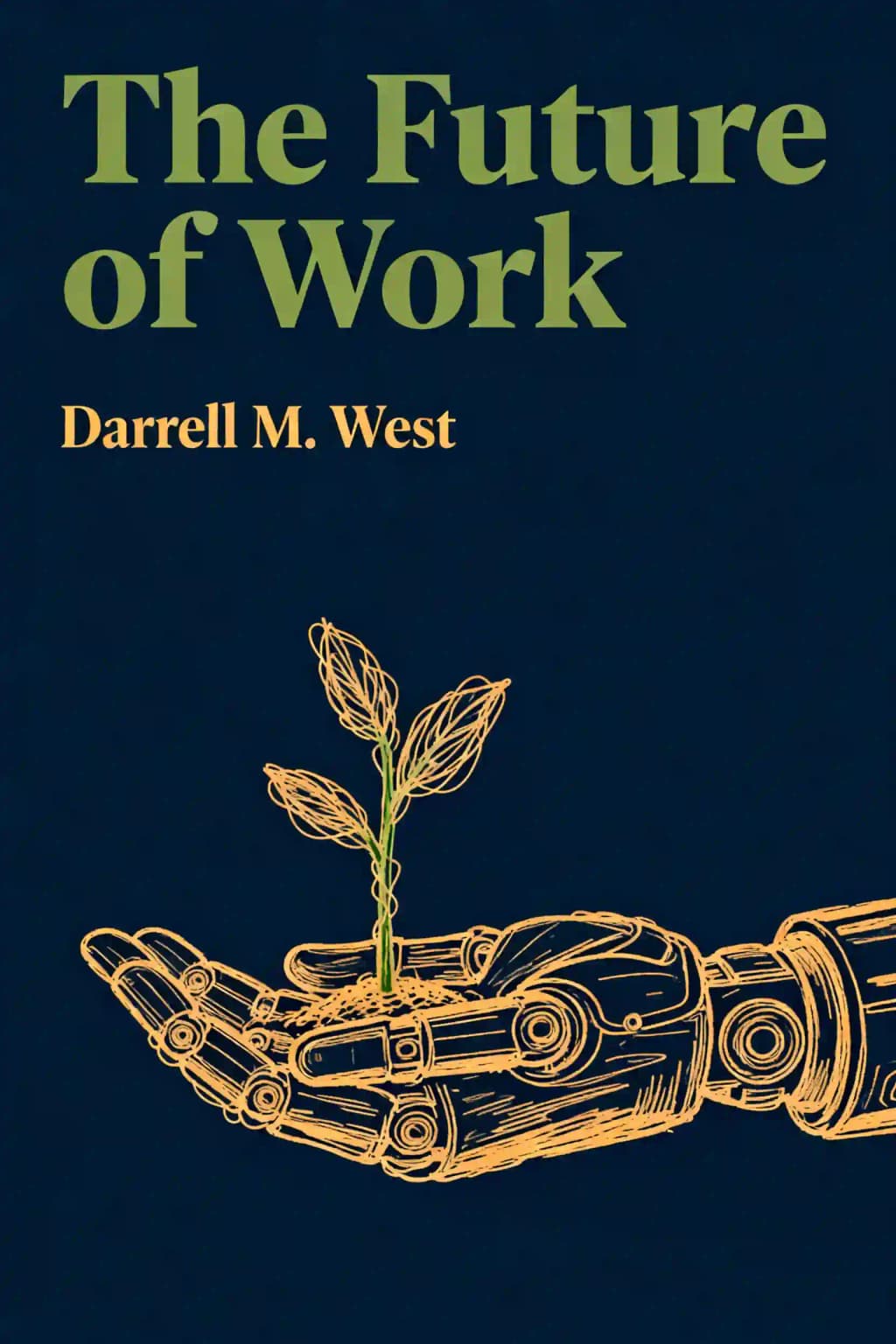
What happens when your assistant's assistant isn't human? This was the startling realization Darrell M. West had when his own assistant Hillary began corresponding with "Amy" - a virtual assistant so convincingly human that the interaction seemed perfectly normal. Far from science fiction, this moment crystallized the reality that AI and automation have already arrived in our workplaces and daily lives. "The Future of Work" has become a cultural touchstone, praised by tech leaders like Reid Hoffman (LinkedIn co-founder) for its prescient analysis of how technology is reshaping employment. The book has influenced policy discussions from Silicon Valley to Washington D.C., with its balanced approach to technological disruption earning praise across the political spectrum. As automation anxiety grows in popular culture - reflected in everything from Black Mirror episodes to bestselling dystopian novels - West's analysis offers a rare combination of technological understanding and humane policy solutions.
Chapitre 2
The Robot Revolution: Machines That Learn and Adapt
The robot revolution is unfolding before our eyes in everyday settings across America. Restaurant executives are responding to tight labor markets by installing automated tablets for food ordering. Former CKE Restaurants CEO Andrew Puzder praised these digital workers for being "always polite," consistently upselling, never taking vacations, showing up late, or causing discrimination cases. McDonald's is rolling out digital ordering kiosks at 2,500 restaurants and mobile ordering at 14,000 locations, with market analysts raising growth projections based on these cost-cutting technologies.
Amazon exemplifies this shift toward automation. Its Amazon Go stores have eliminated cashiers entirely, using sensor technology to track purchases and automatically charge customer accounts - a significant development considering retail clerks and cashiers constitute 6% of the U.S. workforce (8 million workers). In its distribution warehouses, Amazon has deployed 55,000 Kiva robots, up from 30,000 just a year earlier, potentially cutting e-commerce order fulfillment labor costs by a fifth. These robots don't just move heavy racks and locate products - they share what they learn with a "hive mind in the cloud."
The economics driving this revolution are compelling. Robot usage is expanding globally, with sales doubling from 5.4 million units in 2015 to over 10 million in 2016. Industrial robots in factories have increased from 1.2 million in 2013 to 1.9 million in 2017. The driving factor is falling costs - robots that once were restricted to high-wage industries now represent viable alternatives to human labor. A California warehouse found $30,000-$40,000 robots could handle 30-50% of daily shipments in half the time of human workers.
What makes today's robots revolutionary is their capacity for learning and adaptation. They've evolved beyond performing simple repetitive tasks to executing sophisticated work with adaptive decision-making. Autonomous vehicles compile and share real-time information about road hazards, allowing other connected vehicles to adjust accordingly. Some robots can even perform creative activities, like jazz-improvising humanoid marimba players that respond so seamlessly to human musicians that listeners cannot distinguish between robot and human performers.
Perhaps most intriguing is the emergence of "social robots" designed to provide companionship and assistance. These robots correctly understand and respond to people's speech, emotions, and underlying context. In senior care facilities across Europe, these robots reduce loneliness while decreasing healthcare staffing needs. They perform practical tasks like retrieving groceries and taking out trash, while providing peace of mind to family members. For children, devices like Mattel's Aristotle can purchase diapers, read bedtime stories, soothe infants, and teach foreign languages.
The pace of change is accelerating through faster networks, mobile applications, and voice-activated interfaces that make computing ubiquitous. Machine-to-machine communications are supplementing human interactions as sensors connect mechanical objects independently of human intervention. Computers now make autonomous decisions through self-learning algorithms, learning from previous actions and other machines' experiences. How we navigate this technological revolution will profoundly shape our future.
Chapitre 3
Artificial Intelligence: The Invisible Revolution
While robots provide the visible face of automation, artificial intelligence represents a more profound transformation occurring behind the scenes. Treasury Secretary Steven Mnuchin may dismiss AI threats as distant concerns, but Elon Musk's warnings about AI being civilization's biggest risk reflect the technology's revolutionary potential. Despite only 17% of senior business leaders being familiar with AI in 2017, it represents a major growth opportunity with transformative applications across numerous sectors.
AI enables machines to make decisions without human intervention when certain conditions are met. It's being deployed in finance (high-frequency trading), energy management (smart buildings), national defense (Project Maven for surveillance analysis), and public services (Cincinnati Fire Department's emergency response optimization). Law firms like Baker and Hostetler are using AI assistants for legal research, while China is investing heavily to build a $150 billion domestic AI industry by 2030.
Machine learning, a subset of AI, examines structured or unstructured data to identify underlying patterns that can improve human decision-making. Deep learning trains computers to identify abnormalities like irregular lymph nodes at a fraction of human radiologist costs. Richard Yonck argues that emotional intelligence is the next frontier for machine learning, with technologies needing to understand human emotions through facial expressions, intonation patterns, and physiological signals.
Transportation has seen over $80 billion invested in autonomous vehicle technology between 2014-2017. These vehicles integrate advanced capabilities including automated guidance, lane-changing systems, cameras, sensors, and AI that analyzes information in real-time. LiDAR systems provide crucial 360-degree imaging while high-definition maps accurate to within centimeters guide navigation. Digital imaging technologies in these vehicles can see 200 meters ahead compared to humans' 50 meters, with lower error rates than human perception.
Virtual reality technologies supplement human senses with computer-generated graphics and interactive experiences mapped to the physical world. The stunning visual resolution creates immersive experiences so realistic that participants physically react as if the simulations were real. Military applications train soldiers for battle conditions, while psychologists use VR to treat anxiety disorders and PTSD. Industry forecasts suggest nearly 160 million VR units could ship between 2016-2020.
Conversational interfaces like Apple's Siri, Amazon's Alexa, Microsoft's Tay, Google's Home and Assistant, and Facebook's Messenger simplify human-computer interaction through voice commands. Alexa alone has over 25 million monthly American users. The evolution from command lines to voice interfaces has made computing increasingly accessible by removing layers of mediation. In China, the chatbot Xiaoice has engaged in over 10 billion conversations, capable of nuanced interactions about personal problems.
AI and autonomous devices are transforming organizational operations by enabling real-time integration of massive data sets into decision-making processes. However, this raises critical questions about the values programmed into these technologies, their transparency, and potential for misuse. Several problems plague algorithms: poor data quality, biased computational formulas, ethical uncertainties, and questions about human oversight. The fundamental challenge is that AI bases decisions on historical data that often reflects traditional biases.
Chapitre 4
The Internet of Things: Everything Connected
The Internet of Things (IoT) represents the third major technological innovation alongside robots and AI transforming our economy. Walter Reuther's 1954 exchange with a Ford executive-when asked how he'd collect union dues from automated machines, Reuther responded "How are you going to get them to buy Fords?"-encapsulates the economic dilemma of technological innovation. While technology creates efficiency and new jobs, businesses still need customers.
5G networks represent a transformative development that will move us from a user-centric world to one of "massive machine type communications" connecting billions rather than millions of devices. These networks will not only increase capacity but enable even tiny devices to perform complex computations by receiving data from billions of nodes. A critical improvement is latency reduction-from today's 50-80 milliseconds to just a few milliseconds-enabling instant processing. By 2020, the 5G network is expected to support 50 billion connected devices and 212 billion sensors.
Software-defined networks allow businesses to scale bandwidth almost instantly-from 5 Mbps to 20 Mbps in under 90 seconds. This on-demand capability helps companies achieve efficiencies by using only the infrastructure required at any moment. These intelligent networks use algorithms to analyze data and make real-time decisions, relying on network function virtualization, machine-to-machine communications, remote sensors, and automated decision-making rather than human intervention.
Healthcare is a prime beneficiary of IoT networks, with medical devices already recording and transmitting vital signs electronically to physicians. Heart monitors that compile blood pressure, oxygen levels, and heart rate allow doctors to adjust medications remotely, significantly reducing hospital admissions. Digital medicine enables remote access to medical images and information sharing across geographic boundaries, helping overcome disparities based on geography, income, or class.
Precision medicine leverages personalized genetic and environmental information to identify relevant treatments for patients. Many medications are only effective for people with specific genetic makeups, and side effects may occur only in certain genetic substrates. With genetic sequencing costs dropping below $1,000, precision medicine can reach more people. Clinical decision support systems help physicians tap into the latest diagnostic knowledge, while predictive modeling identifies patients at greatest risk for various conditions.
IoT applications extend far beyond healthcare. "Smart city" initiatives use sensors and remote monitoring to improve urban service delivery. Public safety monitoring devices like ShotSpotter have detected over 39,000 gunshots in Washington, D.C. through 300 sensors, allowing for quicker police response. Digital sensors revolutionize water management by identifying leaks in distribution systems. Traffic congestion management systems use real-time data to optimize flow and reduce emissions.
The IoT will revolutionize connectivity by bringing together faster networks, cloud storage, and billions of connected devices and services. However, these developments bring significant social, economic, and political challenges. Large data flows threaten privacy and create security risks, especially since many sensors lack robust protection. Without broad access, technological innovation could exacerbate inequities between information haves and have-nots.
Chapitre 5
The Transformation of Work: Jobs in Peril
Modern companies achieve broad economic scale with minimal full-time employees by outsourcing to contractors and maintaining lean operations. The contrast between top firms of 1962 and 2017 is stark: AT&T had 564,000 U.S. employees with $20 billion market capitalization (in 2017 dollars), while Apple in 2017 had only 116,000 U.S. workers but $800 billion valuation-forty times AT&T's value with just one-fifth the workforce.
The digital economy transformation is evident in employment patterns: e-commerce gained 178,000 jobs in 2017 while traditional department stores lost 448,000. Prime-age male workforce participation has steadily declined from 98% in 1954 to 88% by 2017, particularly among those with high school education and African American men. Technology, automation, and globalization have reduced labor demand, especially for manufacturing jobs.
Oxford researchers Carl Frey and Michael Osborne studied 702 occupational groupings and concluded that 47% of U.S. workers face high probability of job automation within 20 years. Their analysis shows telemarketers, title examiners, and data entry keyers have 99% chance of computerization, while healthcare workers and emergency personnel have less than 1% risk.
Economists Brynjolfsson and McAfee argue technology creates a stark divide: workers with special skills thrive while those with "ordinary" skills suffer as computers acquire these abilities at extraordinary rates. Acemoglu and Restrepo found concrete evidence that one more robot per thousand workers reduces employment by 0.18-0.34 percentage points and wages by 0.25-0.5%. Lawrence Summers predicts a quarter of middle-aged men could be out of work within a generation.
The American public shares these concerns. A Pew Research Center survey found 65% of adults believe robots and computers will do much of human work within fifty years, with most viewing this negatively. A Burson-Marsteller/PSB survey revealed 64% believe automation will eliminate jobs while only 18% think it will create positions. Most Americans (72%) worry about robot automation, with just 33% expressing enthusiasm.
Automation's impact will be unevenly distributed across demographic groups. Young people and racial minorities face particular risks, with unemployment already disproportionately affecting these groups. In 2017, while the national unemployment rate was 4.2%, it reached 14.7% for 16-19 year-olds, 25.9% for African American teens, and a staggering 33.1% for young African American males. Without access to high-speed internet, computers, and digital skills training, these groups will struggle to transition as machines replace jobs.
Digital disruptions are fundamentally changing business models. Companies increasingly outsource traditional functions to cut costs, creating what David Weil calls the "fissured workplace" - operations handled by external firms, temporary workers, and distant suppliers. The sharing economy exemplifies this transformation, with peer-to-peer services coordinated through online platforms. Unlike traditional permanent positions with benefits, sharing economy jobs are episodic and temporary. By 2020, about 40% of American workers will be freelancers.
Chapitre 6
Reimagining the Social Contract for the Digital Age
The emerging digital economy presents fundamental challenges in ensuring income, healthcare, and retirement benefits. As employers increasingly use temporary workers with few benefits, developing creative models to provide essential services becomes vital to prevent societal discontent.
With nearly half of jobs potentially being done by independent contractors by 2020, workers need ways to access essential benefits outside traditional employment. One solution is creating portable "citizen accounts" that consolidate funds for education, training, health insurance, savings, retirement, and unemployment compensation. These accounts would empower individuals to manage disruptions from job loss, retraining needs, or economic shocks.
Economists Seth Harris and Alan Krueger propose creating a new "independent worker" category between full-time employees and contractors. These workers would have collective bargaining rights, pooled benefits, civil rights protections, and optional workers' compensation, but wouldn't receive overtime pay, unemployment insurance, or minimum wage guarantees.
Revamping the social contract requires better valuing parenting and caregiving. Unlike nearly every other Western nation, the United States doesn't provide paid leave for parents caring for newborns or elderly relatives. The AEI-Brookings Working Group on Paid Family Leave proposes Americans should have eight weeks of pay at 70% of regular salary (capped at $600 weekly), addressing the reality that 63% of U.S. children live in households where all parents work.
Brynjolfsson and McAfee propose expanding the earned income tax credit (EITC) to support the working poor during the transition to a digital economy. The EITC has proven remarkably effective - helping 6.5 million people escape poverty while improving health outcomes for parents and educational outcomes for children. For the EITC to address technology disruption effectively, it needs updating: income limits should rise to help more people, and payments should shift from annual to quarterly to provide greater flexibility for struggling families.
For decades, the federal government has helped workers harmed by international trade agreements through the Trade Adjustment Assistance program, providing job retraining, income support, and counseling. The program needs expansion beyond trade-related job losses to include those displaced by automation, robots, AI, or autonomous vehicles.
Many employers have shifted to 401(k)-style pension plans for portable retirement benefits, with employees controlling their investments and taking funds when changing jobs. While 401(k)s were originally designed as supplements to traditional pensions, they've largely replaced them - traditional pension coverage has dropped from 38% of private sector workers in 1979 to just 13% in 2017. The retirement outlook is concerning: only 55% of Americans have retirement accounts, averaging just $50,000 in savings.
Several countries are testing universal basic income models. Finland provides 800 euros monthly in place of social benefits in some communities. The Netherlands has trials in Utrecht providing welfare with no questions asked. A Manitoba, Canada program called MINCOME showed positive results including fewer hospitalizations and higher high school completion rates. To address dependency concerns, UBI could be tied to volunteer activities or community service, creating a "national online marketplace of work" for tutoring, elder care, disaster response, or arts projects.
Professional licensing requirements have become a significant barrier in the digital economy transition. While only 5% of jobs required licenses in the 1950s, nearly a third do today. Reducing unnecessary licensing requirements would give people more flexibility to change occupations and learn new skills without expensive and time-consuming courses.
Chapitre 7
Lifelong Learning: Education for the Age of Disruption
In a world of rapid technological and economic transition, lifelong learning has become imperative. The traditional model of education ending by age twenty-five is obsolete as people now switch jobs multiple times, experience sector disruption, and need to develop new skills throughout their careers. An estimated 65 percent of today's grade school children will work in jobs that don't yet exist.
Community colleges play a vital role in workforce development by providing practical, affordable training for people of limited means, immigrants, and working adults. Career and technical education programs in fields like criminal justice, agriculture, IT, and fashion design have high job placement rates-Colorado reports 94 percent employment for program completers. Private companies are also embracing worker retraining, with 39 percent of large company executives reporting difficulty finding qualified talent.
Digital technology connects students through various distance learning formats: web-facilitated (up to 30% online), blended/hybrid (30-79% online), and fully online (80%+ online). Distance learning has grown dramatically-by 2017, nearly 30% of postsecondary students (over 6 million) had taken online courses, up from just 9.6% in 2002. Research shows students in online learning conditions often perform modestly better than those in face-to-face instruction, with benefits persisting across different content types and learners.
Today's education system needs radical transformation to prepare students for future jobs rather than past ones. Instead of teaching basic skills and instruction-following-qualities needed 50 years ago-schools must develop abilities like negotiation, compassion, motivation, design thinking, and problem-solving. The "shrinking middle" of the workforce particularly needs retraining, as mid-career workers often lack skills for new positions.
New approaches should recognize Howard Gardner's seven types of intelligence, allowing personalized, adaptive learning that engages students through their preferred learning styles. Innovative programs like New York's School of One give students daily "playlists" of activities tailored to their needs, while High Tech High connects students with real-world experiences through internships and project-based assignments.
Activity accounts offer a practical solution for financing lifelong learning in an era of rapid technological change. These portable accounts function like retirement funds, with employers and individuals contributing tax-free money that can be invested and drawn upon for education and retraining throughout one's career. France has already implemented "individual activity accounts" providing similar benefits. The Aspen Institute has proposed "lifelong learning and training accounts" allowing tax-deductible contributions up to $1,000 annually with government or employer matching.
Chapitre 8
Can Democracy Survive the Digital Revolution?
As digital technologies and emerging business models threaten traditional income provision, health benefits, and retirement support, we face a critical challenge: how to build societal consensus around necessary workforce and policy changes. Many developing nations already experience high economic inequality and youth unemployment rates of 30-40%, fueling social unrest. Without addressing digital disruption's impact on work, developed countries risk similar instability.
History reveals the trauma of large-scale economic transformations. During Britain's industrialization, real wages fell 10% between 1770-1810, with gains only appearing 60-70 years later. America's industrialization brought severe challenges: worker retraining needs, food safety issues, child labor concerns, economic concentration, and mass migration from rural South to Midwestern factory cities. Eventually, visionary leaders like Theodore and Franklin Roosevelt implemented reforms for worker safety, food quality, child labor limits, and market competition.
Today's political leaders struggle to overcome polarization and gridlock despite the urgency of economic problems. The transition from industrial to digital economies requires new models for work and social service delivery, but a lack of trust across partisan lines prevents identifying areas of potential agreement. Compromise and negotiation have become political anathemas, while media fails to help citizens understand what's at stake.
Inequality makes economic dislocation and political discontent harder to address by conditioning the environment for policy discussions. Income concentration today mirrors the 1920s, with the top 1 percent garnering nearly 20% of all income-double what it was post-WWII. After-tax income for most workers stagnated from 1979-2009 while rising 155% for the top 1%. The wealthy are far more politically active and maintain extensive high-level political contacts. Most concerning, they hold significantly different policy views than ordinary citizens, particularly on social opportunities.
With increasing unemployment and underemployment, workers need health care, disability, and pension benefits outside traditional employment. This "flexicurity" concept "separates the provision of benefits from jobs." Supporting workers broadly rather than preserving specific jobs is essential, potentially creating "a universal safety net for all those suffering an income drop as a consequence of economic disruption."
A fundamental governance crisis is emerging from the stark mismatch between economic output and political representation. Brookings Institution research found that just 15 percent of U.S. counties generate 64 percent of GDP - mostly urban coastal areas that voted Democratic in 2016. Meanwhile, the remaining 85 percent of counties, generating only 36 percent of GDP, voted for Trump. This economic divergence creates a dangerous political situation where economically stagnant regions could elect two-thirds of U.S. senators while prosperous areas elect only one-third.
Chapitre 9
Building a Future That Works for Everyone
There's a serious risk that political leaders will misdiagnose our current situation and worsen workforce problems through shortsighted decisions. However, several economic reforms could ease the transition to a digital economy, including developing new concepts of remunerated work, enacting paid family leave, expanding earned income tax credits, and improving health and education.
Many workers derive their identity from their jobs, which provide income, benefits, structure, and social networks. Yet this job-focused construct is relatively recent in human history. In the future, people may revert to a more historical way of life, with jobs being just part of a multifaceted existence that includes parenting, mentoring, volunteering, and pursuing personal interests. This transition requires new policies, particularly paid family and medical leave-something every major developed country except the U.S. provides.
Inequality isn't just economic-it profoundly affects health and well-being. Community colleges offer accessible, low-cost worker training options, with many businesses partnering with educational institutions to upgrade workforce skills. The opioid epidemic demands special attention during economic transformation, as psychological stresses from structural changes increase substance abuse and mental health issues.
To implement these initiatives, we need a new kind of politics that allows substantive policy discussions and effective decision-making. With median household income growing just 0.5% annually from 1984-2015, our political dialogue remains stuck in worn-out cliches about economic stimulation and government's proper role. Political polarization presents a major obstacle to addressing structural economic transformation. Universal voting could dramatically disrupt this dysfunction, as more than two dozen countries require citizens to vote, with small civil fines for non-compliance.
Geographic mismatches have created serious problems for American democracy. The coasts and urban areas have prospered far more than rural regions, while those with only high school education have fared worse than college graduates. Programs like "The Rise of the Rest," launched by Stephen Case and J.D. Vance, aim to address this by encouraging venture capital investment in heartland startups, which currently receive only 3% of such funding.
Funding an enhanced social contract during economic dislocation requires creative solutions. A 1 percent solidarity tax on net personal assets over $8 million-affecting only the top 1 percent of wealth holders-could fund citizen accounts, lifetime learning, expanded earned income tax credits, and paid family and medical leave. This approach would not only fund crucial programs but reduce widespread inequality.
America stands at a major inflection point where digital technologies and changing business models have transformed employment and increased inequality. This inequality threatens the political process by making it difficult to address underlying social issues. Increased robotics and AI risk creating unemployment and inequality on a massive scale, and markets alone cannot resolve these issues. Without policies promoting social mobility and opportunity, public anger will grow, intensifying populist backlash against elites. However, by adjusting politics, the social contract, and job definitions, we can navigate these stresses through skills retraining, lifelong education, and reimagining work.