Chapitre 1
The Hidden Motives That Drive Our Everyday Lives
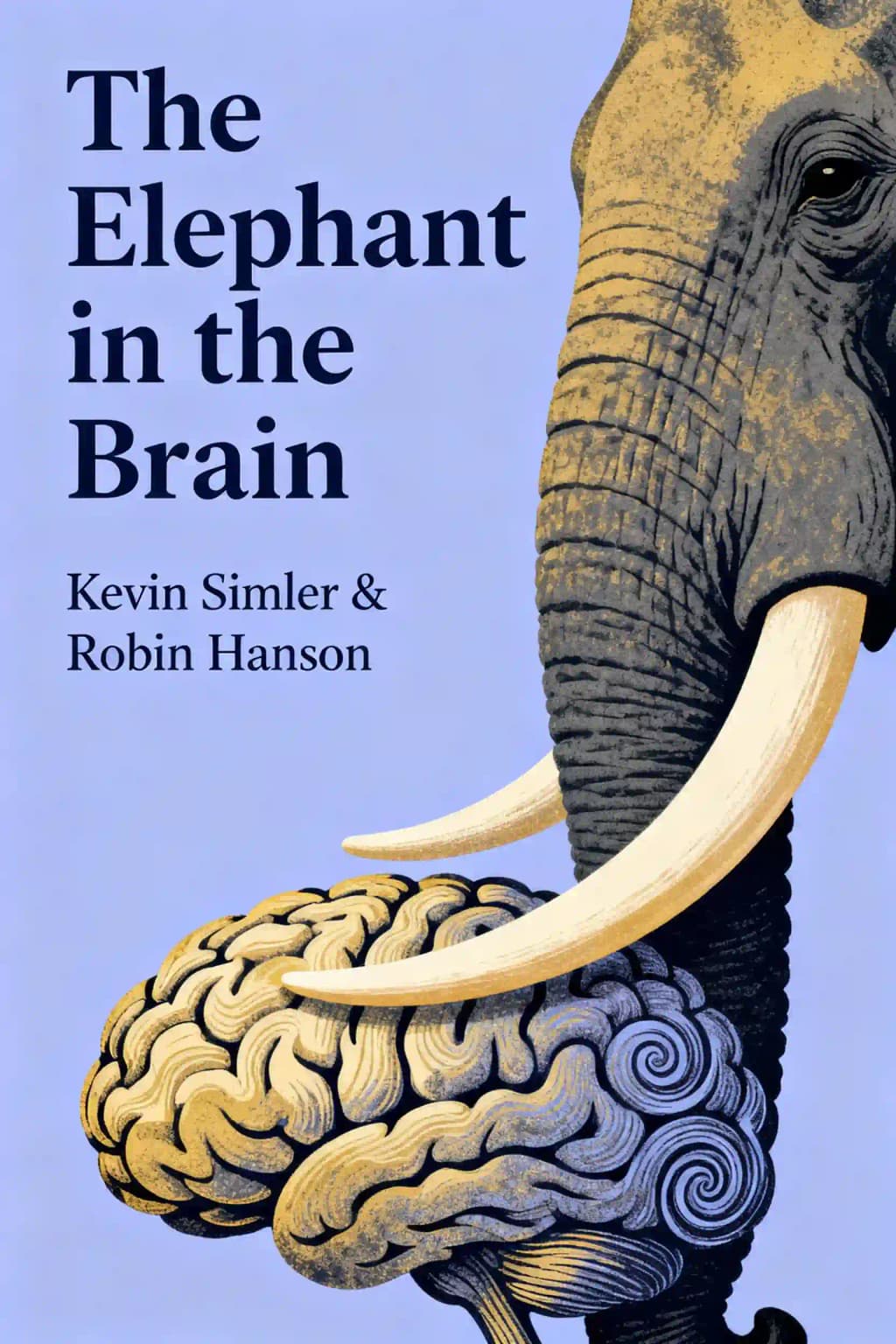
Have you ever wondered why you really do the things you do? The book "The Elephant in the Brain" offers a provocative answer: much of human behavior is driven by hidden motives that we're strategically blind to. This groundbreaking work has become required reading in psychology departments at universities like Stanford and Harvard, and has been praised by thought leaders from Steven Pinker to Sam Harris. While uncomfortable to confront, the book's central thesis-that we evolved to act on hidden, often selfish motives while maintaining a positive self-image-provides a powerful lens for understanding everything from office politics to religious devotion.
Chapitre 2
The Self-Deception Paradox: Why We Hide Our True Motives
The human brain is an extraordinary organ, but it harbors a peculiar feature: it systematically hides information from its conscious owner. This isn't a bug but a feature-we evolved to deceive ourselves because it helps us deceive others more effectively. Think about the last time someone asked why you were late to a meeting. You likely offered a socially acceptable excuse rather than admitting you prioritized something else. But here's the fascinating part: you probably believed your own excuse.
This strategic self-deception operates across all aspects of human life. When Robin Hanson, one of the authors, studied healthcare policy, he discovered patients show little interest in medical outcome statistics despite claiming to care about health. Instead, medicine often functions as "an elaborate adult version of 'kiss the boo-boo'"-a form of conspicuous caring where patients receive social support while providers gain loyalty. Similarly, Kevin Simler observed how office politics resembled primate social behaviors disguised in business jargon.
The authors draw from evolutionary psychology, particularly Robert Trivers' groundbreaking work suggesting our brains evolved to deceive themselves "the better to deceive others." Unlike Freud's view that self-deception protects us from painful truths, this perspective sees it as strategically advantageous. By hiding our competitive, sometimes ugly motives from ourselves, we can pursue them more effectively while maintaining both our self-image and social standing.
Four research strands support this view: microsociology shows how our brains unconsciously choreograph complex social behaviors; cognitive psychology demonstrates systematic information hiding; primatology reveals our Machiavellian behaviors in groups; and economic puzzles expose institutions that consistently fail their stated goals. Together, they paint a portrait of humans as strategically self-deceived, both individually and collectively.
Chapitre 3
The Competitive Roots of Human Intelligence
Why did humans evolve such large brains? While we prefer to believe our intelligence developed for cooperative purposes like hunting or adapting to climates, evidence suggests our big brains evolved primarily through social competition with each other.
Consider the coastal redwood, which grows up to 379 feet not because it needs that height in isolation, but because it competes with other redwoods for sunlight. Similarly, human intelligence didn't evolve to tower above other species but to compete against other humans. The social brain hypothesis suggests our ancestors developed intelligence primarily for social and political competition. Robert Trivers argues that the arms race between lying and lie-detection was particularly influential in developing our intelligence.
This competition manifests in three key domains: sex, social status, and politics. From an evolutionary perspective, reproduction outranks survival in importance. Sexual competition centers on attracting mates, which is locally zero-sum-there are only so many potential partners available. This competition creates evolutionary arms races similar to the peacock's tail, with humans developing elaborate ways to advertise their genetic fitness and parenting potential.
Social status comes in two forms: dominance (gained through intimidation) and prestige (earned through being impressive). Though they operate differently, both are fundamentally competitive. Even prestige, which seems more benign, remains a zero-sum game-there's only so much respect available. We earn prestige through qualities like wealth, beauty, humor, and intelligence, but these are all relative qualities measured against other humans.
Politics elevates dominance hierarchies through coalitions-allies wielding power together. Unlike simple pecking orders, coalition politics requires identifying, attracting, and retaining good allies while navigating shifting alliances. We instinctively form teams, manage relationships, and leave groups when necessary. Whether through Machiavellian manipulation or winning affection through charm, both approaches stem from the same competitive drive.
Chapitre 4
Norms: How Humans Tame Competition
Have you ever felt that surge of adrenaline when someone cuts in line? That physiological reaction is part of our evolutionary toolkit for enforcing social norms-rules about how community members should behave. Unlike redwoods trapped in endless competition, humans possess the superpower of coordination to avoid wasteful competition.
Our ancestors lived as nomadic foragers until about 10,000 BC, in bands of 20-50 individuals who were intensely reliant on each other for survival. Most strikingly, foragers maintained fierce egalitarianism, vigilantly preventing individuals from dominating others. This egalitarianism was arguably the world's first true norm, facilitated by language but resting on a fundamental innovation: ensuring everyone, even the powerful, abides by community standards.
When we do something "wrong," we face reprisal not just from the wronged individual but potentially from the entire community. This collective enforcement is the essence of norms. Gossip-talking about people behind their backs-serves as a powerful enforcement mechanism, allowing communities to coordinate against bad actors, especially powerful ones who might otherwise be difficult to confront directly. Reputation provides both the stick (damage from negative gossip) and carrot (praise for enforcing norms) that make norm enforcement viable despite individual risks.
Beyond obvious prohibitions like murder and theft lie subtle norms that regulate intentions rather than just actions. These "crimes of intent" are precisely what our blind spots-our elephants in the brain-help us navigate. We face strong social pressure to conform to norms against bragging, currying favor, engaging in subgroup politics, and perhaps most importantly, admitting selfish motives.
Consider how awkward it is to answer questions by appealing to self-interest: "I want to be a doctor for the prestige and pay" or "I draw cartoons so people will like me." Though often true, we systematically avoid such answers, preferring to emphasize higher, purer motives.
Chapitre 5
The Art of Cheating: How We Break Rules Without Getting Caught
Everybody cheats-it's simply human nature. While most of us honor major prohibitions like those against robbery or murder, we routinely violate smaller norms by lying, jaywalking, taking office supplies, fudging tax returns, or sucking up to bosses. We cheat because it lets us reap benefits without typical costs, like swimmers who urinate in pools to avoid inconvenient breaks.
The concept of "common knowledge" is crucial to understanding cheating dynamics. For information to be common knowledge, everyone must know it, know that everyone else knows it, and so on. Like in "The Emperor's New Clothes," information can be widely known without being common knowledge until someone breaks the silence. When drinking alcohol in public, wrapping the bottle in a brown paper bag doesn't fool police, but it provides just enough cover for them to avoid criticism from constituents.
Even modest acts of discretion can thwart norm enforcement. Discretion techniques that prevent violations from becoming common knowledge include:
1. Using pretexts (ready-made excuses) - Like King Henry VIII's sudden "discovery" that Catherine hadn't been a virgin on their wedding night-20 years into their marriage. Though ham-handed, it provided enough cover to break from Roman Catholicism.
2. Discreet communication - Using body language, cryptic terms, subtlety, symbolism, and informal speech to keep things "off the record."
3. Skirting norms - Exploiting gray areas in rules, like television shows discussing taboo topics through implication rather than explicit language.
4. Subtlety - Making violations hard to detect or prove, providing plausible deniability.
While celebrities like Steve Jobs (abusive behavior) or JFK (infidelity) got away with violating major norms, everyday people routinely violate minor ones. We brag subtly, gossip behind backs, shirk responsibilities, undermine teammates, suck up to bosses, and manipulate others-but always with discretion. Rather than quoting our IQs or salaries directly, we use show-offy vocabulary or buy conspicuous luxuries.
Chapitre 6
Self-Deception: The Ultimate Cheating Strategy
Deception pervades all levels of life, from genes to cells to individuals to groups. Humans are no exception-our deceptive nature makes perfect evolutionary sense, allowing us to reap benefits without paying full costs. But why do we deceive ourselves?
The traditional view treats self-deception as a defense mechanism-an unconscious coping strategy to protect the ego from unwanted impulses. But this perspective ignores a crucial objection: Why would evolution design our brains to distort vital information? If the goal is preserving self-esteem, a more efficient solution would be to simply make our self-esteem more robust.
Recent evolutionary psychologists offer a more compelling explanation: self-deception is primarily outward-facing, manipulative, and self-serving rather than defensive. This view builds on Thomas Schelling's work on mixed-motive games-scenarios where players' interests partially overlap but also diverge. In such situations, seemingly irrational behaviors become strategic advantages.
Self-deception proves advantageous because lying is simply too difficult. It's cognitively demanding-we struggle to keep our stories straight when deliberately lying. We also face physiological challenges: fear of getting caught triggers tells like racing hearts, sweating, and nervous tics. Since our minds aren't truly private-others scrutinize our words, expressions, and behaviors for inconsistencies-often the most robust strategy for misleading others is to actually believe our own deceptions.
Self-deception manifests through four archetypal strategies:
1. The Madman commits irrationally to a course of action, changing others' incentives-like Nixon's strategy to make North Vietnam believe he might do anything to stop the war.
2. The Loyalist demonstrates commitment by believing what's irrational, earning trust through belief-just as blind faith becomes valuable in religious contexts.
3. The Cheerleader fervently believes to better convince others, like the overconfident politician who rallies supporters or the startup founder who attracts investors through unearned certainty.
4. The Cheater denies knowledge of wrongdoing or hides true intentions, making norm violations harder to prosecute-particularly effective when norms hinge on intent or knowledge.
Our brain operates as a complex modular system with hundreds or thousands of different "modules" handling various information-processing tasks. This modularity allows different parts of our brain to operate semi-independently-what Marvin Minsky called the "society of mind." We can act on information unavailable to our conscious egos, and conversely, believe things consciously without making that information available to behavior-coordinating systems.
Chapitre 7
Counterfeit Reasons: How We Rationalize Our Behavior
Humans are strategically ignorant about our own motives-the "whys" behind our behavior-yet we pretend to know them with certainty. In the 1960s and 1970s, neuroscientists Roger Sperry and Michael Gazzaniga conducted groundbreaking experiments on "split-brain" patients whose corpus callosum-the connection between brain hemispheres-had been surgically severed. When researchers instructed the right hemisphere to perform an action but then asked the left hemisphere (responsible for speech) to explain why, the left hemisphere consistently fabricated plausible but entirely false explanations.
This "interpreter module" functions both for internal understanding and external communication, with the outward-facing role being surprisingly important-hence the metaphor of the "Press Secretary." Like a political press secretary, this brain module provides explanations that sound authoritative regardless of whether they're based on privileged information or mere guesses. It creates a buffer between our deeper motives and outside scrutiny, strategically avoiding acknowledgment of our darker impulses. Most unsettlingly, our conscious selves are this Press Secretary-not the decision-maker but the defender of decisions made elsewhere in the mind.
Rationalizations occur constantly in everyday life. Children use transparent excuses like needing the bathroom to avoid bedtime. Adults are more sophisticated, using plausible explanations that are difficult to disprove. Robin claims his academic goal is advancing knowledge, yet feels cheated when his ideas circulate without attribution, revealing his desire for prestige. Kevin rationalized privacy concerns about his Crohn's disease until a strict diet became a point of pride, suddenly making him eager to share his diagnosis.
These examples demonstrate how we often tell half-truths by cherry-picking acceptable reasons while concealing less flattering motives. Other common rationalizations include parents enforcing bedtimes "for children's good" (while wanting personal time), exaggerating minor impediments to avoid social obligations, and justifying digital piracy with anti-corporate sentiment while never stealing physical media.
Chapitre 8
Body Language: The Silent Signaling System
Despite thousands of hours spent teaching children verbal communication skills throughout their education, virtually no formal instruction is provided on body language-a crucial form of social communication. While the claim that "over 90 percent of communication is nonverbal" is an exaggeration, body language remains vital for conveying emotions, social attitudes, and coordinating meaningful interactions. Yet paradoxically, we remain largely unconscious of the nonverbal signals we send, performing most body language automatically outside conscious awareness.
Unlike spoken language, where words arbitrarily map to meanings, body language is functionally connected to the messages it conveys. We show excitement through physical animation, interest through widened eyes and focused attention. Body language has material consequences: if you lunge aggressively at someone, you must be prepared to fight. This makes body language inherently more honest than words-it's easy to talk, harder to walk the walk.
Given that our ancestors mated for millions of years before developing speech, it's unsurprising that courtship relies heavily on nonverbal communication. When two strangers meet and develop attraction, they often coordinate the entire progression from meeting to intimacy nonverbally. This dance begins with lingering eye contact-a powerful signal of attraction that's conveniently difficult for third parties to notice. Physical openness follows: uncrossed arms, inviting smiles, and bodies turned toward each other.
Of all bodily signals, we're least aware of those related to social status-yet we're obsessed with earning, gauging, and flaunting our status. High-status individuals, feeling secure in their position, maintain relaxed body language: speaking clearly, moving smoothly, adopting open postures. Lower-status individuals constantly monitor for threats, glancing around, speaking hesitantly, and maintaining defensive postures.
Why does so much nonverbal signaling happen outside our conscious awareness? The answer lies in the social domains where body language matters most-sex, politics, and status-all areas heavily regulated by social norms. Body language provides perfect cover for pursuing taboo agendas. Unlike spoken language, nonverbal cues maintain crucial ambiguity. We can "say" things with our bodies that would be inappropriate to state verbally-"I'm the most important person here" or "I'm attracted to you"-while maintaining plausible deniability if challenged.
Chapitre 9
Laughter: The Playful Signal That Reveals Our True Feelings
Laughter-that strange, rhythmic gasping and grunting we do-ranks among humanity's most peculiar behaviors. Despite its oddness, it's universal, innate, and begins in infancy, even among babies born blind and deaf. Unlike language or singing, which vary culturally, laughter sounds remarkably similar worldwide.
What makes laughter particularly fascinating is its involuntary nature. Like breathing, blinking, or flinching, we don't consciously decide to laugh-our brains simply do it spontaneously. Yet unlike those purely physiological responses, laughter serves deeply social purposes, helping us flirt, bond, mock enemies, probe norms, and mark social boundaries.
Laughter fundamentally serves as a play signal-a way to communicate "We're just playing." This insight came to Max Eastman while playing with a baby: making a terrible face after laughing caused the baby to laugh too, but making the same face without laughing first would likely terrify the child. Many species have developed play signals: dogs use a "play bow," chimps employ an open-mouthed "play face" similar to a human smile, and humans use laughter, smiling, exaggerated movements, and high-pitched "play screams." These signals coordinate safe social play, especially in situations that might otherwise seem threatening.
This explains why danger enhances humor-we need play signals most when circumstances might be misinterpreted as serious. A pun becomes funnier as a sexual double-entendre told around children, while humor without sufficient danger (like bland comic strips) falls flat.
Our laughter reveals how we truly feel about others based on two key variables: the amount of pain involved and psychological distance. We're more likely to laugh at minor suffering than severe pain, and at the misfortunes of those psychologically distant from us rather than those close to us. This explains why we might laugh at strangers' misfortunes but feel genuine concern when friends suffer even minor mishaps.
Laughter provides both honesty and deniability when navigating sensitive social topics. Unlike words, which can easily pay lip service to values we don't truly hold, laughter is relatively honest because it's involuntary-"In risu veritas" (In laughter, there is truth). Yet it simultaneously offers plausible deniability when we're accused of inappropriate humor: "I didn't really understand" or "Lighten up, it was just a joke!"
Chapitre 10
Conversation: The Hidden Competition in Our Daily Chatter
For linguists and evolutionary psychologists, the origins of human language remain a fascinating mystery. While we spend roughly 20% of our waking lives engaged in conversation, using language for countless functions from asking questions to telling jokes, one purpose stands out: sharing information. This function appears fundamental, enabling our greatest achievements from science to civilization-building.
But understanding conversation requires analyzing the costs and benefits for both speakers and listeners. Listening costs little while offering the substantial benefit of vicarious learning from others' knowledge and experience. Speaking, however, carries significant hidden costs beyond just physical exertion: the opportunity cost of giving away valuable information rather than monopolizing it, and the costs of acquiring interesting information in the first place. Given these costs, why are humans so eager to speak rather than just listen?
A simple explanation is reciprocal exchange-"I'll share something if you return the favor." But this theory faces puzzling contradictions. If speaking were truly a favor requiring reciprocation, we would expect people to track conversational "debts"-yet we don't resent quieter friends or expect millions of readers to give us something in return. If information exchange were conversation's primary purpose, we would expect people to be greedy listeners and stingy speakers. Instead, we find the opposite-people eagerly compete to speak, often interrupting or barely listening while planning what to say next.
To resolve these puzzles, we must view conversation not as information exchange but as a display of social value. Speaking functions as showing off-speakers strive to impress their audience to raise their social worth. Like sharing tools from a magical backpack that creates copies without depleting the original, conversation contains both text ("Here's new information") and subtext ("I'm the kind of person who knows such things"). Often the subtext-demonstrating one's value as a potential ally-matters more than the actual information shared. Every conversation thus resembles a mutual job interview where each person "applies" for the role of friend, lover, or leader.
This "showing off one's backpack" model explains why people compete to speak rather than listen-the rewards come from demonstrating value as an ally and advertising oneself. No one tracks conversational "debts" because speaking itself is the reward when remarks are appreciated. The relevance criterion exists because reciting memorized trivia is too easy-listeners prefer speakers who can impress them wherever a conversation leads, demonstrating generic facility with information rather than narrow expertise.
Chapitre 11
Beyond Wealth: The Hidden Signals in What We Buy
While conspicuous consumption traditionally refers to flaunting wealth, our purchases signal much more than just financial status. Research shows people choose green products (like hybrid cars) primarily when primed with status motives and when shopping publicly rather than privately. Toyota's Prius was deliberately designed with a distinctive body to make environmental virtue more visible. Beyond wealth, our purchases signal traits like prosocial attitudes, subculture loyalty, trendiness, intelligence, and political values.
To understand how much consumption is driven by signaling, the authors propose a thought experiment: what if an alien made humans completely oblivious to each other's possessions? While we could still enjoy our own things, we'd no longer form impressions about others based on their belongings. In this "Obliviated" world, entire product categories devoted to "showing off" would eventually disappear, including jewelry, branded apparel, luxury watches, designer shoes, and status cars.
Perhaps the most surprising consequence would be the dramatic reduction in product variety. In an Obliviated world, we'd wear the same comfortable outfits daily without concern for matching others, since we wouldn't notice. The concept of "individuality" itself is just another form of signaling. Similar standardization would occur with cars and houses-our aversion to "cookie-cutter" homes would vanish as we'd become indifferent to such distinctions.
Beyond the Obliviation thought experiment, advertising affects us as conspicuous consumers through multiple mechanisms. Some are straightforward: providing information about products and making promises. But lifestyle advertising works differently, creating arbitrary associations between products and cultural images-like Corona beer with beach relaxation. While these ads partly work through Pavlovian conditioning, they also operate through the "third-person effect": we believe we're immune to manipulation but think others will be influenced. This creates social pressure to purchase products with appealing brand images to manage impressions with peers.
Chapitre 12
The Elephant in Our Institutions
The book's second half applies this understanding of hidden motives to major social institutions, revealing how they serve functions beyond their stated purposes. Art, for instance, isn't just about beauty or self-expression but functions as a fitness display similar to the bowerbird's elaborate mating structures. Charity isn't purely about helping others-studies show we donate more when being watched, when solicited by attractive people, and prefer helping identifiable victims over statistically more effective interventions.
Education primarily serves as credentialing rather than learning-explaining why students celebrate canceled classes, take "easy A" courses, and would choose degrees without education if given the option. Medicine functions partly as conspicuous caring-an elaborate adult version of "kiss the boo-boo"-explaining why we consume 45% more healthcare when it's free despite showing virtually no health improvements.
Religion isn't just about supernatural beliefs but about community cohesion-religious sacrifices serve as honest signals of loyalty that build trust within communities. Politics often functions more as tribal signaling than civic problem-solving-explaining why voters show little concern for whether their votes matter, remain willfully uninformed, and become emotionally attached to positions.
Understanding these hidden motives offers several benefits: better situational awareness of the human social world, recognition of our own blind spots, and the ability to design better institutions. While we can't transcend our biology, we can acknowledge selfish motives without glorifying them. The philosophy of "enlightened self-interest" offers a middle path-doing well for ourselves by doing good for others.
Despite evolution's tendency toward selfishness, humans cooperate remarkably well. Our social incentives don't reward strictly ruthless behavior-leaders who dominate excessively are penalized, liars are punished, and people gain friendship and status through service to others. Our genes' competitive strategy was to build ethical brains. We may be competitive, self-interested, and self-deceived animals, but our actual achievements can transcend our mixed motives-"we cooperated our way to the god-damned moon."