Chapitre 1
The Illusion That Makes Us Who We Are
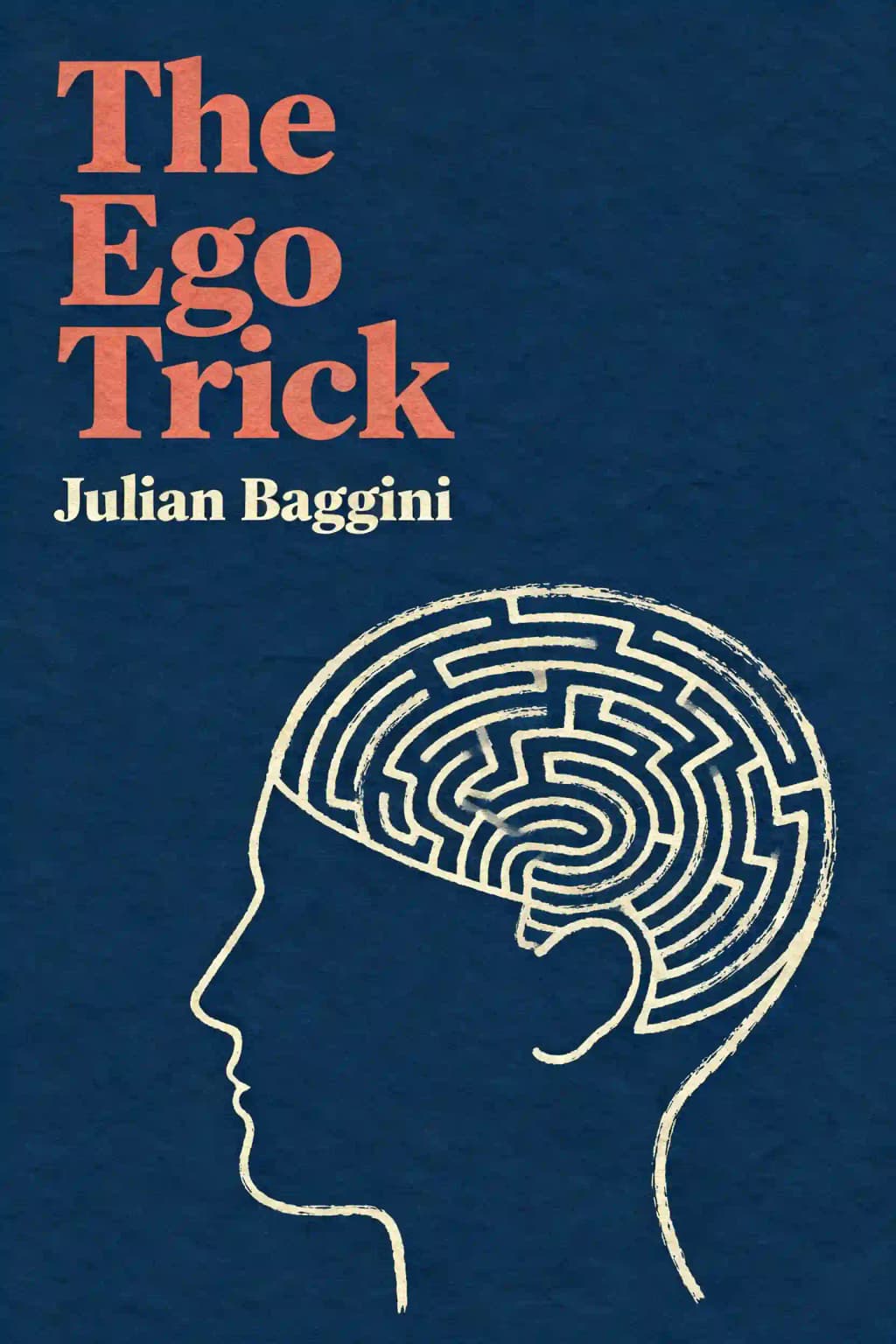
Have you ever wondered what makes you uniquely you? Is there some essential core of your being that remains constant throughout your life? Something that, if removed, would mean you no longer exist? Julian Baggini's "The Ego Trick" tackles these profound questions with remarkable clarity and intellectual depth. This philosophical exploration has garnered praise from cognitive scientists and philosophers alike, with Daniel Dennett calling it "a smart and accessible introduction to the genuine scientific discoveries about the nature of self." The book's influence extends beyond academic circles, resonating with anyone questioning the nature of identity in our increasingly fluid world. What makes this work particularly compelling is how it challenges our most fundamental assumptions about selfhood while remaining grounded in both scientific evidence and lived experience.
Chapitre 2
The Search for the Pearl of Self
Most of us believe we possess an essential "me-ness" that remains constant throughout our lives. Despite the enormous changes we undergo from childhood to adulthood, we feel there's some elusive essence that makes us who we are-a kind of background "flavor" running through all our experiences. This is what Baggini calls the "pearl view" of identity: the notion that somewhere within us lies a hard, unchanging core that constitutes our true self.
But where exactly is this pearl located? Is it in our physical bodies? Philosopher Eric Olsen argues for "animalism"-the view that we are essentially human organisms. Yet thought experiments like Kafka's Metamorphosis or Locke's prince-in-cobbler's-body suggest our essence isn't merely physical. Even children intuitively distinguish between the thinking person within and the animal vehicle they inhabit.
The experiences of transgender individuals provide real-world insight into this relationship between body and identity. Take Jnanamitra, who initially pursued gender transition, then reverted to living as a man named Kit for twelve years to follow Buddhist ordination requirements. Despite dedicated meditation practice hoping to resolve her gender dysphoria through spiritual insight, she discovered during a mindfulness retreat that her gender dysphoria remained "absolutely steady" regardless of her mental state-it was simply there. This led to a "cataclysmic spiritual experience" where she realized meditation couldn't transform this fundamental aspect of herself.
Other cases further demonstrate how identity relates to embodiment. Katie Piper, a model whose face was disfigured in an acid attack, initially experienced an "identity crisis," feeling the "old Katie" was gone. Yet fundamentally she remained the same person, recognizable to family and ultimately to herself. Even more extreme was historian Tony Judt's transformation from an active man to a quadriplegic with ALS. Though reduced to what he called "a bunch of dead muscles thinking," Judt remained himself despite his physical imprisonment.
These cases show that while we depend tragically on our bodies, our identities are determined primarily by the mental life they enable. We can be reduced almost entirely to our psychological selves and still persist as the same person. This suggests our essence may lie in one particular part of our physical being-perhaps the brain.
Chapitre 3
The Neuroscience of Selfhood
The case of Suzanne Segal reveals how brain pathology can masquerade as spiritual awakening. In 1982, she experienced a complete disappearance of her sense of personal self, which she initially found troubling but later reinterpreted as enlightenment. After becoming a spiritual teacher, she began experiencing neurological symptoms and eventually died from a brain tumor in 1997. Her case represents a collision between mysticism and neuroscience, suggesting her "spiritual" experiences were likely neurological in origin.
Modern neuroscience has abandoned the search for a central "pearl of self." There is no single unified brain region acting as master controller. This aligns with philosophical warnings against the homunculus fallacy-the mistaken notion that consciousness requires an inner observer, which would lead to an infinite regress of observers. Instead, the self emerges from multiple brain systems working in concert.
Todd Feinberg proposes that the self operates as a "nested hierarchy" where higher functions incorporate and depend on lower ones, rather than controlling them from the top down. Unlike an army's command structure, the self has no central control point. Our autobiographical self (with its rich temporal awareness) builds upon the minimal self (basic self-awareness shared with simpler animals). This explains why humans can plan for the future and remember the past in ways other animals cannot, while still sharing fundamental self-awareness with them.
The self is simultaneously fragile yet astonishingly robust. Neuropsychologist Paul Broks illustrates this paradox through clinical cases like Cotard Syndrome (where patients believe they don't exist) and temporal lobe epilepsy (where people temporarily lose all sense of identity). Split-brain patients demonstrate how consciousness can be divided when the corpus callosum is severed, yet these individuals maintain a unified experience in everyday life. The famous case of Phineas Gage shows how brain damage transformed his personality completely, yet some essence of selfhood persisted.
This resilience lies precisely in the self's composite nature rather than having a singular essence-it's a construction flexible enough to withstand partial demolition and reconstruction. As Michael Gazzaniga explains using a pipe organ metaphor, consciousness emerges from networks of conscious moments. The paradox resolves by distinguishing between the changing core self and the seemingly permanent autobiographical self. While neuroscience illuminates these mechanisms, Broks maintains that "the self is not ultimately a scientifically tractable question."
Chapitre 4
Memory and Identity
Memory's vital role in personal identity has deep philosophical roots. Leibniz questioned whether becoming King of China while forgetting one's past would effectively create a new person. John Locke defined personal identity through psychological continuity, emphasizing consciousness extending backward to past experiences. Thomas Reid famously challenged this with his "brave officer" example, showing the logical contradiction in a memory-only criterion of identity.
Modern understanding reveals memory as an active, reconstructive process rather than a passive recording system. Memories change each time they're recalled, creating what Derek Parfit calls "overlapping chains" of psychological connectedness. Elizabeth Loftus's research demonstrates memory's remarkable unreliability-memories don't just fade but grow and transform. We both construct our sense of self from memories and construct memories to fit our sense of self, often selectively remembering what aligns with our self-image.
The case of H.M., who had parts of his brain removed in 1953 to treat epilepsy, provides profound insights into memory's role in identity. Though cured of seizures, H.M. lost the ability to form new memories for the remaining fifty-five years of his life. Dr. Brenda Milner, who studied him extensively, noted he never recognized her despite countless meetings. While H.M. retained a sense of his personality traits, his self was severely compromised. Without the ability to connect past to present, his identity remained frozen at age twenty-seven.
Dementia, like H.M.'s condition, severely damages but doesn't completely destroy the self. People's interpretations of what remains vary dramatically. Some relatives describe loved ones with advanced dementia as "no longer there," viewing the self as gradually dimming until extinguished before bodily death. Others see dementia differently. Care home operators Janet and Jackie believe dementia strips away life's accumulated "baggage," revealing one's essential core-"like peeling an onion to its pearl center." They observe that residents consistently "behave in character," with personality traits persisting even as memory fails.
The gradual nature of dementia allows remarkable adaptation. As Janet notes, "it gradually becomes you," explaining why sufferers rarely wish to die despite earlier fears. This creates a paradox where someone can be simultaneously "still there" and "long gone." Robert, whose wife Linda has dementia, calls himself "half a widower," having mourned the person she was while still visiting who she's become. As a friend told Robert about Linda, "She may no longer know you, but you still know her," even as much has gone, with little remaining the same.
Chapitre 5
Beyond the Physical: Soul Searching
The search for the self's core has been unsuccessful yet revealing. While no hard, stable center exists, there is a fragile unity based on memories and minds within an embodied brain. But what about the soul-the non-physical essence many believe persists after bodily death?
The Persian philosopher Avicenna (c.980-1037) proposed the "floating man" thought experiment: imagine being created without sensory perception, falling through space without feeling anything. Most would intuit they still exist in this state, even without awareness of body parts. Avicenna concluded this proves we have non-material souls-our true selves.
But this intuition misleads us. Can we truly imagine having no body, or are we merely imagining not being aware of it? As Gilbert Ryle argued in his 1949 classic "The Concept of Mind," dualists make a "category mistake" by assuming thoughts and feelings must be non-physical things rather than activities of physical brains.
Language encourages this error-since "mind" is a noun, we assume it's a thing. But many nouns (love, songs, team-spirit) aren't physical objects without being ghostly entities. Most philosophers now reject the "ghost in the machine," though some defenders remain, like Oxford theologian Richard Swinburne.
Swinburne's argument begins with a thought experiment inspired by split-brain research. Imagine my brain hemispheres are separated and transplanted into two different bodies-Rightian and Leftian. Both wake claiming to be me, with identical memories and personalities. Which one, if either, is actually me?
Most philosophers agree neither both nor just one can be me. Both can't be me because they're clearly different people with separate experiences. And choosing one over the other would be arbitrary since both have equal claims. The consensus view is that neither is me-I've ceased to exist.
Unlike most philosophers, Swinburne insists one of the hemisphere recipients must be me, though we can't know which. Since physical facts can't determine this, he argues non-physical facts-souls-must exist to settle identity questions. But this makes several questionable leaps, including assuming there must be a "further fact" about which person is me beyond all physical and psychological facts. Nations are more than the sum of their parts without requiring mysterious "nation-souls." Similarly, persons are more than just their parts without needing additional non-physical components.
Despite systematic development by eminent thinkers like Swinburne, the immaterial soul concept fails under scrutiny. After years of philosophical investigation, the author concludes the idea is intellectually dead-it's time to bury it along with other dreams of finding a pearl at the heart of our identity.
Chapitre 6
The Self as Construction
Having abandoned the search for a "pearl of self," we must explore how we are constructions of mind and matter rather than unified entities. This shift from searching for an essential self to understanding the self as constructed may trouble readers who fear it means we could have been constructed differently or are merely arbitrary social formations.
Robert B. Oxnam's case of Dissociative Identity Disorder (DID) reveals how one person contained eleven distinct "alters"-including Bobby the imp, Tommy the angry young man, and Wanda the kind woman-all living within a metaphorical castle in his mind. Despite his success as an academic, Oxnam experienced memory blanks, alcoholism, and depression before discovering through therapy that different personalities had been taking control of his consciousness.
DID remains controversial. Many experts believe it originates from childhood abuse, where dissociation serves as a coping mechanism-the traumatized mind creates separate personalities with memory barriers between them to handle unbearable experiences. Critics question whether therapists inadvertently create these alters through suggestion, especially given how easily false memories can be implanted.
Regardless of DID's validity, its very conceivability challenges the "pearl view" of self. The author proposes a computer analogy: our brain is hardware, with different alters like user profiles that access different memories and functions-multiple users of the same system. This makes more sense than a pearl view where a core self must be erased and reloaded with each alter's settings.
While most people find multiple-personality disorder strange, many embrace a weaker notion of multiplicity, as captured in Walt Whitman's famous line: "I am large, I contain multitudes." Consider Brooke Magnanti (Belle de Jour), who maintained multiple identities but rejects the idea she was different people. She explains that keeping separate identities wasn't about becoming different people but simply "suppressing some things and bringing other things to the fore."
Those emphasizing multiplicity are "more correct in what they reject than what they embrace." While we're less unified and coherent than we typically believe, the singular self remains a better framework than the hyperbolic claim of multiple selves. "The oneness of the self has to be understood for what it is, not rejected for what it is not."
Chapitre 7
The Social Dimension of Identity
Is the key to identity found not within our minds but in the social world? The concept of the "social self" dates back to at least 1890 when William James discussed "the images other men have framed of me"-how others see us affects how we see ourselves.
For transgender individuals like Dru Marland and Jnanamitra, this social dimension is crucial. Marland sought transition partly because "If you are perceived as being male, then people will treat you as a male and that is different to the way that I wanted to be treated." Both described how being treated differently based on gender presentation significantly affected their self-perception, with Jnanamitra noting how middle-aged women "just disappear" in society.
Shakespeare's famous line "All the world's a stage, and all the men and women merely players" captures the theatrical metaphor of social identity, but contains an important ambiguity. Does it mean we have a "real self" behind our social roles, or are we simply the sum of these roles?
The first interpretation fails because if you strip away all roles, what remains? We're always in some environment, playing some role. As philosopher Janet Radcliffe Richards explains, knowing someone's nature means understanding their potential across different situations-"no single environment can show the nature of anything."
Even solitude doesn't necessarily reveal our "true selves." In private, we often indulge in self-delusions, while interactions with others can force us to see ourselves more accurately. Some people feel most themselves when alone, others when with certain people who allow them to "be themselves."
Different cultures appear to have vastly different conceptions of self, but we should be wary of exaggerating these differences. Richard Nisbett's research reveals genuine cognitive differences between Westerners and East Asians: Westerners tend toward reductive, atomistic, individualistic thinking, while East Asians are more holistic, relational and community-based. In experiments, Japanese students made 60% more references to background elements when describing underwater scenes than Americans did.
Yet despite these significant differences, Nisbett found that fundamental theories of personality transcend cultural boundaries. He could discuss individuals' character traits with Asians and be "understood perfectly." These differences, while culturally entrenched, are malleable rather than fixed, with Asian-Americans displaying hybrid patterns.
Chapitre 8
The Ego Trick Revealed
Before presenting a complete account of selfhood, we've established four key claims:
First, there is no single "pearl of self" containing your essence. Your body, brain and memories are crucial to who you are, but none contains your identity.
Second, you have no immaterial soul. You're made of the same kind of stuff as everything else in nature.
Third, since the pearl view is wrong, your sense of self must be a construction-the result of several parts working together rather than a single essence.
Fourth, your unity as a person is both fragile and robust. We're more internally fragmented than common sense suggests, but not so radically multiple that we should abandon thinking of ourselves in the first-person singular.
John Locke's definition of a person as a "thinking intelligent being that has reflection and can consider itself as itself" might seem obvious, but unpacking it reveals radical implications. Most significantly, it makes souls irrelevant to personal identity. Having someone else's soul wouldn't make you that person unless it carried their consciousness with it.
What makes for a single person over time is psychological connectedness and continuity. This explains why we remain the same person despite bodily changes, why severe brain trauma threatens identity, and why brains matter without defining us completely.
The radical implication is that persons are constructions-"bundles" rather than unified entities with a core essence. As David Hume observed through introspection, we never encounter a self separate from our perceptions and thoughts. We are collections of experiences in perpetual flux, not a thing having experiences.
Some might object that Hume's introspective failure to find a self is unsurprising-the self isn't something we observe like a perception but rather what has perceptions. But clinical evidence contradicts this. People with Cotard Syndrome or transient epileptic amnesia have coherent experiences without a stable sense of self, and research on dreaming shows we sometimes experience dreams without a self present at all.
The unity we experience is not caused by an underlying unified thing but is rather an effect of the Ego Trick-the remarkable way a complicated bundle of mental events creates a singular sense of self without any singular thing underlying it. Unity is an effect, not a cause, of our remarkably disunified, bundle-like system.
We are no more than, but more than just, matter. We consist solely of physical stuff, yet describing a person requires more than physical vocabulary. Mental events emerge from physical ones without being identical to them. As Todd Feinberg puts it, "your life is what your particular pack of cells collectively do," though you can't observe or bottle "a life." In this sense, "I" is a verb dressed as a noun.
The idea that 'person' is not a sortal concept may seem bizarre, but it's not as radical as it sounds. Person is not a sortal in the strict sense because the boundaries of the self are not precise. Yet for practical purposes, we can usually say how many persons are in a room or whether I am the same person as yesterday.
The unity of sense of self is so compelling that we naturally think of ourselves as beings with clear boundaries in time and space, whose existence is all-or-nothing. This is the third and least-noticed aspect of the Ego Trick. We are fluid, ever-changing, amorphous selves. While it's usually easy to say we remain the same as we age, early childhood or dementia reveal this isn't always true.
Chapitre 9
Living Without a Soul
Many years ago, I watched a documentary on spontaneous human combustion. The program initially played up the mysterious nature of the phenomenon before explaining what really happens. Days later, someone who'd watched the same program remarked about the "amazing" phenomenon of people "bursting into flames for no apparent reason." He had missed the difference between explaining something and explaining it away.
Similarly, some critics and supporters of bundle theories of the self believe these accounts don't explain what we are, but explain us away. Just as the wick theory explains the appearance of spontaneous combustion while denying its reality, bundle theories explain why we believe ourselves to be individual persons existing over time while denying such beings really exist.
The Buddhist concept of anatta (not-self) doesn't deny all notions of self, but specifically rejects the brahmanic idea of atman-a unitary, partless consciousness that is ultimately indistinguishable from brahman (ultimate reality). The Buddha rejected this model entirely, declaring such an atman a fiction.
The most coherent Buddhist view aligns with bundle theories: the self exists as the five aggregates (body, feelings, perception, mental formations, consciousness)-"neither reducible to them nor understood as existing independently of them." The self isn't an illusion, but our conception of it as unchanging and substantial is illusory-like seeing a cloud as a solid object when it's actually water droplets.
The Ego Trick isn't that we don't exist, but that we believe ourselves more substantial and enduring than we really are. There may be an illusion as to what we are, but not that we are.
Pearl-like assumptions about the self are perhaps most stubborn regarding character. Most people believe their personality is a consistent combination of traits that is both unique and classifiable. Many identify with astrological signs or psychological profiles, convinced these capture something essential about who they really are.
The central truth isn't that character is a myth, but that it varies more by situation than we assume. For traits like generosity, we can't simply label someone generous or mean-we must consider how they behave across different situations. Character traits aren't absolute; an affable person can sometimes be withdrawn, a brave firefighter occasionally paralyzed by fear.
The discomforting corollary: the same person, placed in a different life with different typical situations, might display an entirely different character profile. Many German citizens led blameless lives until the Third Reich placed them in situations bringing out their worse selves.
If character must be built, could identity itself be something we create through our actions? Philosopher Christine Korsgaard argues that the connections that matter most are those produced by our actions and choices. "Beliefs and desires you have actively arrived at are more truly your own than those which have simply arisen in you."
Agency explains the unity of self over time that bundle theories struggle with. Consider marriage vows-they make sense not because we can bind a future self identical to our present one, but because we commit to building future selves capable of maintaining these vows. We don't merely promise to be good spouses; we promise to make ourselves into good spouses.
Derek Parfit describes the profound personal impact of adopting the bundle theory of self: "My life seemed like a glass tunnel, through which I was moving faster every year, and at the end of which there was darkness. When I changed my view, the walls of my glass tunnel disappeared. I now live in the open air." The bundle view dissolves the hardness of both the metaphorical tube we travel through and the pearl of self within it, making the boundaries between self and others less rigid.
If we accept the bundle theory of self, free will becomes problematic-if we're merely physical systems operating according to natural laws, aren't our actions just products of these forces? Perhaps autonomy-regulating behavior through internal rather than external factors-is what truly matters.
The bundle theory changes our relationship with mortality in two ways: it makes us more present-oriented, recognizing that distant future selves are less strongly connected to us; and it shows that even immortality wouldn't preserve our current selves, as we inevitably change beyond recognition. As Stephen Batchelor puts it, "To live fully is to embrace that fact, to take every moment as an opportunity, as something quite precious, as something that will not last."
In the end, messy, complicated bundles prove more remarkable and human than cold, hard gems.