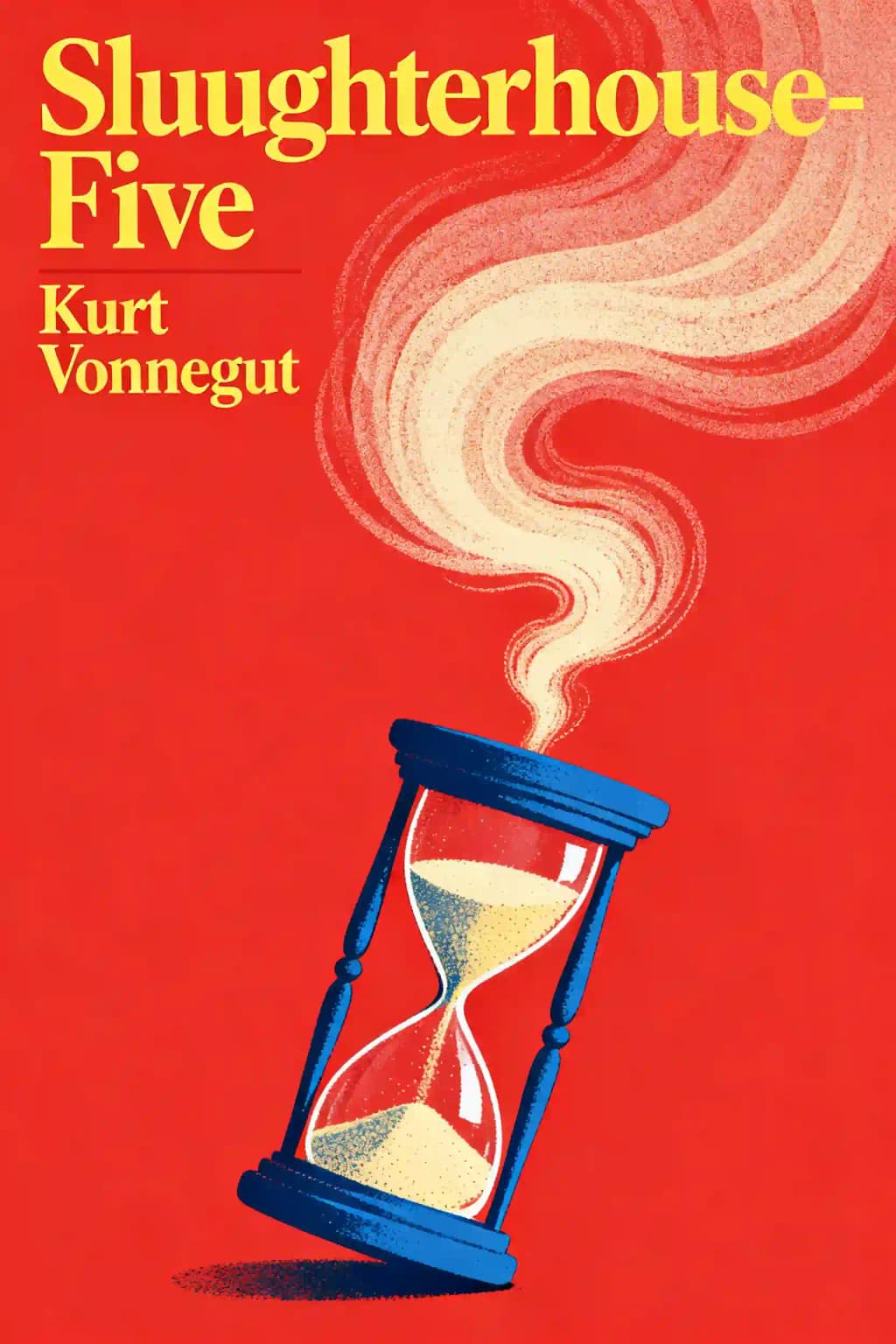
Time-traveling veteran Billy Pilgrim becomes "unstuck in time" in Vonnegut's masterpiece blending Dresden bombing memoir with sci-fi. Banned yet beloved, this anti-war classic ranked 18th on Modern Library's "100 Best Novels" list, influencing generations from college classrooms to Saturn Award-winning cinema.
Kurt Vonnegut (1922–2007), the renowned American novelist and master of satirical fiction, authored Slaughterhouse-Five, a defining work of 20th-century anti-war literature. A World War II veteran captured during the Battle of the Bulge, Vonnegut survived the 1945 Dresden firebombing as a prisoner of war—an experience that hauntingly shaped this genre-blending novel combining historical fiction, science fiction, and dark humor.
His unique narrative voice, marked by fragmented timelines and grim wit, dissects war’s psychological toll through protagonist Billy Pilgrim’s surreal journey, cementing the book’s themes of fatalism and humanity’s cyclical violence.
Vonnegut’s literary legacy includes other seminal works like Cat’s Cradle and Breakfast of Champions, which similarly blend philosophical inquiry with absurdist satire. A Distinguished Public Service Medal recipient and former anthropology student, he transformed wartime trauma into profound social commentary. Slaughterhouse-Five remains a modern classic, named one of the Modern Library’s 100 Best Novels and translated into over 30 languages, its iconic phrase “So it goes” enduring as a cultural shorthand for life’s inevitable tragedies.
Slaughterhouse-Five follows Billy Pilgrim, a WWII soldier who becomes "unstuck in time," reliving his capture by Germans, survival of the Dresden firebombing, and encounters with alien Tralfamadorians. The nonlinear narrative blends historical fiction, science fiction, and dark humor to critique war’s senseless violence and explore themes of free will vs. determinism.
Readers interested in anti-war literature, postmodern narratives, or explorations of PTSD will find this novel compelling. Its mix of satire, sci-fi elements, and historical events appeals to fans of authors like Joseph Heller (Catch-22) and Margaret Atwood.
Yes—it’s widely regarded as a 20th-century masterpiece and was a New York Times bestseller. Despite being banned 18+ times for its "unpatriotic" themes and language, it won critical acclaim for its bold critique of war and inventive structure.
The phrase, repeated 106 times, reflects the Tralfamadorian view of death as inevitable and unremarkable. Vonnegut uses it to underscore war’s dehumanizing toll while darkly satirizing societal numbness to violence.
Billy’s disjointed timeline and flashbacks mirror PTSD symptoms, illustrating how trauma fractures memory. Vonnegut’s own wartime experiences inform the novel’s visceral depiction of psychological scars, challenging glorified war narratives.
Banned for "obscene language," sexual content, and anti-war messaging, including critiques of the Vietnam War. In 1973, a school board burned 32 copies, calling it “degenerate”.
Dresden’s firebombing—which killed ~25,000 civilians—anchors the story. Vonnegut, a survivor, uses it to condemn war’s indiscriminate destruction, contrasting official silence with survivors’ trauma.
These fourth-dimensional aliens perceive all time simultaneously, symbolizing fatalism. Their philosophy (“ignore the awful parts”) critiques human complicity in violence and offers a lens to process trauma.
Praised for its innovation and moral urgency, it became Vonnegut’s breakout work. However, some critics dismissed its fragmented style, while others hailed it as a defining anti-war text.
The novel merges historical memoir (Dresden), sci-fi (Tralfamadorians), and dark comedy to subvert war-story tropes. This hybrid approach amplifies its critique of nationalism and dehumanization.
Both satirize war’s absurdity, but Catch-22 uses circular logic and bureaucracy, while Slaughterhouse-Five employs nonlinear storytelling and sci-fi to question free will.
Ressentez le livre à travers la voix de l'auteur
Transformez les connaissances en idées captivantes et riches en exemples
Capturez les idées clés en un éclair pour un apprentissage rapide
Profitez du livre de manière ludique et engageante
Billy Pilgrim, our unlikely protagonist, has "come unstuck in time."
"So it goes," he repeats after each death.
"Ignore the awful times, and concentrate on the good ones."
Writing anti-war books is as futile as writing "anti-glacier books."
The suspense isn't in what will happen, but in how these events connect.
Décomposez les idées clés de Slaughterhouse-Five en points faciles à comprendre pour découvrir comment les équipes innovantes créent, collaborent et grandissent.
Condensez Slaughterhouse-Five en indices de mémoire rapides mettant en évidence les principes clés de franchise, de travail d'équipe et de résilience créative.

Découvrez Slaughterhouse-Five à travers des récits vivants qui transforment les leçons d'innovation en moments mémorables et applicables.
Posez n'importe quelle question, choisissez la voix et co-créez des idées qui résonnent vraiment avec vous.

Cree par des anciens de Columbia University a San Francisco
"Instead of endless scrolling, I just hit play on BeFreed. It saves me so much time."
"I never knew where to start with nonfiction—BeFreed’s book lists turned into podcasts gave me a clear path."
"Perfect balance between learning and entertainment. Finished ‘Thinking, Fast and Slow’ on my commute this week."
"Crazy how much I learned while walking the dog. BeFreed = small habits → big gains."
"Reading used to feel like a chore. Now it’s just part of my lifestyle."
"Feels effortless compared to reading. I’ve finished 6 books this month already."
"BeFreed turned my guilty doomscrolling into something that feels productive and inspiring."
"BeFreed turned my commute into learning time. 20-min podcasts are perfect for finishing books I never had time for."
"BeFreed replaced my podcast queue. Imagine Spotify for books — that’s it. 🙌"
"It is great for me to learn something from the book without reading it."
"The themed book list podcasts help me connect ideas across authors—like a guided audio journey."
"Makes me feel smarter every time before going to work"
Cree par des anciens de Columbia University a San Francisco

Obtenez le resume de Slaughterhouse-Five en PDF ou EPUB gratuit. Imprimez-le ou lisez-le hors ligne a tout moment.
Billy Pilgrim has come unstuck in time-and perhaps that's the only way to survive what he's witnessed. One moment he's a successful optometrist in 1960s Ilium, New York, examining a patient's eyes; the next, he's a terrified prisoner of war stumbling through the snow in a woman's coat and frozen boots. This isn't a literary device or a clever metaphor. For Billy, time has become a scrambled film reel, and he's trapped watching his life play out of sequence, unable to control which scene comes next. What sounds like science fiction is actually the most honest depiction of trauma ever written. Because this is what war does-it shatters your relationship with time itself, making the past as vivid and immediate as the present, collapsing decades into a single, endless moment of horror that refuses to stay buried.