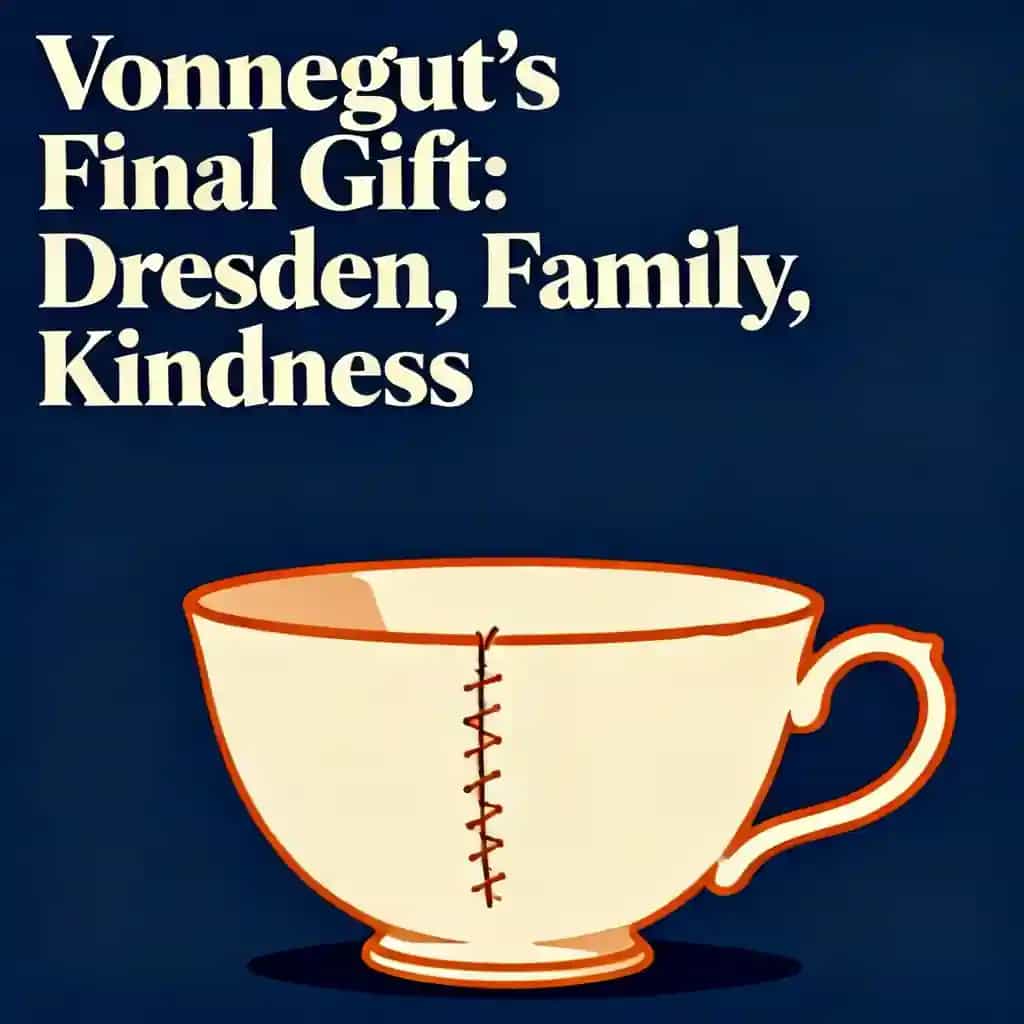
Aperçu de Kurt Vonnegut
Step into Vonnegut's brilliant mind through six decades of intimate letters. From Dresden's ashes to Jon Stewart's couch, these candid correspondences reveal the man behind "Slaughterhouse-Five." What made this literary rebel respond so personally to his New York Times critic in 1981?
- Persist through rejection to master storytelling’s dark humor and resilience
- Cherish friendships and family as lifelines through creative struggles
- Critique societal power structures by embracing compassion over competition
- Vonnegut’s anti-war ethos stems from witnessing Dresden’s destruction firsthand
- Adopt concise sentences and irony to humanize complex political themes
- Value ordinary moments as antidotes to life’s existential uncertainties
- Reject militarism by cultivating empathy through personal correspondence
- Vonnegut’s writing rules demand every sentence reveals character or action
- Frame life’s unpredictability as adventurous rather than planned
- Humanism triumphs when acknowledging shared flaws and fragile beauty
- Creative success requires writing for one ideal reader
- War’s absurdity demands dark humor to process collective trauma
- Artistic integrity means prioritizing truth over commercial validation
À propos de l'auteur de Kurt Vonnegut
Kurt Vonnegut Jr., author of Letters by Kurt Vonnegut Jr., was a master of satirical fiction and one of America’s most irreverent literary voices. Born in Indianapolis in 1922, Vonnegut drew from his experiences as a World War II POW and survivor of the Dresden firebombing to craft works blending dark humor, existential themes, and humanist critiques of modern society. His letters, like his novels, reveal his sharp wit, moral clarity, and preoccupation with the absurdities of war, technology, and social inequality.
Vonnegut’s iconic novels, including Slaughterhouse-Five (a National Book Award winner), Cat’s Cradle, and Breakfast of Champions, established him as a cornerstone of postmodern literature. A Cornell University and University of Chicago alum, he transitioned from careers in journalism and public relations to full-time writing, producing 14 novels and five nonfiction works. His works, translated into over 30 languages, have inspired films, plays, and a devoted global readership. Slaughterhouse-Five alone has sold over 1 million copies, cementing Vonnegut’s legacy as a countercultural icon.
FAQ sur Kurt Vonnegut
What is Kurt Vonnegut: Letters about?
Kurt Vonnegut: Letters is a curated collection of personal correspondence spanning decades, offering intimate insights into the author’s creative process, relationships, and worldview. The letters reveal his humor, critiques of war and inequality, and philosophical musings on art and existence, blending his signature wit with raw vulnerability. They also document his career struggles, family dynamics, and interactions with literary figures.
Who should read Kurt Vonnegut: Letters?
This book appeals to Vonnegut fans seeking deeper connections to his novels, aspiring writers interested in his creative journey, and readers drawn to candid historical correspondence. It’s particularly valuable for those studying post-war American literature or humanist perspectives on societal issues.
Is Kurt Vonnegut: Letters worth reading?
Yes, for its unflinching portrayal of Vonnegut’s life and timeless commentary on resilience, creativity, and societal flaws. The letters humanize the author, showcasing his self-doubt, humor, and moral convictions, making it essential for understanding his literary legacy.
What themes are explored in Kurt Vonnegut: Letters?
Key themes include:
- Humanism: Advocacy for compassion and empathy.
- Anti-war sentiment: Reflections on WWII and violence’s psychological toll.
- Existential inquiry: Questions about life’s purpose and artistic responsibility.
How do the letters reflect Kurt Vonnegut’s writing style?
The correspondence mirrors his novels’ conversational tone, dark humor, and irony. Personal anecdotes and candid self-reflection—hallmarks of his fiction—appear alongside sharp societal critiques, creating a cohesive voice across genres.
What are the most notable quotes from Kurt Vonnegut: Letters?
- “The two real political parties in America are the Winners and the Losers”: A critique of systemic inequality.
- “I am enchanted by the Sermon on the Mount”: Emphasizes ethical compassion.
- “Something telepathic is broken”: Lamenting marital estrangement.
How does Kurt Vonnegut: Letters compare to his novels?
While his novels use satire and sci-fi allegories, the letters offer direct, unfiltered commentary. Both share themes of human resilience and societal critique, but the correspondence provides autobiographical context for his fictional worlds.
What personal challenges does Kurt Vonnegut discuss in his letters?
He details career rejections, battles with depression, and marital struggles. Letters to his children reveal guilt over familial distance, while wartime accounts expose trauma from surviving the Dresden bombing.
How does Kurt Vonnegut: Letters address societal issues?
Vonnegut critiques political polarization, corporate greed, and militarism. His WWII experiences underpin anti-war arguments, and he champions marginalized voices through appeals for equity and intellectual freedom.
What insights do the letters provide about Vonnegut’s views on creativity?
He advocates persistence amid rejection, urging artists to prioritize authenticity over commercial success. Letters to his children encourage creative pursuits as vital to self-discovery, contrasting his father’s pragmatic career advice.
How does Kurt Vonnegut: Letters depict his relationships?
The collection highlights his loyalty to friends, mentorship of younger writers, and complex familial bonds. Correspondence with his first wife, Jane, shifts from playful early notes to poignant reflections on their divorce.
Why is Kurt Vonnegut: Letters relevant today?
Its critiques of inequality, political division, and dehumanization resonate in modern contexts like AI ethics and climate policy. Vonnegut’s humanist call for empathy offers a counterbalance to contemporary cynicism.
Ressentez le livre à travers la voix de l'auteur
Transformez les connaissances en idées captivantes et riches en exemples
Capturez les idées clés en un éclair pour un apprentissage rapide
Profitez du livre de manière ludique et engageante
Personnages de Kurt Vonnegut
- Kurt VonnegutThe subject and author of the letters
- Jane CoxKurt's wife and a Phi Beta Kappa graduate
- Kurt Sr.Kurt's father and a respected architect
- Miller HarrisKurt's friend from Cornell and correspondent
Thèmes clés dans Kurt Vonnegut
- literary correspondence
- dresden firebombing
- struggling artist
- post-war disillusionment
- creative integrity
Citations de Kurt Vonnegut
without acquainting me with the language or the literature or the oral family histories which my ancestors had loved.
I have been a sore-headed occupant of a file-drawer labeled 'science fiction' ever since.
like the proverbial fart in a wind storm.
Explorez Votre Façon d'Apprendre
 Mode Résumé Rapide
Lisez ou écoutez le résumé de Kurt Vonnegut en 8 minutes
Décomposez les idées clés de Kurt Vonnegut en points faciles à comprendre pour découvrir comment les équipes innovantes créent, collaborent et grandissent.

 Mode Fun
Leçons de Kurt Vonnegut Racontées en Histoires de 23 Min
Découvrez Kurt Vonnegut à travers des récits vivants qui transforment les leçons d'innovation en moments mémorables et applicables.
 Mode Personnaliser
Découvrez Kurt Vonnegut dans votre propre style d’apprentissage
Posez vos questions, choisissez votre style d’apprentissage et co-créez des idées qui vous correspondent vraiment.

Cree par des anciens de Columbia University a San Francisco
"Instead of endless scrolling, I just hit play on BeFreed. It saves me so much time."


"I never knew where to start with nonfiction—BeFreed’s book lists turned into podcasts gave me a clear path."


"Perfect balance between learning and entertainment. Finished ‘Thinking, Fast and Slow’ on my commute this week."
"Crazy how much I learned while walking the dog. BeFreed = small habits → big gains."
"Reading used to feel like a chore. Now it’s just part of my lifestyle."

"Feels effortless compared to reading. I’ve finished 6 books this month already."
"BeFreed turned my guilty doomscrolling into something that feels productive and inspiring."

"BeFreed turned my commute into learning time. 20-min podcasts are perfect for finishing books I never had time for."
"BeFreed replaced my podcast queue. Imagine Spotify for books — that’s it. 🙌"

"It is great for me to learn something from the book without reading it."
"The themed book list podcasts help me connect ideas across authors—like a guided audio journey."
"Makes me feel smarter every time before going to work"
Cree par des anciens de Columbia University a San Francisco
"Instead of endless scrolling, I just hit play on BeFreed. It saves me so much time."
"I never knew where to start with nonfiction—BeFreed’s book lists turned into podcasts gave me a clear path."
"Perfect balance between learning and entertainment. Finished ‘Thinking, Fast and Slow’ on my commute this week."
"Crazy how much I learned while walking the dog. BeFreed = small habits → big gains."
"Reading used to feel like a chore. Now it’s just part of my lifestyle."
"Feels effortless compared to reading. I’ve finished 6 books this month already."
"BeFreed turned my guilty doomscrolling into something that feels productive and inspiring."
"BeFreed turned my commute into learning time. 20-min podcasts are perfect for finishing books I never had time for."
"BeFreed replaced my podcast queue. Imagine Spotify for books — that’s it. 🙌"
"It is great for me to learn something from the book without reading it."
"The themed book list podcasts help me connect ideas across authors—like a guided audio journey."
"Makes me feel smarter every time before going to work"
"Instead of endless scrolling, I just hit play on BeFreed. It saves me so much time."
"I never knew where to start with nonfiction—BeFreed’s book lists turned into podcasts gave me a clear path."
"Perfect balance between learning and entertainment. Finished ‘Thinking, Fast and Slow’ on my commute this week."
"Crazy how much I learned while walking the dog. BeFreed = small habits → big gains."
"Reading used to feel like a chore. Now it’s just part of my lifestyle."
"Feels effortless compared to reading. I’ve finished 6 books this month already."
"BeFreed turned my guilty doomscrolling into something that feels productive and inspiring."
"BeFreed turned my commute into learning time. 20-min podcasts are perfect for finishing books I never had time for."
"BeFreed replaced my podcast queue. Imagine Spotify for books — that’s it. 🙌"
"It is great for me to learn something from the book without reading it."
"The themed book list podcasts help me connect ideas across authors—like a guided audio journey."
"Makes me feel smarter every time before going to work"
"Instead of endless scrolling, I just hit play on BeFreed. It saves me so much time."
"I never knew where to start with nonfiction—BeFreed’s book lists turned into podcasts gave me a clear path."
"Perfect balance between learning and entertainment. Finished ‘Thinking, Fast and Slow’ on my commute this week."
"Crazy how much I learned while walking the dog. BeFreed = small habits → big gains."
"Reading used to feel like a chore. Now it’s just part of my lifestyle."
"Feels effortless compared to reading. I’ve finished 6 books this month already."
"BeFreed turned my guilty doomscrolling into something that feels productive and inspiring."
"BeFreed turned my commute into learning time. 20-min podcasts are perfect for finishing books I never had time for."
"BeFreed replaced my podcast queue. Imagine Spotify for books — that’s it. 🙌"
"It is great for me to learn something from the book without reading it."
"The themed book list podcasts help me connect ideas across authors—like a guided audio journey."
"Makes me feel smarter every time before going to work"

Telecharger le resume de Kurt Vonnegut
Obtenez le resume de Kurt Vonnegut en PDF ou EPUB gratuit. Imprimez-le ou lisez-le hors ligne a tout moment.