Chapitre 1
The Paradox of Our Time: Why Rationality Matters Now More Than Ever
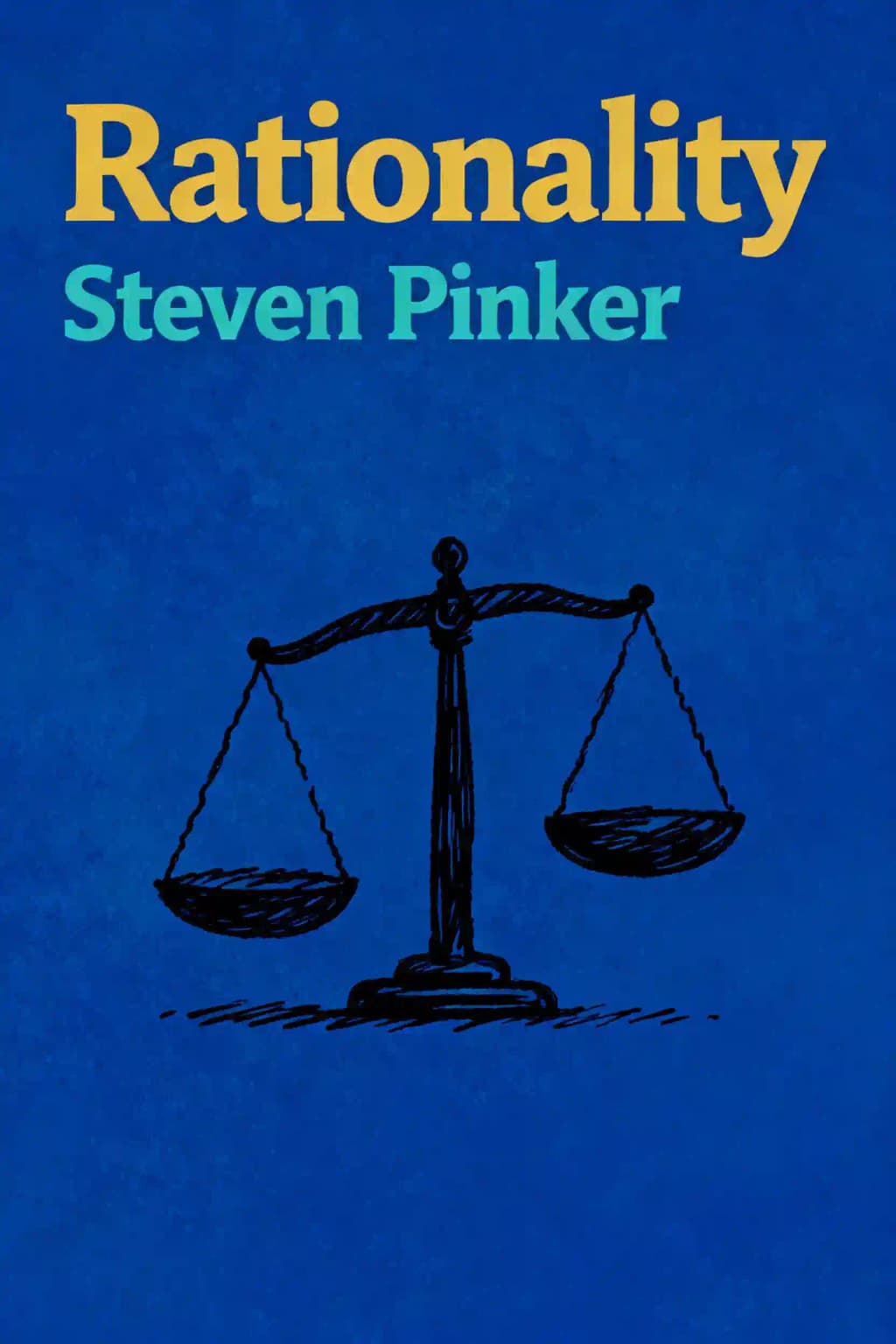
In an era when we have unprecedented access to information and scientific knowledge, our public discourse seems increasingly dominated by conspiracy theories, fake news, and "post-truth" rhetoric. Steven Pinker's "Rationality" arrives at this critical juncture, offering a compelling case for reason in an apparently unreasonable world. The book has garnered praise from intellectual heavyweights like Bill Gates, who called it "the most important book of our time," and has become required reading in university courses across disciplines. What makes this work particularly timely is how it bridges the gap between our remarkable scientific achievements-like developing COVID vaccines in record time-and our collective struggle to apply rational thinking to pressing social problems. Pinker, with his characteristic blend of scientific rigor and accessible prose, doesn't just lament our cognitive shortcomings but provides a toolkit for overcoming them, making this book both a diagnosis of and potential cure for our current epistemic crisis.
Chapitre 2
The Rational Animal: Our Cognitive Achievements and Limitations
Homo sapiens means "wise hominin," and in many ways, we've earned this title. Our species has dated the universe's origin, decoded life's secrets, unraveled consciousness, and chronicled our history. We've applied this knowledge to enhance human flourishing, extending lifespans from thirty to over seventy years, reducing extreme poverty from ninety to less than nine percent of humanity, and dramatically decreasing deaths from war and famine. Even when facing new pandemics, we can identify causes within days, sequence genomes within weeks, and develop vaccines within a year.
Yet despite these achievements, we struggle with seemingly simple reasoning problems. Consider the bat and ball problem: "A bat and ball cost $110 in total. The bat costs $100 more than the ball. How much does the ball cost?" Most people immediately answer $10, but that would make the bat cost $110, for a total of $120. The correct answer is $5 (with the bat costing $105). Similarly, in the Wason selection task testing logical reasoning, only 10% of participants correctly identify which cards must be checked to test an "if-then" rule.
Our probability intuitions fare no better. In the Monty Hall problem, where contestants choose between three doors with a prize behind one, most people fail to recognize that switching doors after one empty door is revealed doubles their chances of winning. Even professional mathematicians like Paul Erdos initially rejected this counterintuitive solution.
These cognitive illusions don't indicate a fundamentally broken reasoning system but reveal how our minds prioritize socially useful interpretations over mathematical precision. Just as visual illusions show how our visual system optimizes for real-world accuracy rather than technical precision, cognitive illusions demonstrate how our reasoning systems favor practical interpretations over literal correctness. Our cognitive systems, like our visual ones, are marvels of evolution-not fundamentally flawed, but optimized for different priorities than technical accuracy.
However, just as pilots must learn to trust instruments over visual intuitions when flying in clouds, we must learn when to override our intuitive reasoning with formal tools of logic, probability, and critical thinking. In the modern world, thinking "by the seat of our pants" can send our democracy into a fatal error pattern similar to what killed inexperienced pilots who trust their feelings over their instruments.
Chapitre 3
Rationality's Image Problem: The Case for Reason
Rationality has an image problem in contemporary culture. Being labeled a "nerd," "wonk," or "geek" implies social deficiency, while Hollywood and popular music celebrate escape from reason as the path to freedom and joy. Even academic movements like postmodernism treat rationality as merely a social construction that justifies privilege. Despite this cultural disdain, rationality-defined as "the ability to use knowledge to attain goals"-deserves our allegiance.
The case for rationality seems obvious: if you want things, rationality helps you get them. While we can't provide an ultimate justification for reason without circular reasoning (as Lewis Carroll illustrated in "What the Tortoise Said to Achilles"), we commit to reason by engaging in argument itself. As Thomas Nagel noted, rejecting rationality is self-defeating-if you claim rationality is unnecessary, either your statement is irrational (so I needn't believe it) or rational (contradicting your claim).
Contrary to popular misconception, rationality doesn't oppose emotion or creativity. David Hume's famous statement that "reason is the slave of the passions" doesn't advocate impulsivity but recognizes that reason is a means to ends determined by our desires and feelings. It's neither rational nor irrational to prefer chocolate ice cream to maple walnut, or to fall in love, keep gardens, or care for stray dogs. These preferences operate in domains where reason serves rather than dictates our aims.
Many apparent irrationalities actually reflect conflicts between multiple goals or different time frames. The famous marshmallow test (one now or two later) exemplifies the dilemma between immediate small rewards versus delayed larger ones. While some discounting of future rewards is rational (the future is uncertain; "a bird in hand is worth two in the bush"), people often discount irrationally by preferring smaller immediate rewards over much larger delayed ones, or by reversing preferences as rewards get closer in time.
Sometimes it's even rational to choose ignorance or incapacity. We avoid spoilers for movies to preserve suspense and enjoyment. The Brink's truck driver who "does not know combination to safe" can't be coerced into revealing it. In Thomas Schelling's paradoxes of reason, sometimes it's rational to be powerless or even irrational-like visibly removing your ability to swerve in a game of Chicken, forcing your opponent to yield.
Even morality can be grounded in reason through three simple premises: self-interest (we prefer good things happen to us), sociality (we live with others whose actions affect us), and impartiality (the logical recognition that "I" and "you" are interchangeable perspectives). From these premises emerges the Golden Rule and its variants across cultures and religions.
Chapitre 4
The Tools of Logic: Formal Rules and Human Reasoning
Logic forms the foundation of rational argument, allowing us to infer true conclusions from true premises. Despite logic's power, we haven't achieved Leibniz's dream of settling disagreements by simply calculating. This failure stems from three challenges: logic can be difficult even for logicians, people often don't follow logical rules, and logic is a tool suited only for certain goals with certain kinds of knowledge.
Formal logic deals with the structure of statements rather than their content, focusing on how they're assembled using subjects, predicates, and logical connectors like "and," "or," "not," and "if-then." The power of logic comes from rules of valid inference-algorithms that allow leaping from true premises to true conclusions. These include modus ponens ("If P then Q; P; therefore Q"), modus tollens ("If P then Q; not Q; therefore not P"), and others.
Common formal fallacies include affirming the consequent ("If P then Q; Q; therefore P") and denying the antecedent. These errors appear in political rhetoric, crackpot claims about geniuses being laughed at, and assumptions about college dropouts becoming tech billionaires. Formal reconstruction helps identify these fallacies by unpacking arguments into explicit premises and conditionals.
While formal fallacies violate specific rules of logic, informal fallacies exploit psychologically compelling but intellectually spurious reasoning. Many informal fallacies stem from our deep-seated desire to win arguments-a feature so fundamental that cognitive scientists Dan Sperber and Hugo Mercier suggest it was the evolutionary pressure that developed human reasoning. Common informal fallacies include the straw man (misrepresenting an opponent's position), special pleading (making exceptions to one's own rules), moving the goalposts (changing definitions when challenged), and the no-true-Scotsman fallacy (excluding counterexamples by definition).
Logic will never completely rule our reasoning because logical propositions differ fundamentally from empirical ones. Logical truths (what Hume called "relations of ideas") can be determined by analyzing definitions and checking truth tables-like verifying "all bachelors are unmarried." Empirical truths ("matters of fact") require observation-like discovering that not all swans are white when finding black ones in New Zealand.
Additionally, most human concepts don't fit classical logic's requirement for necessary and sufficient conditions. As Wittgenstein famously demonstrated, try defining "game"-no single feature unites board games, sports, children's play, and card games. Instead, our concepts work by "family resemblance," where members share overlapping features rather than essential defining traits.
Human rationality is a hybrid system combining pattern association with logical symbol manipulation. This logical reasoning enables our highest achievements-science, morality, and law-by freeing us from similarity and stereotypes.
Chapitre 5
Probability and Randomness: Navigating an Uncertain World
Rationality requires dealing with randomness and uncertainty. "Randomness" refers to both a lack of pattern in data and unpredictability in processes. While quantum mechanics may introduce true randomness at subatomic scales, our everyday experience of randomness comes from two sources: the butterfly effect in chaotic systems, where tiny unmeasurable differences in initial conditions produce enormous differences in outcomes, and complexity-when outcomes depend on numerous tiny causes impossible to track (like in a coin flip), the result appears random from a human perspective.
Probability has multiple interpretations that often align but sometimes diverge, causing confusion and controversy. These include classical (counting favorable outcomes divided by total outcomes), propensity (physical disposition of objects), subjectivist/Bayesian (quantifying belief from 0 to 1), evidential (degree to which information warrants a conclusion), and frequentist (proportion of outcomes in many repetitions).
While probability is fundamentally about events as a proportion of opportunities, humans rarely calculate it this way. Instead, we rely on the "availability heuristic"-judging probability by how easily examples come to mind. This mental shortcut works reasonably well when our memories accurately reflect frequencies, but fails when our impressions are distorted by media coverage, recency, vividness, or emotional impact.
The media functions as an "availability machine," serving up anecdotes that distort our understanding of prevalence. News, by definition, reports what happens rather than what doesn't happen, making the denominator in probability calculations invisible and biasing us toward the morbid and sudden rather than gradual improvements. This availability-driven ignorance creates measurable misperceptions: people consistently believe crime is rising during periods of decline and think global indicators of well-being are worsening when they're improving.
When calculating probabilities of multiple events, we must understand how they combine. For disjunctions (OR relationships), the probability equals the sum of individual probabilities minus their overlap. For complements (NOT relationships), the probability is simply 1 minus the original probability. Conditional probabilities-the probability of A given B-cause endless confusion despite their simple formula: prob(A|B) = prob(A AND B)/prob(B).
People frequently make three critical errors: confusing base rates with conditional probabilities (like thinking overall lightning strike probability equals the probability during storms); failing to enumerate all possibilities (as in the Boy or Girl paradox where the probability of two girls given at least one girl is 1/3, not 1/2); and most dangerously, reversing conditionals-confusing prob(A|B) with prob(B|A). This last error appears in the prosecutor's fallacy, where the probability of matching evidence given innocence gets confused with the probability of innocence given matching evidence.
Chapitre 6
Bayesian Reasoning: Updating Beliefs with Evidence
The Rationality Community stands as a hopeful counterpoint to the general disdain for reason in online discourse. These individuals strive to be "less wrong" by acknowledging their cognitive biases and embracing critical thinking standards. At the heart of their approach is Bayes' rule-the mathematical law governing how we should update our beliefs when encountering new evidence.
When doctors assess a positive cancer test result as indicating an 80-90% chance of disease (when the actual probability is only 9%), they're demonstrating base-rate neglect-a major flaw in our Bayesian reasoning. We fixate on the positive test (the likelihood) while forgetting the disease's rarity (the prior). Instead of proper Bayesian calculation, we rely on the representativeness heuristic-judging probability by similarity to stereotypes rather than statistical reality.
Prior credence isn't prejudice or dogma but accumulated knowledge from past experience. In Bayesian updating, yesterday's posterior probability becomes today's prior. This explains why skepticism toward paranormal claims is rational rather than close-minded-as Francis Crick noted, "Any theory that can account for all the facts is wrong, because some of the facts are wrong." Hume's argument against miracles is thoroughly Bayesian: extraordinary claims require extraordinary evidence.
When measuring any socially significant variable and breaking it down by demographics like race or gender, the averages are never identical. This creates a dilemma: a good Bayesian would use these base rates for accurate predictions about individuals, essentially engaging in profiling. Yet most people are horrified by this, and for good reason. While actuarial prediction might favor using all available information, higher goals like fairness, building social trust, avoiding self-fulfilling prophecies, and signaling commitment to equality justify forbidding the use of demographic base rates in many contexts.
For all our taboos and neglects, we aren't hopelessly un-Bayesian. When problems are reframed using "natural frequencies" instead of decimal fractions, people's Bayesian reasoning improves dramatically-87% of doctors get the breast cancer screening problem right versus 15% with the original wording. Visual representations make Bayesian reasoning even more intuitive. Rather than writing people off as irrational, we should enhance their existing rationality through better education in risk literacy, especially for professionals whose decisions affect our lives.
Chapitre 7
Making Rational Choices: Risk, Reward, and Human Decision-Making
Rational choice theory is widely misunderstood and maligned as claiming humans are selfish psychopaths or hyper-rational calculators. In reality, it's a mathematical theorem about decision consistency with no direct implications for how humans actually think. The theory, formalized by von Neumann and Morgenstern in 1944, defines rationality as making choices consistent with one's goals.
Rational choice theory rests on seven axioms that together lead to expected utility theory: rational deciders must assess outcomes on a continuous scale, multiply by probability, and choose the option with highest expected utility. Utility isn't about self-interest or hedonism but whatever values a person consistently maximizes. The theory doesn't dictate values but offers guidance on not squandering them.
Money's relationship to utility isn't linear but concave, showing diminishing marginal utility-an extra hundred dollars increases a poor person's happiness more than a rich person's. This explains risk aversion: people buy insurance because a small certain loss causes less utility reduction than the risk of a catastrophic loss. However, the theory struggles to explain why people also gamble, suggesting either irrationality, entertainment value, or a second bend in the utility curve where jackpots promise entry to a different lifestyle.
People violate rational choice axioms in several ways. With Commensurability, they resist putting prices on sacred values like endangered species or human lives. Herbert Simon's concept of bounded rationality acknowledges that real humans have limited information, time, and memory. Instead of optimizing, people must satisfice-settle for options that are "good enough"-which can lead to violations of axioms like Transitivity.
People's choices flip dramatically based on how risks and rewards are framed. When presented with identical final outcomes, people are risk-averse for gains (preferring a guaranteed $500 over a 50% chance at $1,000) but risk-seeking for losses (preferring a 50% chance of losing $1,000 over a guaranteed loss of $500). This reveals that people aren't consistently risk-averse-rather, they're loss-averse, willing to take risks specifically to avoid losses.
While cognitive scientists and behavioral economists have made careers demonstrating how people violate rational choice axioms, we're often better off when our decisions align with expected utility calculations. Many everyday decisions would improve through basic probability-times-outcome thinking: extended warranties on appliances are typically terrible deals; low insurance deductibles rarely make mathematical sense; medical screening decisions become clearer when weighing true benefits against false positives.
Chapitre 8
Signal Detection: Balancing False Alarms and Missed Opportunities
Rationality requires distinguishing what is true from what we want to be true, resisting wishful thinking even as we navigate an uncertain world. Signal Detection Theory offers a rational approach by combining Bayesian reasoning with rational choice-estimating probabilities and weighing expected costs and benefits. The fundamental challenge is determining whether an indicator represents a genuine signal or merely noise in our perception.
Statistical distributions help us understand how to interpret erratic indicators of reality. Bell curves arise when measurements vary randomly around an average value, appearing whenever a measurement comes from many small causes. But our observations are always contaminated by noise, creating overlapping distributions between signal and noise. We must set a criterion to decide whether to say "Yes" (signal) or "No" (noise), which creates four possible outcomes: hits (correctly identifying signals), false alarms (saying "Yes" to noise), misses (failing to detect signals), and correct rejections (properly ignoring noise).
The rational way to set a detection criterion depends on the benefits of correct decisions and costs of errors. A rational observer sets a higher criterion when noise is more common than signals, when hits yield smaller rewards, when correct rejections bring greater benefits, when false alarms are costly, or when misses are less catastrophic.
While signal detection always forces tradeoffs between misses and false alarms, we can mitigate this tragedy by increasing the sensitivity of our observations. The costs depend on both our response bias (where we set the cutoff) and sensitivity (d'), which measures how far apart the signal and noise distributions are. By perfecting our detection systems to better distinguish signals from noise-pushing the bell curves farther apart-we achieve both fewer misses and fewer false alarms regardless of where we set our criterion.
Legal proceedings exemplify signal detection problems, where evidence about a defendant's guilt varies in strength and overlaps more than most realize. We traditionally set a high criterion ("guilty beyond reasonable doubt"), following Blackstone's principle that "It is better that ten guilty persons escape than that one innocent suffer." But our moral aspirations likely outstrip our probative powers-meeting our ethical standards would require evidence from guilty defendants to be 3-5 standard deviations stronger than from innocent ones, far beyond typical forensic sensitivity.
Statistical significance testing operates on the same principles as signal detection theory. When scientists analyze data, they must distinguish between real effects (signals) and sampling error (noise). Most scientists fundamentally misunderstand what statistical significance actually means. A p-value below .05 doesn't indicate the probability that the null hypothesis is true, that there is a 95% chance of an effect, or that you'd replicate the finding 95% of the time. These are all posterior probabilities, while p-values are likelihoods-the probability of obtaining the data given the hypothesis.
Chapitre 9
The Rationality Challenge: Overcoming Biases in a Post-Truth Era
Despite human reasoning's vulnerabilities, we need not surrender to irrationality. The arc of knowledge bends toward rationality-few people today believe in werewolves, bloodletting, or divine omens that were mainstream centuries ago. Most people can judge headline veracity reasonably well and change their minds when presented with clear corrections.
Our susceptibility to pseudoscience and paranormal beliefs stems from deep cognitive intuitions. As intuitive dualists, we readily accept that minds can exist separately from bodies, leading to beliefs in telepathy, ghosts, and souls. As essentialists, we sense invisible substances in living things, making us receptive to homeopathy and suspicious of vaccines. As teleologists, we see purpose in complexity, embracing creationism and astrology.
Viral misinformation and fake news thrive because they're fundamentally entertaining. They feature compelling narrative elements of sex, violence, revenge, danger, fame, and taboo-the same features that make urban legends and fiction culturally attractive. Headlines like "FBI Agent Suspected in Hillary Email Leaks Found Dead in Apparent Murder-Suicide" succeed because they would make excellent plots for suspense thrillers.
Conspiracy theories flourish because humans evolved to be vigilant against real conspiracies. Throughout human history, from tribal warfare to modern politics, stealthy plots by enemy coalitions have been genuine threats. In signal detection terms, missing a real conspiracy costs more than false-alarming to a suspected one, so we're biased toward the trigger-happy end of the scale.
To strengthen our cognitive immune systems, we should valorize rationality itself, making it socially rewarding to question dogmas and change minds when facts change. Universities must restore trust by ending their suffocating monocultures that punish questioning of certain dogmas. The press should embrace viewpoint diversity, critical thinking, and statistical literacy, implementing fact-checking and avoiding false balance between experts and cranks. Educational institutions should make rationality "the fourth R" alongside reading, writing and arithmetic, with well-designed courses that train students to spot cognitive biases in real-life settings.
Rationality is a public good requiring protection from the Tragedy of the Commons where each person prefers their truth while collectively we need the truth. Successful institutions of rationality never depend on individual brilliance but on feedback systems that make the whole smarter than its parts. Social media platforms must redesign their incentive structures to stop rewarding dangerous falsehoods, while other institutions from journalism to governance should implement mechanisms that give disinterested truth an edge over myside bias. Rationality is ultimately not just cognitive but moral-requiring the same impartiality that lies at the core of ethics.
Chapitre 10
Why Rationality Matters: The Stakes for Our Future
Cognitive biases extract real costs in our everyday lives. We discount the future myopically, sacrificing larger future rewards for quick highs. We throw good money after bad by trying to recoup sunk costs. We avoid safe planes for dangerous cars based on availability bias. We save too little for retirement due to blind spots about exponential growth, and invest in expensive managed funds that underperform simple indexes.
Research confirms that rational thinking skills protect against life's mishaps. A study measuring reasoning competence (avoiding fallacies like overconfidence, sunk costs, and framing effects) found that better reasoners suffered fewer negative life outcomes like accidents, financial losses, and unwanted pregnancies. This relationship held true even when controlling for intelligence and socioeconomic status, suggesting that rationality itself provides protection against misfortune.
Human progress is an empirical fact hidden by availability bias. When we examine trend lines rather than headlines, we see humanity is healthier, wealthier, longer-lived, better fed, better educated, and safer than in centuries past. This progress isn't driven by some mystical force but by rationality-humans applying ingenuity through institutions that pool collective intelligence.
Progress extends beyond material well-being to how we treat each other. Cruel practices like human sacrifice, slavery, despotism, blood sports, sadistic punishments, and various forms of persecution and oppression have declined significantly throughout history. Surprisingly, reasoned arguments often served as the first domino in moral progress. Philosophers would write treatises explaining why certain practices were indefensible or inconsistent with widely-held values. These arguments would spread, be debated in public spaces, influence leaders and legislators, and eventually become absorbed into society's conventional wisdom.
Sound arguments alone cannot improve the world, but they guide movements for change, making the difference between moral force and brute force. They reveal moral blights and help discover feasible remedies, ensuring moral progress continues. The equality of sentient beings, grounded in the logical irrelevance of distinguishing between "me" and "you," is an idea people throughout history rediscover and extend to new living things, expanding our circle of sympathy.
This power of rationality to guide moral progress connects directly to its ability to guide material progress and wise life choices. Our well-being and capacity for goodness depend on grasping impartial principles that transcend our limited personal experience, awakening us to ideas and realities that may confound our intuitions but are true nonetheless.