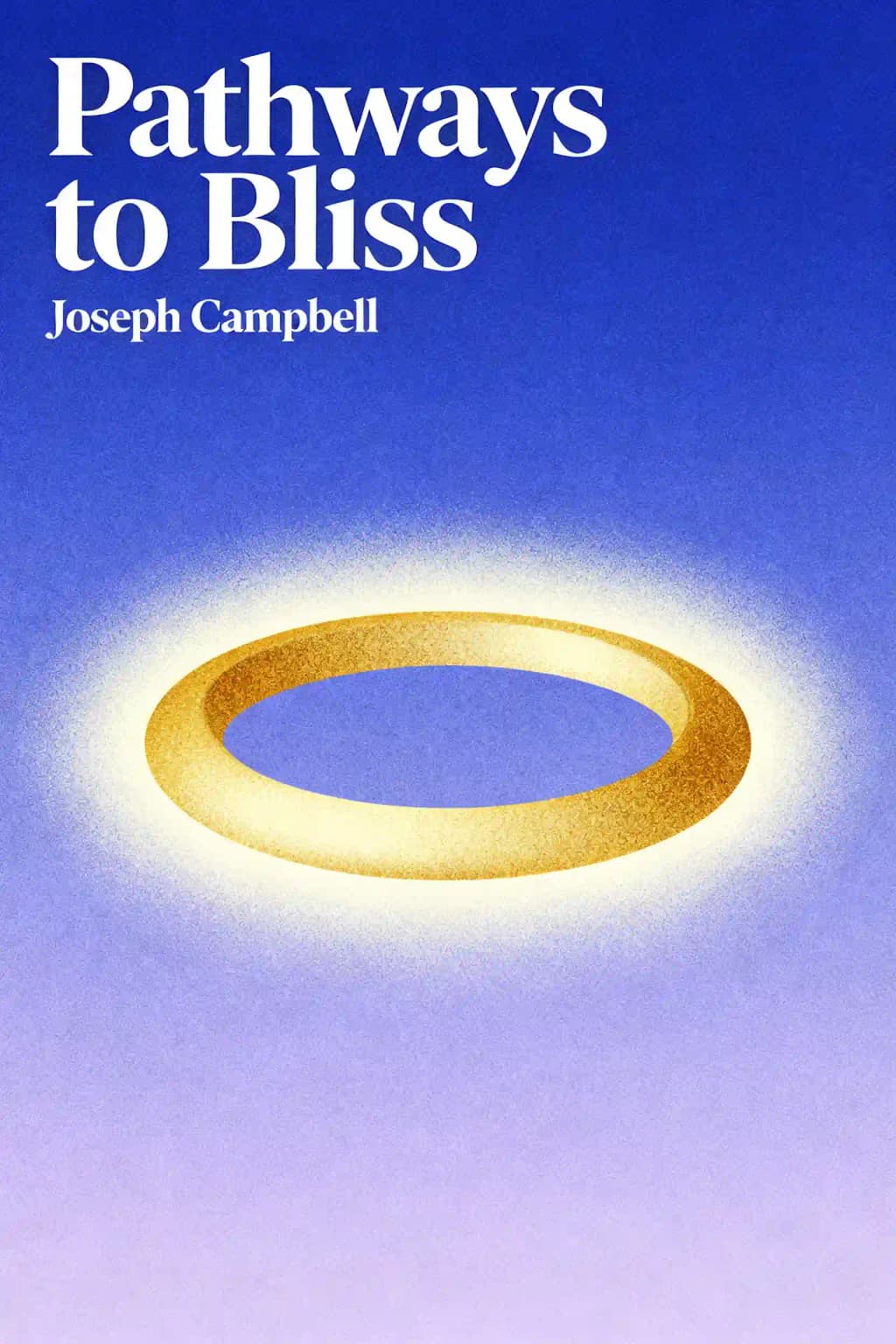
Discover why George Lucas credits Campbell's mythology for Star Wars' magic. "Pathways to Bliss" reveals how ancient myths unlock your life purpose, offering the same transformative wisdom that inspired filmmakers, writers, and thought leaders to follow their own unique bliss.
Joseph John Campbell (1904–1987) was a renowned mythologist, educator, and author of Pathways to Bliss, celebrated for his groundbreaking work in comparative mythology and narrative psychology.
A Sarah Lawrence College literature professor for 38 years, Campbell fused academic rigor with accessible storytelling to explore universal themes of spiritual growth, symbolic transformation, and the hero’s journey—concepts that shaped his influential The Hero with a Thousand Faces (1949) and the four-volume Masks of God series.
His analysis of mythic patterns across cultures revolutionized modern storytelling, notably inspiring George Lucas’ Star Wars saga. Campbell’s philosophy of "follow your bliss" became a cultural touchstone, bridging ancient wisdom with contemporary self-discovery.
His works, translated into over 20 languages, remain essential reading in literature, film studies, and psychology curricula worldwide, with The Hero with a Thousand Faces alone selling millions of copies since its 1949 debut.
Pathways to Bliss explores how mythology shapes personal transformation, blending cross-cultural stories with psychology. Campbell argues that myths guide individuals to discover their unique life purpose through the concept of "following your bliss"—a call to align actions with inner fulfillment, even amid challenges. The book examines symbolic journeys, like the hero’s quest, as metaphors for self-discovery.
This book suits readers interested in mythology, psychology, or self-discovery. It’s valuable for those seeking purpose, writers exploring symbolic narratives, and fans of Campbell’s earlier works like The Hero with a Thousand Faces. Academics and spiritual seekers will appreciate its interdisciplinary approach to myth’s role in modern life.
Yes—Campbell’s insights remain influential for connecting ancient myths to contemporary self-growth. The book offers actionable frameworks, such as viewing life as a hero’s journey, and clarifies misconceptions about "bliss" (e.g., it’s not hedonism but purposeful alignment). Critical acclaim highlights its depth, though some find its abstract ideas challenging.
Campbell defines "bliss" as a destiny-driven calling beyond mere pleasure. It involves courageously pursuing what energizes you, even if it demands sacrifice—like Buddha leaving his palace or Christ’s crucifixion. Bliss arises from transcending societal expectations to honor one’s unique path.
The hero’s journey—a recurring mythic pattern—parallels the personal quest for bliss. Both involve leaving comfort zones, facing trials, and returning transformed. Campbell uses this framework to show how myths provide blueprints for navigating life’s challenges and achieving self-realization.
Critics argue Campbell’s "bliss" concept risks oversimplification, potentially ignoring systemic barriers to self-actualization. Others note his focus on individualism may downplay communal traditions. Despite this, the book is praised for bridging mythic wisdom to modern psychology.
Campbell analyzes global myths to reveal universal themes—like the "Forest Adventurous," symbolizing uncharted self-discovery. He argues myths offer symbolic tools to reframe struggles, integrate subconscious drives (à la Jung), and connect personal experiences to transcendent truths.
While both discuss mythic patterns, Pathways to Bliss focuses more on personal application than academic analysis. It integrates psychology (e.g., Jungian archetypes) and practical advice, whereas Hero details narrative structures across cultures.
Yes—Campbell’s ideas encourage viewing transitions as mythic journeys. By identifying "bliss signals" (joy, flow) and reframing obstacles as trials, readers can navigate uncertainty with purpose. The book is cited in coaching and leadership contexts for its resilience-building insights.
The "Forest Adventurous" symbolizes the uncharted territory of self-discovery. Campbell urges readers to embrace uncertainty, as pre-existing paths reflect others’ journeys. This metaphor underscores the book’s call to courageously explore one’s unique potential.
Campbell critiques ideologies (e.g., Marxism, Freudianism) that "blame" external forces for personal dissatisfaction. He advocates self-accountability and mythic thinking to navigate crises, making the book relevant to topics like burnout, identity, and cultural fragmentation.
Ressentez le livre à travers la voix de l'auteur
Transformez les connaissances en idées captivantes et riches en exemples
Capturez les idées clés en un éclair pour un apprentissage rapide
Profitez du livre de manière ludique et engageante
Follow your bliss and the universe will open doors where there were only walls.
If you do follow your bliss you put yourself on a kind of track that has been there all the while, waiting for you, and the life that you ought to be living is the one you are living.
Participate joyfully in the sorrows of the world.
Your sacred space is where you can find yourself again and again.
life lives on life.
Décomposez les idées clés de Pathways to bliss en points faciles à comprendre pour découvrir comment les équipes innovantes créent, collaborent et grandissent.
Découvrez Pathways to bliss à travers des récits vivants qui transforment les leçons d'innovation en moments mémorables et applicables.
Posez vos questions, choisissez votre style d’apprentissage et co-créez des idées qui vous correspondent vraiment.

Cree par des anciens de Columbia University a San Francisco
"Instead of endless scrolling, I just hit play on BeFreed. It saves me so much time."
"I never knew where to start with nonfiction—BeFreed’s book lists turned into podcasts gave me a clear path."
"Perfect balance between learning and entertainment. Finished ‘Thinking, Fast and Slow’ on my commute this week."
"Crazy how much I learned while walking the dog. BeFreed = small habits → big gains."
"Reading used to feel like a chore. Now it’s just part of my lifestyle."
"Feels effortless compared to reading. I’ve finished 6 books this month already."
"BeFreed turned my guilty doomscrolling into something that feels productive and inspiring."
"BeFreed turned my commute into learning time. 20-min podcasts are perfect for finishing books I never had time for."
"BeFreed replaced my podcast queue. Imagine Spotify for books — that’s it. 🙌"
"It is great for me to learn something from the book without reading it."
"The themed book list podcasts help me connect ideas across authors—like a guided audio journey."
"Makes me feel smarter every time before going to work"
Cree par des anciens de Columbia University a San Francisco

Obtenez le resume de Pathways to bliss en PDF ou EPUB gratuit. Imprimez-le ou lisez-le hors ligne a tout moment.
What if the key to your happiness has been hiding in ancient stories all along? Joseph Campbell discovered that myths aren't just entertaining tales - they're psychological maps guiding us through life's most challenging transitions. His directive to "follow your bliss" has inspired countless seekers, from Hollywood filmmakers to spiritual practitioners worldwide. Campbell's revolutionary insight was that mythology isn't about believing impossible things - it's about discovering the extraordinary within ourselves. In a world increasingly fragmented by technology and conflicting belief systems, his work offers something precious: a universal language of human experience that transcends cultural boundaries and speaks directly to our deepest needs for meaning and transformation. By understanding the hero's journey embedded in stories across time and cultures, we gain access to a profound template for navigating our own lives with greater purpose and fulfillment. Mythology serves four essential functions that remain surprisingly relevant today. First, it reconciles us with existence's harsh realities - particularly the uncomfortable truth that "life lives on life." Early myths didn't shy away from life's brutalities but transformed them through ritual and meaning. Second, myths present an image of the universe that sustains our sense of wonder. Third, they validate social systems by grounding laws in cosmic order. Finally - and most crucially for modern seekers - myths guide individuals through life stages from birth to death. While science has largely replaced mythology's cosmological explanations and secular institutions have taken over its sociological role, Campbell argues that we need mythology more than ever to navigate personal transitions. Modern rational thinking has "ripped to shreds" what he calls mythology's protective "marsupial pouch" - a "womb with a view" where emotions safely develop. With diverse belief systems now accessible through globalization, we live in what Nietzsche called "the period of comparisons" without shared cultural horizons.
Campbell differentiates between "elementary ideas" (universal mythic themes) and "ethnic ideas" (cultural expressions). The hero's journey exemplifies this - while core themes remain constant, cultural figures like Luke Skywalker and Buddha represent local variations. These universal patterns emerge from shared human experiences of family, growth, and mortality. Mythic symbols represent spiritual principles, not historical events. Campbell sees Jesus as historical but Christ as an eternal principle, arguing that literal interpretations obscure deeper psychological meanings. These symbols connect our conscious and unconscious minds. Human mythology evolved through tribal, agricultural, and scientific periods, each creating distinct narratives about nature. Hunter-gatherers believed in eternal return through ritual, while agricultural societies embraced the cycle of death and renewal. Even in our technological age, hero stories resonate because they address fundamental human needs - overcoming challenges, personal transformation, and community contribution. Though forms change, the underlying patterns persist across cultures.
Campbell traces a mythological divide at Persia: Eastern traditions maintained views of impersonal cosmic cycles, while Western regions experienced conflicts between goddess-worshipping agricultural societies and masculine warrior cultures. This tension manifests in myths of sky gods defeating earth goddesses, like Zeus overthrowing the Titans. The Semitic tradition diverged by worshipping exclusive tribal deities - unlike Greeks and Romans who readily absorbed foreign gods. Hebrew mythology represents pure patriarchal mythology without goddess figures. Eastern traditions maintained an impersonal cosmic order where ultimate mystery is both transcendent and immanent ("tat tvam asi" - you are it). Eastern paths seek unity through meditation, while Western religions emphasize divine relationship through institutions. These contrasting approaches - Eastern inward focus versus Western external orientation - continue shaping modern perspectives on nature, society, and identity.
Myths operate through symbols that act as psychological triggers. Campbell explores two animal psychology concepts: the innate releasing mechanism (IRM) and imprinting. The IRM explains instinctive responses, like chicks fleeing hawk-shaped shadows, while imprinting shows how ducklings permanently bond with moving objects seen after hatching. Campbell finds imprinting more significant in humans, though both matter. This raises the question: why do universal symbols appear across civilizations if they're neither innate nor purely cultural? Campbell suggests these symbols emerge from shared human experiences: parent relationships and universal stages of psychological development. Jung proposed that psychic energy manifests differently through basic attitudes: introverts focus inward while extroverts orient toward others. Everyone possesses both tendencies but favors one. When the primary orientation fails, the inferior personality surfaces. At midlife, an "enantiodromia" often occurs - the dominant trait yields to its opposite. Jung's archetypes include the persona (our social mask) which becomes risky when over-identified with, and the shadow - our repressed qualities that we often project onto others.
The infant psyche begins with pure desire for gratification. When these impulses meet social restrictions, both get pushed into the unconscious, creating neurosis. Traditional initiation rites channeled infantile energies into mature forms, guiding the transition to adult responsibility. Mythic symbols resonate because they connect to universal experiences of growth and mortality, mirroring our own psychological development. The anima (in men) and animus (in women) represent inner contrasexual aspects projected onto romantic partners. When these projections fade, we must learn to love real people rather than ideals - embracing human imperfection. The qualities that irritate us most in others typically reflect denied aspects of ourselves, while those we admire often embody what we lack. Understanding these projections helps integrate our psyche. True psychological wholeness comes from acknowledging our full nature and embracing our contradictions.
Jung's personal crisis revolved around identifying his guiding myth. Through work with psychotic patients, he found their imagery mirrored ancient mythological themes - revealing universal patterns in unconscious imagery across all mental states. Campbell observed that unlike traditional societies with inherited myths, our multicultural world requires individuals to discover their own mythological frameworks. Modern mythology serves to awaken wonder through science, reveal mystery in the ordinary (like the moon landing), provide ethical guidance, and connect inner psychology to outer experience. Your personal mythology may emerge through resonance with cultural symbols, recurring dreams, or meaningful stories. Campbell recommends discovering it by examining your dreams, life patterns, values, and significant narratives - particularly during life transitions when conventional frameworks fall short.
Campbell's signature advice to "follow your bliss" derives from the Sanskrit concept of ananda, representing our deepest spiritual state. Bliss isn't mere pleasure-seeking but alignment with something greater than ourselves - a profound connection to our innermost nature. In our world lacking established myths, Campbell offers two paths: emulating an inspiring figure from youth, or "living for bliss" by following your authentic calling. While ancient wisdom provides guidance, you must translate these teachings into your personal context. The goal is becoming "transparent to transcendence" - letting the universal shine through your particular life circumstances. This emerges from pursuing what truly inspires you, despite external pressures. When you lose yourself in meaningful work, you've found your bliss. Campbell assures that following this path reveals unexpected opportunities and transforms you into a living embodiment of the mythic hero, contributing to humanity's spiritual renewal.