Chapitre 1
The Timeless Tragedy That Haunts Our Collective Psyche
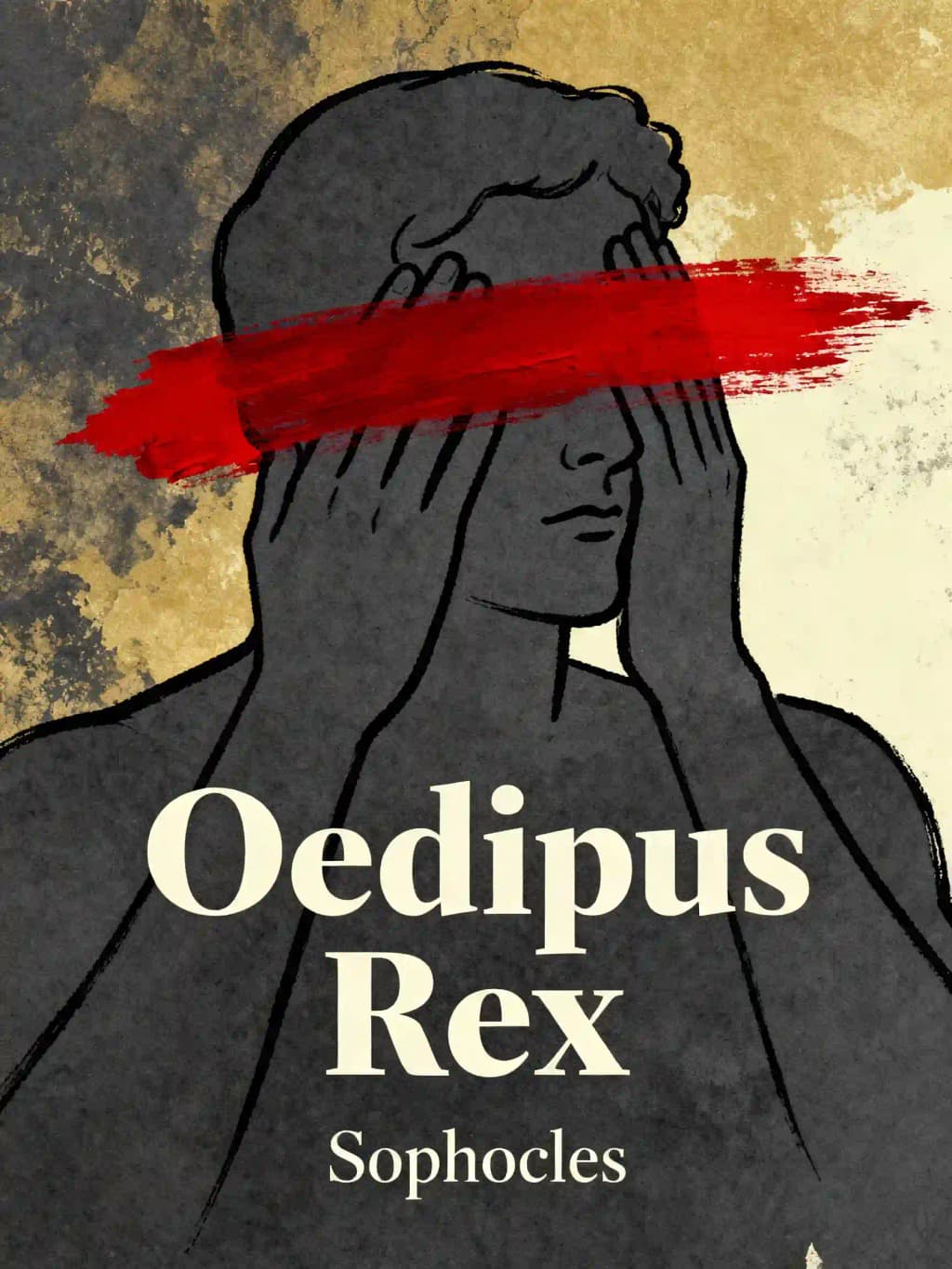
Imagine a story so powerful that it has shaped how we understand ourselves for over two millennia. A tale that inspired Freud to name one of psychology's most controversial theories, has been performed thousands of times across continents, and continues to resonate with audiences despite being written in 429 BCE. "Oedipus Rex" stands as perhaps the most influential tragedy ever written, a work so fundamental to Western literature that philosopher Friedrich Nietzsche claimed all subsequent dramatic writing was merely a footnote to Sophocles. When Aristotle needed to define the perfect tragedy in his "Poetics," he pointed to this masterpiece. Even today, its exploration of fate, free will, and human hubris feels startlingly modern. Martin Scorsese cites it as a key influence on his filmmaking, and when Barack Obama was asked about works that shaped his worldview, this ancient Greek tragedy made his short list. What makes this story of a man who unknowingly kills his father and marries his mother so enduring? And why does its tragic hero-brilliant yet blind to his own identity-continue to haunt our collective imagination?
Chapitre 2
The Historical Canvas: Ancient Greece and the Birth of Tragedy
To truly understand "Oedipus Rex," we must first journey back to the world that produced it. The play emerged from the remarkable flowering of Greek civilization during the 5th century BCE, particularly in Athens. This was the Golden Age-a time of unprecedented intellectual and artistic achievement when democracy was still a radical experiment and the Persian Wars had united the Greek city-states in triumph against overwhelming odds.
Sophocles, born around 495 BCE in the village of Colonus near Athens, came of age during this extraordinary period. As a sixteen-year-old, he reportedly led the victory celebration after the naval battle of Salamis, where the Greeks decisively defeated the Persian fleet. This early brush with history foreshadowed his later prominence as both artist and civic leader. Throughout his long life (he lived to nearly ninety), Sophocles would serve as a general, treasurer, and diplomat while writing approximately 123 plays, of which only seven survive complete.
Greek tragedy itself had evolved from religious festivals honoring Dionysus, god of wine and ecstasy. What began as choral performances gradually incorporated actors who portrayed mythological characters, creating a new art form that blended poetry, music, dance, and drama. By Sophocles' time, these performances had become major civic events held in the Theater of Dionysus, an open-air venue that could accommodate some 15,000 spectators-nearly half of Athens' citizen population.
The City Dionysia festival, where tragedies premiered, was both religious ceremony and artistic competition. Three playwrights would each present a trilogy of tragedies followed by a lighter satyr play. Wealthy citizens funded these productions as a civic duty, while ten judges selected by lot determined the winners. Performance conventions included masks for the three actors (who played multiple roles), an all-male chorus of twelve to fifteen members who sang and danced between episodes, and elaborate costumes that helped distinguish characters.
When "Oedipus Rex" was first performed around 429 BCE, Athens was in crisis. The Peloponnesian War with Sparta had begun two years earlier, and Pericles' strategy of abandoning the countryside to shelter behind Athens' walls had backfired when plague struck the overcrowded city. The disease killed perhaps a third of the population, including Pericles himself. Against this backdrop of suffering and uncertainty, Sophocles presented a play that begins with a plague-stricken city seeking salvation from its ruler-a resonance his audience would have felt immediately.
Curiously, despite its later reputation as the perfect tragedy, "Oedipus Rex" actually placed second in its festival competition, losing to a playwright named Philocles whose works are now entirely lost. Perhaps its unflinching portrayal of leadership's failures struck too close to home for Athenians mourning Pericles and questioning their city's future.
Chapitre 3
The Sphinx's Riddle: Oedipus as Detective and Criminal
At its core, "Oedipus Rex" operates as history's first detective story-with the devastating twist that the investigator ultimately discovers he himself is the criminal he seeks. The play opens not at the beginning of Oedipus's story but near its end. He has already killed his father Laius at a crossroads and married his mother Jocasta after saving Thebes by solving the Sphinx's riddle. For years he has ruled as a respected king, fathering four children with Jocasta, all without knowing his true identity or the horror of his actions.
The brilliance of Sophocles' structure lies in how he transforms ancient myth, which his audience already knew, into edge-of-seat drama through masterful revelation. When the play begins, Thebes suffers under a devastating plague. Citizens gather at Oedipus's palace as suppliants, seeking help from the man who once saved them from the Sphinx. Oedipus, the consummate problem-solver, has already dispatched his brother-in-law Creon to consult Apollo's oracle at Delphi.
The oracle's response sets the investigation in motion: the plague will end only when Laius's murderer is found and punished. Oedipus, displaying the same intellectual confidence that helped him defeat the Sphinx, vows to solve this mystery. "I'll bring it all to light myself," he declares, unaware that the light will blind him to madness.
What follows is a masterclass in dramatic irony, as Oedipus pursues clues that increasingly point toward himself while the audience watches in growing horror. He summons the blind prophet Tiresias, who initially refuses to speak but when goaded, explodes with the accusation that Oedipus himself is the murderer and the source of Thebes' pollution. Rather than considering this possibility, Oedipus immediately suspects a conspiracy between Tiresias and Creon to seize his throne.
This reaction reveals Oedipus's fatal flaw-not simple pride, but a particular kind of intellectual hubris. Having built his identity on his ability to solve riddles and see truths others miss, he cannot recognize when he himself is the riddle that needs solving. His name in Greek suggests this blindness: "Oidi-pous" connects to "oida" (I know) and "pous" (foot)-the man who knows about feet (referring to his swollen feet as an infant) but doesn't know where his feet have taken him.
The investigation accelerates when Jocasta, attempting to comfort Oedipus by discrediting prophecies, reveals that her first husband Laius was killed "where three roads meet." This detail triggers Oedipus's memory of killing an older man at such a crossroads years earlier. As more evidence accumulates-the timing, the location, the description of Laius-Oedipus begins to suspect his guilt but continues pressing forward, displaying both courage and catastrophic determination.
The final pieces fall into place with the arrival of a messenger from Corinth and an old shepherd who once served Laius. Their testimonies confirm that Oedipus was not the biological son of Polybus and Merope as he believed, but a foundling given to them-the very child born to Laius and Jocasta, pierced through the ankles and left to die on Mount Cithaeron to avoid the prophecy that he would kill his father. The shepherd, taking pity on the infant, had given him to the Corinthian instead of letting him die.
This revelation completes the circle. Oedipus, fleeing Corinth to avoid killing the man he thought was his father and marrying the woman he thought was his mother, had run straight into fulfilling the prophecy with his actual parents. The man who prided himself on his vision and insight had been blind to his own identity all along.
Chapitre 4
The Paradox of Free Will and Fate
Perhaps no aspect of "Oedipus Rex" has generated more philosophical debate than its treatment of fate versus free will. On one level, the play seems to present a deterministic universe where prophecies inevitably come true despite human efforts to evade them. Both Laius and Jocasta, attempting to thwart the oracle by exposing their infant son, and later Oedipus, fleeing Corinth to avoid harming his supposed parents, find their very actions leading to the prophesied outcomes.
Yet Sophocles complicates this reading by emphasizing how Oedipus's specific character traits-his intelligence, determination, quick temper, and unwavering pursuit of truth-drive the fulfillment of his destiny. As the philosopher Heraclitus famously observed, "Character is fate." Oedipus is not a passive victim of external forces but an active agent whose choices, shaped by his inherent nature, create his reality.
Consider the pivotal moment at the crossroads where Oedipus kills Laius. The text deliberately leaves ambiguous whether this was justified self-defense or an example of Oedipus's hair-trigger temper. When describing the incident, Oedipus admits striking the older man "in rage" after being pushed from the road. Was this a proportionate response to the provocation? Could he have subdued rather than killed his attackers? These questions remain unanswered, suggesting that while the meeting at the crossroads might have been fated, the violence that ensued reflected Oedipus's character.
Similarly, his solving of the Sphinx's riddle demonstrates both his exceptional intelligence and his fundamental blindness. The answer-"man, who crawls on four legs as a baby, walks on two as an adult, and uses a staff in old age"-perfectly describes the human condition. Yet Oedipus, brilliantly identifying humanity's universal journey, fails to understand his own particular journey. He knows man in the abstract but not himself in the concrete.
This tension between knowing and not-knowing runs throughout the play. Oedipus is simultaneously the wisest and most ignorant person in Thebes-capable of saving the city through his intellect yet unaware of his own origins. When he finally discovers the truth, his self-blinding becomes a physical manifestation of this paradox: "You, you'll see no more the pain I suffered, all the pain I caused! Too long you looked on the ones you never should have seen, blind to the ones you longed to see, to know! Blind from this hour on!"
The chorus reinforces this theme with their famous observation: "Count no man happy until he dies, free of pain at last." This isn't merely saying "wait and see how things turn out" but suggesting a deeper truth: complete self-knowledge remains impossible while we live and act in the world. Only in retrospect, when a life is complete, can its full pattern be discerned.
Chapitre 5
The Political Dimension: Tyranny and Democracy
While modern readers often focus on the psychological and philosophical aspects of "Oedipus Rex," its original Athenian audience would have been equally attuned to its political dimensions. The play was performed during Athens' radical democratic experiment, when citizens prided themselves on having overthrown tyranny. Yet Athens itself had become increasingly tyrannical toward its allies in the Delian League, extracting tribute and imposing its will-a contradiction that contributed to the Peloponnesian War.
Sophocles explores this tension through Oedipus's character as ruler. The play's Greek title, "Oedipus Tyrannos," uses a term that had not yet acquired its exclusively negative modern connotations. A "tyrannos" was simply one who ruled without hereditary legitimacy, having gained power through ability rather than birthright. Oedipus fits this description perfectly: he became king of Thebes by solving the Sphinx's riddle, not through royal succession (though ironically, we learn he was the legitimate heir all along).
Initially, Oedipus appears as the model benevolent ruler-concerned for his suffering citizens, proactive in addressing the plague, and committed to justice. "I grieve for you, my children," he tells the suppliants, demonstrating the empathy expected of good leadership. Yet as the investigation proceeds, we see darker aspects emerge: his quick temper, his suspicion of Creon, his dismissal of Tiresias, and his unwavering confidence in his own judgment.
The chorus's ode following the confrontation with Tiresias directly addresses this political dimension: "Hubris breeds the tyrant, hubris if it is glutted with a surfeit, unseasonable, unprofitable, climbs to the roof-top and plunges sheer down to the ruin that must be, and there its feet are no use to it." This could be read as commentary on Oedipus specifically or as a broader political observation about the inevitable fall of overreaching rulers-something that would resonate with Athenians watching their empire's growing troubles.
Creon serves as a deliberate contrast to Oedipus in this political dimension. When accused of plotting against the king, he offers a rational defense: why would he want the burdens of rule when he already enjoys its privileges without its responsibilities? "I have no natural craving for the name of king, preferring to do what kings do," he explains, articulating a pragmatic approach to power that prioritizes substance over title. This speech, often overlooked in psychological readings, would have carried significant political weight for Athenian citizens debating the proper use of power.
By the play's end, we see a complete reversal of political fortune. Oedipus, once the celebrated ruler who saved Thebes through his brilliance, becomes a pollution to be removed. Creon, initially suspected of treachery, assumes leadership with a measured, cautious approach. This transition raises questions about the nature of legitimate authority and the relationship between personal character and political leadership that remained urgently relevant in democratic Athens-and continue to resonate today.
Chapitre 6
The Sacred and the Profane: Religion and Rationality
"Oedipus Rex" emerged during a period of intellectual ferment in Athens, when traditional religious beliefs were being challenged by new philosophical approaches. The sophists, traveling teachers of rhetoric and philosophy, questioned established truths and promoted a more humanistic, rational worldview captured in Protagoras's famous dictum: "Man is the measure of all things."
Sophocles engages directly with this tension between religious tradition and emerging rationality. Oedipus embodies the new intellectual approach-solving the Sphinx's riddle through human intelligence rather than divine inspiration, investigating Laius's murder through evidence and testimony rather than simply accepting the prophet's word. Yet the play ultimately affirms the inescapable power of divine prophecy, as every attempt to outsmart the gods leads precisely to the prophesied outcome.
This doesn't mean Sophocles simply rejects rationality in favor of blind faith. Rather, he suggests a more complex relationship where human reason operates within a larger framework of divine order that exceeds complete human comprehension. The chorus articulates this perspective in their ode following Jocasta's dismissal of oracles: "May destiny ever find me pious in word and deed prescribed by the laws that live on high: laws begotten in the clear air of heaven, whose only father is Olympus; no mortal nature gave them birth, no forgetfulness shall lull them to sleep; the god is mighty in them, and he grows not old."
Tiresias, the blind prophet who "sees" what the physically sighted Oedipus cannot, represents this tension between human and divine knowledge. When Oedipus mockingly asks if his prophetic power failed him with the Sphinx, Tiresias replies that Oedipus's apparent triumph actually began his downfall. This suggests that purely human intelligence, divorced from divine wisdom, leads to catastrophic misunderstanding-solving the immediate puzzle while missing the larger pattern.
Jocasta's character arc dramatically illustrates the danger of dismissing divine prophecy. Early in the play, she attempts to comfort Oedipus by discrediting oracles: "No human being possesses the art of prophecy," she insists, citing how the prophecy about her son killing his father apparently failed. This rationalistic dismissal makes her subsequent recognition of the truth all the more devastating. When she finally understands that the prophecy was fulfilled precisely through their attempts to evade it, she rushes to her death, unable to bear the revelation.
The play's structure reinforces this religious dimension through its setting at the palace entrance, where suppliants have placed offerings at altars to the gods. This liminal space between domestic and public realms mirrors the play's exploration of boundaries between human and divine knowledge. The chorus, representing Theban elders, consistently advocates for religious reverence even as the main characters pursue their investigations through rational means. Their final judgment-that no one should be called fortunate until they have completed life without suffering-suggests that true understanding requires a perspective beyond individual human experience.
Chapitre 7
The Body in Pain: Suffering as Revelation
Physical suffering permeates "Oedipus Rex" from its opening moments, when plague-stricken citizens gather at the palace, to its horrific conclusion with Jocasta's suicide and Oedipus's self-blinding. This corporeal dimension isn't incidental but central to the play's exploration of how truth becomes embodied through pain.
The plague itself functions as a physical manifestation of moral pollution-the miasma created by harboring Laius's unavenged killer. The chorus describes its devastating effects in vivid terms: "The city reeks with the death in her streets, death-bringing... The fever grips our city and brain... Black Death luxuriates in groans and wails." This collective suffering creates urgency for Oedipus's investigation; the body politic cannot heal until truth emerges.
Oedipus's own body carries hidden knowledge throughout the play. His name refers to his swollen feet, the result of being pinned through the ankles as an infant-a physical mark of his parents' attempt to thwart prophecy. When the Corinthian messenger mentions this detail, it triggers recognition in Jocasta before Oedipus himself understands its significance. His body knows his identity before his mind does.
The play's most shocking moments involve deliberate bodily harm as response to unbearable truth. When Jocasta recognizes that she has married her son, she hangs herself-a method of suicide that simultaneously evokes sexual shame through its phallic imagery and maternal failure through its echo of birth (passing through the noose as through the birth canal). The servant's description emphasizes this physical horror: "she hung there, swaying, her neck caught in the twisted rope."
Oedipus's self-blinding represents the play's most powerful fusion of physical suffering and symbolic meaning. Using Jocasta's golden brooches, he repeatedly stabs his eyes, creating a bloody spectacle described in graphic detail: "blood spurted from his eyeballs, drenching his beard, not trickling drop by drop but showering down like black rain, a hailstorm of blood." This act transforms metaphorical blindness into physical reality-the man who could not "see" his identity despite his sharp intelligence now deliberately destroys the organs of sight that failed him.
When Oedipus reappears on stage blind and bleeding, the chorus recoils in horror while simultaneously acknowledging they cannot look away. This paradoxical response-being both repelled and compelled to witness suffering-captures the essence of tragic catharsis as Aristotle would later define it. Through witnessing Oedipus's physical agony, the audience experiences a purification of fear and pity.
Oedipus himself articulates how his physical blindness represents a new kind of vision: "What good were eyes to me? Nothing I could see could bring me joy." This inverts the conventional understanding of blindness as deprivation, suggesting instead that certain truths become accessible only through suffering. His mutilated body becomes the site where personal identity, divine prophecy, and human choice converge in painful revelation.
Chapitre 8
Family Entanglements: The Oedipal Web
Long before Freud appropriated the story for his psychological theory, "Oedipus Rex" explored the complexities of family relationships with remarkable sophistication. The play presents family not merely as a background element but as the very web in which identity is formed and fate enacted.
The central horror of Oedipus's situation lies in how thoroughly it collapses family boundaries. As he himself laments after discovering the truth: "Am I not born most evil? Am I not utterly unclean? If I must flee the country, in my exile I cannot see my parents or set foot in my own country... I am the murderer of the very man whose wife... whose mother... unholy polluter of the bed of him who gave me my own wretched blood."
This collapse creates impossible contradictions in relationships. Oedipus is simultaneously father and brother to his children, son and husband to Jocasta. These paradoxes of identity emerge from what initially appeared to be a successful family structure-the respected king and queen of Thebes with their four children. The revelation doesn't create new relationships but exposes the true nature of existing ones, suggesting that our understanding of our most intimate connections may be fundamentally flawed.
Jocasta's character offers a particularly complex exploration of motherhood. Having attempted to destroy her infant to avoid prophecy, she later unknowingly marries that same child grown to manhood. When she begins suspecting the truth, her immediate instinct is to stop the investigation: "For god's love, let us have no more questioning! Is your life nothing to you? My own is pain enough for me to bear." This can be read as either self-protection or maternal instinct-trying one last time to shield her son/husband from unbearable knowledge.
The play also explores how family patterns repeat across generations. Oedipus's daughters, briefly appearing at the play's conclusion, face a future shaped by their father's actions. His lament for them acknowledges how their identity will be forever marked by his crimes: "What gatherings of citizens will you attend, what festivals, from which you will not return home in tears instead of joy? And when you reach maturity for marriage, who will he be, the man who will risk taking such reproaches?"
This generational dimension would have resonated powerfully with the original audience, familiar with the full Theban cycle where Oedipus's children indeed inherit his tragic fate. His sons Eteocles and Polynices eventually kill each other in civil war, while his daughter Antigone dies for insisting on proper burial rites against her uncle Creon's decree. The family's destruction extends beyond Oedipus himself to consume an entire lineage.
Perhaps most disturbing is how the play suggests that family relationships-supposedly our most natural and fundamental connections-are actually constructed through social recognition rather than biological fact. Oedipus lived for years as Polybus and Merope's son without questioning this identity until a drunken man's taunt at a banquet. He then lived as Jocasta's husband without recognizing her as his mother. These relationships functioned socially despite their biological impossibility, raising unsettling questions about the foundations of family identity that continue to resonate in our era of blended families, reproductive technology, and genetic testing.
Chapitre 9
The Aftermath: Living with Unbearable Knowledge
The final scenes of "Oedipus Rex" move beyond the moment of horrific recognition to explore an equally profound question: how does one continue living after discovering unbearable truth? Unlike many tragic protagonists who die upon recognition of their situation, Oedipus must face existence as a man who knows exactly who and what he is.
His self-blinding represents not merely punishment but an attempt to create physical boundaries between himself and the world that has become intolerable to witness. "How could I look my father in the eyes when I go down to death?" he asks. "Or mother... against whom I have committed such abominations?" Yet blindness also connects him to a new kind of vision-the inward sight exemplified by Tiresias, who saw truth without physical eyes.
Oedipus's request to be exiled "where no man will see me" reflects both his shame and his recognition that he has become pollution incarnate-a walking miasma whose very presence threatens the community. Yet there's also dignity in his insistence on bearing the consequences of actions he committed, however unwittingly. When Creon suggests consulting the oracle before determining his fate, Oedipus reminds him that Apollo has already made his will clear: "Drive out the pollution from the land."
The play's final image-of the blind Oedipus being led into the palace to await exile-captures this ambiguous aftermath. He has lost everything that defined his identity: his kingship, his understanding of his parentage, his role as husband and father, even his sight. Yet he continues to exist, a living embodiment of the gap between human intention and outcome, between what we believe ourselves to be and what we may discover ourselves to have been.
This refusal of clean resolution distinguishes "Oedipus Rex" from simpler moral tales. There is no redemption here, no suggestion that suffering leads to spiritual growth or enlightenment. Instead, Sophocles presents the stark reality of a man who must somehow incorporate unbearable knowledge into continued existence-a challenge that resonates beyond the specific circumstances of the myth to touch universal human experience.
The chorus's final words emphasize this ongoing nature of Oedipus's suffering rather than offering closure: "Look upon that last day always. Count no man happy till he dies, free of pain at last." This isn't merely saying "wait and see how things turn out" but suggesting that complete understanding of a life remains impossible while living it. Only retrospectively, when the pattern is complete, can meaning be discerned-a sobering thought that transforms Oedipus from merely a figure of pity to a symbol of the human condition itself.
Chapitre 10
The Enduring Power: Why Oedipus Still Matters
Over 2,400 years after its creation, "Oedipus Rex" continues to exert remarkable influence across disciplines and cultures. Its endurance stems not from historical importance alone but from how it addresses fundamental questions of human existence with unparalleled psychological insight and dramatic power.
The play's exploration of self-knowledge remains urgently relevant. Oedipus's journey from confident certainty to devastating recognition mirrors our own struggles to understand ourselves truthfully. His famous line upon discovering his identity-"O god, all come true, all burst to light!"-captures the shock of confronting aspects of ourselves we've kept hidden, whether from others or from our own conscious awareness.
This psychological dimension explains why Freud found the play so compelling as a framework for understanding unconscious desires. While his specific theory of the Oedipus complex remains controversial, his recognition that the play speaks to universal human struggles with forbidden impulses and self-knowledge continues to resonate. As Freud noted, the play's power comes not just from its plot but from how it awakens something "in all of us"-a recognition of our own capacity for self-deception.
Beyond psychology, "Oedipus Rex" continues to inform political thought through its examination of leadership, power, and responsibility. Oedipus's transformation from celebrated problem-solver to source of pollution raises eternal questions about the relationship between a leader's personal character and public role. His determined pursuit of truth regardless of personal consequences presents both an admirable model of leadership and a cautionary tale about the limits of human control.
The play's religious dimensions speak to contemporary spiritual seekers navigating between rationalism and faith. Oedipus's story suggests that purely intellectual approaches to life's mysteries may solve immediate puzzles while missing deeper patterns that require different kinds of knowing. This tension between different ways of seeing truth-through reason, prophecy, or suffering-remains at the heart of modern spiritual quests.
Perhaps most fundamentally, "Oedipus Rex" endures because it confronts the central paradox of human existence: our simultaneous freedom and constraint. We make choices that feel entirely our own, yet find ourselves shaped by forces beyond our control-biology, history, social context, unconscious drives. Oedipus acts freely throughout the play, making decisions that reflect his character and values, yet these very choices fulfill a destiny he desperately tried to avoid.
This paradox has lost none of its power to disturb and fascinate. In our age of apparent self-determination, when we're told we can reinvent ourselves at will, Oedipus reminds us of the limits to self-creation. His story suggests that complete self-knowledge may be both necessary for authentic living and potentially devastating to the narratives that sustain our identities.
The final chorus's famous warning against calling anyone happy until "he's dead, free of pain at last" continues to challenge our assumptions about what constitutes a good life. It suggests that meaning emerges not from momentary success but from the complete pattern of a life-including how we face inevitable suffering and limitation. In a culture obsessed with happiness as the ultimate goal, Oedipus offers a more complex vision where confrontation with painful truth, however devastating, remains preferable to comfortable illusion.
This is why, millennia after its creation, directors continue staging new productions, philosophers cite it in arguments about free will, psychologists reference it in discussions of identity formation, and ordinary readers find themselves moved by Oedipus's journey. The play speaks to something essential about being human that transcends its specific historical context-the universal experience of discovering that we are not quite who we thought we were, and must somehow live with that knowledge.