Chapitre 1
The Illusion That Creates Our Reality
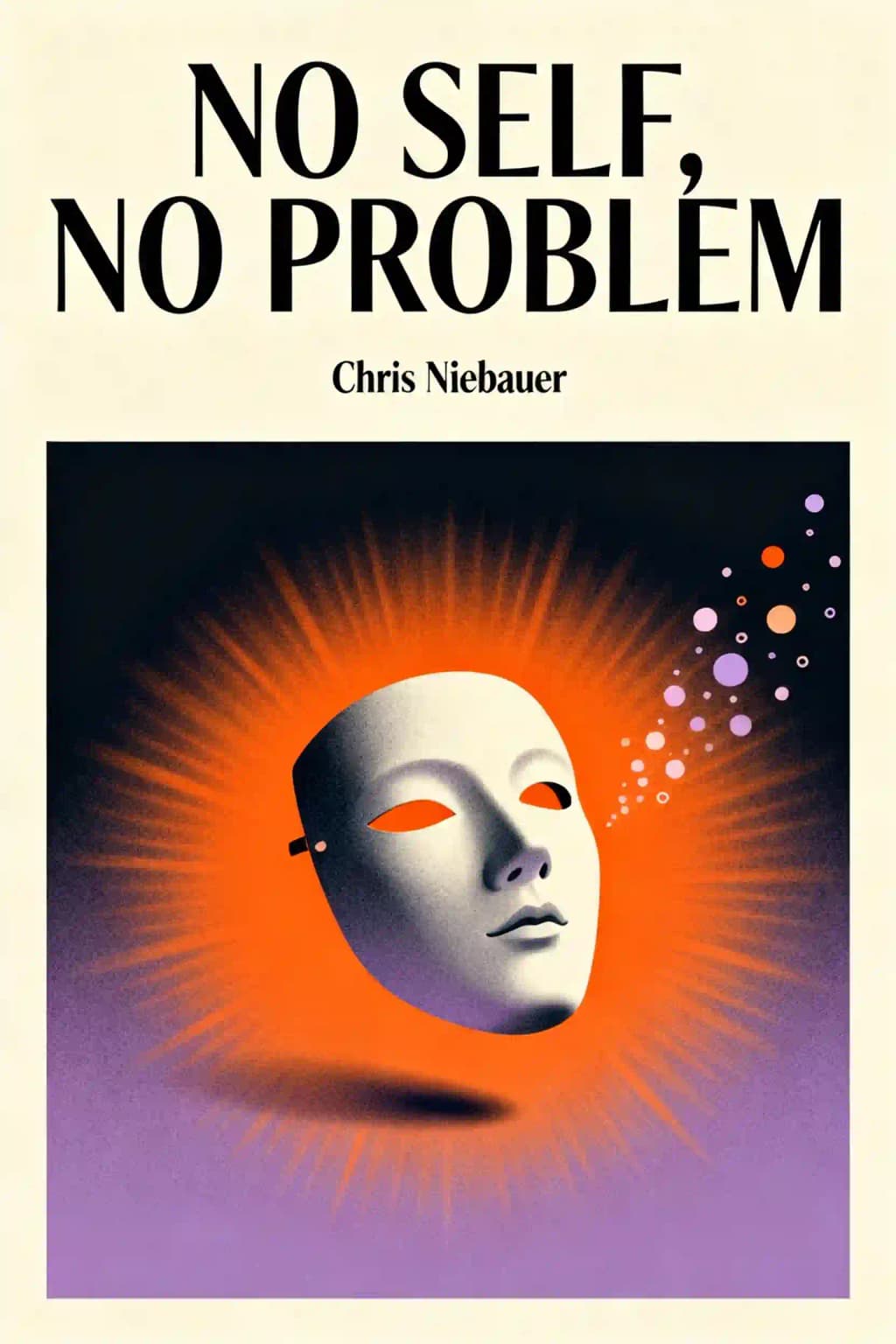
Have you ever felt like you're living in a story of your own making? What if your sense of self-that inner voice narrating your life-is actually an elaborate fiction created by your brain? This groundbreaking idea forms the core of "No Self, No Problem," where neuropsychologist Chris Niebauer bridges ancient Eastern wisdom with cutting-edge neuroscience to reveal a startling truth: the self we identify with is an illusion generated by our left brain. This revelation isn't merely academic-it offers a path to freedom from mental suffering. The book has gained attention in mindfulness circles and among neuroscience enthusiasts, with figures like Sam Harris and Robert Wright referencing similar concepts in their work. As mental health struggles reach epidemic proportions, Niebauer's integration of Buddhist concepts with brain science provides a refreshingly practical approach to understanding why we suffer and how we might stop. His unique background as both a meditation practitioner and cognitive neuropsychologist allows him to translate complex brain science into accessible insights that can transform how we experience consciousness itself.
Chapitre 2
The Accidental Discovery of the Interpreting Mind
In the 1960s, neuroscientist Michael Gazzaniga made a revolutionary discovery while working with split-brain patients whose corpus callosum-the bridge connecting the brain's hemispheres-had been surgically severed. What he found would challenge our most fundamental assumptions about human consciousness.
When Gazzaniga showed different images to each hemisphere of these patients' brains, something remarkable happened. The right brain would see an image and respond appropriately, but when asked to explain this response verbally (a left-brain function), patients would confidently invent completely false explanations. In one famous experiment, when the word "walk" was shown only to a patient's right brain, they stood up and began walking. When asked why, their left brain-which hadn't seen the instruction-confidently explained: "I'm going to get a Coke." The left brain had no access to the real reason but fabricated a plausible story on the spot.
This pattern repeated consistently. When instructed to laugh through information presented only to their right brain, patients would later explain they were laughing at the experimenters or something in the room-never acknowledging the actual command they couldn't consciously access. The left brain, Gazzaniga realized, functions as an "interpreter" that constantly creates explanations for our behaviors, even when those explanations are completely wrong.
This phenomenon extends beyond split-brain patients. Dr. Ramachandran found similar results with patients suffering right-brain damage. When asked about their paralyzed left limbs, they'd deny the paralysis entirely or rationalize it with elaborate excuses. Even more striking, studies with normal subjects show we regularly invent reasons for our preferences while remaining completely unaware of actual influences like right-side bias in consumer choices.
Our emotional responses follow similar patterns. In "misattributed arousal" studies, male subjects who experienced an "accidental" backward tilt in a dental chair accompanied by a loud noise found female research assistants more attractive but disliked male assistants more than control groups. Our nervous system gets stimulated, and the left-brain interpreter creates explanations for this arousal that may be entirely unrelated to its true cause.
The implications are profound. We live under the direction of an interpreter that creates explanations for our experiences without questioning their authenticity. Most significantly, this interpreter creates the illusion of an "I" that appears to be making these assumptions and decisions. What we consider our conscious self might actually be just another story created by this interpreting mechanism-a fiction we've mistaken for reality.
Chapitre 3
Language and Categories: How We Construct Reality
The left-brain interpreter uses two primary tools to create our sense of reality: language and categorization. These same mechanisms, when turned inward, construct our sense of self.
Language functions as a form of mapmaking, creating symbols that represent reality. The problem arises when we mistake these maps for reality itself-what philosopher Alfred Korzybski called "confusing the map with the territory." The left brain becomes so dependent on these linguistic maps that it lives in a world of language-based stories rather than direct experience.
The power of language becomes evident in the Stroop effect-the difficulty we experience trying to name the color of ink when it spells a different color word (like "RED" printed in blue ink). This demonstrates how powerfully the left brain takes language literally, explaining why verbal abuse can be as harmful as physical abuse-we take words as seriously as the physical world they represent.
Alongside language, the left brain constantly creates categories-mental representations that don't exist in the world but only in the mind. Categories group continuous things by common features while ignoring differences. While useful as tools, problems arise when we believe these groupings are inherently real rather than mental constructs.
Consider a "university" or a country like "Canada." These exist only as thoughts-when no one is thinking about them, the buildings and land remain, but the categories themselves don't exist independently of minds. Similarly, our sense of self is a categorical fiction expressed through language.
The left brain's obsession with categories creates paradoxes like "which came first, chicken or egg?" that reveal the limits of categorical thinking. These categories require judgment-drawing lines along continuums to separate one thing into two. The interpreter functions essentially as a judge, constantly determining where cold becomes hot, good becomes evil, or poor becomes rich.
Recognizing this judging nature of the interpreter brings freedom-you can see interpretations as subjective rather than absolute truth. This awareness creates distance from judgments, allowing you to see them as "just my opinion" rather than "the way it is."
The left-brain interpreter also creates belief systems that can cause immense suffering when we over-identify with them. People fight and die for beliefs they mistake for reality itself-another example of confusing the map with the territory. When we see beliefs for what they are-merely outcomes of brain processes-we become less attached to the idea that our beliefs are "right," opening us to new perspectives.
The interpreter may also use these same tools to create the belief in an individual self, which we then mistake for reality. This leads to further categorization of this imaginary self into conflicting parts-"how I am" versus "how I want to be"-creating an inner conflict that cannot be resolved. We are the only species capable of believing in ourselves, lying to ourselves, and both loving and hating ourselves-fundamental aspects of the human experience from ancient Greek poetry to today's headlines.
Chapitre 4
The Pattern-Seeking Brain and the Self Illusion
The left brain functions as an advanced pattern-perception machine. Reading itself demonstrates this ability-seeing marks on paper as meaningful language. Grammar and spelling difficulties in patients with left-brain damage further confirm the left hemisphere's role in pattern recognition.
This pattern-seeking tendency creates false stories that cause unnecessary suffering. In one study, humans performed worse than rats in predicting random light appearances because humans kept searching for nonexistent patterns. While rats simply responded to the actual frequency of lights, humans developed elaborate theories about sequences and timing that didn't exist.
The brain's hemispheres differ in neurochemistry-the left brain is dominant for dopamine while the right brain has more serotonin and norepinephrine. Research shows increased dopamine levels enhance pattern recognition, even when patterns don't exist. In one fascinating study, "skeptics" who rarely saw patterns in random images began seeing nonexistent patterns when their dopamine levels were artificially increased.
When threatened, our pattern perception increases-skydivers were more likely to see patterns in random noise before jumping than control subjects. This suggests the self defends against potential dissolution by strengthening its pattern-making abilities when under threat.
The left brain's pattern-perception machinery, when turned inward, inevitably creates the illusion of a self. Like the illusory triangle we perceive in certain images that doesn't actually exist, our sense of self is merely inferred from surrounding information. This aligns with Buddhist teachings that the self is an illusion-not non-existent, but more like a mirage.
The left brain creates this self-illusion by noticing categorical differences between "me" and "not me," combining observations with memory and preferences. We define ourselves relationally-as father, professor, extrovert-categories that depend on others for contrast.
Our suffering comes from creating idealized self-images and feeling inadequate when we can't match them, never realizing the self itself is just another thought pattern. Rather than being a solid, unchanging entity, our self is more like a river in constant flow. We can observe this by noticing how many different "selves" appear throughout a day-a work self, home self, and countless variations depending on who we're with or what we're doing.
Like a flip-book creating the illusion of continuous animation from separate images, our mind weaves these distinct selves into one continuous story. Between these selves are moments of complete engagement where the self isn't noticeable at all, raising the question: where is the self when no one is thinking about it?
Chapitre 5
Discovering Right-Brain Consciousness
When neuroanatomist Dr. Jill Bolte Taylor experienced a stroke that disabled much of her left brain, she discovered a profound state of consciousness: her inner voice silenced, boundaries between self and world dissolved, and she experienced an expanding sense of grace and tranquility. This experience reveals how right-brain consciousness offers an alternative to the left brain's constant categorization and interpretation of reality.
While the left brain categorizes and separates, the right brain processes holistically. It takes a global approach rather than dividing things into categories, attending to the whole scene and perceiving the world as a continuum. The right brain's attention is broad and vigilant, processing the global form rather than isolated elements, and remains focused on the present moment rather than sequentially dividing time.
This explains why optical illusions like circles appearing different sizes fool our left brain, while our right brain accurately guides physical interactions with objects. Importantly, the right brain's processing is often dismissed as "unconscious" simply because it operates outside the language sphere, though it represents a valid form of consciousness that Western science has devalued.
Right-brain consciousness can be accessed through practices like yoga (which means "union" of self with universe), meditation (particularly Zazen's focus on breath awareness), and movement practices like tai chi and qigong. These activities create an alert form of consciousness difficult to verbalize.
Athletes and artists experience this state as being "in the zone"-what psychologist Mihaly Csikszentmihalyi calls "flow," where ego falls away, time flies, and actions flow naturally without conscious deliberation. Mindfulness practice similarly helps access right-brain consciousness by observing reality directly rather than thinking about reality, lessening identification with the left-brain interpreter.
The essence of right-brain consciousness is doing things without thinking about them. Eastern philosophers valued this nonlinguistic consciousness because living in abstractions-language, concepts, beliefs-is living in a dream world rather than reality. Our suffering comes from getting swept up in stories and forgetting they aren't reality.
To experience right-brain consciousness, try performing activities for no reason at all-not for money or self-improvement-to bypass the left brain's need for purpose. Even focusing completely on a single breath, feeling the sensations in your body as you inhale, hold, and exhale, can wrest control from the chattering left brain. Even one conscious breath can bring you back to reality from left-brain fantasy.
The right brain also acts as a counterbalance to the left brain's storytelling, stepping in when stories become too outlandish. These "aha moments" of clarity often come when the right brain signals the left brain that its story has drifted too far from reality.
Chapitre 6
The Meaning-Making Mind
Meaning and understanding are vital processes that occur in the right brain, not the left as many assume. While the left brain focuses on individual parts, the right brain perceives the whole where meaning resides.
This becomes clear when reading seemingly random text that only makes sense once given context (like a paragraph about flying a kite). Meaning allows us to hold information in memory-we can more easily remember coherent sentences than random word strings because we process meaningful chunks rather than individual words.
Viktor Frankl's "Man's Search for Meaning" demonstrates how finding meaning may be life's purpose itself. Frankl observed in Nazi concentration camps that inmates with a sense of purpose were more likely to survive, concluding that meaning matters more than happiness. Recent research supports this, showing that actively pursuing happiness often makes people less happy, while meaningful activities (like parenting) can bring fulfillment despite discomfort.
There are two types of understanding: "interpretive understanding" (left brain) focuses on how separate things cause each other, while right-brain understanding perceives whole systems. The Newtonian view of the universe as a mechanical clock exemplifies interpretive understanding-knowing each gear's function without grasping the clock's overall purpose.
While this linear understanding has given us technological breakthroughs, it remains fundamentally dependent on the right brain's larger vision. The left brain breaks the world into parts and categories, seeing one billiard ball hitting another, but never grasping that none of it would be possible without the right brain's holistic perspective.
Metaphor bridges the gap between left and right brain understanding by mapping abstractions onto perceptions. The left brain relies on the right to make connections beyond literal meaning. Eastern traditions, particularly Buddhism with over a thousand metaphors in the Pali Canon, use this technique to bypass the interpretive mind's defenses. Even the term "Buddha" is metaphorical, meaning "one who is awake."
The right brain perceives the whole picture-both objects and the spaces between them-understanding that figures are determined by their backgrounds. This fundamental relationship is often missed by the left brain. The difference between one and two isn't a "thing" but the space between. The yin-yang symbol perfectly expresses this interdependence: white needs black to be visible and vice versa.
Buddhism's romance with emptiness stems from this understanding that without space, no separate things could exist. The Heart Sutra captures this: "Form is emptiness, emptiness is form." While the left brain processes one wave at a time, the right brain sees the entire ocean, sensing reality in parallel rather than series.
Chapitre 7
The Intelligence Beyond Words
Zen Buddhism's concept of prajnaparamita or "perfection of wisdom" refers to insight beyond language and reasoning-a "wisdom beyond wisdom" connected to understanding emptiness. This may be accessible only to the right brain, which possesses intelligence beyond the left-brain interpreter's comprehension.
William James identified this as "fringe consciousness"-a vague "feeling of knowing" without direct sensory content, like instantly sensing a room's atmosphere. Brain imaging shows the right hemisphere activates during tip-of-the-tongue moments when we know something but can't verbalize it, highlighting the right brain's role in nonverbal knowing, particularly intuition.
Intuition, defined as "immediate apprehension or cognition without reasoning," presents a fundamental challenge to the left-brain interpreter. Studies show intuition is a valid form of intelligence where the right brain perceives patterns before conscious awareness.
In card experiments, participants' palms would sweat when reaching for disadvantageous decks after just ten draws, while conscious understanding took fifty to eighty draws. Another study showed emotional images flashed subliminally improved participants' ability to detect dot movement, suggesting the right brain processes information unavailable to the left brain and sends it as gut feelings. This explains why intuition often works but can't be verbally justified.
The right brain primarily handles emotions, which explains why Western society often values "logic over emotion"-another way the left-brain interpreter demands mastery. While traditional IQ tests measure verbal ability and reasoning, emotional intelligence (EQ) recognizes the importance of understanding emotions in ourselves and others.
Daniel Goleman's work on EQ identifies four components: self-awareness, self-management, social awareness, and relationship management-mostly involving right-brain functions. Self-reflection requires stepping outside our left-brain ego system, which the right brain enables through emotional awareness. Zen practice demonstrates that mastering emotions means not fighting them-when we stop trying to control emotions, they no longer control us.
Gratitude and compassion are innate right-brain functions, not virtues to achieve. Dr. Jill Bolte Taylor reported feeling extremely compassionate during her stroke when her left brain went offline. Complaining-objecting to reality with statements like "this weather is terrible"-stems from the interpretive mind and leads to anxiety and depression.
Studies show gratitude activates the right brain, with grateful people showing more gray matter in certain right-brain regions. One study found people who regularly listed things they were grateful for became more optimistic and healthier than those who listed hassles.
Compassion, seeing interconnectivity and imagining ourselves in another's position, involves the right temporoparietal junction (RTPJ), which helps us understand others' perspectives. When this region is disrupted, our ability to empathize diminishes. As Joseph Campbell noted, "When real trouble comes, your humanity is awakened," explaining why we might instinctively run into a burning building to save a stranger-an action illogical to the left-brain interpreter.
The right brain's association with creativity stems from its neural structure-it has more and longer connections both within itself and to other brain regions compared to the left brain. This extensive connectivity enables novel connections between diverse ideas. Creativity extends beyond traditional artistic pursuits to include making unexpected associations, like connecting the words "widow," "bite," and "monkey" with "spider."
Even scientific genius like Einstein's involves perceiving novel connections between concepts like space and time. Many creative individuals attribute their success to intuition-Ray Bradbury advised writers to "get out of the way" of their intuition, while David Lynch called intuition "the key to everything." Steve Jobs, Oprah Winfrey, and Carl Jung all credited intuition for their greatest achievements.
Chapitre 8
Consciousness Beyond the Brain
While neuropsychology supports Buddhist ideas that the self is an illusion causing mental suffering, one undeniable fact remains: we are conscious. Traditional neuroscience assumes consciousness is localized in individual brains, but this may be incomplete.
Consciousness might be more verb than noun, fluid rather than fixed, with individual brains tapping into a larger field rather than generating consciousness independently. Perhaps every morning, consciousness tunes into seven billion brains, each with unique memories and perspectives, with the interpreter being reborn daily.
This challenges our fundamental belief that consciousness sits behind our eyes and between our ears-both individual consciousness and the self might be illusions. Modern science assumes material things like brains give rise to consciousness, but Eastern philosophies suggest consciousness gives rise to matter, echoing the Heart Sutra's teaching that emptiness gives rise to form.
Simple experiments reveal how easily consciousness can be shifted from its perceived location in the brain. In one classroom demonstration, when a blindfolded student's finger is guided to tap another student's nose while their own nose is simultaneously tapped in perfect synchrony, their brain radically revises reality to believe their nose is two feet long.
Similarly, the "rubber hand illusion" occurs when subjects watch a fake hand being tapped in sync with their hidden real hand-consciousness relocates into the fake hand so completely that subjects react with genuine pain when the rubber hand is harmed. Dr. Ramachandran has even used mirror boxes to treat phantom limb pain by tricking the brain into seeing the missing limb moving normally.
These experiments suggest consciousness is more pliable and less rooted in the brain than commonly believed. To test whether consciousness extends beyond the skull, gather friends and a deck of cards. Place five cards face up, then have one person leave the room while the group selects one card. When the "receiver" returns, they hover their hand over each card while the "senders" mentally transmit "no" for incorrect cards and "yes" for the correct one. Statistically, random guessing would yield 20% accuracy, but some groups achieve up to 80% success rates.
Chapitre 9
Finding Freedom Beyond the Self
When students ask "If my left-brain interpreter is fiction, who is the real me?"-a question that itself reveals the interpreter's need for certainty-I share an Eastern tale about God playing hide-and-seek. Being all-powerful and all-knowing, God created a game by forgetting himself, becoming lost in each of us to experience adventure and drama.
Like a casino owner who can only truly enjoy gambling by forgetting he owns the casino, or like watching a movie that requires conflict to be interesting, perhaps our existence is this divine game of forgetting. All play requires challenges to overcome-what religions call evil, sin, or delusion. Death must seem real for the game to matter.
We see this pattern in children's play ("Don't let me go!") before it becomes serious adult suffering. Perhaps winning the game of life means experientially discovering it's all a game and you are its creator-the realization that ended suffering for Buddha and other masters.
There are three approaches to this cosmic game: First, continue believing the left brain is you, playing society's game with its victories and defeats, friends and enemies-the most popular but anxiety-filled option. Second, wholeheartedly pursue right-brain activities seeking enlightenment through meditation, mindfulness, compassion, and interconnection-the path of saints and monks.
Third, follow a middle path with one foot in each world-cheering at your child's soccer victory while maintaining an inner smile knowing every win depends on loss, experiencing moments of egoless consciousness followed by ego frustration when a coworker ignores you. Many already live this way-meditating in the morning, cursing traffic in the afternoon.
Whichever path you choose, understanding the left-brain interpreter's mechanisms can help you take it less seriously, lessening your suffering. To discover who you really are beyond the interpreter's stories, turn inward to find the source of the "I" thought-not through left-brain labels or categories, but as a feeling found in silence and space.
Consider whether you are your name, gender, job, social roles, age, intelligence, education, body, thoughts, memories, preferences, desires, emotions, beliefs, reactions, expectations, or mental movies. The real you cannot be captured in words, categories, labels, or anything that can be known. This meditation can be practiced anytime, even for just seconds during your day.
By recognizing the interpreter's stories as just that-stories-we can experience moments of freedom from its constant narration. In these moments, we glimpse what Eastern traditions have called our true nature: consciousness itself, unbounded by the artificial boundaries the interpreter creates. As the Zen axiom states: "No self, no problem."