Chapitre 1
The Cult of Speed and Our Desperate Need to Slow Down
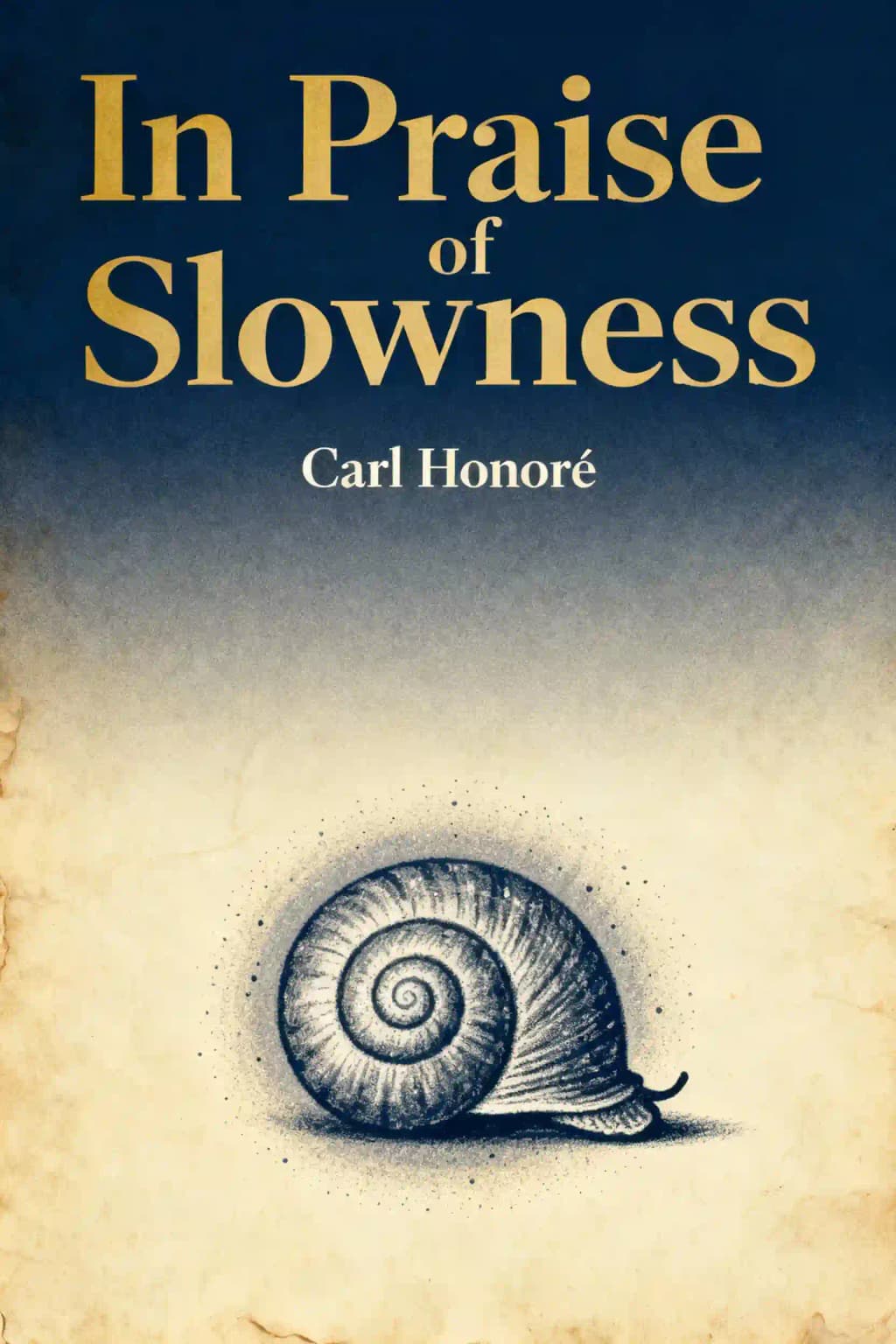
In a world that glorifies speed, Carl Honore's "In Praise of Slowness" arrives like a deep, calming breath. The book has become something of a cultural touchstone since its 2004 publication, inspiring a global movement and earning praise from celebrities like Arianna Huffington and Naomi Klein. Honore's personal epiphany came while waiting for a flight, excited to discover "One-Minute Bedtime Stories" that would speed up his nightly ritual with his son-until he realized with horror what he'd become: "Scrooge with a stopwatch, obsessed with saving every last scrap of time." This moment of clarity sparked a global investigation into our collective time-sickness and the growing resistance against it. As Gandhi wisely observed in the book's epigraph: "There is more to life than increasing its speed." In our hyperconnected, always-on culture, these words have never been more relevant or revolutionary.
Chapitre 2
The Acceleration Trap: How We Became Addicted to Speed
We've all joined the cult of speed, where everything has become a race against the clock. As Klaus Schwab, founder of the World Economic Forum, ominously warns: "We are moving from a world in which the big eat the small to one in which the fast eat the slow." This obsession with acceleration has turned toxic, leaving environmental devastation, rushed products, and human casualties in its wake.
The human toll is particularly alarming: burnout, stress-related illnesses, obesity, stimulant abuse, sleep deprivation, and traffic fatalities. Even leisure has become dangerous as we push our bodies too hard, too fast. Most tragically, speed erodes what gives life meaning. When we rush, we skim the surface, failing to make real connections. Half of British adults report losing touch with friends due to hectic schedules.
Children suffer most from our acceleration obsession. Growing up faster than ever, they're as overscheduled as adults-juggling tutoring, music lessons, and sports practices-leaving little time for unstructured play and daydreaming. This high-pressure lifestyle manifests in anxiety, depression, and stress disorders in children as young as five.
Our relationship with time has become increasingly dysfunctional. We obsessively divide time into ever-smaller increments, making us more neurotic about its passage. In our 24/7 world, all time has become the same-we pay bills on Saturday, shop on Sunday, work through the night. With constant connectivity, everyone and everything is permanently available. Even sleep is no longer a haven from haste, with people studying languages and management techniques while dozing.
Why are we so time-poor amid material wealth? Partly because Western culture views time as linear and finite rather than cyclical and renewable. Christianity added pressure to use every moment productively. Consumerism compounds this-we try cramming in careers, hobbies, social lives, family time, and endless shopping. Technology promises to save time but often creates new demands instead, like washing machines that led to washing clothes more frequently, or email that generated mountains of digital correspondence.
The human brain is hardwired for speed-we get a neurochemical kick from it as epinephrine and norepinephrine course through our bodies. We also become "velocitized," growing accustomed to speed and constantly craving more. This explains why our first car, aptly named "La Jamais Contente" (Never Happy), was built solely to break speed records. The same velocitization affects our patience with technology-broadband Internet that once seemed lightning fast now feels sluggish after mere seconds of delay.
Time-sickness can be a symptom of deeper existential malaise. Some speed up to avoid confronting unhappiness. As Milan Kundera suggests, our obsession with speed helps us forget, showing "it no longer wishes to be remembered." Others see speed as escape from mortality. Mark Kingwell, philosophy professor at the University of Toronto, explains: "It's hard to think about the fact that we're going to die... Speed, with the sensory rush it gives, is one strategy for distraction."
Chapitre 3
The Slow Revolution: Finding Balance in a Hurried World
A growing minority is choosing not to do everything at full-throttle. In every human endeavor-from sex and food to work and medicine-these rebels are making room for slowness. The Slow movement isn't about doing everything at a snail's pace or rejecting modernity. It's about balance: being fast when appropriate and slow when slowness is called for. As Carlo Petrini of Slow Food explains: "Being Slow means controlling the rhythms of your own life."
In the Austrian Alps resort town of Wagrain, the Society for the Deceleration of Time holds its annual conference. With over a thousand members across central Europe, the Society leads the Slow movement against the cult of speed. Members practice slowness in their professional and personal lives-doctors take more time with patients, consultants refuse weekend work calls, others cycle instead of driving. They embrace the concept of eigenzeit-the idea that every living being, event, or process has its own inherent pace or tempo giusto.
The Society combines serious philosophical inquiry with playful activism. They run "speed traps" in town centers, timing pedestrians and "punishing" the hasty by making them walk while steering a tortoise marionette. "Most people have not even thought about why they are going so fast," explains Jurgen Adam, a teacher who ran a speed trap in Ulm. "But once we get them talking about speed and time, they are very interested."
The Decelerators aren't hippie relics but concerned professionals-lawyers, consultants, doctors, architects, and teachers. For many, joining the Slow movement provides crucial social validation. "I felt that the constant acceleration of everything was bad, but when you are alone, you always suspect that you might be wrong," confesses Erwin Heller, a Munich property lawyer. "Knowing there are many other people thinking the same way has given me the confidence to slow down."
The movement extends globally. Japan's Sloth Club advocates less hurried, environmentally friendly living through its Tokyo cafe and merchandise bearing the slogan "Slow is beautiful." In San Francisco, the Long Now Foundation warns that civilization is developing "a pathologically short attention span." To encourage long-term thinking, they're building clocks that tick once yearly and measure time over ten millennia.
Chapitre 4
Slow Food: Reclaiming the Pleasure of the Table
The Jetsons cartoon gave children a glimpse of a high-tech future where everything was super-fast and ultra-convenient. The family's "home food dispenser" instantly produced synthetic meals at the push of a button, and sometimes they simply ate pills for dinner. While meal pills remain science fiction, our approach to food has indeed been hijacked by haste.
Hurry invaded our dining tables during the Industrial Revolution. Today, meals have become mere refueling stops-we eat alone, on the move, or while multitasking. Nearly half of Britons eat dinner in front of the TV, and the average McDonald's meal lasts just eleven minutes. This acceleration extends to farming, where every scientific trick-from chemical fertilizers to genetic modification-has been deployed to make livestock and crops grow faster. Modern pigs reach 220 pounds in six months compared to five years for their ancestors to reach 130 pounds.
Though attitudes toward food vary globally, with Americans spending just an hour daily on eating, even food-loving cultures are succumbing to haste. In Paris, cafes specializing in "restauration rapide" now compete with traditional bistros. As Brillat-Savarin warned, "The destiny of nations depends upon the manner in which they feed themselves"-a warning proven by today's obesity epidemic and environmental damage from industrial farming.
The Slow Food movement began in 1986 when McDonald's opened near Rome's Spanish Steps. Carlo Petrini launched a counterrevolution promoting fresh, local, seasonal produce; traditional recipes; sustainable farming; and leisurely dining with loved ones. With the snail as its symbol, Slow Food has attracted 78,000 members across fifty countries. The movement publishes guides, organizes events, and rescues endangered artisanal foods-from Sienese wild boar to rare American turkeys-helping small producers navigate regulations and find global markets.
Industrial methods strip natural taste from food, while artisanal production preserves complex flavors. At Neal's Yard Dairy in London, around eighty handcrafted British and Irish cheeses offer a sensory feast. Their artisanal cheddars each have distinct characters-Keen's is soft and grassy, Montgomery's is drier with nutty notes, Lincolnshire Poacher is mellow with Alpine sweetness, and Isle of Mull cheddar has a gamey taste. As Randolph Hodgson explains, these flavors develop slowly in the mouth and linger, unlike factory cheese that leaves little impression.
Beyond slow production, many people are rediscovering cooking and communal dining. Matthew Kovacevich and Catherine Creighton, Manhattan marketers, transformed their eating habits after experiencing European food culture. Now they cook together, shop at farmers' markets, and make time for proper meals even after twelve-hour workdays. Matthew finds cooking meditative: "It's easy in New York to get so wound up that you end up rushing everything. Cooking gives you a little oasis of slowness."
Chapitre 5
Slow Cities: Creating Spaces for Human Connection
Inspired by Slow Food, the Citta Slow (Slow Cities) movement transforms urban environments into havens from modern frenzy. Beginning in 1999 with four Italian towns including Bra, the movement has expanded to over thirty cities worldwide. The fifty-five-point manifesto commits to reducing noise and traffic, increasing green spaces, supporting local producers, preserving traditions, and fostering neighborliness. Rather than simply being fast cities slowed down, Slow Cities create environments where people can resist clock-dominated living.
Bra is methodically working through the fifty-five Citta Slow pledges, closing some streets to traffic, banning supermarket chains and neon signs, and granting prime real estate to family businesses selling handcrafted goods. The city subsidizes traditional building renovations, serves local organic food in schools and hospitals, and maintains traditional shop closing days. The movement has boosted the local economy, with expanded businesses like Bruno Boggetti's delicatessen now offering more local specialties to meet growing demand.
Cities have long been criticized for their frenetic pace. In 1819, Shelley compared London to hell, while Dickens chronicled urban squalor in industrializing Britain. Throughout history, people have sought escape from urban stress-some through back-to-nature movements, others through weekend cottages. Urban planners have tried to balance city dynamism with rural tranquility through innovations like public parks, garden cities, and suburbs. Yet most people don't want to abandon cities entirely-they simply wish urban living were less hectic.
The automobile, more than any invention, expresses our passion for speed. Despite knowing traffic accidents kill 3,000 people daily, we routinely break speed limits. We speed to keep up in our busy world, enjoy the adrenaline rush, or because modern cars are built for it. Yet cars dominate urban landscapes, creating barriers between people. Studies worldwide show a direct correlation: less traffic flowing more slowly means more social contact among residents.
The war against speeding is stronger than ever, with governments installing speed bumps, narrowing streets, deploying radar cameras, and cutting speed limits. Lancashire's Speed Awareness Program offers speeders an alternative to fines: a one-day course to help them "kick the acceleration habit." Participants learn that speeding rarely saves significant time-driving two miles at 80 mph instead of 50 mph saves just 54 seconds. BBC journalist Peter Holland, once proud of his speeding, experienced a profound shift after attending: "When you're a calmer driver, you're calmer with your family, your work, with everything."
Beyond slowing traffic, cities worldwide are pedestrianizing roads, adding bicycle lanes, cutting parking, imposing road tolls and holding car-free days. In Britain, residents have created over eighty "Home Zones" where children play in streets, cars move slowly, and neighbors socialize. These zones have brought communities together-residents in Ealing now throw street parties and socialize in evenings.
Chapitre 6
The Mind-Body Connection: Slow Thinking in a Fast World
In the war against the cult of speed, the front line exists inside our heads. The human brain naturally flits between thoughts, and workplace pressure forces quick reactions rather than reflection. But the mind can do much more when allowed to slow down, bringing better health, inner calm, enhanced concentration and creativity-what Milan Kundera calls "the wisdom of slowness."
According to psychologist Guy Claxton, the brain has two modes: Fast Thinking (rational, analytical, logical) and Slow Thinking (intuitive, woolly, creative). Brain scans show these produce different waves-slower alpha and theta waves during Slow Thinking, faster beta waves during Fast Thinking. Research confirms that people think more creatively when calm and unhurried. Time pressure creates tunnel vision, as shown in a 1952 study where participants asked to work faster while encoding phrases invariably floundered.
History's greatest thinkers understood this: Darwin described himself as a "slow thinker," Einstein spent hours staring into space, and Sherlock Holmes entered meditative states to solve crimes. The ideal is balancing both modes-using Slow Thinking to generate ideas and Fast Thinking to analyze them, knowing when to wander and when to focus.
Meditation trains the mind to relax, generating slower brain waves and affecting the amygdala to create lasting serenity. Once considered fringe, meditation has gone mainstream with ten million American practitioners and meditation rooms appearing in airports, schools, prisons, hospitals and offices. Even hardcore business leaders like Bill Ford of Ford Motors have embraced it.
Despite Descartes' philosophical separation of mind and body, they remain deeply connected. Meditation offers physical benefits for conditions ranging from migraines and heart disease to cancer and depression. One five-year study found transcendental meditation practitioners were 56% less likely to be hospitalized. The fitness world is also rediscovering slowness through Eastern practices like yoga, which unites body, mind and spirit through controlled breathing and fluid movements.
Yoga has infiltrated every corner of society-from offices and hospitals to fire departments and factories. Even Wall Street trader Mark Cohen discovered yoga's transformative power despite initial skepticism. After just months of practice, his flexibility improved, his posture strengthened, and he discarded his lumbar cushion. Most importantly, yoga cultivated inner calm that transferred to his high-pressure work environment. "When things get crazy, I'm just Mr. Calm," he explains.
Chi Kung, sometimes described as "yoga with meditation and movement," encompasses ancient Chinese exercises promoting health through circulating chi throughout the body. Practitioners move slowly through elongating postures while breathing deeply, focusing on control and awareness rather than elevated heart rates. The practice improves balance, strength, posture and movement rhythm while cultivating a relaxed yet active mental state.
Chapitre 7
Slow Medicine: Healing at the Right Pace
Modern medicine suffers from a hurry sickness. In Britain's National Health Service, the average GP visit lasts just six minutes, with doctors practicing "beeper medicine" and focusing on quick symptom treatment rather than holistic care. But a backlash against Fast medicine is gaining momentum, with research showing patience often yields better results. For instance, a 2002 European study found that giving couples an extra year to conceive naturally was more effective than rushing to in vitro fertilization.
Millions are turning to complementary and alternative medicine (CAM), which embraces unhurried, holistic healing traditions. The global CAM market exceeds $60 billion annually, with half of North Americans seeking care outside mainstream medicine. While scientific evidence remains contested, preliminary research suggests some CAM treatments are effective. The trend now is toward "integrative medicine" that combines Western and traditional approaches, with CAM courses multiplying in conventional medical schools and centers appearing at prestigious universities like Harvard and Columbia.
CAM therapies are inherently Slow, working with rather than forcing the body to heal. Mainstream doctors increasingly embrace Slow-style therapies-using meditation, yoga, and Chi Kung to treat conditions from cancer to epilepsy. Many now refer patients to alternative practitioners. While CAM treatments typically work gradually, they can sometimes bring faster relief than conventional approaches, as with Ayurvedic Marma massage versus pharmaceutical anti-inflammatories.
Former pharmaceutical researcher Catherine Watson exemplifies this shift, leaving the industry to practice herbalism with hour-long consultations and gradual, side-effect-free treatments. For patients like Nik Stoker, who suffered years of debilitating menstrual pain despite conventional treatments, acupuncture and herbal remedies provided not just physical healing but mental clarity. Reiki practitioner Danira Caleta helps patients like cancer survivor Marlene Forrest prepare for surgery through breathing exercises and visualization, resulting in remarkable recoveries.
Chapitre 8
Slow Sex: Rediscovering Intimacy in the Bedroom
The chapter opens with the anecdote of Sting becoming the subject of widespread jokes after publicly discussing his practice of Tantric sex with his wife. Despite his later attempts to downplay these comments, the rock star became permanently associated with "never-ending nooky" in the public imagination. Modern society is saturated with sexual imagery yet devotes surprisingly little time to actual lovemaking. Studies show the average American spends only half an hour weekly on sex, with most encounters being brief. This hurried approach has roots in both biology and our fast-paced culture, where efficiency and goal-orientation have infected even our most intimate moments.
Across the world, people are embracing the concept that slower sex is better sex. Men's magazines are beginning to promote unhurried lovemaking, with Japan's leading men's publication Weekly Gendai running a successful twelve-week series on intimate, sensual approaches to sex that boosted circulation by 20%. In Italy, Alberto Vitale founded the official Slow Sex movement in 2002, applying Slow Food principles to the bedroom. As Vitale explains, "In our consumer culture, the aim is to sleep with someone quickly and then move on to the next conquest," but slowing down has transformed his own approach to intimacy.
The worldwide Tantra boom exemplifies the yearning for slower sex. Tantra, a 5,000-year-old spiritual discipline from India, treats the body as an instrument of prayer, using mindful sexual union as a path to enlightenment. Through meditation, yogic exercises, controlled breathing and unhurried foreplay, practitioners learn to channel sexual energy through the body's chakras. Men learn to prolong erection and experience orgasm without ejaculation, while women are treated as goddesses. The practice promises both spiritual transcendence and extraordinary physical pleasure, including multiple orgasms.
The author interviews Tantra practitioners including the Kimbers, a middle-aged couple whose 30-year marriage was rejuvenated through Tantric practice. They now dedicate time weekly to Tantric sessions in a special "sacred space," experiencing deeper intimacy and more intense orgasms. However, Tantra can also expose relationship flaws, as happened with Tim Dyer, whose engagement ended after a workshop revealed fundamental incompatibilities. For the Kimbers, the slowness of Tantric practice has extended beyond the bedroom, with Roger working fewer hours and running his business along Slow principles.
Chapitre 9
Working Slowly: Productivity Without Burnout
The workplace represents a key battlefront for the Slow movement. When work consumes excessive hours, everything else gets squeezed into a race against the clock. Polls across 27 countries show 70% of people want better work-life balance. Americans are increasingly resisting workaholism through lawsuits against unpaid overtime and embracing books on "lazy success." Younger job applicants now routinely ask about reasonable hours and vacation time.
Different countries are finding their own paths to working less. In Japan, where workaholism once dominated, young "Generation Fureeta" increasingly reject corporate life for part-time work and leisure. Continental Europe has moved furthest in reducing work hours, with Germans now spending 15% less time working than in 1980. France implemented the boldest change with its 35-hour workweek, creating a leisure revolution where weekends often start Thursday or end Tuesday. Many French workers report greater efficiency and life satisfaction, with increased participation in arts, travel, and family time.
Cutting work hours often brings smaller financial sacrifices than expected. Reduced spending on work-related expenses like transport, convenience food, childcare and retail therapy, plus lower tax bills, can offset income reductions. Some Canadian workers actually saved more money after reducing hours. Forward-thinking companies now offer work-life balance options. SAS in North Carolina maintains a 35-hour workweek with generous benefits and on-site amenities. The Royal Bank of Canada allows 40% of staff to use flexible arrangements like job-sharing and reduced hours.
Beyond working less, working more slowly often produces better results. In our deadline-driven culture, strategic planning, creative thought and relationship-building suffer from constant rushing. Companies increasingly recognize technology's limits, with some implementing email-free periods or encouraging disconnection. Ernst & Young told US employees it's acceptable not to check messages on weekends, while executives experiment with turning off devices during personal time. Investment banker Jill Hancock discovered that silencing her phone during breaks and weekends helped her overcome depression and fatigue-ultimately improving her productivity while making room for slow pursuits like yoga and cooking real meals.
Chapitre 10
Reclaiming Leisure: The Art of Doing Nothing
In a world obsessed with work, leisure is a serious matter-declared a basic human right by the UN in 1948. While Aristotle considered using free time wisely a central human challenge, historically only elites had abundant leisure. The Industrial Revolution eventually democratized free time, formalizing leisure activities like spectator sports, public parks, and reading. Philosophers from Plato to Bertrand Russell championed leisure's importance, with Russell predicting shorter workdays would make us "more kindly and less persecuting." Yet today, work still dominates our lives, and when free time appears, we rush to fill it with activity rather than embracing stillness.
People increasingly devote free time to slow, contemplative hobbies that satisfy nostalgia for pre-speed-obsessed times. Gardening has shaken off its pensioner image to become fashionably "horticulture chic" with 78.3 million American practitioners. TV presenter Matt James values how gardening reconnects us to seasons and social connections while slowing us down. For London trader Dominic Pearson, tending his urban garden provides therapeutic calm that improves his work performance.
Beyond gardening, reading experiences a renaissance with book clubs flourishing and people like Paula Dembowski rediscovering how "reading adds another, slower register to things." Many advocate "Slow Reading"-savoring books like Dickens' novels in monthly installments or keeping reading diaries. Similarly, painting serves as deceleration therapy for busy professionals like Tokyo web designer Kazuhito Suzuki, who finds balance between his computer and easel.
Music offers another path to slowness, with the Tempo Giusto movement advocating playing classical compositions at slower tempos. German pianist Uwe Kliemt champions this approach, arguing that musicians began playing faster during industrialization when virtuosos like Franz Liszt dazzled with technical brilliance. Even Mozart and Beethoven complained about rushed performances, with Beethoven lamenting "a curse on the virtuosos" whose "practised fingers are always off in a hurry."
Beyond Tempo Giusto, other artists use musical slowness to challenge our speed-obsessed culture. In east London, Jem Finer's "Longplayer" project features Tibetan singing bowls in a thousand-year concert that never repeats itself. Meanwhile, in Halberstadt, Germany, John Cage's composition "ASLSP" (As Slow As Possible) is being performed over 639 years in St. Burchardi Church. This glacially-paced concert, scheduled to end in 2640, draws hundreds of spectators whenever new notes are played.
Chapitre 11
Raising Unhurried Children in a Hurried World
Our turbocharged world has infected even childhood with the hurry virus. From overscheduled four-year-olds to teenagers rushing through degrees, children are being denied the slow, exploratory pace that true development requires. Harvard Dean Harry Lewis challenges this trend in his annual letter to freshmen titled "Slow Down," arguing that selective slowness leads to better thinking and higher achievement. Meanwhile, psychologists warn that rushing children causes stress-related illnesses, sleep deprivation, and actually impairs learning.
Children today are growing up faster than ever-six-year-olds organize social lives with cellphones, teenagers launch businesses, and childhood itself seems shorter with earlier puberty. The pressure comes from all directions: single-parent homes force adult responsibilities earlier, advertisers target younger consumers, schools teach clock-based efficiency, and parents pack schedules with activities. Competition drives much of this acceleration, with parents fearing their children will fall behind.
The price of rushed childhoods is increasingly evident. Children as young as five suffer from stress-induced ailments including upset stomachs, headaches, insomnia, depression and eating disorders. Sleep deprivation makes them cranky, jumpy and impairs their social development. Academically, the "intensification" approach is backfiring. Research by child psychologist Kathy Hirsh-Pasek found that preschoolers from relaxed learning environments were less anxious, more eager to learn, and better at independent thinking than those subjected to "drill and kill" teaching.
A growing backlash against hurried childhood is gaining momentum worldwide. Rather than rote memorization, Slow schools encourage deep exploration and engaged learning. Finland exemplifies this approach, starting formal education at seven with fewer high-pressure exams, yet consistently topping world educational rankings. Alternative models like Steiner schools (with over 800 worldwide) delay reading instruction until age seven, focusing instead on play, creativity, and natural development.
Parents are increasingly questioning academic hothousing and choosing slower educational paths. Some lobby schools for less homework, while others switch from pressure-cooker private schools to more relaxed state institutions. Julian Griffin moved his artistic son James from a demanding private school where he suffered panic attacks to a state school where he thrived with less pressure. Home education is rising dramatically, with over a million American children now learning at home. While parents choose this path for various reasons, many see it as liberation from rigid timetables, allowing children to learn at their own pace.
Unstructured play helps children develop essential skills, but many families struggle with over-scheduling. The Barnes family of London exemplifies the shift toward slowness after realizing their eight-year-old Jack was burning out from constant activities. They limited him to three extracurricular activities and reduced scheduled weekend outings. The result? Jack blossomed-becoming livelier, more talkative, and even performing better in his remaining activities.
Chapitre 12
Finding Your Tempo Giusto: The Path Forward
A century after the Titanic disaster failed to make humanity question its obsession with speed, we're still racing toward burnout. Yet a powerful backlash-the Slow movement-is gaining momentum. This isn't about replacing speed-worship with slowness-worship, but finding the right pace for each situation. The movement faces obstacles in our speed-addicted world, but demographics favor deceleration as populations age. Once people slow down in one area, they often apply the lesson elsewhere-from Slow Food to Slow Education, from Tantric sex to reduced work schedules.
The yearning for slowness reflects a deeper spiritual hunger for meaningful connections. While critics dismiss it as unaffordable luxury, most slow practices cost nothing: spending time with loved ones, walking, cooking, reading. Far from destroying capitalism, Slow offers it a sustainable path forward by valuing people and environment as assets rather than disposable inputs. Its greatest selling point? Pleasure-the simple joy of doing things properly.
The Slow movement needs to reach critical mass to become a revolution, requiring both individual action and systemic change. We must reframe our relationship with time, seeing it not as a finite resource draining away but as the benign element we live in. Starting with small acts of slowness-cooking from scratch, taking walks, reading without distractions-can lead to bigger changes.
For the author, his own recovery from speedaholism is evident in his newfound patience at supermarket checkouts and his ability to read bedtime stories to his son without rushing-a transformation that brings joy to them both. In a world that constantly tells us to hurry up, perhaps the most revolutionary act is simply to slow down and rediscover what makes life worth living in the first place.