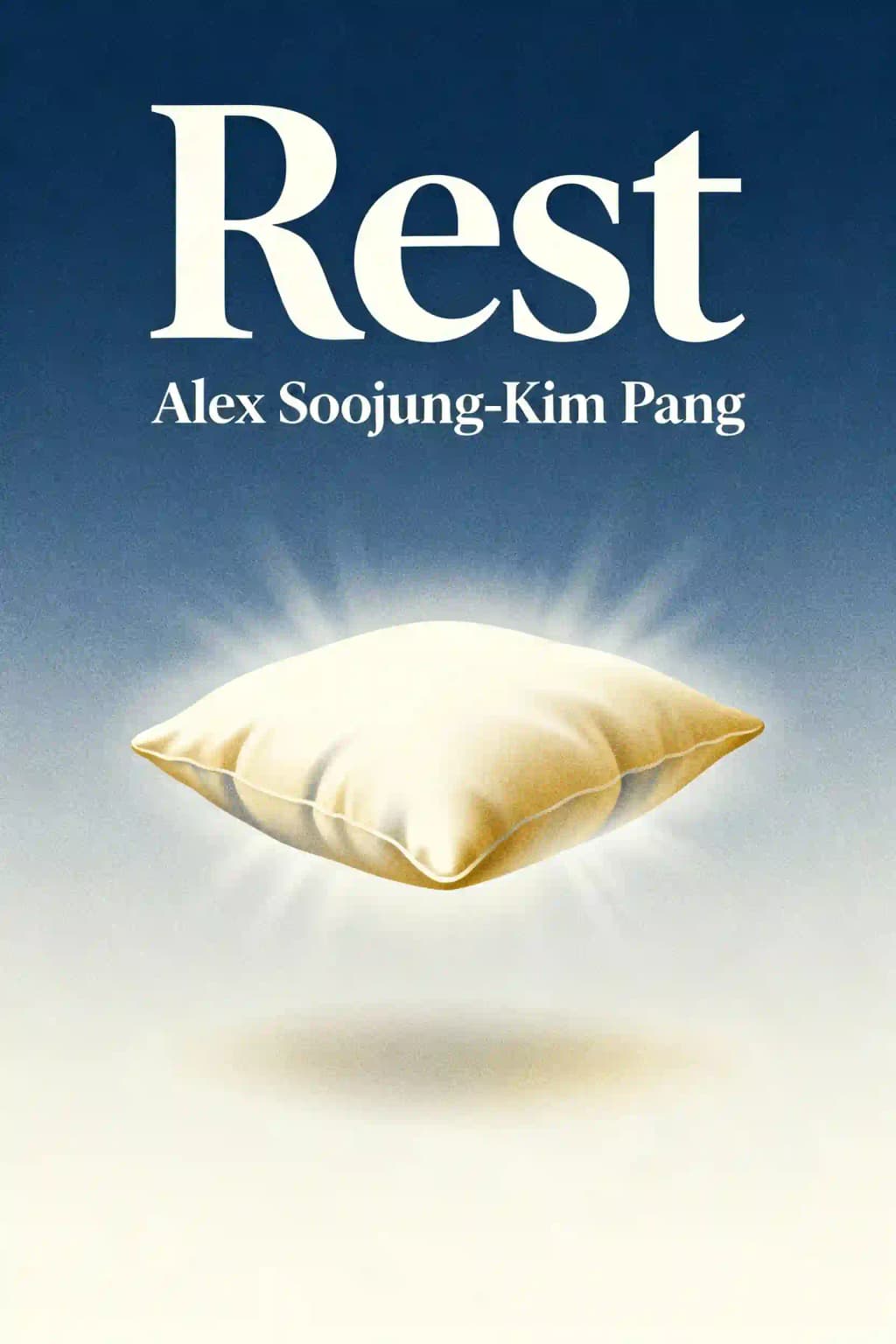
Rest
Why You Get More Done When You Work Less
Aperçu de Rest
In "Rest," Alex Soojung-Kim Pang challenges our hustle culture with counterintuitive science: working less actually boosts productivity. Endorsed by Arianna Huffington, it reveals how Darwin and Hemingway achieved genius in just four-hour workdays. Could your exhaustion be killing your success?

Thèmes clés dans Rest
- deliberate rest
- creative recovery
- deep work cycles
- hustle culture critique
- strategic downtime
Citations de Rest
Deliberate rest is a skill.
Rest is not optional.
Work and rest should be allies.
Rest is essential for creativity.
We brag about our busy schedules, glorify hustle culture, and wear our stress like expensive jewelry.
Personnages de Rest
- Alex Soojung-Kim PangAuthor and researcher on deliberate rest
- Santiago Ramon y CajalNeuroscientist who studied scientific discovery
- Anders EricssonPsychologist known for deliberate practice research
À propos de l'auteur
À propos de l'auteur de Rest
Alex Soojung-Kim Pang is a Silicon Valley futurist and bestselling author of Rest: Why You Get More Done When You Work Less, a groundbreaking exploration of productivity and creativity that blends neuroscience, history, and psychology. Pang holds a PhD in the history and sociology of science from the University of Pennsylvania.
He has spent decades researching how rest and focused work intersect, drawing from his roles as a visiting scholar at Stanford University and director of research at 4 Day Week Global. His expertise in redefining workplace efficiency is further showcased in related works like Shorter: How Working Less Will Revolutionize the Way Your Company Gets Things Done and The Distraction Addiction, which examine technology’s role in modern focus.
Pang’s insights have been featured in The Guardian, The Wall Street Journal, and his TED Talk on the four-day workweek, cementing his status as a leading voice in productivity innovation. His books, translated into over 20 languages, inform strategies at organizations worldwide, from Fortune 100 companies to government agencies. As founder of The Restful Company, he champions evidence-based approaches to help individuals and teams achieve more through deliberate rest.
Telecharger le resume de Rest
Obtenez le resume de Rest en PDF ou EPUB gratuit. Imprimez-le ou lisez-le hors ligne a tout moment.
FAQ sur ce livre
Rest by Alex Soojung-Kim Pang challenges the myth that overwork leads to success, arguing deliberate rest—like strategic walks, naps, and hobbies—enhances productivity. Blending neuroscience with examples from Darwin to Stephen King, Pang shows how rest fuels creativity, sharpens focus, and sustains energy. The book redefines rest as an active partner to work, not its opposite.
This book is ideal for overworked professionals, burnout-prone creatives, and anyone seeking sustainable productivity. It’s particularly relevant for leaders aiming to optimize team performance and individuals interested in historical or scientific insights on work-rest balance. Pang’s research appeals to skeptics of hustle culture and those curious about merging efficiency with well-being.
Yes, Rest offers actionable insights backed by psychology and case studies, though some readers find anecdotes repetitive. Its core argument—that 4-hour focused workdays outperform marathon sessions—provides a fresh perspective on productivity. While structured around similar templates per chapter, the evidence and historical examples make it a valuable rethink of modern work habits.
Deliberate rest is intentional, restorative downtime that actively enhances creativity and productivity. Unlike passive activities like binge-watching, it includes practices like walking, meditation, or hobbies that stimulate the mind. Pang contrasts this with “workaholic” culture, showing how figures like Nietzsche and Dickens used such rest to sustain groundbreaking work.
Pang cites studies showing peak cognitive performance lasts 4-5 hours daily. Examples like Charles Darwin’s structured mornings highlight how focused bursts followed by rest yield higher-quality output than prolonged grind. The book argues that beyond this threshold, diminishing returns and mental fatigue erode effectiveness.
Morning routines leverage peak mental clarity, as shown by writers like Toni Morrison and architects like Le Corbusier. Pang links early productivity to circadian rhythms and reduced distractions, enabling deep work. These rituals also create psychological momentum, making rest periods more rewarding.
Walking stimulates divergent thinking, boosts mood, and facilitates problem-solving. Pang highlights Nietzsche, Beethoven, and Dickens, who used daily walks to overcome creative blocks. The rhythmic activity allows subconscious processing, often leading to breakthroughs.
Pang frames work and rest as symbiotic, not opposing forces. Like waves, they alternate to sustain creativity and energy. High achievers use rest to consolidate learning and spark insights. The book debunks the “10,000-hour rule,” suggesting rest and sleep contribute more to mastery than practice alone.
Critics note repetitive anecdotal structures and limited diversity in case studies (mostly Western male figures). Some argue Pang oversimplifies organizational challenges in adopting shorter work hours. However, the core thesis—rest as a productivity multiplier—is widely praised for its evidence-based approach.
While Atomic Habits focuses on incremental behavior change, Rest prioritizes strategic recovery as the foundation for sustainable productivity. Pang’s work complements habit-building by highlighting the physiological need for downtime, offering a counterpoint to “grind culture” narratives.
Sabbaticals, like those taken by graphic designer Stefan Sagmeister, provide extended deliberate rest to recharge and gain perspective. Pang advocates for sabbaticals as periods of exploration and skill-building, showing they reduce burnout and spark innovation upon returning to work.
Pang critiques society’s glorification of nonstop activity, linking it to burnout and shallow work. He traces this to industrial-era labor norms and Silicon Valley’s “hustle” ethos, advocating instead for measured effort balanced with restorative practices. The book urges readers to redefine success beyond mere busyness.
- “Work and rest are partners… You can’t have the high without the low.”
- “Deliberate rest makes you better at your work… but it also makes your work more sustainable.”
- “The four-hour workday isn’t a radical idea—it’s how many great minds operated.”
Each underscores the book’s thesis that rest is a skill to cultivate, not a sign of weakness.
With a PhD in science history and roles at Stanford/UC Berkeley, Pang blends academic rigor with Silicon Valley consulting experience. His work at The Restful Company and 4 Day Week Global grounds the book in real-world applications, bridging theory and practice.





