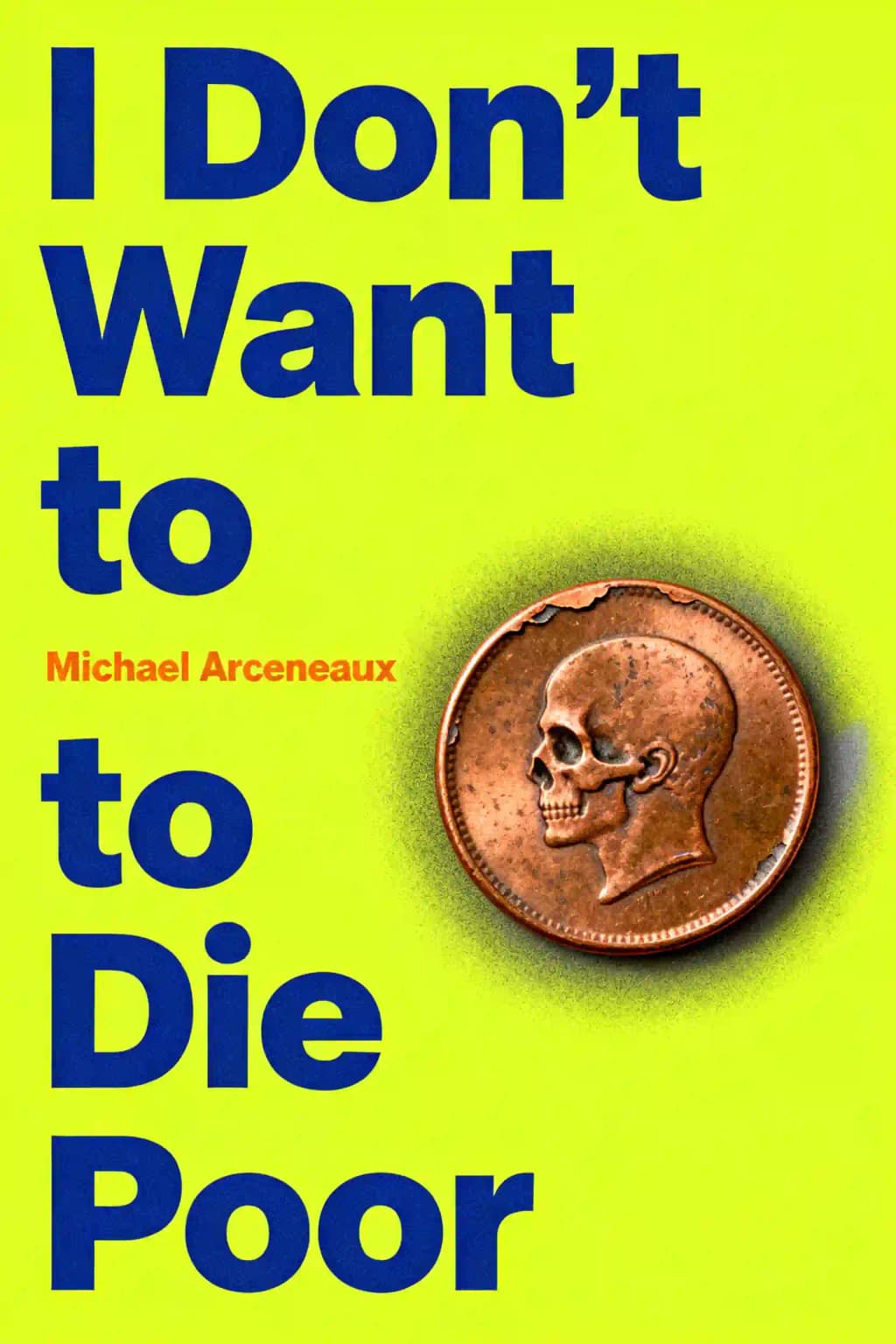
In "I Don't Want to Die Poor," Michael Arceneaux hilariously dissects student debt's suffocating grip through raw essays that made BuzzFeed call him "as joyful as he is shrewd." His black, queer perspective transforms financial anxiety into cultural revelation - can you afford not to read it?
Michael Arceneaux is the New York Times bestselling author of I Don’t Want to Die Poor and a celebrated voice in contemporary personal essays. He explores race, class, sexuality, and financial anxiety.
Born in Houston, Texas, to a working-class Black family, Arceneaux draws from his experiences with student debt, systemic inequality, and navigating adulthood as a queer Black man to craft candid, darkly humorous narratives. A Howard University graduate, his work has appeared in The New York Times, The Washington Post, Rolling Stone, and Essence. He has contributed commentary to MSNBC, NPR, and Comedy Central.
His debut essay collection, I Can’t Date Jesus (2018), became a cultural touchstone, followed by I Finally Bought Some Jordans (2024), which confronts grief and self-discovery. Arceneaux’s writing resonates with readers grappling with identity and economic precarity, blending memoir with sharp social critique. His books have been widely praised for their unflinching honesty and wit, solidifying his reputation as a defining chronicler of modern millennial struggles.
I Don’t Want to Die Poor is a candid essay collection exploring the financial and emotional toll of pursuing dreams amid systemic barriers. Michael Arceneaux details his battles with student debt, economic anxiety, and how race, sexuality, and class intersect to shape financial instability. With humor and sharp insight, he critiques America’s exploitative education system and the myth of meritocracy.
This book resonates with millennials, Black LGBTQ+ communities, and anyone grappling with student debt or economic insecurity. Readers seeking relatable, darkly humorous narratives about systemic inequality, personal resilience, and the cost of ambition will find Arceneaux’s voice both validating and incisive.
Yes—Arceneaux’s blend of wit and vulnerability offers a refreshing take on financial struggle. Praised by Time and NPR, the book balances candid storytelling with sharp cultural critique, making it essential for understanding the modern economic landscape’s impact on marginalized voices.
Key themes include economic inequality, the emotional weight of debt, and the intersection of race, sexuality, and class. Arceneaux dissects how systemic failures trap marginalized individuals in cycles of financial precarity while challenging narratives that equate success with moral virtue.
While I Can’t Date Jesus focused on race, religion, and sexuality, this sequel delves deeper into financial struggles. It retains Arceneaux’s trademark humor but adopts a darker tone, reflecting the urgency of economic survival in a rigged system.
Some reviewers note uneven pacing, with certain essays feeling less impactful. However, most praise its authenticity, though critics argue it prioritizes personal anecdotes over structural solutions to debt crises.
He recounts his $150,000+ student loan burden, illustrating how debt limits career choices, mental health, and relationships. Arceneaux critiques predatory lending practices and the societal pressure to pursue higher education at any cost.
Humor acts as a coping mechanism, softening harsh realities without trivializing them. Arceneaux’s wit—like calling himself a “K Street Thot” for underpaid writing gigs—highlights absurdities in capitalism’s exploitation of marginalized labor.
These lines underscore the book’s critique of systemic oppression.
Arceneaux argues that Black LGBTQ+ individuals face compounded barriers: wage gaps, discrimination, and fewer family safety nets. He ties financial insecurity to broader societal inequities, rejecting bootstrap rhetoric.
With rising student debt and economic inequality post-COVID, Arceneaux’s critique of exploitative systems remains urgent. The book’s themes align with ongoing debates about loan forgiveness and racial wealth gaps.
Arceneaux urges collective action over individual blame.
While no official guide exists, the essays naturally prompt conversations on debt, race, and resilience. Book clubs can explore themes like “How does debt impact identity?” or “What systemic changes does Arceneaux suggest?”
Ressentez le livre à travers la voix de l'auteur
Transformez les connaissances en idées captivantes et riches en exemples
Capturez les idées clés en un éclair pour un apprentissage rapide
Profitez du livre de manière ludique et engageante
Of course it was an attractive light-skinned Black man who led me to ruin.
My mother called me a "self-centered bastard" when I shared my acceptance news.
Even the sympathetic collectors are villains to me.
I don't like most children who aren't related to me.
I didn't want to return to being fat.
Décomposez les idées clés de I Don't Want to Die Poor en points faciles à comprendre pour découvrir comment les équipes innovantes créent, collaborent et grandissent.
Condensez I Don't Want to Die Poor en indices de mémoire rapides mettant en évidence les principes clés de franchise, de travail d'équipe et de résilience créative.

Découvrez I Don't Want to Die Poor à travers des récits vivants qui transforment les leçons d'innovation en moments mémorables et applicables.
Posez n'importe quelle question, choisissez la voix et co-créez des idées qui résonnent vraiment avec vous.

Cree par des anciens de Columbia University a San Francisco
"Instead of endless scrolling, I just hit play on BeFreed. It saves me so much time."
"I never knew where to start with nonfiction—BeFreed’s book lists turned into podcasts gave me a clear path."
"Perfect balance between learning and entertainment. Finished ‘Thinking, Fast and Slow’ on my commute this week."
"Crazy how much I learned while walking the dog. BeFreed = small habits → big gains."
"Reading used to feel like a chore. Now it’s just part of my lifestyle."
"Feels effortless compared to reading. I’ve finished 6 books this month already."
"BeFreed turned my guilty doomscrolling into something that feels productive and inspiring."
"BeFreed turned my commute into learning time. 20-min podcasts are perfect for finishing books I never had time for."
"BeFreed replaced my podcast queue. Imagine Spotify for books — that’s it. 🙌"
"It is great for me to learn something from the book without reading it."
"The themed book list podcasts help me connect ideas across authors—like a guided audio journey."
"Makes me feel smarter every time before going to work"
Cree par des anciens de Columbia University a San Francisco

Obtenez le resume de I Don't Want to Die Poor en PDF ou EPUB gratuit. Imprimez-le ou lisez-le hors ligne a tout moment.
There's something almost poetic about how life's biggest mistakes often begin with attraction. Standing at a high school college fair in Houston, surrounded by folding tables and glossy brochures, a young student locks eyes with a charismatic Hampton University recruiter-light-skinned, charming, impossibly confident. In that moment, attending a prestigious out-of-state university transforms from impossible dream to tangible reality. Never mind the financial logistics or the warnings from a worried mother who sees disaster ahead. The decision gets made, applications fly out, and Howard University sends back an acceptance letter that feels like validation. Seventeen scholarships later, there's still a gap-one that gets filled with $10,000 in loans the first year, then more as scholarships slip away. By graduation, the monthly bill arrives: almost $800 for private loans alone, with twelve years to pay them off. What seemed like an investment in the future becomes a sentence-one that dictates every decision, every relationship, every moment of peace for decades to come. The calls start at 6 a.m., sometimes on Christmas Eve, delivered by collectors who sound disturbingly cheerful as they remind you of your failure.