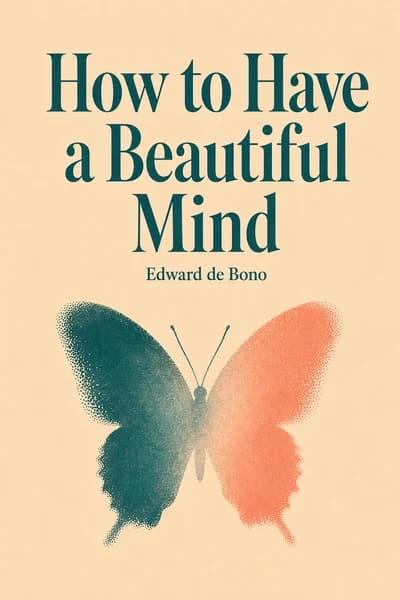
How to Have a Beautiful Mind
Aperçu de How to Have a Beautiful Mind
Discover how to make your mind truly attractive in Edward de Bono's guide to intellectual beauty. From the legendary thinker behind the "Six Thinking Hats" method used globally, learn the counterintuitive art of listening, agreeing, and disagreeing that transforms ordinary conversations into fascinating exchanges.

Thèmes clés dans How to Have a Beautiful Mind
- lateral thinking
- conversational intelligence
- intellectual attraction
- conflict resolution
- perspective shifting
Citations de How to Have a Beautiful Mind
Mental attractiveness isn't about high IQ—it's about how you use your mind.
Being right constantly is less important than being beautiful-minded.
Always winning arguments means gaining nothing new.
Gentle disagreement is as valid as aggressive disagreement but far more beautiful.
Emotions become problematic when they enter the logic of an opinion.
Personnages de How to Have a Beautiful Mind
- Edward de BonoAuthor and pioneering authority in creative thinking
À propos de l'auteur
À propos de l'auteur de How to Have a Beautiful Mind
Edward Charles Francis Publius de Bono (1933–2021), Maltese physician, psychologist, and pioneering thinker, authored How to Have a Beautiful Mind as part of his lifelong mission to revolutionize human communication and creative problem-solving.
A Rhodes Scholar with degrees from Oxford and Cambridge, de Bono originated seminal concepts like lateral thinking and the Six Thinking Hats® framework, tools widely adopted by corporations like IBM, Nestlé, and British Airways. His 85 books, including global bestsellers Six Thinking Hats and Lateral Thinking, have been translated into 46 languages, cementing his reputation as the foremost authority on structured creativity.
Trained in medicine and psychology, de Bono blended scientific rigor with practical wisdom, creating accessible methods to enhance dialogue, reduce conflict, and foster innovation. As founder of the Cognitive Research Trust (CoRT), he shaped thinking curricula used in over 5,000 schools worldwide. How to Have a Beautiful Mind distills his decades of research into techniques for cultivating intellectual grace and collaborative curiosity.
De Bono’s work remains foundational in business strategy, education, and diplomacy, with his models referenced in academic programs from Harvard to the University of Malta. Over 30 million copies of his books have sold globally.
Telecharger le resume de How to Have a Beautiful Mind
Obtenez le resume de How to Have a Beautiful Mind en PDF ou EPUB gratuit. Imprimez-le ou lisez-le hors ligne a tout moment.
FAQ sur ce livre
Edward de Bono’s How to Have a Beautiful Mind argues that intellectual beauty transcends physical appearance. The book teaches practical techniques to enhance conversational skills, listening, and creative thinking through frameworks like lateral thinking and the Six Thinking Hats method. It emphasizes open-minded dialogue, constructive disagreement, and nurturing curiosity to make one’s mind more engaging.
This book is ideal for professionals, students, and individuals seeking to improve communication, critical thinking, or creativity. It’s particularly useful for those in leadership, education, or collaborative roles, as well as anyone interested in de Bono’s methods like lateral thinking. Critics note it may appeal more to beginners than advanced practitioners.
Yes, if you value structured approaches to improving dialogue and creativity. Readers praise its actionable advice on listening, questioning, and idea exploration. However, some find its concepts repetitive or too basic, suggesting it’s best for those new to de Bono’s work.
The Six Thinking Hats is a framework for parallel thinking, where each “hat” represents a distinct perspective:
- White: Neutral facts.
- Red: Emotions.
- Black: Critical judgment.
- Yellow: Optimism.
- Green: Creativity.
- Blue: Process control.
This method helps structure discussions and reduce conflict.
A beautiful mind prioritizes curiosity, empathy, and creativity over raw intelligence. De Bono argues it’s cultivated through active listening, respectful debate, and exploring ideas without ego. For example, he suggests asking “Why?” three times to deepen understanding.
Key strategies include:
- Lateral thinking: Generating unconventional ideas.
- Parallel thinking: Using the Six Hats for focused dialogue.
- Constructive disagreement: Challenging ideas without personal attacks.
- Listening with intent: Paraphrasing and asking clarifying questions.
Some reviewers argue the concepts oversimplify complex social dynamics or repeat de Bono’s earlier work. Others note the advice may feel abstract without real-world examples. However, most agree it provides a solid foundation for improving conversational habits.
Unlike generic advice, How to Have a Beautiful Mind integrates de Bono’s proprietary frameworks like lateral thinking and Six Hats. It focuses less on persuasion and more on collaborative idea-building, making it unique in the creativity and problem-solving niche.
Yes. The book’s methods are widely used in business for brainstorming, conflict resolution, and meetings. For instance, the Six Hats technique helps teams evaluate projects holistically. De Bono’s emphasis on “conceptual thinking” also aids innovation in competitive industries.
- Prioritize understanding over winning debates.
- Use structured thinking tools to explore ideas.
- Cultivate humility and curiosity in conversations.
- Develop the habit of rephrasing others’ points to ensure clarity.
The book remains pertinent for navigating AI-driven communication and remote collaboration. Its focus on empathy and structured dialogue addresses modern challenges like misinformation and polarized debates. Updated editions or companion workshops could enhance its applicability.
Summaries are available in PDF, EPUB, and audiobook formats through platforms like Goodreads and dedicated book summary sites. These distill key concepts like lateral thinking and conversational frameworks.