Chapitre 1
The Social Scientist's Guide to Human Connection
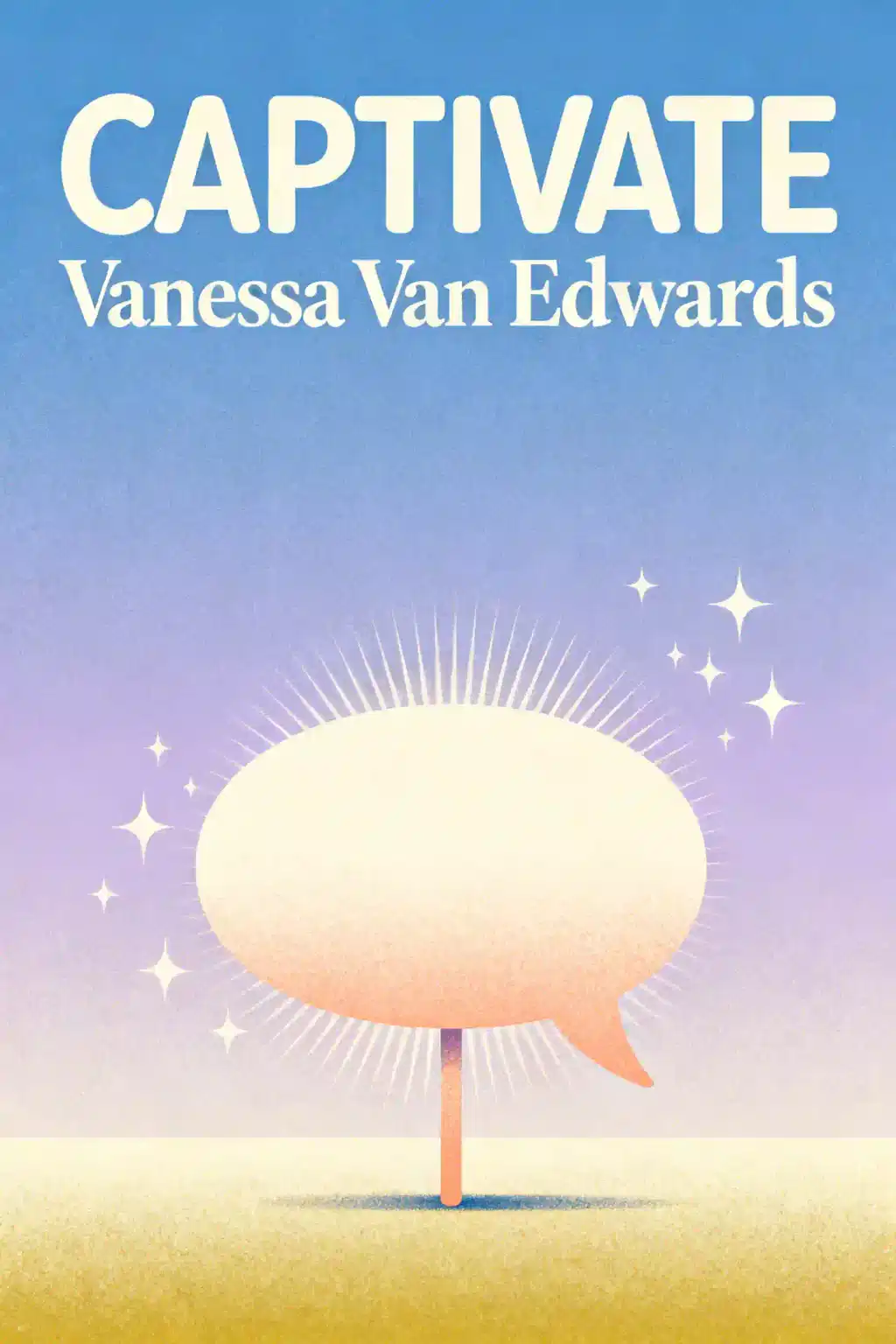
Have you ever felt that awkward silence creep in during a conversation? Or wondered why some people effortlessly command attention while others fade into the background? Vanessa Van Edwards understands this struggle intimately. Once a self-described "recovering awkward person" who volunteered for punch bowl duty at dances and broke out in anxiety-induced hives around the cool kids, Van Edwards transformed her social struggles into expertise through systematic study of human behavior. Her approach, which she calls "behavior hacking," has helped Fortune 500 teams, singles at speed-dating events, and entrepreneurs making pitches. "Captivate" has become a cornerstone text in the field of social dynamics, praised by figures like Gretchen Rubin and Daniel Pink, and featured in publications from The Wall Street Journal to Fast Company. What makes this book particularly powerful is that it doesn't just theorize about social skills-it provides concrete, science-backed techniques that can increase your interpersonal intelligence (PQ) and potentially boost your annual income by $29,000 while making you 42% happier, according to research cited by Van Edwards.
Chapitre 2
Taking Control of Social Situations
Harry Truman secured the Democratic vice presidential nomination in 1944 not through grand speeches but by leveraging personal connections. Working party leaders and delegates one-on-one, he transformed 319.5 votes into 1,031 in just hours. This wasn't mere political maneuvering-it was a masterclass in playing to social strengths.
The science is clear: faking social comfort simply doesn't work. People detect inauthenticity with remarkable accuracy-63% of survey respondents cite "fake people" as their biggest social annoyance. Dr. Barbara Wild's research demonstrates that emotions are contagious, even from brief 500-millisecond exposures to facial expressions. When you force yourself to attend dreaded events, your discomfort spreads like a virus.
Instead of following the misguided advice to "say yes to everything," develop a strategic Social Game Plan that leverages your natural strengths. Begin by mapping your social terrain: identify your "thrive locations" where you naturally excel, neutral locations where you perform adequately, and "survive locations" that drain your energy. Why struggle through networking cocktail parties if coffee meetings bring out your best?
Learning to work a room strategically transforms social interactions. Most people make the mistake of hovering in the "Start Zone" near entrances where everyone is distracted and anxious, or hiding in "Side Zone" traps like food tables and bathrooms. The most successful connectors position themselves in "Social Zone" sweet spots-near the bar exit or close to the host-where meaningful connections happen naturally.
For introverts, becoming a "Grazer" by making multiple trips to the food area creates natural breaks between conversations. The key insight: control where, how, and with whom your interactions take place. Rather than trying to please everyone, identify your ideal connections and target "your people." Just as Van Edwards transformed her business by focusing on high performers with above-average intelligence and busy schedules, you can enhance your social success by playing to your strengths rather than forcing yourself into uncomfortable situations.
Chapitre 3
Making a Killer First Impression
When conductor Arild Remmereit stepped in to lead the Pittsburgh Symphony Orchestra with just hours' notice, he had mere seconds to establish trust with the musicians. The audience witnessed a triumphant performance, unaware of the backstage drama-a testament to how quickly we form impressions that determine the course of relationships.
Harvard researchers Ambady and Rosenthal discovered that people make remarkably accurate character assessments from just two-second video clips of teachers, and these snap judgments matched end-of-semester evaluations. These rapid assessments aren't superficial-they're survival mechanisms helping us quickly determine if someone is worth our time and attention.
First impressions operate on three levels of trust: determining if someone is friend or foe (safety), winner or loser (confidence), and ally or enemy (affinity). Fascinatingly, research comparing popular versus unpopular TED talks found that success wasn't about content but nonverbal delivery. The most viewed TED speakers used nearly twice as many hand gestures (465) as less popular speakers (272), demonstrating that how we communicate matters more than what we say.
To create powerful first impressions, master the Triple Threat technique. First, keep hands visible (never in pockets, which "murder rapport") and offer a perfect handshake-dry, vertical, and firm. Handshakes trigger oxytocin production, facilitating trust. Second, adopt the "Launch Stance"-a modified winner's posture with shoulders back, chin up, and arms away from the torso. Research confirms that confidence matters more than reputation or expertise. Third, maintain proper eye contact (ideally 60-70% of conversation time) to signal alliance and respect.
Together, these nonverbal elements communicate a powerful message: "You can trust me, I have a winning idea, and I'm here to help you." While we can't control others' perceptions entirely, we can significantly influence them by understanding and leveraging the science of first impressions. When we master these elements, we create a foundation for meaningful connection before we've even spoken a word.
Chapitre 4
Creating Dazzling Conversations
Have you ever noticed how some conversations feel like boring kiddie rides at an amusement park-flat, predictable, and forgettable-while others resemble Space Mountain-thrilling and memorable with dynamic peaks and valleys? The difference lies in what Van Edwards calls conversational "sparks"-emotional high points that make interactions memorable.
These sparks aren't just pleasurable; they're neurologically significant. When conversations create emotional peaks, our brains release dopamine, which Dr. John Medina describes as a mental "Post-it note" that flags information as important. By creating conversational sparks, we make ourselves more memorable and our interactions more enjoyable.
The first step to creating sparks is abandoning boring social scripts. In speed networking experiments, the highest-rated conversation starters were "What was the highlight of your day?", "What personal passion project are you working on?", and "Have anything exciting coming up in your life?" The lowest-rated were the common defaults "How are you?" and "What do you do?" Even simple changes like using "howdy" instead of "hey" can increase engagement-OkCupid data shows messages with unique greetings get 40% higher response rates.
The second step is pushing "hot buttons"-topics that light someone up, visible through engagement cues like nodding, leaning in, raising eyebrows, or exclaiming "fascinating!" Finding these passion points creates dopamine spikes and memorable conversations. OkCupid's research shows specific interests in messages (like "metal," "vegetarian," or "zombie") get more responses than generic comments. The most successful communicators reference details they've noticed about the other person, using phrases like "You mentioned" or "I noticed that" to discover potential hot buttons.
Finally, wake people up with slightly unusual or surprising elements that jolt them out of conversational autopilot. This could be handing out lollipops with business cards saying "Learn how not to suck," offering hot cocoa instead of coffee, or having Pop Rocks instead of mints at trade shows. These small surprises create memorable interactions that stand out in a sea of forgettable small talk.
Remember names using the three-step Name Game: Meet and Repeat (say their name immediately), Spell It Out (ask about spelling or pronunciation), and Associate and Anchor (connect their name to something memorable). By abandoning social scripts, igniting genuine connections, and actively listening rather than passively engaging, you transform mundane interactions into dazzling conversations that people will remember long after they've ended.
Chapitre 5
Becoming the Most Memorable Person in the Room
After learning she was an "interrupter" in conversations, Van Edwards took a seven-day Vow of Silence. Rather than hiding away, she attended all her usual social events with only four flash cards to communicate. To her surprise, she made better business connections during her silent week than at a fast-paced industry conference, discovering that "the best conversations aren't about what you say, they are about what you hear."
Harvard neuroscientists found talking about ourselves activates the brain's dopamine system, creating pleasure-people will even forgo money for the opportunity to express opinions. This explains why Dale Carnegie's advice to "be interested" works so well. Van Edwards realized her constant mental preparation of witty responses prevented her from truly listening, while her silence paradoxically won her more friends than her overeagerness.
Alfred P. Sloan transformed General Motors from holding just 12% market share in 1920 to over 52% by 1956 through his listening-driven management style. Nicknamed "Silent Sloan," he personally visited dealerships nationwide, listening to salespeople's suggestions rather than imposing his ideas. In meetings, Sloan rarely spoke except to clarify with questions, concluding with brief summaries and follow-up memos assigning accountability. His approach was so effective that MIT named its management school after him.
To become memorable, become a "highlighter"-someone who genuinely acknowledges and emphasizes the best qualities in others. This isn't about flattery but about honestly acknowledging what's noteworthy in others. Research confirms the Pygmalion effect-the phenomenon where great expectations are met with greatness. Voters labeled "politically active" have higher turnout rates, donors told they're "above-average givers" donate more, and hotel maids told they have "high-intensity jobs" burn more calories. Humans respond powerfully to positive labels, which improve self-image and motivate better performance.
When introducing people, be a "raver" who highlights accomplishments or interesting facts rather than making boring introductions ("John, meet Vanessa"). This approach gives people positive labels, sets up great conversation topics, and gets people talking about themselves (which produces dopamine). Conversely, avoid the golem effect-the opposite of the Pygmalion effect-where low expectations lead to poor performance. Research shows randomly assigned negative labels to Air Force cadets resulted in worse performance.
Being memorable isn't just about listening but how you respond to what you hear. Consider the contrast between dining with a beautiful but forgettable former model who barely spoke, versus interactions with George, a parking lot attendant who shares daily fun facts and solicits them from others. The key insight: "When you tell people they are good, they become better. When you search for what's good, you feel great."
Chapitre 6
Building Authentic Connections Through Similarity
Have you ever experienced that instant connection when discovering someone shares your obscure interest or preference? This isn't coincidence-it's the similarity-attraction effect in action. When Van Edwards' friend Tyler immediately bonded with someone over their shared preference for a specific pen (Pilot G-2 with 0.7mm tip), he was demonstrating how humans naturally seek out people similar to themselves.
Research by Dr. Berscheid and Dr. Walster suggests we enjoy spending time with similar people because: it's easier to get along, agreement validates our opinions, we can better predict their behavior, and we hope they'll be attracted to us. We constantly search for "Me too!" moments in conversation, while "Not me!" statements push people away and shut down connection.
Lewis Howes, who built a successful business after a career-ending sports injury, developed a strategy of finding at least three things he shared with each contact-typically mutual connections, interests, and organizations. His approach evolved from learning from successful people to becoming a connector who helped others build valuable relationships.
To become more socially attractive, use Thread Theory-a three-step process for finding and following threads of similarity. First, search for threads in three categories: People (mutual contacts), Context (the situation you're in), and Interests (shared passions). Use opener questions like "How do you know the host?" or "What brings you here today?" to identify these threads.
Once you find a common thread, deepen the connection by exploring it through asking "why." Toyota founder Sakichi Toyoda's "Five Whys" technique, typically used for problem-solving, becomes a powerful conversation tool. By repeatedly asking why someone feels or thinks something, you move beyond small talk into deeper territory exploring motivations, dreams, and interests.
For special interactions, create ties by connecting your abilities to others' needs. When Lewis Howes asked people what they needed and offered to help, he created deeper bonds. Try ending great meetings with "Can I help you with anything?"-one of the most powerful questions you can ask.
When you can't find a similarity, saying "Teach me" still creates connection. Asking someone to explain something you don't know about establishes a different kind of thread. The key insight: the more you have in common with someone, the more likable you become. By searching for commonalities, going deeper with the Five Whys, and tying yourself to others by making their problems your own, you build authentic connections that transcend superficial interactions.
Chapitre 7
Decoding Hidden Emotions
When "Mary," a suicidal housewife, successfully deceived hospital staff about her improved condition, Dr. Paul Ekman discovered fleeting "microexpressions" of despair on her face that revealed her true emotional state. This breakthrough led to Ekman's groundbreaking research on universal facial expressions, including studies with remote tribes in New Guinea that confirmed these expressions are innate human behaviors rather than learned cultural responses.
Contrary to popular belief, babies don't learn to smile by mimicking parents-congenitally blind babies make the same facial expressions despite never seeing a face. Ekman's research demonstrated that even people with no exposure to Western media could accurately identify emotions in photographs of Americans, and vice versa, proving that facial expressions are universal human behaviors.
Microexpressions-brief, involuntary facial movements that reveal intense emotions-provide a window into people's true feelings regardless of what they say. On The Bachelorette, contestant Arie revealed his racing career to Emily (whose former fiance died in a racing accident). Despite Emily saying she was "totally" okay with Arie's profession, her facial microexpressions of sadness, fear and contempt revealed her true discomfort.
To decode faces effectively, learn to spot Ekman's seven universal microexpressions: anger (marked by lowered pinched eyebrows, vertical creases, tensed eyelids and tightened lips), contempt (a one-sided mouth raise or "smirk"), happiness (genuine smiles involving upper cheek muscles and crow's feet wrinkles), fear (widened eyes, lifted eyebrows and slightly opened mouth), surprise (raised rounded eyebrows, widened eyes and dropped-open jaw), disgust (wrinkled nose, lifted upper lip), and sadness (pinched eyebrow corners, drooping eyelids and downturned mouth corners).
After spotting microexpressions, choose an appropriate response. For anger, see it as an opportunity to explain and address concerns. For contempt, recognize it as a "red flag" that can fester into disrespect if not addressed. For happiness, celebrate and capitalize on it; for fear, address the source and provide comfort; for surprise, clarify understanding; for disgust, give permission to express true feelings; and for sadness, show empathy and understanding.
Beyond the seven universal microexpressions, understand special exceptions: the eyebrow raise indicates interest rather than surprise; facial punctuators are rapid movements that accent speech; and squelching occurs when someone tries to hide a microexpression, creating a mishmash of facial gestures that might indicate lying or concealed feelings.
First impressions online happen within 100 milliseconds of seeing a photo. Common mistakes in profile pictures include showing contempt while trying to look casual, using fake smiles, squinting in sun (resembling anger), or reacting to camera flashes (appearing fearful). By understanding microexpressions, you gain insight into people's true emotions, allowing you to respond appropriately and build deeper connections based on emotional truth.
Chapitre 8
Understanding Personality Types
Richard Nicolosi transformed Procter & Gamble by recognizing that "people come in a host of flavors" and understanding what motivates each individual. His three-step process-using probing questions while observing body language, observing people in action, and listening to language patterns-led to a 68% profit increase by 1988.
The five-factor model of personality (OCEAN)-openness, conscientiousness, extroversion, agreeableness, and neuroticism-emerged in the 1980s as the most accurate personality assessment framework, proving more reliable than Myers-Briggs, DiSC, or Enneagram. Research shows that 35-50% of personality is genetically determined, with upbringing shaping much of the rest-making it futile to try changing others' fundamental nature.
Each trait represents a spectrum: Openness reflects how someone approaches new ideas (high: novelty-seeking; low: tradition-valuing); Conscientiousness describes one's approach to getting things done (high: organized and scheduled; low: big-picture focused); Extroversion indicates how someone approaches people and energy (high: socially energized; low: needing alone time); Agreeableness describes one's approach to cooperation (high: empathetic and caring; low: analytical and practical); and Neuroticism reflects emotional reactivity (high: frequent worrying; low: emotional stability).
To speed-read personalities, first understand your own matrix by identifying where you fall on each trait. Then decode others through direct questions ("I'm reading this book about five personality types..."), observation of verbal cues and nonverbal signals, or analysis of behavioral evidence. Researcher Sam Gosling's work shows how personal belongings and spaces reveal personality traits.
Once you've decoded someone's personality, examine where your traits complement or conflict with theirs. When traits match, communication flows smoothly. When they differ, you have two options: compromise (finding middle ground) or optimize (stepping outside your comfort zone for harmony). For example, if you're highly conscientious but your partner isn't, you might compromise with separate sock drawers or optimize by accepting some disorder in shared spaces.
Knowing someone's personality significantly enhances persuasive effectiveness. For high openness, emphasize exciting new benefits; for low openness, highlight what isn't changing. With high conscientiousness, offer detailed proposals; with low conscientiousness, provide brief executive summaries. Extroverts respond to social proof and group discussions; introverts need time to review proposals privately. High agreeable people need reassurance about others' feelings, while low agreeable people prefer direct, fact-based approaches.
The key insight: understanding personality differences allows for more effective interactions and prevents unnecessary friction in relationships. Rather than trying to change others, learn to decode, optimize for, and predict behavior based on personality traits. This approach transforms frustrating differences into opportunities for deeper connection and more effective communication.
Chapitre 9
Appreciating People in Their Language
Paige Hendrix Buckner built her successful company ClientJoy by understanding that genuine appreciation is a powerful human need-the Department of Labor notes lack of appreciation as the primary reason people leave jobs. Van Edwards shares a personal story about repeatedly missing the mark with elaborate birthday gifts for her father, only to discover that simply watching football with him was his ideal gift-revealing that people express and receive love differently.
Dr. Gary Chapman's concept of the 5 Love Languages explains why: Words of Affirmation (verbal expressions), Gifts (tokens of appreciation), Physical Touch (hugs, embraces), Acts of Service (doing things for others), and Quality Time (simply being present). With Dr. Paul White, Chapman adapted these for professional environments as "appreciation languages." Feeling underappreciated is particularly damaging in workplaces-65% of Americans received no recognition at work in the past year, and while 88% of managers believe money drives turnover, only 12% of employees actually leave for financial reasons.
To identify someone's appreciation language, observe what they do for you-those who hang out may value Quality Time, those who leave notes prefer Words of Affirmation, huggers appreciate Physical Touch. Ask revealing questions about memories, gifts, and celebrations. Microexpressions also reveal preferences: happiness confirms you've hit the mark, while contempt, anger or disgust signal misalignment with someone's appreciation language.
Research by Dr. Gottman and Dr. Levenson shows that couples who use "we" language rather than "me" language have higher relationship satisfaction. The appreciation language hack helps shift to this "we-ness" mentality by considering both your needs and others'. Van Edwards provides specific ways to honor each appreciation language professionally and romantically, with a special caution about appropriate workplace touch.
Using someone's appreciation language is like speaking their native tongue-it creates deeper connection and understanding. Comparing using a non-natural appreciation language to writing with your non-dominant hand highlights why mismatches feel awkward and ineffective. The key insight: appreciation drives life and job satisfaction. By learning your own appreciation languages, decoding others' languages, and actively honoring the languages of important people in your life, you create relationships where everyone feels genuinely valued and understood.
Chapitre 10
Building Deeper Connections Through Stories
When Ty Warner created Beanie Babies with names, birthdays, and stories, he transformed stuffed animals into a $700 million business. Stories create connection by activating the similarity attraction effect, creating conversation sparks, and bonding teller to listener. Research shows that during storytelling, the listener's brain activity synchronizes with the storyteller's-a phenomenon called neural coupling. Even reading sensory words activates the corresponding brain regions, making stories powerful tools for connection.
Van Edwards shares her experience as a college telefund caller, where she initially struggled until a manager advised her to share stories about the university. By focusing first on telling her own Emory stories and then asking alumni for theirs, she created connection that dramatically improved her success rate. This approach transformed her job from frustrating to enjoyable as she "hunted for stories" rather than just asking for donations.
To harness the power of storytelling, create a Story Stack-a framework for organizing and deploying captivating stories in conversation. It consists of three elements: Trigger Topics (common conversation subjects that can launch stories), Sparking Stories (anecdotes that produce laughter or engagement), and Boomerangs (questions that bring the conversation back to the other person). Keep stories under three minutes to avoid becoming a "conversation hog."
Great storytelling requires three key elements: a Hook (an attention-grabbing opening), a Struggle (a challenge or problem that creates suspense), and Provocative Words (descriptive language that activates listeners' brains). Research shows that 35% of viral New York Times articles promised stories-making it the most effective content category.
The most effective stories are authentic and reveal vulnerability. Van Edwards shares how an email about couples fighting that included a personal anecdote about her husband's socks achieved higher engagement than average. Comedian Nicol Paone believes people connect through shared failures: "When you hear someone else's failure you are less judgmental of your own." The best stories balance both failures and successes, creating genuine connection through vulnerability.
Stories are shortcuts to connection that "light up and sync up our brains." By thinking of enjoyable stories, practicing telling them with hooks and expressive language, and creating a system to remember great stories when you hear them, you transform ordinary interactions into meaningful connections that resonate on a neurological level.