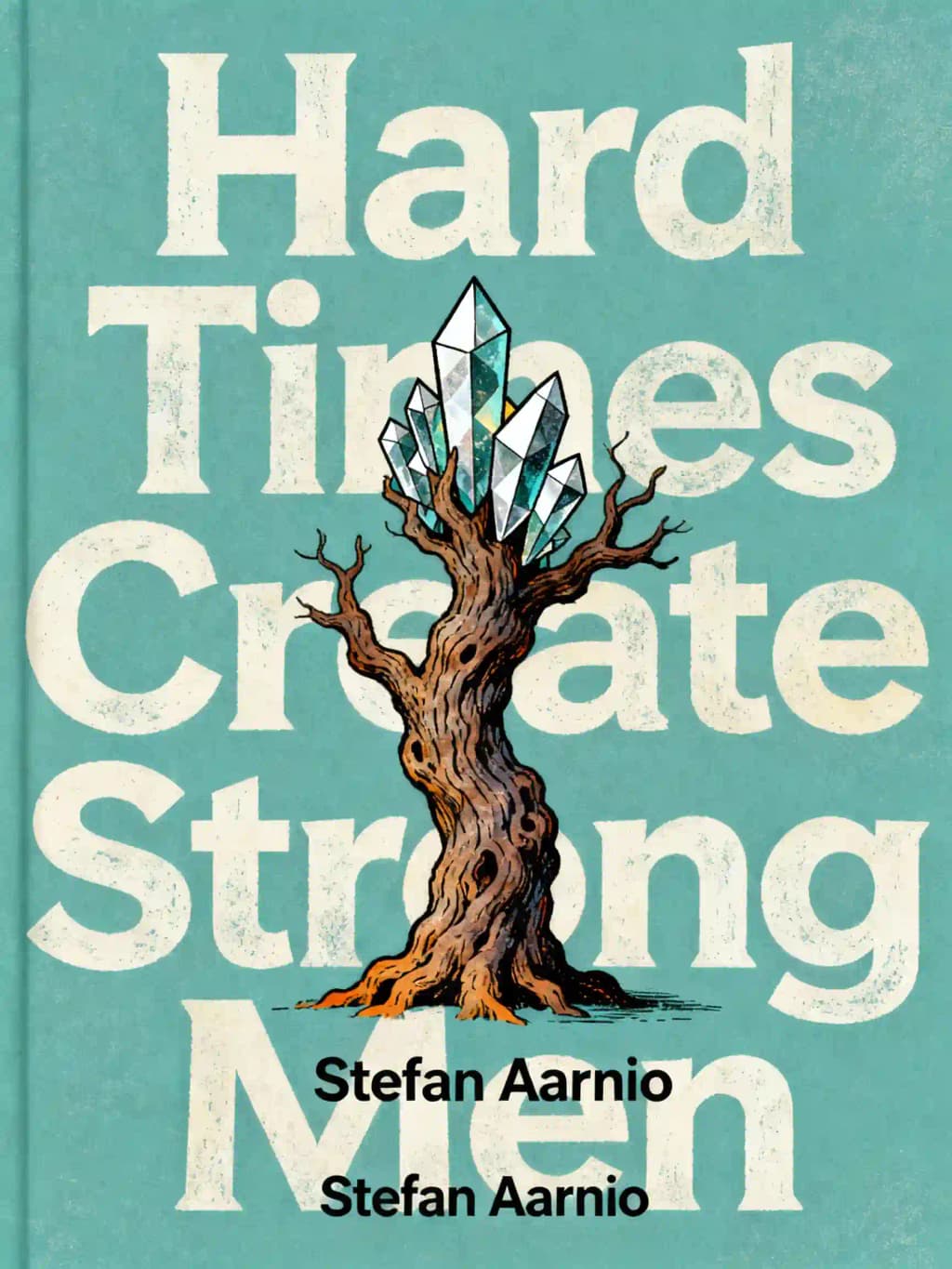
Hard Times Create Strong Men
Aperçu de Hard Times Create Strong Men
In a world where masculinity is questioned, Stefan Aarnio's provocative bestseller explores history's cyclical pattern: "Hard times create strong men." With 1,000+ passionate reviews, this raw manifesto challenges modern males: are you prepared for the coming hard times?

Thèmes clés dans Hard Times Create Strong Men
- traditional masculine virtues
- generational cycle theory
- radical personal responsibility
- fatherless household crisis
- work ethic development
Meilleure citation de Hard Times Create Strong Men
You are not a special and unique snowflake.
Personnages de Hard Times Create Strong Men
- Stefan AarnioAuthor and real estate entrepreneur
- Stefan Aarnio's fatherA man whose failures illustrate the book's themes
- Stefan Aarnio's motherThe breadwinner who grew resentful of her role
À propos de l'auteur
À propos de l'auteur de Hard Times Create Strong Men
Stefan Aarnio (1986–2020), author of the provocative self-help manifesto Hard Times Create Strong Men, was an award-winning real estate investor and unconventional thought leader. A self-made millionaire who built a multimillion-dollar portfolio from $1,200, Aarnio channeled his entrepreneurial grit into exploring societal cycles, masculinity, and leadership through historical case studies and contrarian philosophies.
His 2014 Rich Dad International Hall of Fame win and features in Entrepreneur Magazine’s “Top 10 Real Estate Influencers” list cemented his authority in wealth-building strategies, detailed in earlier works like Money People Deal and The Oracle.
The book’s creation during an 18-day fasting retreat reflects Aarnio’s intense, experiential approach to personal development. His BlackCard Elite Academy coaching platform and viral blog posts amplified his direct, challenge-driven style that polarizes readers.
Despite controversy over its gender role commentary, the posthumously impactful work gained recognition through Aarnio’s final battle with cancer, chronicled in later writings. Five of his eight published books analyze success frameworks, with Hard Times Create Strong Men remaining his most debated legacy.
Telecharger le resume de Hard Times Create Strong Men
Obtenez le resume de Hard Times Create Strong Men en PDF ou EPUB gratuit. Imprimez-le ou lisez-le hors ligne a tout moment.
FAQ sur ce livre
Hard Times Create Strong Men explores the cyclical nature of societal strength, arguing that adversity fosters resilient leadership while prosperity breeds complacency. Stefan Aarnio examines modern masculinity through themes like work ethic, discipline, and personal responsibility, using historical examples and critiques of contemporary culture. The book challenges readers to embrace traditional masculine values to navigate challenges in money, sex, religion, and politics.
This book is ideal for men—particularly young men—seeking guidance on reclaiming purpose, discipline, and leadership in a society Aarnio views as increasingly hostile to masculinity. It’s also relevant for readers interested in societal cycles, self-improvement, or critiques of modern gender roles. Critics note its politically incorrect tone may polarize audiences.
Yes, for those open to its confrontational style. Readers praise its actionable advice on overcoming distractions (e.g., porn, video games) and building discipline. However, some criticize its abrasive tone and reliance on stereotypical masculinity. Fans describe it as life-changing, while detractors call it divisive.
The core idea is the historical cycle: Hard times → strong men → good times → weak men → hard times. Aarnio argues that modern comfort has weakened men’s resilience, threatening societal stability. He advocates for reclaiming “strong man” traits—leadership, accountability, and frugality—to reverse this decline.
Aarnio critiques “man-boys” addicted to instant gratification and dismisses “toxic masculinity” narratives. He champions traits like problem-solving, manual labor, and family leadership, urging men to prioritize work over fleeting pleasures. The book contrasts modern vulnerabilities with historical examples of wartime or economic hardship.
- Focus on purpose-driven work over distractions like social media or porn.
- Build discipline through routine, physical labor, and financial prudence.
- Reject victimhood by taking ownership of failures and societal contributions.
Aarnio cites post-war generations and economic depressions to illustrate how adversity shapes resilience. He contrasts these with modern “weak men” shaped by abundance, arguing that societies thrive only when men embrace struggle and sacrifice.
- “The reality is, it is a jungle out there; young men need to be better informed.” (Gene Simmons) – Emphasizes preparation and realism.
- “A man’s purpose is his work; you are not a unique and beautiful snowflake.” – Rejects entitlement in favor of productivity.
Aarnio blames feminism, welfare systems, and “participation trophy” mentalities for eroding male accountability. He argues these forces discourage risk-taking and promote dependency, undermining traditional masculine roles.
Critics call it overly cynical, reductionist, and dismissive of systemic issues. Some argue Aarnio’s solutions (e.g., rejecting modern comforts) are unrealistic. Others dislike his binary view of strength/weakness and politically incorrect language.
Both books emphasize primal masculine virtues, but Aarnio focuses more on societal cycles and practical self-improvement. While Jack Donovan’s The Way of Men explores tribal masculinity, Aarnio ties strength to economic and familial leadership.
Stefan Aarnio, a Canadian real estate investor and author, passed away from cancer in 2020. His abrupt death sparked renewed interest in his works, with readers praising his blunt yet motivational style.
Many report increased motivation to pursue goals, quit addictions, and prioritize family. Critics caution against its extreme rejection of modernity. The book’s polarizing nature fuels debates on masculinity’s role in 2025.