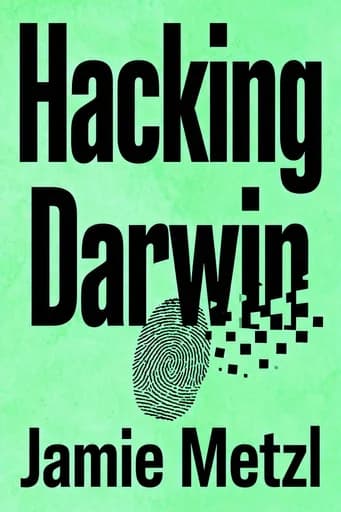
Hacking Darwin
Genetic Engineering and the Future of Humanity
Aperçu de Hacking Darwin
Genetic engineering is reshaping humanity's future. In "Hacking Darwin," Jamie Metzl explores our biological evolution's next frontier - praised by Siddhartha Mukherjee as "groundbreaking." What happens when we can design our children? This 2019 nominee challenges our deepest beliefs about being human.
Thèmes clés dans Hacking Darwin
- human genetic engineering
- embryo selection ethics
- directed evolution
- crispr technology impact
- future of reproduction
Citations de Hacking Darwin
We are beginning to hack Darwin.
Our mutations will no longer be random but self-designed.
Conception through sex may be seen as unnecessarily risky.
Every human needs to participate in answering these questions.
Darwin's rules are changing.
Personnages de Hacking Darwin
- Jamie MetzlAuthor and expert on the genetic revolution
- Samuel SchenkScientist who discovered egg fertilization in 1878
- Louise BrownThe first person born via IVF (test-tube baby)
- Charles DarwinNaturalist whose rules of evolution are changing
À propos de l'auteur
À propos de l'auteur de Hacking Darwin
Jamie Metzl, author of Hacking Darwin: Genetic Engineering and the Future of Humanity, is a bestselling technology futurist and geopolitical expert renowned for decoding the ethical and societal implications of emerging sciences.
A Senior Fellow at the Atlantic Council and former National Security Council official, Metzl’s work bridges biotechnology, AI, and global governance. His nonfiction exploration of genetic engineering in Hacking Darwin draws from his role on the World Health Organization’s expert advisory committee on genome editing and his decades of policy leadership.
Metzl’s acclaimed science fiction novels, including Genesis Code and Eternal Sonata, similarly grapple with biotech ethics, blending speculative narratives with real-world science. A frequent commentator on CNN, BBC, and 60 Minutes, he holds a PhD in Southeast Asian history from Oxford and a Harvard law degree.
Hacking Darwin has been translated into 15 languages and cited in congressional hearings on biotechnology security. An Ironman triathlete, Metzl’s interdisciplinary authority spans academia, policy, and public discourse.
Telecharger le resume de Hacking Darwin
Obtenez le resume de Hacking Darwin en PDF ou EPUB gratuit. Imprimez-le ou lisez-le hors ligne a tout moment.
FAQ sur ce livre
Hacking Darwin explores the genetic engineering revolution and its ethical implications for humanity’s future. Jamie Metzl examines CRISPR technology, embryo selection, and gene editing’s potential to eradicate diseases or create genetic disparities. The book connects historical evolutionary biology with emerging tech trends, warning of a possible genetic arms race while advocating for global ethical frameworks.
This book is essential for futurists, bioethicists, policymakers, and anyone interested in biotechnology’s societal impacts. Readers of Homo Deus or The Gene will appreciate its interdisciplinary approach blending science, ethics, and geopolitics.
Yes—Metzl’s 2019 predictions about accelerating gene-editing advancements remain critically relevant. The book’s analysis of CRISPR, designer babies, and longevity research provides foundational knowledge for navigating today’s debates about AI-aided genetic engineering and equitable access to biotech.
Metzl highlights risks like genetic inequality, unintended mutations, and state-sponsored eugenics programs. He argues uncontrolled editing could create a “genetic underclass” while emphasizing the need for international oversight to prevent exploitation.
CRISPR is presented as a revolutionary gene-editing tool enabling precise DNA modifications. Metzl details its applications in curing genetic diseases, enhancing physical traits, and potentially extending human lifespans, while cautioning about its military and commercial misuse.
Metzl holds a Ph.D. in Southeast Asian history from Oxford but has advised the WHO on genome editing and served as a biotechnology executive. His expertise combines geopolitical strategy with scientific literacy, validated by his Atlantic Council and Singularity University roles.
While Yuval Harari’s Homo Deus speculates broadly about post-human futures, Metzl’s work focuses specifically on genetic engineering’s near-term implications. Both books critique unchecked technological power, but Hacking Darwin offers concrete policy recommendations for biotech governance.
He advocates for a global regulatory body similar to the IAEA, transparent public-private research partnerships, and ethical guidelines prioritizing health equity over enhancement. Metzl stresses the urgency of preemptive action before technologies become weaponized.
Yes—the book analyzes preimplantation genetic testing (PGT) and embryo selection, which could evolve into trait customization. Metzl warns that unregulated markets might commodify genetic “upgrades,” exacerbating social inequalities.
Metzl explores telomere extension, senescence reversal, and AI-driven drug discovery as potential longevity breakthroughs. He questions whether life extension would benefit society broadly or only wealthy elites.
Some reviewers argue Metzl overstates near-term capabilities of gene editing while underestimating technical hurdles. Others note the book focuses more on Western perspectives, lacking input from Global South scientists.
Metzl predicts AI will accelerate genetic research by analyzing massive genomic datasets and simulating edits. This synergy could democratize access to treatments—or enable hyper-targeted bioweapons if misused.
It warns nations might compete to develop enhanced soldiers, cognitively superior workforces, or pathogen-resistant populations. Metzl compares this to the Cold War space race but with higher existential stakes.
Case studies include China’s CRISPR-edited twins, mitochondrial replacement therapy in the UK, and the U.S. military’s interest in performance-enhanced troops. These examples illustrate both medical promise and ethical gray areas.