Discover why Wall Street Journal bestseller "Getting to Zero" transforms relationship conflicts into growth opportunities. Endorsed by relationship guru Harville Hendrix, Gaddis' LUFU method revolutionizes how we navigate high-stakes conversations. What emotional threshold is blocking your deepest connections?
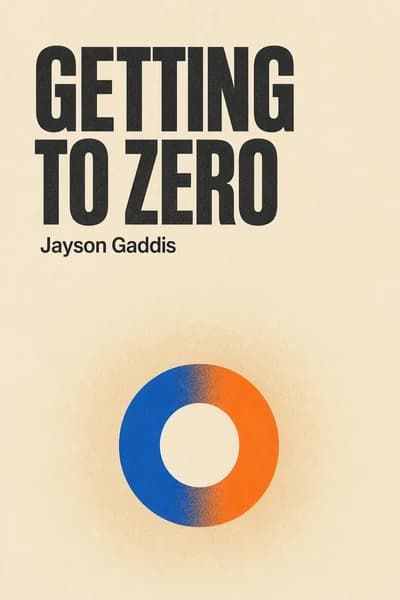
Jayson Gaddis, author of Getting to Zero: How to Work Through Conflict in Your High-Stakes Relationships, is a bestselling relationship expert, conflict resolution specialist, and founder of The Relationship School®. A licensed professional counselor turned global educator, Gaddis combines 20+ years of crisis intervention experience—including work with domestic violence survivors and Fortune 500 leaders—with practical tools for transforming conflict into deeper connection. His book, blending self-help and leadership development, addresses communication mastery and emotional resilience in personal and professional relationships.
Gaddis hosts The Relationship School Podcast (6+ million downloads, 450+ episodes), featuring thought leaders like Dr. Dan Siegel and Dr. Gabor Maté. Through his Boulder-based coaching practice and online programs, he trains individuals and teams in Interpersonal Intelligence® and Present Centered Relationship Coaching®. Recognized as a 2021 Amazon Editors’ Choice pick, Getting to Zero won Best Non-Fiction and Best Leadership/Business Book awards, cementing its status as a modern conflict resolution manual for couples and executives alike.
Getting to Zero provides a roadmap for transforming conflict into connection in high-stakes relationships. Jayson Gaddis teaches practical tools like the "Conflict Box" framework and NESTR meditation to navigate disagreements, resolve emotional triggers, and achieve "zero"—a state of resolved tension and deeper relational bonds. The book blends personal stories, neuroscience insights, and actionable strategies to upgrade traditional conflict resolution methods.
This book is ideal for couples, therapists, coaches, and professionals seeking to improve communication in personal or workplace relationships. It’s especially valuable for those avoiding difficult conversations or stuck in repetitive conflicts. Gaddis’ approach appeals to readers wanting science-backed methods to build emotional resilience and relational trust.
Yes, it’s praised for its street-level applicability to modern relationship challenges. The Wall Street Journal bestseller combines academic rigor with relatable anecdotes, offering fresh alternatives to outdated conflict resolution models. Readers gain skills to stop avoiding disagreements and instead use them as catalysts for intimacy.
The Conflict Box helps users visualize and navigate four stages of conflict: Trigger, Story, Feelings, and Need. By identifying which stage they’re in, individuals can avoid escalation, address core issues, and shift from disconnection to resolution. This tool is central to Gaddis’ method for breaking cyclical arguments.
Gaddis explains triggers as rooted in primal survival instincts (e.g., fear of abandonment or criticism). The book teaches "relational blueprint" awareness—understanding how childhood patterns shape adult reactions—and offers practices like mindfulness and vocal toning to regulate nervous system responses during conflicts.
These emphasize facing disagreements courageously and recognizing how evasion perpetuates disconnection. Gaddis uses quotes to reinforce that conflict, when managed well, strengthens relationships.
Unlike theoretical guides, Getting to Zero focuses on real-time, high-stakes scenarios (e.g., marital disputes or workplace tensions). It diverges from "quick fix" approaches by emphasizing emotional accountability and collaborative problem-solving, akin to Esther Perel’s work but with more structured frameworks.
Some reviewers note the concepts require consistent practice to master, which may challenge time-strapped readers. Others suggest the methods work best with a therapist or coach, as solo application during intense conflicts can feel overwhelming.
Gaddis’ “NESTR” technique (Name, Empathize, Safety, Timeout, Repair) helps de-escalate team tensions. The book also advises leaders to model vulnerability by openly addressing misunderstandings, fostering cultures where conflict drives innovation rather than toxicity.
In an era of polarized discourse and remote-work challenges, its tools for bridging emotional divides remain critical. The rise of AI-mediated communication heightens the need for Gaddis’ emphasis on face-to-face connection and embodied conflict resolution practices.
This idea refers to unconscious patterns formed in childhood that dictate how we handle conflict as adults. Gaddis teaches readers to identify and rewrite these blueprints through reflective exercises and intentional communication habits.
As a former “emotionally constipated” man and founder of The Relationship School®, Gaddis draws from 20+ years of coaching experience and personal marital struggles. His blend of academic training and lived authenticity lends credibility to the book’s advice.
Ressentez le livre à travers la voix de l'auteur
Transformez les connaissances en idées captivantes et riches en exemples
Capturez les idées clés en un éclair pour un apprentissage rapide
Profitez du livre de manière ludique et engageante
Good relationships aren't defined by an absence of conflict but by the ability to work through it.
Conflicts are primarily triggered by feeling threatened.
The trigger scale measures our activation level from 0-10.
Unless a child's self-expression has been cultivated through secure attachment relationships, the Strategic Self dominates.
Décomposez les idées clés de Getting to Zero en points faciles à comprendre pour découvrir comment les équipes innovantes créent, collaborent et grandissent.
Condensez Getting to Zero en indices de mémoire rapides mettant en évidence les principes clés de franchise, de travail d'équipe et de résilience créative.

Découvrez Getting to Zero à travers des récits vivants qui transforment les leçons d'innovation en moments mémorables et applicables.
Posez n'importe quelle question, choisissez la voix et co-créez des idées qui résonnent vraiment avec vous.

Cree par des anciens de Columbia University a San Francisco
"Instead of endless scrolling, I just hit play on BeFreed. It saves me so much time."
"I never knew where to start with nonfiction—BeFreed’s book lists turned into podcasts gave me a clear path."
"Perfect balance between learning and entertainment. Finished ‘Thinking, Fast and Slow’ on my commute this week."
"Crazy how much I learned while walking the dog. BeFreed = small habits → big gains."
"Reading used to feel like a chore. Now it’s just part of my lifestyle."
"Feels effortless compared to reading. I’ve finished 6 books this month already."
"BeFreed turned my guilty doomscrolling into something that feels productive and inspiring."
"BeFreed turned my commute into learning time. 20-min podcasts are perfect for finishing books I never had time for."
"BeFreed replaced my podcast queue. Imagine Spotify for books — that’s it. 🙌"
"It is great for me to learn something from the book without reading it."
"The themed book list podcasts help me connect ideas across authors—like a guided audio journey."
"Makes me feel smarter every time before going to work"
Cree par des anciens de Columbia University a San Francisco

Obtenez le resume de Getting to Zero en PDF ou EPUB gratuit. Imprimez-le ou lisez-le hors ligne a tout moment.
Have you ever noticed how the people you care about most are also the ones who can trigger your deepest reactions? This isn't coincidental. "Getting to Zero" reveals a profound truth: conflict isn't something to avoid-it's the pathway to deeper connection. Most of us were taught that fighting is "bad" and that simple apologies fix complex situations. But this avoidance creates a painful paradox: we need deep connection for wellbeing, yet achieving that connection requires navigating the very conflicts we're programmed to avoid. Research consistently shows that relationships are crucial to our health and longevity. The quality of our connections directly impacts everything from immune function to mental health. Yet many trade authentic self-expression for superficial harmony, fearing that honesty will lead to abandonment. This creates relationships that look peaceful on the surface but lack depth and resilience. Good relationships aren't defined by an absence of conflict but by the ability to work through it. The most successful couples have mastered not conflict avoidance but conflict navigation-the ability to move from disconnection back to connection through what's called the Conflict Repair Cycle. Think about it: when was the last time avoiding a difficult conversation actually made your relationship stronger?