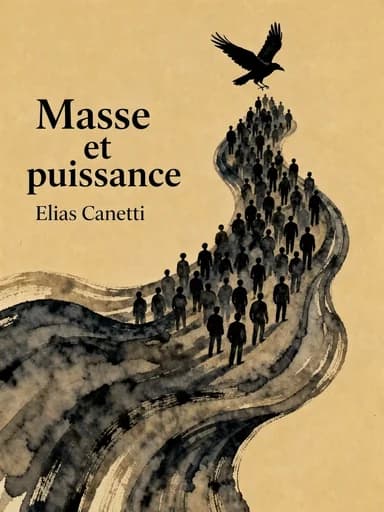
Nobel laureate Elias Canetti's "Crowds and Power" explores humanity's primal fear of touch and how it shapes mass behavior. Initially baffling critics, this 1960 masterpiece now influences fields from sociology to military strategy - revealing why crowds can transform from unified purpose to destructive force.
Elias Canetti (1905–1994), Nobel Prize-winning author of Crowds and Power, was a visionary polymath whose incisive explorations of mass psychology and societal dynamics redefined 20th-century social theory.
Born in Ruse, Bulgaria, to a multilingual Sephardic Jewish family, his upbringing across Europe—from Vienna to Zurich—shaped his penetrating analysis of cultural identity and collective behavior.
A trained chemist who abandoned the lab for literature, Canetti fused anthropological rigor with literary artistry, exemplified in his seminal nonfiction work Crowds and Power (1960), which dissects the mechanics of power through historical and mythological lenses. His acclaimed modernist novel Auto-da-Fé (1935) and autobiographical trilogy, including The Tongue Set Free, further cement his legacy as a chronicler of human obsession and intellectual extremes.
Awarded the 1981 Nobel Prize in Literature for works of "broad outlook, wealth of ideas, and artistic power," Canetti’s interdisciplinary insights continue to influence philosophy, political science, and cultural studies. Crowds and Power remains a cornerstone text in understanding group behavior, translated into over 30 languages and routinely cited in academic and policy circles.
Crowds and Power examines the psychological dynamics of crowds and their transformation into lasting power structures. Canetti explores how primal fears drive human behavior, analyzing how temporary crowds evolve into institutions through leaders, rituals, and symbolic destruction. Key themes include the dissolution of individuality in crowds, the role of fear in shaping societies, and historical examples like the French Revolution.
This book is ideal for scholars of sociology, political science, and psychology, as well as activists and leaders seeking to understand collective behavior. Its interdisciplinary insights into power dynamics and crowd psychology also appeal to readers interested in historical revolutions, social movements, or human behavior under pressure.
Yes, for its groundbreaking analysis of crowd behavior and power structures. While criticized for its Eurocentric focus and lack of empirical data, the book offers unparalleled literary depth and provocative ideas about fear, survival, and institutionalization. It remains a seminal text for understanding collective action and societal transformation.
Canetti argues that crowds crystallize into power structures through shared rituals, symbolic acts (like burning objects), and charismatic leaders. The French Revolution exemplifies this: chaotic crowd energy institutionalized into a republic, embedding ideals like liberty into governance. This process channels raw collective emotion into enduring hierarchies.
Fear of the unknown—particularly physical touch—drives humans to create barriers (homes, clothing) and seek safety in crowds. Within crowds, fear dissolves as hierarchies collapse, enabling destructive or revolutionary acts. Canetti posits that power structures exploit fear to control populations, offering security in exchange for obedience.
Crowd crystals are small, organized groups (e.g., religious sects or political cells) that attract larger crowds. They act as catalysts, providing structure and purpose to otherwise chaotic masses. These crystals enable rapid crowd formation and direction, shaping movements from revolutions to religious gatherings.
Leaders emerge by embodying the crowd’s desires, often using symbolic gestures or rhetoric to direct its energy. Once in power, they institutionalize the crowd’s ethos, becoming gatekeepers of its ideals. However, Canetti suggests leaders harbor a darker urge to be the "sole survivor," wielding power to eliminate rivals.
Canetti cites the French Revolution’s shift from mob rule to republicanism, the Xhosa tribe’s self-destructive cattle-killing ritual, and Shiite Ashura self-mutilation practices. These examples illustrate how crowds oscillate between liberation and destruction, often leaving lasting societal imprints.
Critics highlight its reliance on anecdotal evidence, Eurocentric bias, and vague definitions. Some argue Canetti overlooks economic factors in crowd behavior and overemphasizes primal instincts. Despite this, the work is praised for its poetic prose and innovative framework for analyzing power.
The book’s insights into crowd psychology resonate with modern movements like BLM or digital activism. Canetti’s analysis of anonymity in crowds explains online mobilization, while his focus on fear and leadership illuminates how movements institutionalize demands into policy or cultural change.
Power, for Canetti, is rooted in the desire to outlast others. Leaders crave being the "sole survivor," using dominance to eliminate threats. This aligns with historical tyrants who equated power with immortality, though democratic leaders also channel survival instincts into legacy-building.
Crowds often target symbols of hierarchy (statues, buildings) to erase existing power structures. Destruction creates unity and catharsis, as seen in revolutions or riots. Canetti ties this to a primal urge to dismantle barriers, arguing that such acts redefine social order.
Ressentez le livre à travers la voix de l'auteur
Transformez les connaissances en idées captivantes et riches en exemples
Capturez les idées clés en un éclair pour un apprentissage rapide
Profitez du livre de manière ludique et engageante
All the distances which men create round themselves seem to be dictated by this fear.
It is only in a crowd that man can become free of this fear of being touched.
Nothing terrifies humans more than unexpected touch.
Like a wildfire, they must expand or die.
Décomposez les idées clés de Crowds and power en points faciles à comprendre pour découvrir comment les équipes innovantes créent, collaborent et grandissent.
Découvrez Crowds and power à travers des récits vivants qui transforment les leçons d'innovation en moments mémorables et applicables.
Posez vos questions, choisissez votre style d’apprentissage et co-créez des idées qui vous correspondent vraiment.

Cree par des anciens de Columbia University a San Francisco
"Instead of endless scrolling, I just hit play on BeFreed. It saves me so much time."
"I never knew where to start with nonfiction—BeFreed’s book lists turned into podcasts gave me a clear path."
"Perfect balance between learning and entertainment. Finished ‘Thinking, Fast and Slow’ on my commute this week."
"Crazy how much I learned while walking the dog. BeFreed = small habits → big gains."
"Reading used to feel like a chore. Now it’s just part of my lifestyle."
"Feels effortless compared to reading. I’ve finished 6 books this month already."
"BeFreed turned my guilty doomscrolling into something that feels productive and inspiring."
"BeFreed turned my commute into learning time. 20-min podcasts are perfect for finishing books I never had time for."
"BeFreed replaced my podcast queue. Imagine Spotify for books — that’s it. 🙌"
"It is great for me to learn something from the book without reading it."
"The themed book list podcasts help me connect ideas across authors—like a guided audio journey."
"Makes me feel smarter every time before going to work"
Cree par des anciens de Columbia University a San Francisco

Obtenez le resume de Crowds and power en PDF ou EPUB gratuit. Imprimez-le ou lisez-le hors ligne a tout moment.
A rock concert surges around you. Bodies press from every side. Suddenly, that person against your shoulder doesn't feel like a stranger anymore-they feel like you. Your separateness dissolves into something larger, electric, alive. This sensation, simultaneously liberating and terrifying, reveals humanity's most primal social force: the crowd. Nothing shapes our world more profoundly than this ancient dynamic, yet we rarely examine it. From religious gatherings to political revolutions, from sports stadiums to digital mobs, crowds transform individuals into something entirely different. They create moments of ecstatic unity and horrifying violence, often within the same breath. Understanding crowds means understanding the hidden architecture of human civilization itself-the invisible forces that turn isolated individuals into movements capable of toppling empires or building cathedrals.
We spend our lives defending against touch-multiple locks, elevator bubbles, violent flinching when touched during sleep. This visceral fear shapes everything from urban design to social etiquette, creating elaborate systems of separation. Yet in crowds, this fear transforms. Body pressed against body, all distinctions vanish. A CEO stands shoulder-to-shoulder with a janitor. Those carefully constructed boundaries simply disappear. This explains the crowd's peculiar magnetism. People surrender to crowds precisely to escape the burden of separation and individuality. The denser the crowd, the greater the relief. Within this mass, we shed the weight of rank, status, and property-all those artificial distances causing us to "petrify and darken" in isolated social roles. But this equality contains dangerous illusion. Eventually, people must return to separate houses, possessions, and identities. Only continued growth prevents this retreat. Open crowds recognize no boundaries, constantly seeking expansion-like wildfire, they must grow or die. Closed crowds-churches, theaters, stadiums-sacrifice growth for permanence, maintaining collective power through ritual rather than constant expansion.
Watch any riot unfold and you'll notice something disturbing: the almost joyful destruction. Crowds fixate on shattering anything representing established order-breaking windows, smashing mirrors, destroying glass. These acts produce satisfying sounds of "fresh life" while symbolically violating boundaries. This destruction serves deeper purpose. When crowds attack doors, windows, and containers, they're assaulting the very symbols of separation that keep humans apart. Closed doors particularly irritate because they represent boundaries the crowd seeks to eliminate. Fire becomes the crowd's most powerful expression-visible from afar, attracting more people, destroying irrevocably, spreading with the same contagious energy as the crowd itself. The crowd perceives itself as perpetually persecuted, developing angry sensitiveness toward designated enemies. Like a besieged city, it feels threatened from all sides. This persecution complex drives the hunger for growth-it must constantly increase or face starvation. When growth becomes impossible, panic reveals the fragile nature of crowd unity. A theater fire demonstrates this perfectly: unified feeling quickly disintegrates. Each person sees only the exit as salvation, violently fighting against others who become hostile obstacles rather than fellow humans. From the French Revolution to modern movements, this pattern repeats-transformation from unified purpose to chaotic individualism when crowds face containment or threat.
Before modern crowds, humans organized in packs - small bands where members maintain individual identity while moving between center and edge. Their strength lies in continuity: knowing each other well, they can always reform when scattered. Four fundamental pack forms exist, each transforming into another. The hunting pack pursues dangerous prey with singular focus. The war pack confronts equal opponents, seeking complete annihilation. The lamenting pack channels collective grief into frenzied excitement. The increase pack performs rituals expressing dissatisfaction with current numbers, seeking growth. Religion emerges through transmutation between pack types. The Lele tribe's communal hunts reinforce social structure through strict distribution rules, explicitly linking hunting and childbearing as equivalent male and female productivity. The Jivaros transform war into increase rituals. Believing all deaths result from enemy sorcery requiring vengeance, they take only shrunk heads as trophies. These become centerpieces for elaborate feasts where circular dances invoke hunted animals, asking heads to grant sexual potency. Islam manipulates invisible crowds through four assemblies: daily prayer packs, Holy War gatherings, Mecca pilgrimage, and Last Judgment. More than other religions, Islam emphasizes invisible double crowds in eternal opposition - believers and unbelievers destined to fight.
A nation's identity stems from its crowd symbols-carrying density, growth, cohesion, rhythm, and discharge-not geography or language. The English identify with the sea through a captain commanding a ship, revealing their individualism: the captain stands alone with absolute authority over a sea that exists to be ruled, manifesting in the Royal Navy's prominence and Britain's "island fortress" metaphor. The Dutch symbol is the dyke-a human wall opposing the sea. Unlike the English who rely on ships, the Dutch wrest land from water itself, shaping their culture of collective effort and consensus-based decision-making. The German crowd symbol is the marching forest-orderly upright trees whose density fills Germans with deep delight. Army and forest transfuse each other: bark resembles armor, grouped trees suggest uniformed soldiers, representing both natural power and disciplined order. The French symbol is their revolution, celebrated annually when streets fill and anyone may dance with anyone. This periodic outbreak recalls how revolutionary armies conquered Europe, continuing to influence French political culture through frequent protests. These symbols explain historical developments like Nazism's rise. When World War I erupted, Germany became one open crowd. Hitler's rise depended on the Treaty of Versailles disbanding the German army-the prohibition on universal military service transformed this closed crowd into an open one, with the Nazi party becoming its substitute.
Power masks its intentions through elaborate strategies. Filippo Maria Visconti interrogated men for days before revealing his purpose; Stalin made casual conversation before pronouncing death sentences. Commands embody power's most dangerous element. Predating speech itself, they derive from the original "flight-command"-a death sentence forcing victims to flee from stronger predators. The survivor represents mankind's darkest impulse. Standing alive while others lie dead creates profound triumph and corrupting superiority-manifesting as survivor's guilt or justification for further violence. The survivor feels chosen among many who faced identical dangers but perished. All designs on immortality contain this desire to outlast others, from Egyptian pharaohs building pyramids to billionaires funding life-extension research. Today's critical question: can we contain the survivor, now amplified by technology? A single individual can destroy much of mankind using technical means he doesn't understand while remaining hidden and risking nothing. The ancient principle of power-safeguarding the ruler at others' cost-has collapsed under mutual assured destruction. Today either everyone survives or no one.
In our world of declining religious authority and exploding production, enormous crowds stand armed but reluctant for war. Countries protect productivity over people. War is dying, replaced by peaceful power rotation and worldwide sport. Yet Christianity's legacy persists in the image of the dying man who ought not to die. Through centuries of veneration, Christ's suffering has become part of human consciousness. Anyone persecuted sees himself as Christ. The most urgent challenge is confronting the survivor's most dangerous activity: giving commands. The command, even domesticated, is a suspended death sentence. Anyone who suddenly seizes control acquires abnormal command anxiety and inevitably tries to dispel it. The threat he constantly uses ultimately turns against himself. His ultimate deliverance is the sudden command for mass death-starting wars where his own people die, secretly relieving his command anxiety. Our collective future depends on recognizing these ancient patterns. The thrill of dissolving into the crowd carries both creative and destructive potential. The same force that builds cathedrals can torch cities. Only by seeing these patterns clearly-in ourselves, in our leaders, in our movements-can we hope to channel them toward life rather than destruction. The question isn't whether crowds will form, but whether we'll recognize the ancient dynamics at play when boundaries dissolve and commands are issued.