Chapitre 1
When Enemies Must Work Together: The Radical Art of Stretch Collaboration
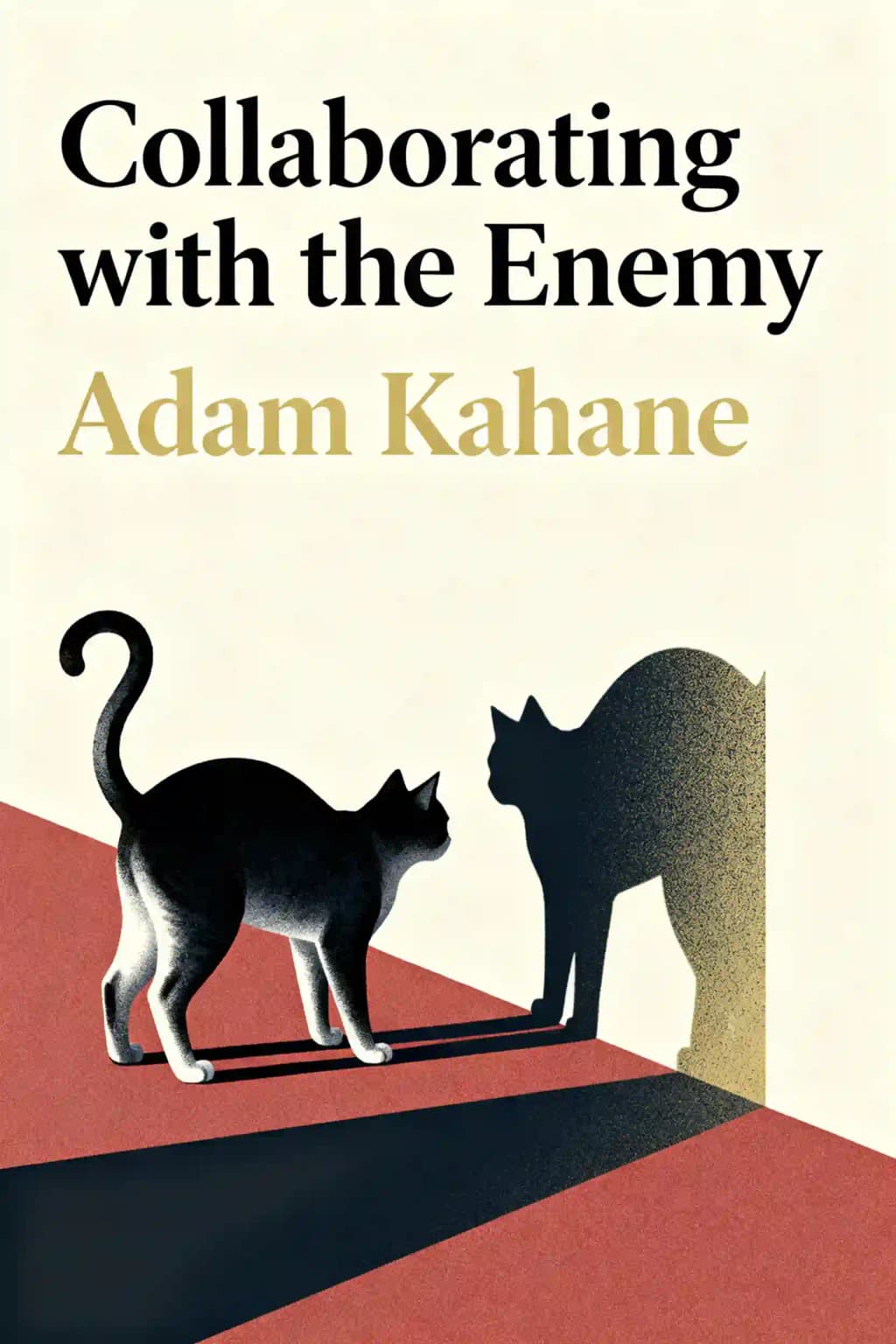
In a world increasingly divided by ideology, politics, and values, Adam Kahane's "Collaborating with the Enemy" arrives as a timely antidote to our polarized discourse. This groundbreaking work has been compared to classics like Sun Tzu's "The Art of War" and Machiavelli's "The Prince" for its practical wisdom on navigating human conflict. Drawing from his twenty-five years facilitating high-stakes collaborations across the globe-from South Africa's transition from apartheid to Colombia's peace process-Kahane challenges our fundamental assumptions about how to work with those we don't agree with, like, or trust.
The book has developed a cult following among leaders across sectors, with former Colombian President and Nobel Peace Prize winner Juan Manuel Santos crediting Kahane's work as "one of the most significant events in the country's search for peace." What makes this book particularly remarkable is how it transforms the seemingly impossible-working productively with enemies-into a learnable skill set that applies equally to international conflicts, corporate boardrooms, and family dinner tables.
Chapitre 2
The Collaboration Paradox: More Necessary Yet More Difficult
We face an increasing paradox in our complex, interconnected world: collaboration is becoming simultaneously more essential and more challenging. The more we need to work together, the harder it becomes-especially with those we consider opponents. This dynamic plays out across sectors, from global climate negotiations to local community projects, where interdependence demands cooperation even as differences intensify.
This paradox manifests in what Kahane calls the "enemyfying syndrome"-our tendency to treat others as the cause of our problems. We differentiate ourselves from "those people," seeing them as opponents or enemies. This syndrome creates self-perpetuating cycles of fear and blame that pervade politics, workplaces, and even family life. For example, in corporate mergers, departments often view other units as threats rather than partners, while in environmental disputes, activists and industry representatives frequently demonize each other instead of seeking common ground.
While enemyfying simplifies complex realities into black and white categories, making it easier to mobilize action, it ultimately obscures challenges, amplifies conflicts, narrows problem-solving possibilities, and distracts us with unrealizable dreams of decisive victory. Consider how political discourse increasingly frames issues as zero-sum battles between good and evil, making compromise seem like betrayal rather than progress. The central challenge of collaboration lies in its dual meaning: "to work jointly with" but also "to cooperate traitorously with the enemy." We must work with others to move forward, yet worry about betraying our principles when working with those we disagree with.
This challenge grows more acute as people become increasingly individualistic, diverse, and vocal, with fluid identities and affiliations. Social media amplifies these divisions, creating echo chambers that reinforce our biases and deepen mistrust of others. As hierarchies break down and complexity increases, we increasingly need to work with opponents-yet find it increasingly difficult. This collaborative challenge emerges from declining authoritarianism (a positive development) but risks producing fragmentation and polarization (a negative outcome) if we fail to meet it effectively.
Kahane's personal experiences highlight this challenge. During a workshop with 33 national leaders addressing their country's critical problems, when some organizers criticized his facilitation behind his back, he became defensive and mistrustful-ironically reproducing the same dynamics of mistrust and fragmentation that the larger project aimed to address. This small conflict revealed how easily we can fall into the enemyfying trap, even when our explicit goal is collaboration. Similar patterns emerge in international peace negotiations, where facilitators must navigate complex webs of historical grievances and competing interests while maintaining their own objectivity.
The paradox becomes particularly evident in crisis situations, where the need for swift, coordinated action often collides with deep-seated divisions and mistrust. Whether addressing global pandemics, climate change, or economic inequality, the very urgency that demands collaboration often intensifies the forces that make it difficult. Understanding this paradox is the first step toward developing more effective approaches to working across differences.
Chapitre 3
Beyond the Collaboration Default: Four Response Options
Despite our increasing interconnectedness in the modern world, collaboration isn't always the optimal response when facing problematic situations. Leaders and organizations need to develop a nuanced understanding of when to collaborate, not just how to do it effectively. This requires careful assessment of context, power dynamics, and potential outcomes.
When facing challenging situations-whether in politics, business, or personal life-we have four fundamental response options: collaborating, forcing, adapting, or exiting. Each serves different purposes and comes with distinct advantages and risks. We typically pursue collaboration when we want to create change but recognize we can't achieve it alone. While collaboration often produces more effective and sustainable solutions with broader stakeholder buy-in, it also carries significant risks: the process can be frustratingly slow, require uncomfortable compromises, or dilute essential principles and values.
Forcing becomes viable when we possess sufficient power and believe we know the best course of action. This might involve using authority, resources, or influence to implement changes unilaterally. While forcing can achieve quick results, it frequently generates resistance and resentment, potentially undermining long-term success. Adapting involves finding creative ways to function within constraints we cannot change, requiring resilience and flexibility. Exiting-whether from a relationship, organization, or situation-represents a clean break when other options prove unfeasible.
Kahane illustrates these dynamics through his extensive work with Thai leaders during political unrest in 2010. The team identified three distinct approaches to their country's challenges: We Adapt (individuals focus on personal welfare while deferring larger issues to authorities), We Force (pushing for top-down solutions through political movements and protests), and We Collaborate (developing cross-factional, bottom-up solutions). Though initial consensus favored collaboration for addressing Thailand's complex challenges, many participants reverted to forcing or adapting as tensions escalated, ultimately leading to a military coup in 2014. This case demonstrates how crisis conditions can strain collaborative commitments.
Successful collaboration requires mutual recognition of interdependence and shared interest in joint problem-solving. Sometimes this means waiting patiently for others' collaboration readiness to increase or actively working to make collaborative approaches more attractive. The Mont Fleur Scenario Exercise in South Africa (1991) showcases collaboration's transformative potential when diverse leaders from across the deeply divided society worked together to envision and support South Africa's transition from apartheid. However, Kahane's subsequent experiences revealed numerous situations where collaboration proved suboptimal or impossible-from companies protecting competitive advantages to governments deliberately avoiding engagement with opposition groups for strategic reasons.
Understanding these response options helps leaders make more informed choices about when to pursue collaboration versus alternative approaches. The key lies in recognizing that while collaboration often produces superior outcomes, it isn't universally applicable or always the most effective response to complex challenges.
Chapitre 4
The Fatal Flaw in Conventional Collaboration
Our default collaboration mode assumes control, but this approach simply doesn't work in complex, contentious situations. Conventional collaboration follows a three-step model: smart people analyze the problem and solution, get approval from authorities, and have subordinates execute the plan. This rationalist approach assumes "there is one best solution" that strategists must identify before addressing implementation.
Kahane's physics-trained approach proved fundamentally unsuited for "wicked problems" where there is no undisputable public good or objective definition of equity. The starting assumption that "there is one right answer" leaves no room for others' perspectives, creating dangerous certainty. As Kahane observed in Thailand, every leader claimed to know "the truth" about their political crisis.
We cling to being right to protect our identity-what German psychologist Anja Koehne calls "feeling superior as a condition of being." This reveals why conventional collaboration fails in complex situations: it cannot accommodate multiple truths or perspectives.
When hospital CEO Susan Jones launched a collaborative transformation project, she made three critical mistakes: First, she focused only on "the good of the whole," papering over different departmental perspectives and ignoring that only her interests fully aligned with the institution's. Second, she pushed for a single problem statement and solution in a complex situation where no one truly knew what would work without experimentation. Third, she assumed a hierarchical model where higher-level people change lower-level people, making everyone defensive. The transformation ultimately failed, with staff responding with cynicism and resistance.
Similarly, when parents John and Mary tried to help their financially troubled son Bob with a directive approach-offering a narrow compromise with clear boundaries-their controlled collaboration failed because it didn't address underlying issues. Their constricted approach prevented genuine progress and left everyone more frustrated than before.
Collaboration cannot require agreeing on a single truth but must find ways to move forward beyond such agreements-just as successful marriages establish dialogue about perpetual problems rather than solving them. Conventional collaboration is becoming obsolete as complexity increases and control decreases.
Chapitre 5
Stretch Collaboration: Embracing the Uncomfortable
Stretch collaboration offers an alternative approach by abandoning the illusion of control. While conventional collaboration assumes we can control the focus, goal, plan, and each person's role (like a team following a road map), stretch collaboration offers a way forward without being in control (like multiple teams rafting a river). This approach acknowledges that in complex situations, no single person or group can fully control or predict the outcome.
It requires stretching in three dimensions, each uncomfortable but essential for collaborating in complex situations:
1. Embracing both conflict and connection when team members have different perspectives and interests. This means maintaining relationships while actively engaging with disagreements rather than avoiding them. For instance, in workplace settings, team members might openly discuss conflicting priorities while affirming their shared commitment to organizational success.
2. Experimenting with multiple possibilities to discover what works step by step. Instead of trying to plan everything in advance, teams test various approaches simultaneously. This might involve running several pilot projects, gathering feedback, and adjusting course based on real-world results rather than theoretical planning.
3. Stepping fully into the situation and being open to changing ourselves. This requires participants to acknowledge that they are part of the system they're trying to change, not external observers. Leaders must be willing to examine and modify their own behaviors and assumptions.
When John and Mary deal with their son Bob's mortgage payment troubles using stretch collaboration, they acknowledge their loving connection while openly discussing their different perspectives. Though they don't agree on the problem or solution, they try modest new actions: John guarantees a bank loan, Mary helps Bob's wife find work, and they spend more time together as a family. Each person also focuses on changing their own behavior rather than trying to control others. John examines his tendency to solve problems with money alone, while Mary reflects on her habit of offering unsolicited advice.
The approach proves particularly valuable in complex organizational settings. For example, when multiple departments face conflicting priorities, stretch collaboration allows them to maintain productive relationships while acknowledging and working through their differences. A manufacturing team might disagree with marketing about product features, but instead of forcing consensus, they might run small-scale tests of different approaches while maintaining open dialogue.
Though uncomfortable, this stretching toward greater conflict and connection offers more hope than conventional approaches. As Kahane notes, "For most people, stretch collaboration is unfamiliar and uncomfortable"-but increasingly essential in our complex world. The discomfort often comes from three sources: the need to hold opposing ideas simultaneously, the uncertainty of not having a fixed plan, and the vulnerability of personal change. However, this discomfort is precisely what makes the approach effective in dealing with complex challenges that resist simple solutions.
Success in stretch collaboration isn't measured by achieving perfect harmony or complete resolution, but by developing more nuanced and effective ways of working together through difficulty. Organizations that embrace this approach often find they can address challenges that seemed intractable under conventional collaborative methods.
Chapitre 6
The First Stretch: Embracing Conflict and Connection
In conventional collaboration, we focus on working harmoniously to achieve what's best for the whole team. This works in simple, controlled situations where perspectives and interests align. But in complex, uncontrolled situations where perspectives and interests conflict, we need to work with both our conflicts and our connections-to fight as well as talk.
Kahane's experience in Guatemala initially epitomized his belief that connecting through dialogue was the key to collaboration. Ten years later, activist Clara Arenas explained why she and colleagues had publicly refused to participate in further dialogues-the government expected them to abandon strikes and protests while dialoguing, effectively disarming their primary means of achieving objectives.
This tension stayed with Kahane until three experiences shifted his understanding: environmentalist David Suzuki refusing to engage with oil executives without prior agreement on fundamental principles; reflections on Nelson Mandela's legacy revealing how Mandela strategically employed both dialogue and confrontation; and Thailand's military coup attempting to impose collaboration by suppressing dissent. These experiences revealed that true collaboration requires both engaging harmoniously and asserting forcefully-suppressing either suffocates the social system.
The key insight is that social systems consist of multiple overlapping "holons"-entities that are simultaneously wholes and parts of larger wholes. A person is a whole within a team, which is a whole within an organization, and so on. Each has distinct needs and interests. Claiming to focus on "the good of the whole" is misleading-it really means prioritizing whichever whole matters most to the speaker.
Every holon has two essential drives: power and love. Following theologian Paul Tillich, Kahane defines power as "the drive of everything living to realize itself," manifested through asserting, differentiation, and individuation. Love is "the drive towards the unity of the separated," manifested through engaging, homogenization, and integration. As Martin Luther King Jr. said, "Power without love is reckless and abusive, and love without power is sentimental and anemic."
Using psychologist Barry Johnson's polarity mapping, Kahane explains that power and love function like inhaling and exhaling-we need both alternately, not simultaneously. When collaborating, we must cycle between engaging (love) and asserting (power). Most people default to their comfort zone (either love or power) under stress, often weakening their stronger drive or outsourcing their weaker one.
As former Alcan CEO David Culver said: "When I feel myself wanting to be compassionate, I try to be tough, and when I feel myself wanting to be tough, I try to be compassionate." The key is noticing feedback that signals imbalance and making the corresponding rebalancing move.
Chapitre 7
The Second Stretch: Experimenting a Way Forward
In conventional collaboration, we move forward by agreeing on the problem, solution, and implementation plan. This works in simple, controlled situations, but complex scenarios require experimentation: taking steps, observing results, and adjusting accordingly. We cannot control the future, but we can influence it.
Kahane describes how a drug policy project required abandoning control. His team assembled 46 diverse leaders from across the Americas, focusing on what could happen rather than what should happen-a crucial framing that shifted entrenched positions toward creative possibility. Despite tensions between government officials and reformers, the carefully structured process allowed the team to work freely and democratically, producing an unprecedented report discussing radical alternatives to the war on drugs.
The project didn't solve the drug problem but created new narratives and relationships that helped unstick a system frozen for forty years. Kahane realized that influencing situations we cannot control requires giving up control itself. The team made progress precisely because they stopped trying to force agreement on either problems or solutions.
In stretch collaboration, we discover our path forward rather than knowing it in advance-a process both exciting and unnerving. As Deng Xiaoping captured when describing China's economic transition: "We are crossing the river by feeling for stones." This principle appears in Karl Weick's story of lost soldiers who found their way using the wrong map-demonstrating that teams progress not through perfect planning but through action, learning, and mutual support.
The creative process demands what poet John Keats called "negative capability"-being comfortable with "uncertainties, mysteries, and doubts without any irritable reaching after fact and reason." Stretch collaboration is daunting precisely because it demands this patient experimentation not privately, but publicly with opponents on issues that matter deeply.
Open listening is the essential practice for experimenting a way forward. It enables discovering options not yet apparent by cultivating fresh noticing-what Zen master Shunryu Suzuki calls "beginner's mind," where possibilities abound compared to the expert's few. The Vision Guatemala team demonstrated how shifting listening patterns can transform collaboration, progressing through Otto Scharmer's four modes of listening: downloading (listening only from within one's own story), debating (listening objectively to judge correctness), dialoguing (listening empathetically from inside others), and presencing (listening from the whole system).
All four modes are legitimate, but if we remain stuck in downloading and debating, we merely reenact existing realities. Creating new possibilities requires dialoguing and presencing.
Chapitre 8
The Third Stretch: Stepping Into the Game
The third stretch demands moving from sidelines into direct engagement, requiring a fundamental shift in how we approach collaborative challenges. In conventional collaboration, we focus on changing what others are doing, which works in controlled situations like managing a team project or organizing an event. But in complex scenarios - whether addressing climate change, resolving community conflicts, or transforming organizational culture - we must shift focus to our own contributions and behaviors.
When faced with challenging situations, we habitually focus on what others should be doing rather than examining our own role. This manifests in common phrases like "If only they would..." or "They need to understand that..." After experiencing rejection in a project, Kahane stewed in humiliation for months until encountering Martin Buber's wisdom: focusing on what others should do rather than beginning with ourselves contains a "fundamental error." This pattern of blaming others-asking "How can we get them to...?"-reveals a hierarchical mindset that separates us into heroes and villains, making genuine collaboration impossible.
We can relate to situations either as directors/spectators (apart from and above the action) or as cocreators (part of the situation). Directors view themselves as external problem-solvers, while cocreators recognize their embeddedness in the system they're trying to change. In stretch collaboration, we must see ourselves as cocreators. As Bill Torbert notes, "If you are not part of the problem, then you cannot be part of the solution." This requires a profound shift in perspective - seeing ourselves as "part of" rather than "apart from" the situation-like saying "I am traffic" rather than "I am in traffic." This shift applies equally to environmental issues, social conflicts, and organizational challenges.
This means fully engaging with the risk of being changed or hurt-being like the pig in a ham omelet (committed) rather than the chicken (merely involved). True engagement requires vulnerability and the willingness to be transformed by the collaborative process. The transformative moment in collaboration comes when participants realize they themselves-not just others-must change. This might mean acknowledging unconscious biases, questioning long-held assumptions, or adapting cherished ways of working.
When we blame others, we feel unhappy and helpless; when we commit to what we can do, we become alert and energetic. This shift from blame to responsibility creates momentum and opens new possibilities for action. The essential practice is attending to ourselves-whenever we notice ourselves blaming others, we must return to the simple question: what must we do next? This requires developing new habits of self-reflection and personal accountability, regularly asking questions like "How am I contributing to this situation?" and "What can I change about my approach?"
Success in stretch collaboration depends on this willingness to step fully into the game, accepting both the risks and responsibilities of being an active participant rather than a distant observer. This might mean initiating difficult conversations, acknowledging mistakes, or being the first to model the change we seek in others.
Chapitre 9
Learning to Stretch: The Path to Mastery
Learning these unfamiliar behaviors requires practice, curiosity, openness, and self-reflection. The primary obstacle is overcoming the comfort of habitual patterns, requiring you to loosen attachment to fixed positions and identities.
The way forward isn't about perfection but about developing awareness of your actions and their impacts, enabling quicker adaptation and learning. Moving from unconscious incompetence to conscious incompetence to conscious competence to unconscious competence requires loosening attachment to opinions, positions, and identities. This shift from declarative ("It must be this way") to subjunctive ("It could be this way") thinking can feel both frightening and liberating.
As tai chi teacher Wolfe Lowenthal notes about push hands practice, our inability to deal gently with opponents reveals our own stuckness, and the real progress comes from confronting ourselves. Counterintuitively, those we consider enemies can become our greatest teachers by forcing us to pause and find new approaches when they don't conform to our expectations.
Paradoxically, your enemies can be your greatest teachers, as they force you to find fresh ways forward when others don't do what you want. The Colombian peace process illustrates this principle dramatically. In 1996, Juan Manuel Santos visited South Africa and learned about Mont Fleur from Nelson Mandela. This led to the Destino Colombia project, bringing together forty-two representatives of Colombia's violent conflict.
Despite initial fear and mistrust, the process enabled unprecedented dialogue. One evening, communist leader Jaime Caicedo, paramilitary commander Ivan Duque, and retired general Juan Salcedo stayed up late talking and playing guitar together-a connection that later saved Caicedo's life when Duque convinced his boss to call off an assassination. Santos, who became president in 2010 and won the Nobel Peace Prize for negotiating peace with the FARC in 2016, credited this early collaboration as "one of the most significant events in the country's search for peace."
The project demonstrated that people with contradictory positions could find ways to work together-not by ignoring their differences or forcing agreement, but by stretching beyond conventional collaboration to embrace conflict and connection, experiment their way forward, and step fully into the game.
In our increasingly divided world, this approach offers not just a methodology but a mindset-one that acknowledges the messy reality of human differences while providing practical tools for making progress despite them. As Kahane reminds us, the question isn't whether we can eliminate conflict, but whether we can learn to collaborate effectively even with those we consider enemies. The answer, his work suggests, is a challenging but hopeful yes.