Marx's revolutionary critique of capitalism exposed the exploitation of labor and shaped global economics. Studied by Lenin, Guevara, and Chomsky, "Das Kapital" remains controversial yet foundational. What hidden economic forces control your daily life? The answer might unsettle you.
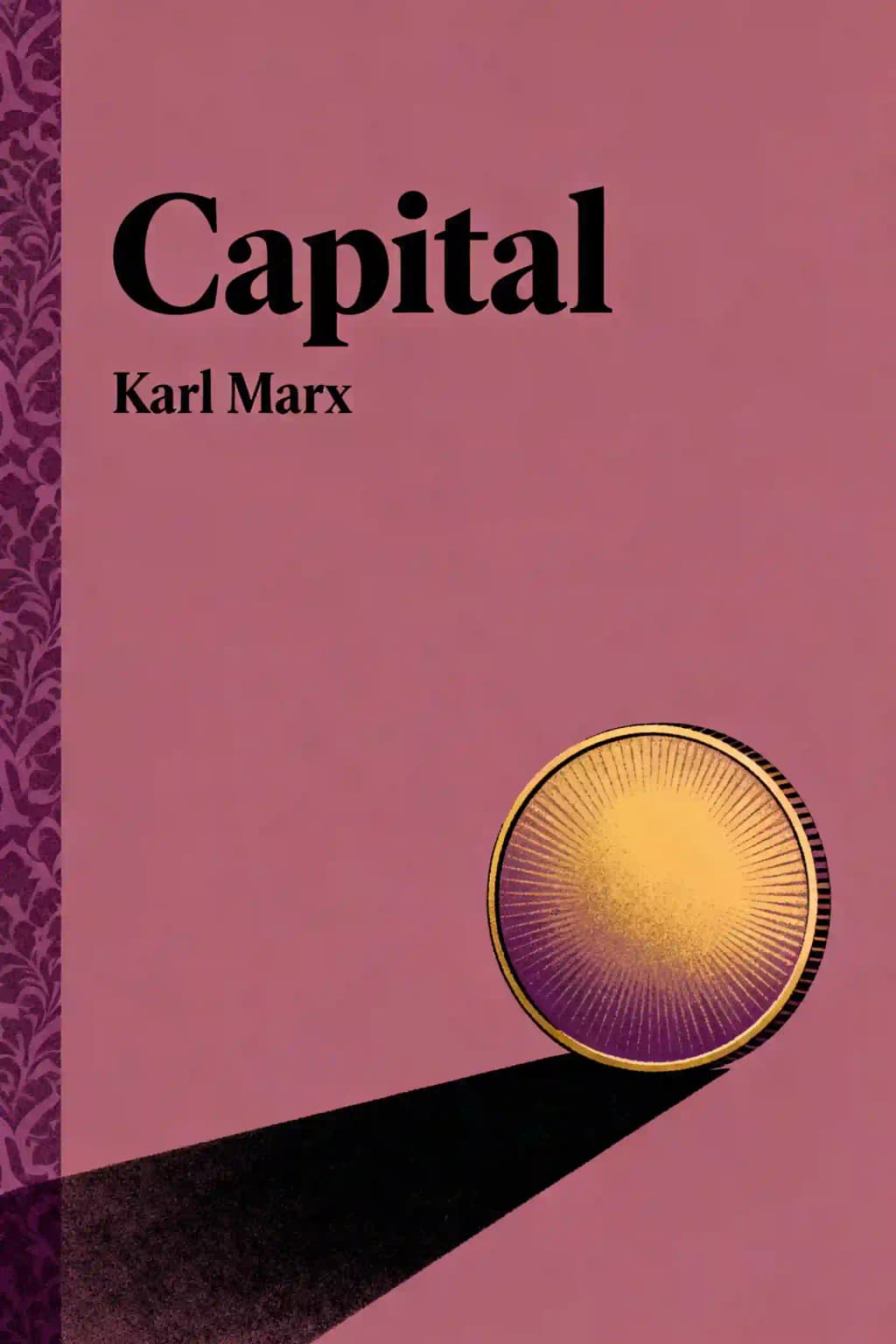
Karl Marx (1818–1883) was a German-born philosopher, economist, and revolutionary socialist whose critical analysis of capitalism reshaped modern political thought. His seminal work Capital (1867) combines rigorous political economy, historical critique, and philosophical inquiry to expose the dynamics of class struggle and capital accumulation.
Educated at the University of Berlin and the University of Jena, Marx’s academic training in philosophy and law informed his later economic theories, while his journalism and activism with Friedrich Engels—co-author of The Communist Manifesto (1848)—cemented his role as a foundational figure in socialist movements. Exiled from Germany, France, and Belgium for his radical ideas, Marx spent decades refining Capital in London, supported by Engels’ editorial collaboration.
Alongside The Communist Manifesto, Marx’s works like The German Ideology and Critique of the Gotha Program established dialectical materialism as a framework for analyzing social change. Capital remains a cornerstone of Marxist theory, translated into over 50 languages and cited as foundational in economics, sociology, and political science. Its analysis of commodity fetishism, surplus value, and systemic exploitation continues to inspire academic debate and social movements worldwide.
Capital critiques capitalism’s economic system, analyzing how surplus value is extracted from workers through exploitation. Marx argues that profit stems from unpaid labor, leading to class struggle between capitalists and workers. The book also examines commodity fetishism, machinery’s role in crises, and capitalism’s self-destructive tendencies.
Students of economics, political theory, or philosophy will find Capital foundational for understanding Marxist critiques of capitalism. Activists, historians, and policymakers seeking insights into labor exploitation, class dynamics, and systemic inequality also benefit. The dense analysis suits readers comfortable with theoretical and historical contexts.
Yes, for its profound influence on economic thought and critique of industrial capitalism. While dense, it offers essential frameworks for analyzing labor relations, profit motives, and systemic inequality. Modern readers may challenge its determinism, but its exploration of capital’s “laws of motion” remains influential.
Surplus value is the profit generated when workers produce goods worth more than their wages. Marx argues capitalists exploit labor by appropriating this excess value, which fuels capital accumulation. Only labor—not machinery—creates surplus value, leading to crises as profit rates decline.
Commodity fetishism refers to misattributing economic value to goods themselves rather than the labor behind them. Marx claims capitalism obscures human labor’s role, making commodities appear intrinsically valuable. This illusion sustains unequal power dynamics between workers and owners.
Class struggle arises from capitalists (owners) exploiting proletarians (workers) to maximize profit. Marx posits this conflict as capitalism’s driving force, predicting worker revolts would dismantle the system. Historical shifts, like feudalism to capitalism, stem from such material conflicts.
Machines boost production but don’t create surplus value—only labor does. Capitalists invest in machinery to outcompete rivals, yet this reduces profit rates long-term. Workers face unemployment or wage suppression, intensifying exploitation and systemic crises.
While Smith celebrates free markets’ “invisible hand,” Marx exposes capitalism’s exploitative core. Capital critiques classical economics for ignoring labor’s undervaluation, contrasting Smith’s optimism with a focus on inequality and class conflict.
Critics argue Marx underestimates capitalism’s adaptability and overstates class solidarity. Others note his analysis overlooks non-economic factors like culture. Despite this, his labor theory of value and crisis predictions remain pivotal in economic discourse.
Capital’s analysis of wealth inequality, automation, and corporate power resonates in modern debates. Its framework helps critique gig economies, wage disparities, and financial crises, offering tools to question capitalism’s ethical and structural flaws.
Profit stems from extracting surplus value via exploited labor. Capitalists prioritize profit over human needs, creating cycles of overproduction, unemployment, and social alienation. This “limitless” pursuit drives inequality and systemic instability.
Ressentez le livre à travers la voix de l'auteur
Transformez les connaissances en idées captivantes et riches en exemples
Capturez les idées clés en un éclair pour un apprentissage rapide
Profitez du livre de manière ludique et engageante
Capitalism introduces a specific form of alienation that converts nature into purely a matter of utility.
Humans can create nothing without nature.
Capitalism's ecological problems stem not from insufficient technology or bad policies.
Capitalism necessarily treats nature as an external resource to be commodified and exploited.
Each represents not an accidental feature but a systematic outcome of capitalism's alienated relationship with nature.
Décomposez les idées clés de Capital en points faciles à comprendre pour découvrir comment les équipes innovantes créent, collaborent et grandissent.
Découvrez Capital à travers des récits vivants qui transforment les leçons d'innovation en moments mémorables et applicables.
Posez vos questions, choisissez votre style d’apprentissage et co-créez des idées qui vous correspondent vraiment.

Cree par des anciens de Columbia University a San Francisco
"Instead of endless scrolling, I just hit play on BeFreed. It saves me so much time."
"I never knew where to start with nonfiction—BeFreed’s book lists turned into podcasts gave me a clear path."
"Perfect balance between learning and entertainment. Finished ‘Thinking, Fast and Slow’ on my commute this week."
"Crazy how much I learned while walking the dog. BeFreed = small habits → big gains."
"Reading used to feel like a chore. Now it’s just part of my lifestyle."
"Feels effortless compared to reading. I’ve finished 6 books this month already."
"BeFreed turned my guilty doomscrolling into something that feels productive and inspiring."
"BeFreed turned my commute into learning time. 20-min podcasts are perfect for finishing books I never had time for."
"BeFreed replaced my podcast queue. Imagine Spotify for books — that’s it. 🙌"
"It is great for me to learn something from the book without reading it."
"The themed book list podcasts help me connect ideas across authors—like a guided audio journey."
"Makes me feel smarter every time before going to work"
Cree par des anciens de Columbia University a San Francisco

Obtenez le resume de Capital en PDF ou EPUB gratuit. Imprimez-le ou lisez-le hors ligne a tout moment.
What if the environmental crisis isn't about plastic straws or carbon footprints, but about something far more fundamental-the very way we organize work and production? While we're told to recycle and buy greener products, a 19th-century thinker identified the root problem: capitalism treats nature as an infinite ATM, withdrawing resources without ever making deposits. This isn't about individual choices or better technology. It's about a system that, by its very design, must consume the world to survive. Even Elon Musk admitted these ecological insights were "surprisingly prescient." The contradiction is stark-capitalism needs nature to function, yet its core logic demands nature's destruction.
Capitalism violently separated humans from the land that sustained them. Peasants who once worked common fields were fenced out, forced to sell their labor to survive. This wasn't mere economic restructuring-it fundamentally rewired humanity's relationship with nature. People who understood themselves as part of nature's cycles, embedded in seasons and soil, now saw the world through pure utility: forests became timber, rivers became power sources, mountains became mineral deposits. Consider your morning coffee. You likely don't know where the beans grew, who picked them, or what chemicals saturated the soil. That disconnection is the point. When production is organized for profit rather than need, both humans and nature become mere inputs-variables in a spreadsheet, not living relationships. Farmers don't decide what to grow based on what the land can sustainably provide; the market makes that decision. The result is a peculiar paradox: we depend entirely on nature for survival, yet treat it as external and expendable, something to conquer rather than cooperate with.
Every living thing exchanges matter with its environment-eating, breathing, transforming energy. Humans do this consciously through labor, reshaping nature rather than merely adapting to it. Under capitalism, this metabolic relationship becomes profoundly distorted. Imagine your heart prioritizing speed over sustainability, pumping faster until collapse. That's production organized around profit. Capital treats natural processes as infinitely flexible, but they're not. Forests need decades to mature. Soil requires years to regenerate. Fish populations need time to reproduce. Yet capitalism demands: grow now, profit now, expand now. When resources deplete, capital exploits new territories, develops extraction technologies, or works existing resources harder-creating "living contradictions" where it destroys the very foundations it depends upon while frantically seeking to overcome the limits it creates. The disconnect between economic logic and physical reality becomes obvious during crises. A drought disrupts supply chains, crashes markets, triggers food shortages. Capital's "elastic power" can't transcend material limits-it can only postpone confronting them, making the eventual reckoning more severe.
Under capitalism, our relationships with each other start resembling relationships between things, while things gain apparent agency. You've experienced this checking stock prices or worrying about "what the market will do." We discuss markets as inevitable forces of nature rather than human-created systems we could change. This reflects real social relations. When we produce commodities for exchange rather than direct use, products gain power over us. Farmers grow what fetches the best price, not what feeds hungry people. Factories make profitable things, not useful things. The system inverts: instead of humans controlling production, production controls humans. We become "bearers" of economic forces, swept along by market currents we didn't choose and can't escape. This inversion devastates ecosystems. Capitalists can't farm sustainably when competitors cut costs by depleting soil. Logging companies can't preserve forests when shareholders demand quarterly growth. The system's structure forces short-term thinking and environmental destruction, regardless of individual intentions. Workers endure dangerous conditions because they need wages. Capitalists slash safety measures and environmental protections because competition demands it. Everyone becomes trapped in logic serving no one's long-term interests-least of all the planet's.
The critique becomes concrete when examining agriculture. In the 1860s, agricultural chemists discovered that modern farming was systematically exhausting soil fertility. Nutrients from food grown in the countryside were consumed in cities, then flushed into rivers as sewage rather than returned to fields. The metabolic cycle was broken. One scientist condemned this as "a crime against humanity," warning that European civilization faced collapse through soil depletion. Capitalism's response? Import fertility from elsewhere. British farms spread Peruvian guano-bird droppings accumulated over millennia-across their fields. This "solution" exemplified ecological imperialism: exhausting resources globally rather than maintaining local cycles. Within years, guano deposits were depleted, triggering resource wars and brutal labor exploitation. The pattern repeats endlessly-extract, exhaust, move on. Ireland illustrated the human cost. For over a century, England transformed Irish lands into pastures for English livestock. Ireland's population crashed from 8.2 million to 5.5 million in just 25 years, while livestock numbers increased. The land was "indirectly exported" to England through food shipments, without nutrients ever returning. Soil fertility declined, rural communities disintegrated, and famine killed millions. Yet from capital's perspective, the system worked perfectly.
Later research revealed that soil chemistry alone couldn't explain agricultural sustainability-climate, forests, and entire ecosystems played crucial roles. Studies across Mediterranean regions showed how deforestation altered rainfall patterns, caused erosion, and collapsed civilizations. Ancient texts described once-fertile regions turned barren. The pattern was clear: clear forests, disrupt water cycles, exhaust soil, abandon land, repeat. This challenged the notion that chemical fertilizers could solve everything. Traditional communities maintained fertility for centuries without modern inputs, working with natural processes. River valleys stayed fertile through periodic flooding. Mountain erosion renewed lowland soils. These communities prohibited exporting wood, straw, and dung, keeping resources local. Production was organized around maintaining cycles, not maximizing short-term extraction. The contrast is stark. Capitalism treats environmental limits as obstacles to overcome through technology, always seeking to transcend natural constraints. But forests need time to grow. Rainfall patterns can't be engineered. Soil formation takes centuries. These aren't problems technology can solve-they're fundamental realities that any sustainable society must work within, not against.
The ecological crisis isn't accidental or fixable through better policies within capitalism. Organizing production through value-abstract labor time-can only recognize nature as a "free gift" to exploit. Competition forces capitalists to minimize costs, including environmental ones, producing "outrageous squandering" while ignoring genuine needs. Yet this reveals possibility. By identifying capitalism's contradictions with nature, we can envision alternatives. A sustainable society requires "associated producers" consciously regulating their metabolism with nature-organizing production according to human needs and ecological limits rather than profit. This means transforming how we decide what to produce, how to produce it, and for whom. Traditional communities maintained sustainable relationships with land for generations, proving humans can organize production differently. The question isn't whether sustainability is possible but whether we can create it at modern scale. This demands more than individual consumption choices or carbon markets-it requires democratically controlling production itself. As climate change accelerates and biodiversity collapses, these insights become urgent. The metabolic rift has only widened since the 19th century. The path forward isn't backward to pre-industrial life, but toward consciously regulating our relationship with nature-producing what we need, in ways the planet can sustain. Given the alternative-ecological collapse-this isn't utopian dreaming. It's simply necessary.