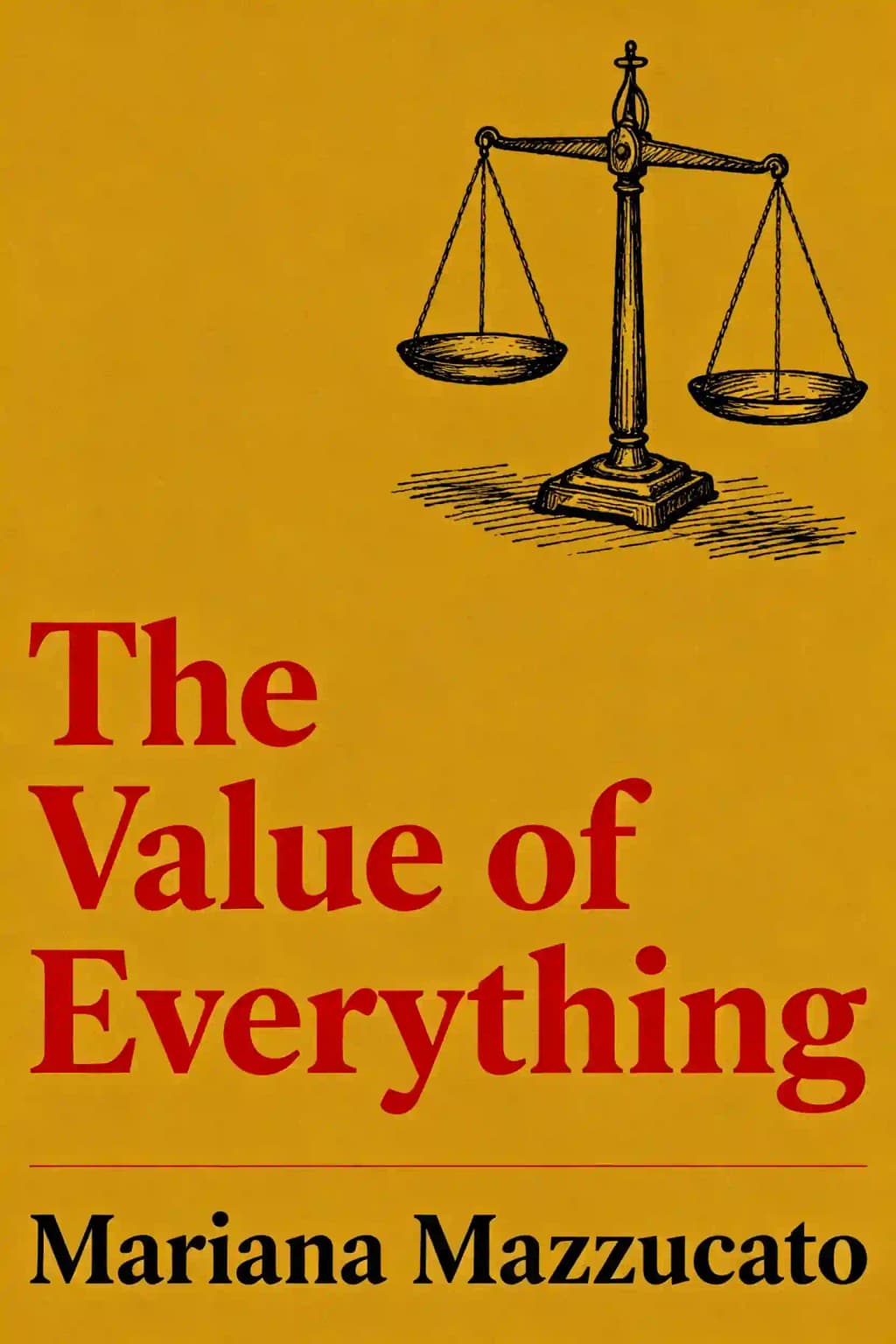
Mazzucato's groundbreaking critique redefines value in modern capitalism, challenging who creates versus extracts wealth. Shortlisted for FT's Business Book award, it's sparked global economic debates and earned praise from Martin Wolf as a "stimulating analysis" of inequality's true causes.
Mariana Francesca Mazzucato, acclaimed economist and bestselling author of The Value of Everything: Making and Taking in the Global Economy, is a leading voice on redefining economic value and public policy. As Professor in the Economics of Innovation and Public Value at University College London and founding director of its Institute for Innovation and Public Purpose, her work challenges conventional narratives about wealth creation, emphasizing the state’s role in driving transformative innovation.
The book—a seminal critique of modern financial systems—draws from Mazzucato’s expertise in value theory and her advisory roles for institutions like the World Health Organization and the United Nations.
Her influential works include The Entrepreneurial State, which redefined perceptions of public-sector innovation, and Mission Economy, a blueprint for addressing 21st-century challenges through collaborative, goal-driven policies. Honored as a Grande Ufficiale of the Italian Republic and recipient of the John von Neumann Award, Mazzucato’s ideas have shaped global policies on climate action and equitable growth.
Translated into over 20 languages, The Value of Everything has become essential reading in economics curricula and policymaking circles worldwide.
The Value of Everything critiques modern economics’ failure to distinguish value creation (productive activities like innovation) from value extraction (unproductive rent-seeking). Mazzucato argues sectors like finance often capture existing value rather than generate new wealth, skewing growth metrics like GDP and exacerbating inequality. The book redefines value through historical economic theories and案例研究 from Silicon Valley, big pharma, and government policy.
This book is essential for economists, policymakers, and readers interested in inequality, innovation, or economic reform. Mazzucato’s insights appeal to those questioning orthodox views of capitalism, the role of government, and how value is measured. It’s particularly relevant for advocates of mission-driven public investment and critics of financialization.
Yes—it was shortlisted for the Financial Times & McKinsey Business Book of the Year and praised for its bold critique of neoliberal economics. Mazzucato’s blend of theory, history, and real-world examples (e.g., the 2008 financial crisis) offers a fresh lens to rethink capitalism’s flaws and potential solutions.
Value creation involves producing goods/services that benefit society (e.g., public-funded research). Value extraction refers to profiting without contributing to productivity, such as shareholder buybacks or predatory financial practices. Mazzucato shows how dominant sectors like finance masquerade as “value creators” while draining resources from the real economy.
Mazzucato argues finance increasingly extracts value through fees, speculation, and rent-seeking rather than funding productive ventures. Case studies reveal how short-term profit motives (e.g., high-frequency trading) distort markets, inflate asset bubbles, and divert resources from innovation. The 2008 crisis exemplifies systemic risks from prioritizing extraction over creation.
The state acts as the “investor of first resort,” funding high-risk innovation (e.g., STEM research, green tech) that private firms avoid. Mazzucato challenges the myth of the “unproductive public sector,” highlighting how initiatives like NASA or the internet originated from public investment. Governments shape markets by directing long-term missions, not just fixing “market failures”.
Patient capital refers to long-term investments in innovation (e.g., R&D, infrastructure) that prioritize societal benefit over quick profits. Mazzucato contrasts this with short-termism in stock buybacks or speculative trading, arguing patient funding is vital for breakthroughs like renewable energy or mRNA vaccines.
Mazzucato links rising inequality to financialization, where wealth flows to asset owners rather than wage earners. She advocates reorienting corporate goals toward stakeholder value (workers, communities) and taxing extractive activities. Policies promoting inclusive growth—like wealth taxes or universal public services—could redistribute value more equitably.
Yes: She advocates mission-oriented policies (e.g., Green New Deal) where governments set bold societal goals and partner with private actors. Reforming corporate governance to prioritize stakeholders and rethinking GDP metrics to reflect sustainability are also key proposals.
Drawing on Smith, Marx, and Keynes, she revives the classical focus on production (e.g., labor, innovation) over exchange. Value isn’t inherent in price but in contributions to human well-being. This framework exposes extractive sectors while legitimizing public investment’s role in growth.
Ressentez le livre à travers la voix de l'auteur
Transformez les connaissances en idées captivantes et riches en exemples
Capturez les idées clés en un éclair pour un apprentissage rapide
Profitez du livre de manière ludique et engageante
incomes are justified by producing something valuable, and value is measured by earning income.
The disappearance of value theory from economic debate hides what should be publicly contested.
The way we define the production boundary shapes our economic priorities and policies.
When we fail to distinguish between value creation and extraction, we enable extractive activities to masquerade as productive ones.
Décomposez les idées clés de Value of Everything en points faciles à comprendre pour découvrir comment les équipes innovantes créent, collaborent et grandissent.
Condensez Value of Everything en indices de mémoire rapides mettant en évidence les principes clés de franchise, de travail d'équipe et de résilience créative.

Découvrez Value of Everything à travers des récits vivants qui transforment les leçons d'innovation en moments mémorables et applicables.
Posez n'importe quelle question, choisissez la voix et co-créez des idées qui résonnent vraiment avec vous.

Cree par des anciens de Columbia University a San Francisco
"Instead of endless scrolling, I just hit play on BeFreed. It saves me so much time."
"I never knew where to start with nonfiction—BeFreed’s book lists turned into podcasts gave me a clear path."
"Perfect balance between learning and entertainment. Finished ‘Thinking, Fast and Slow’ on my commute this week."
"Crazy how much I learned while walking the dog. BeFreed = small habits → big gains."
"Reading used to feel like a chore. Now it’s just part of my lifestyle."
"Feels effortless compared to reading. I’ve finished 6 books this month already."
"BeFreed turned my guilty doomscrolling into something that feels productive and inspiring."
"BeFreed turned my commute into learning time. 20-min podcasts are perfect for finishing books I never had time for."
"BeFreed replaced my podcast queue. Imagine Spotify for books — that’s it. 🙌"
"It is great for me to learn something from the book without reading it."
"The themed book list podcasts help me connect ideas across authors—like a guided audio journey."
"Makes me feel smarter every time before going to work"
Cree par des anciens de Columbia University a San Francisco

Obtenez le resume de Value of Everything en PDF ou EPUB gratuit. Imprimez-le ou lisez-le hors ligne a tout moment.
Here's a puzzle: How did Goldman Sachs employees become "among the most productive in the world" just months after their company helped trigger the worst financial crisis since the Great Depression? Lloyd Blankfein's audacious 2009 claim wasn't just corporate spin-it revealed something profound about how we've come to measure worth in modern economies. His bank had just received a $125 billion government bailout, yet somehow generated $63 billion in profits while laying off thousands. This wasn't productivity in any meaningful sense, yet our economic metrics validated it. We've arrived at a dangerous place where extracting wealth has become indistinguishable from creating it, where price determines value rather than value determining price. Understanding this shift isn't just an academic exercise-it shapes who gets rewarded, what activities flourish, and whether our economy serves society or merely concentrates wealth.